

Mehwish Hussain ( Dow University of Health Sciences, Karachi, Pakistan. )
Muhammad Shahzeb Khan ( Dow University of Health Sciences, Karachi, Pakistan. )
Anum Wasim ( Dow University of Health Sciences, Karachi, Pakistan. )
Sidra Sabih ( Dow University of Health Sciences, Karachi, Pakistan. )
Sana Saleem ( Dow University of Health Sciences, Karachi, Pakistan. )
Ammara Mushtaq ( Dow University of Health Sciences, Karachi, Pakistan. )
December 2014, Volume 64, Issue 12
Original Article

Abstract
Objective: To determine the satisfaction of in-patients towards quality of service provision and environment of public-sector hospitals.
Methods: The cross-sectional study was conducted in four major public-sector hospitals of Karachi from December 2010 to February 2012. The questionnaire, besides the demographic details, also had 5-point Likert scale questions regarding satisfaction of patients with doctors, staff, administration and the hospital environment. SPSS 20 was used for statistical analysis and results were expressed as frequencies with percentages.
Results: Of the 710 subjects in the study, 475(67%) agreed that their doctors checked them with concentration and care. Staff was reported as being kind natured and well-mannered by 423(59.6%) and 451(63.5%) patients respectively. However, 414(58.3%) were not pleased with the sanitary condition of the hospital. Only 225(31.7%) got comfortable beds, while 498(70.14%) patients found bugs in beds. In terms of overall satisfaction 452(63.7%) were satisfied with the staff, 463(65.2%) with doctors, and 385(54.2%) with the hospital environment.
Conclusion: Patients were relatively satisfied with the staff, but sanitary conditions and hospital environment were a concern for majority of the patients.
Keywords: Patient satisfaction, Public hospital, Doctor-patient communication, Nurses services, Hospital environment, Healthcare quality. (JPMA 64: 1392; 2014).
Introduction
Satisfaction of patients is not only an objective to be achieved by healthcare professionals, but it is also one of the desirable targets for clinical practice in order to achieve good results in terms of outcomes. It also has notable influence over patients\' compliance and consequently on their use of health services.1 A number of studies have laid emphasis on different dimensions to measure patient satisfaction. Some referred to overall quality of the hospital as the principal key for acquiring patient satisfaction.2 Others reported nursing care3 and a few considered that organisational efforts play an integral part in ensuring satisfaction among patients.4 Nevertheless, literature has considered patient-physician communication as a successful key for adherence to treatment.5.6
Inequalities in providing health facilities have been observed in many regions of the world.7 In Pakistan, the public sector is badly neglected and policymakers show lack of concern regarding healthcare.8 A few studies have already been conducted in this region to study the same aspect. However, most of them were either conducted in a single centre and worked on a single aspect with a small sample size covering a non-representative general population or in the out-patient department (OPD) and family physician clinics.9 All of these studies reported a low score of satisfaction with regards to healthcare facilities in various aspects. This study was derived to get a pertinent insight about patient satisfaction towards different domains of quality services and the environment in major public-sector hospitals of Karachi, Pakistan.
Subjects and Methods
The cross-sectional study was conducted in four major public-sector hospitals of Karachi from December 2010 to February 2012. The approval was obtained from the Institutional Review Board of Dow University of Health Sciences (DUHS), Karachi. After conducting intense literature review, a questionnaire was structured and tested through a pilot survey by the principal investigator. Relevant amendments in the questionnaire were done and training to data-collectors was given. The questionnaire mainly covered 5 major sections. The first part dealt with the demographic details of the subjects which included age, gender, income level, admission duration, residence etc. The latter parts comprised 5-point Likert scale questions regarding satisfaction of patients with doctors, staff, administration and the hospital environment as a whole. These questions encompassed the satisfaction levels of certain parameters, including doctor-patient communication, hospital care, attitudes of healthcare professionals, outcome of patients\' illness, and behaviour of the paramedic staff along with the environmental, sanitary and nutritional status in the hospitals. Any additional aspect not covered by the questionnaire was noted down at the end.
The study design was cross-sectional and convenient sampling technique was employed. The inclusion criteria comprised patients who had been admitted for atleast three days who were between 18-60 years of age and those who were fully conscious to respond. Patients who were admitted to emergency department, intensive care unit/coronary care unit (ICU/CCU) and those unable to respond to the answers were excluded. Verbal informed consent was taken from each patient. Interview was conducted in the national language.
A sample size of 664 was calculated using 99% confidence interval (CI), 5% margin of error and taking previously reported proportion of satisfaction (50%)9. Non-response rate of 15% was added in the computed sample size and target sample size to achieve was set to be 770.
Data was entered in EpiData v. 3.1 and exported to SPSS 20. Results were expressed as frequencies and percentages. To check consistency in responses of the patients throughout the interview, Cronbach\'s alpha was computed for each portion and whole part of questionnaire. The measure of acceptable reliability was set if alpha exceeded the value of 0.70.
Results
A total of 770 patients were approached. Of them, 57(7.4%) refused to participate and 3(0.38%) left in the middle of the interview. Thus, 710(92.2%) patients completed the questionnaire. Out of them 325(48.5%) were males, 462(65.1%) were married, 227(32%) were illiterate, 411(57.8%) had an income of less than Rs.10,000 and 225(35.5%)communicated in Urdu language. The overall reliability of the questionnaire was 95.4% implying excellent consistency in the responses of the participants throughout the interview.
Overall, 475(67%) patients agreed that their doctors checked them with concentration and care. However, only 469(66.1%) acknowledged that the doctor examined each and everything on his visit to the patient. Besides, 436(61.4%) were in favour of the fact that their doctor\'s attitude towards them was still similar to how it was on the first day of admission. Only 132(18.6%) strongly agreed that the doctor guided them properly with respect to diet and prevention related to their disease, while 445(62.7%) simply agreed to the statement. Of the total, 178(25%) denied that doctors tell everything about their treatment. Besides, 425(60%) were satisfied with the prescribed medication; 473(66%) acknowledged that the doctors understood their illness very well;453(64%) admitted that the doctors listened to them with interest; 417(58.7%) considered that their doctor had a good understanding of their disease; 152(21.4%)strongly affirmed the doctors\' expertise on relevant disease was; 360(50.7%) admitted that their healthcare professional encouraged them to ask questions regarding their illness; and 140(19.7%) reported that doctor ignores their questions related to their ailments. Overall, data was gathered on 29 counts in this section (Table-1).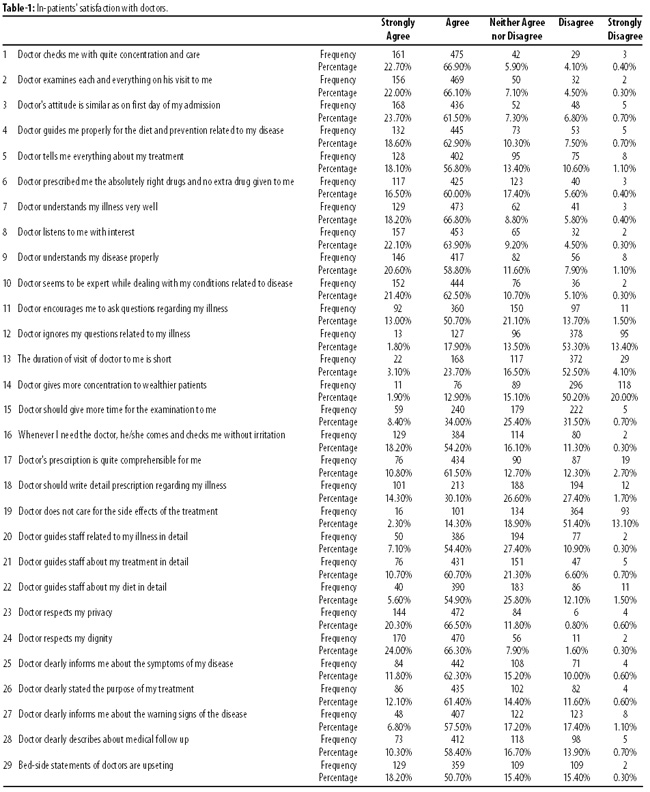
The reliability of this section was 87.5%.
Staff was reported as being kind-natured and well-mannered by 423(59.6%) and 451(63.5%) patients respectively; 375(52.8%) said staff listened to their problems interestedly while 345(50%) said staff tried to solve problems immediately; 469(66.1%) agreed that the staff followed the doctor\'s advice. Only 415(58.5%) patients were provided the diet prescribed by the doctor in hospitals even though the doctor\'s prescribed treatment was given to 565(79.7%). The section had 16 questions (Table-2) and its reliability value was 88.6%.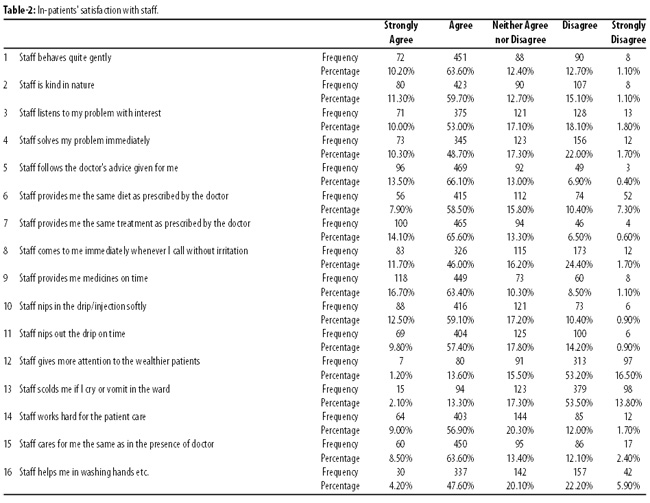
The last segment had 19 questions (Table-3)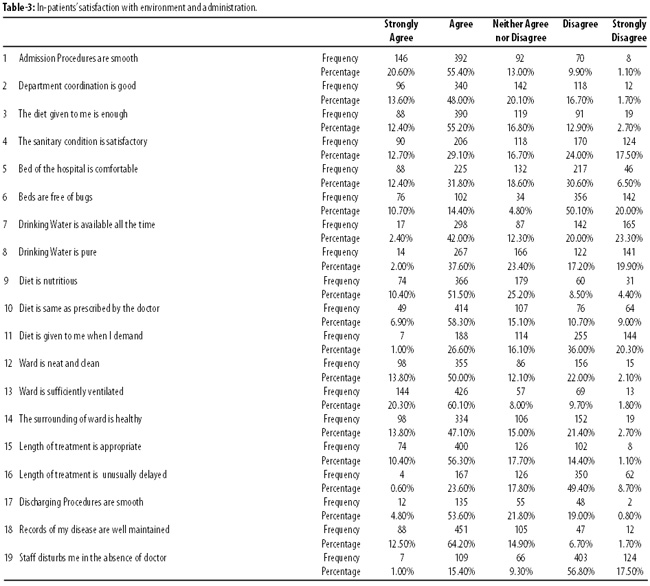
and its reliability value was 87%. A total of 392(55.2%) patients considered admission procedure smooth and hassle-free; 340(47.9%) declared that department coordination was good; 414(58.3%) were not pleased with the sanitary conditions of the hospital; 225(31.7%) got comfortable beds; 498(70%) found bugs in beds; 395(55.6%) complained of water scarcity at times.
Further, 355(50%) patients found their wards neat and clean; 426(60%) had well-ventilated wards 334(47%) considered the ward surroundings healthy; 400(56.3%) said length of treatment was appropriate; 350(49.3%) believed treatment was not delayed. This section had excellent reliability as the value of Cronbach\'s alpha was 91.2%.
When asked about the overall satisfaction level with the staff, doctors and environment of the hospitals, 452(63.7%) were satisfied with the staff, 463(65.2%) with doctors and 385(54.2%) were satisfied with the environment of the hospitals. These three questions were also checked for reliability and acquired alpha value of 71.9%.
Discussion
While covering the aspect of all problems and issues suffered by public-sector hospitals in Karachi, this study is first of its kind to cover multi-centre and large sample population to measure satisfaction of the patients. Besides, the questionnaire was designed in such a way that it would not leave any related aspect which standard patient\'s scores do not cover. Our study had a brilliant response rate of 92.2%. This was largely due to the tactic of using dedicated assistants who went and spoke directly with the patients. Our excellent response rate is comparable to the response rate (91.2%) of a study done in Saudi Arabia regarding in-patients\' satisfaction.10
Public health hospitals are usually least considered for any improvement. Environmental hazards,8 less communication with doctors11 and ignorance of paramedical staff12 are the factors reported in different studies. These factors with low satisfaction of treatment process are the predictors for the quality of care leading to the satisfaction of patients.13
The section which covered communication, expertise and behaviour of doctor with patients in our setup, suggested approximately 40% denial attitude of physicians. The avoidance of doctor to inform and guide patients about their disease is also observed in other parts of world14 though a study from Saudi Arabia reported excellent patient-doctor communication.10 Studies have been conducted to identify parameters for improving this aspect.5,6 Update status of bed-side treatment has not been asked in any earlier study. However, by our study, large proportion of patients reported the upset status of the same. This also clearly showed ignorance of patient\'s material related to their treatment. While analysing this aspect, doctor\'s work burden cannot be ignored as in public-sector hospitals the flow of patients remains massive. This could lead to ignorance of these aspects by the physicians.
Staff burnout and their unfriendly behaviour have been observed in different parts of the world.3,12 Guidelines to produce good organisational effort to improve patient\'s satisfaction are also provided.4 In our setup, this prospect is reported conversely. Our patients were satisfied with paramedic\'s response and considered them experts in providing technical services. Even the proportions of soft and kind nature of staff in our setup is higher than that of developed countries like Belgium, Finland, Germany, Greece and Spain.3 Nevertheless, the solution of the patient\'s problems appeared to be less than that of all developed countries addressed in the same study.3
With our intense literature review, we could not find any study asking questions about the bugs in the beds, about diet and water availability in hospitals. We included these investigations based on personal observations and experiences. Expectedly, about 500 patients reported bugs in bed and 414 respondents were not pleased with the sanitation of the hospital. More than half of the patients reported that water was not accessible at all times and water given to them for drinking was not potable. This clearly suggests that one of the major reasons for low in-patient satisfaction in the public sector is poor hygienic conditions and poor maintenance.
The recommendation of the hospital by our patients was almost 45%. This is lesser than the average recommendation rate seen in US hospitals which ranges from 64%3 to 68%.10 Greece and Spain had relatively higher recommendation rates, but in the same range as ours. There is another surprising depiction in our findings that even though the proportion of recommendation of the hospital to other people is quite low (45% approx.), but about 71% of our respondents intended to return to the same department for future needs. This may be because most of the participants belonged to low socio-economic class and in public-sector hospitals the treatment is relatively cheaper than other healthcare centres in the region. Therefore, these patients confined themselves to these hospitals despite low satisfaction levels. Comparing with Saudi Arabia, this is also significantly low where 99% of the patients said that they would come back even if they had resources to get treatment outside the country.10
As described above, patient-physician communication,5,6 nursing care,3 organisational efforts4 and, above all, overall quality of the hospital care2 and treatment1 are the key factors which enhance patient satisfaction. Monitoring of these key factors should be done periodically.8 The monetary and manpower resources should be enhanced by the government to reduce environmental hazards and improve departmental conditions of the hospitals.
Conclusion
In-patients were relatively satisfied with the aspect of communication with hospital personnel. Hospital environment, sanitary conditions and manpower resources are needed to be improved for health safety of the patients.
Acknowledgement
We are grateful to administrative staff, volunteers and patients who helped us in data collection.
References
1. Seiler A, Visintainer P, Brzostek R, Ehresman M, Benjamin E, Whitcomb W, et al. Patient satisfaction with hospital care provided by hospitalists and primary care physicians. J Hosp Med 2012; 7: 131-6.
2. Rahmqvist M, Bara A-C. Patient characteristics and quality dimensions related to patient satisfaction. Int J Qual Health Care 2010; 22: 86-92.
3. Aiken LH, Sermeus W, Van den Heede K, Sloane DM, Busse R, McKee M, et al. Patient safety, satisfaction, and quality of hospital care: cross sectional surveys of nurses and patients in 12 countries in Europe and the United States. BMJ 2012; 344: e1717.
4. Bacon CT, Mark B. Organizational effects on patient satisfaction in hospital medical-surgical units. J Nurs Adm 2009; 39: 220-7.
5. Zolnierek KBH, DiMatteo MR. Physician communication and patient adherence to treatment: a meta-analysis. Med care 2009; 47: 826-34.
6. King A and Hoppe RB. "Best Practice" for Patient-Centered Communication: A Narrative Review. J Grad Med Educ 2013; 5: 385-93.
7. Nathanson CA. Who owns health inequalities? Lancet 2010; 375: 274-5.
8. Hussain M. Biosafety outside Laboratories. Biosafety 2013; 2: 2.
9. Hafeez A, Kiani A, Din Su, Muhammad W, Butt K, Shah Z, et al. Prescription and Dispensing Practices in Public Sector Health Facilities in Pakistan-Survey Report. J Pak Med Assoc 2004; 54: 187-91.
10. Binsalih SA, Waness AO, Tamim HM, Harakati MS, Al Sayyari AA. Inpatients\' care experience and satisfaction study. J Family Community Med 2011; 18: 111-7.
11. Ha JF, Longnecker N. Doctor-patient communication: a review. Ochsner J 2010; 10: 38-43.
12. Argentero P, Dell\'Olivo B and Ferretti MS. Staff burnout and patient satisfaction with the quality of dialysis care. Am J Kidney Dis 2008; 51: 80-92.
13. Ahmad I, Nawaz A, Khan S, Khan H, Rashid MA, Khan MH. Predictors of patient satisfaction. Gomal J Med Sci 2012; 9.
14. Oates J, Weston WW, Jordan J. The impact of patient-centered care on outcomes. Fam Pract 2000; 49: 796-80.
Journal of the Pakistan Medical Association has agreed to receive and publish manuscripts in accordance with the principles of the following committees:


