

Aneeq Ullah Baig Mirza ( Department of Ophthalmology, Islamic International Medical College Trust/Riphah International University, Railway Hospital Rawalpindi. )
Rehan Ahmed Khan ( Department of General Surgery, Islamic International Medical College Trust/Riphah International University, Railway Hospital Rawalpindi. )
Sohail Zia ( Department of Ophthalmology, Islamic International Medical College Trust/Riphah International University, Railway Hospital Rawalpindi. )
Yasir Iqbal ( Department of Ophthalmology, Islamic International Medical College Trust/Riphah International University, Railway Hospital Rawalpindi. )
December 2014, Volume 64, Issue 12
Original Article

Abstract
Objective: To assess perceptions of medical students about the factors that may enhance motivation for learning through small group discussions.
Methods: The qualitative descriptive study was conducted in May, 2013, at Riphah International University, Islamabad, and comprised undergraduate medical students from the first to the fourth year who were given a questionnaire that sought their opinion about group characteristics, composition, expectations from the teachers, environment, additional tools and optimum time duration. The effects of granting extra marks for active participation, feedback and weightage of attendance in enhancing motivation in small group discussions were also explored. Common themes from within the responses were highlighted.
Results: Initially, 400 students were given the questionnaire, but complete responses were received from 290(72.5%). About the effective group size, 221(76.2%) suggested 12 or less students, while 153(52.75%) thought groups should be divided into subgroups according to the task, and 148(51.03%) were in favour of mixed gender composition of a group. A comfortable and air-conditioned environment was suggested as a motivating factor by 156(53.79%) students. Use of models, laptops and internet during the discussion was suggested by 97(33.44%) students, and 232(80%) suggested an hour or less as sufficient time. Grant of extra marks 209(72.06%), feedback 220(75.86%) and weightage of attendance 193(66.55%) were all considered positive motivating factors. Finally, 250(86.20%) were in favour of continuation of small group discussion as a learning tool.
Conclusion: Most students thought a smaller size makes a small group discussion more effective, and that it should continue to be used as one of the learning modalities.
Keywords: Students' perspective, Factors motivating participation, Small group discussion. (JPMA 64: 1339; 2014).
Introduction
In recent years, there has been a shift of focus from teaching to learning. Traditional learning was teacher-centred and students were mostly passive learners. Module system has a more student-centred approach. This requires the students to be more active learners instead of being spoon-fed by the teachers.
Small group discussion (SGD) is one important component of the module system. It helps in developing thinking skills and interpersonal relationships and at the same time fosters sense of achievement. However, if the students are not prepared, it can stigmatise low-achievers and enhance the academic differences among students. SGD cannot replace the traditional teaching. Rather, it should be used as a part of the teaching strategy.1 It helps in developing a feeling of community among the students and the relationship acts as a positive force in learning.2 SGD develops self-confidence and self-learning. This helps in making students life-long learners. However, a prerequisite for learning by SGD is motivation. Without it, the benefits of SGD cannot be attained. Motivation depends upon circumstances, goals and application of novel techniques.3 Motivation may also be enhanced by computer-assisted class-room discussion.4 Another factor that may enhance motivation is the students' prior knowledge of the assessment criterion and its application on self-assessment and peer marking.5
The basic idea of the current study was to get students' perceptions about the factors that may enhance motivation for learning by SGD. Since students are the major stake-holders, their opinion should, therefore, be given due weightage.
Subjects and Methods
The qualitative descriptive study was conducted in May, 2013, at Riphah International University, Islamabad, and comprised undergraduate medical students from the first to the fourth year who were given an open-ended questionnaire based on 'Incentive Theory of Motivation'.6 The questionnaire (Annexure) was divided into three parts. The first part concerned the participants. The second part was related to the learning environment, while the third part consisted of SGD outcomes and the future of SGD. Opinion was sought regarding group characteristics like effective group size, variation according to the difficulty of task, reshuffling or constant composition of the groups, separate or mixed gender composition and expectations from the teachers. In the second part, opinion was taken regarding effective learning environment, additional tools and optimum time duration of an SGD. In the third part, the students were asked about the effects of certain incentives upon the outcome of an SGD like granting of extra marks for active participation, feedback and weightage of attendance (in the final assessment). Finally, they were asked if in their opinion SGD should continue to be used as a learning tool or should it be abandoned. Study alignment was done using the research onion. The research question and the tool were hence aligned. Content analysis of the data was done and common categories were identified. This was followed by quantitative analysis of qualitative data which was expressed as frequencies and percentages.
Results
Initially, 400 students were given the questionnaire, but complete responses were received from 290(72.5%). About the effective group size, 88(30.34%) suggested less than 10 as effective group while 133(45.86%) favoured a number of 10-12, and 153(52.75%) opined that groups should be divided into subgroups according to the task.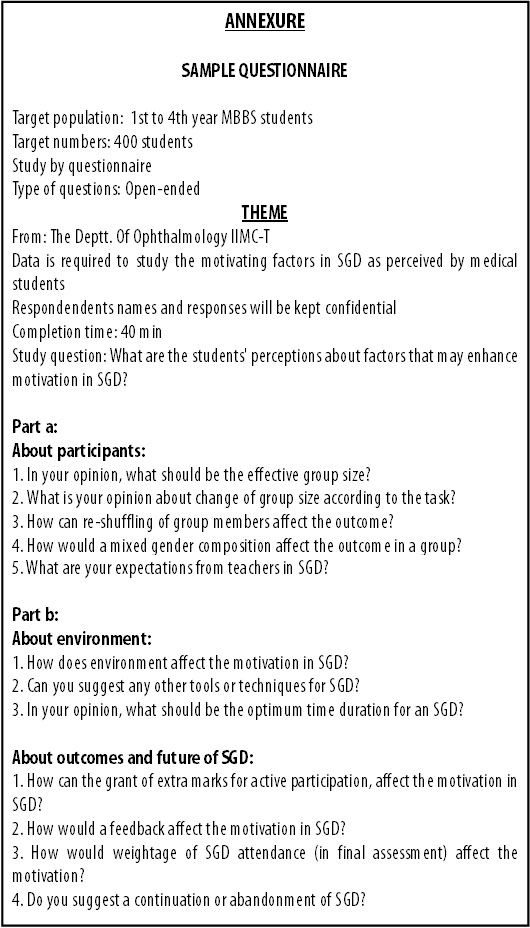
Besides, 141(48.62%) students favoured reshuffling of groups in subsequent SGDs as a motivating factor. Overall, 148(51.03%) students were in favour of a mixed gender composition of a group, and 124(42.75%) thought SGD was meaningless without a well-prepared teacher (Table-1).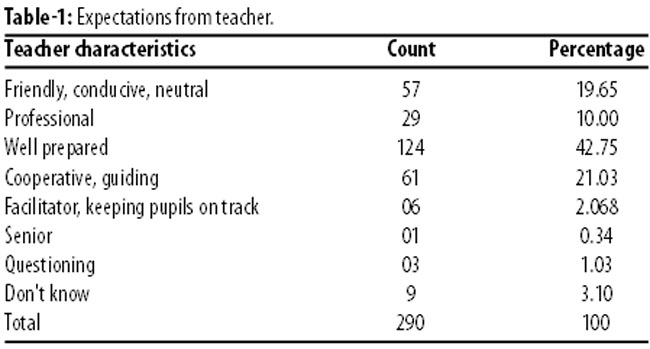
A comfortable and air-conditioned environment was suggested as a motivating factor by 156(53.79%) students (Table-2).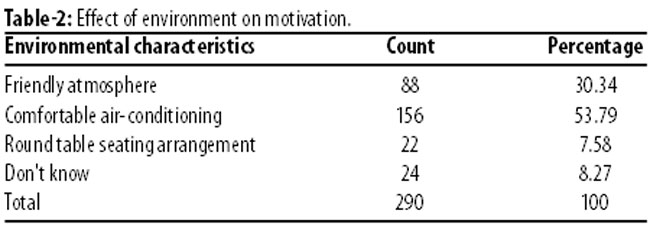
Use of models, laptops and internet during SGD was suggested by 97(33.44%) students (Table-3),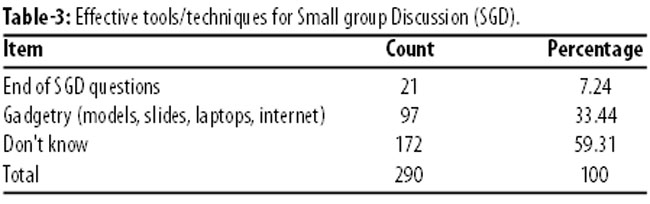
and 232(80%) suggested an hour or less as sufficient time.
Grant of extra marks 209(72.06%), feedback 220(75.86%) and weightage of attendance 193(66.55%) were all considered positive motivating factors, and 250(86.20%) were in favour of continuation of SGD as a learning tool.
Discussion
There has been a major change in priority of modern educational institutions from what teachers teach to what the students learn. This requires a change in role of an educator from a didactic teacher to a facilitator of learning.7
A superficial learning method is adopted where there is heavy workload and there is little choice over topics. Self-directed learning fosters deeper learning and the motivation is provided by the need to know (since the problem is presented in the beginning). It increases interaction between the staff and the students and makes learning experience more enjoyable.8 The hierarchy of motivation in the form of building blocks was described in 19549 according to which the requirements for motivating learning were physiological needs, safety, belonging, self-esteem and self-actualisation.
Motivation can be intrinsic or extrinsic. Intrinsic motivation depends upon the desire to achieve, past learning experiences and relevance of the subject to learner's future plans. External factors include assessments, teacher's role and enthusiasm and learning environment. Inclusion of student representatives in curriculum committees can help in designing a more student-centred curriculum. Teacher is the most powerful variable in the learning environment. His actions and attitude have far-reaching consequences in the learning process. A comfortable learning environment includes adequate temperature control, short breaks in between long teaching sessions, noise control and comfortable seats.10
According to one study,11 there are three general types of motivational beliefs in self-directed learning. First is self-efficacy, which includes self-assessment of an individual for a particular task. Students who believe in themselves are better able to utilise self-regulated learning. Second is the task value belief. It includes the interest and importance of the task. Third is the goal orientation belief which includes focus on achieving mastery (self-improvement), getting higher grades or outclassing other colleagues.
Another study12 has described methods to improve group dynamics and the process. A conducive environment for small group learning can be created when all the participants are sitting in a circular arrangement, facing each other and using revolving chairs. Maximum participation of all group members can be ensured by dividing the group into subgroups in case the task is difficult. Buzz groups can be created and reshuffling performed to maximise crossing over of information. One way of enhancing group participation is to give a time-frame for the task and leave the room for a while so that all students may take active part in discussion without any inhibitions. Well-organised group discussions with a clear purpose help motivating the students, resulting in better communication.
In our study, 76.20% students defined an effective small group as one containing 12 or less students. Beyond that, individual participation starts decreasing. Besides, 52.75% had the opinion that in case of a difficult task, the group should be divided into subgroups as smaller size would ensure individual participation and more individual participation would enhance deeper learning. Nearly half of the students (48.62%) were in favour of reshuffling of group members for enrichment of ideas, while others were against it. Fear of the unknown makes students feel secure in their own environment. A mixed gender composition of the group was considered a motivating factor according to 51% students as they have to come prepared and stay alert all the time to avoid any embarrassment. Besides, 42.75% of students had a misconception about the role of teacher in SGD and demanded a well-prepared teacher to conduct an SGD. It is understood that a teacher should be well-prepared all the time. The emphasis should be on his skill to conduct an SGD as a facilitator. Other important attributes to a teacher included 'friendly', 'cooperative' and 'guiding type'. A comfortable and air-conditioned environment was given due emphasis. Majority of the students opined that time duration of up to one hour was sufficient. Feedback, grant of extra marks and attendance were all considered important factors enhancing motivation, and majority of students wanted a continuation of SGD as a learning technique.
A study13 of student perceptions about effective SGD focused on the following aspects; effective small group, goals of small group teaching, effective small group tutor, effective case and effective small group evaluations. Effective tutor characteristics included personal attributes, promotion of group interaction and problem solving. An effective tutor outlines the objectives, presents the case, leaves the students alone for problem-solving, involves himself when the students get stuck and summarizes the discussion at the end. Other factors included non-threatening group atmosphere, clinical relevance and integration. Students preferred short assessment at the end with a feedback on their handling of the case and group participation.
In a randomised trial14 between group discussion and lectures in orthopaedic undergraduates, 77 students were assessed. First group received 12 formal lectures, while the second group underwent 12 group discussion sessions in which the content of discussion was primarily determined by the students. A 10-minute oral and short answer written test was conducted at the end. The interactive teaching style was found to be more popular with better presentation ratings than conventional lectures, and knowledge retention was better. The students in discussion group performed significantly better in their written tests. According to them, interactive discussion promotes better knowledge retention and provides a deeper approach to learning than didactic lectures. This study also proves that an SGD is itself a motivating factor for learning compared to conventional lectures.
One of the limitations of our study was that the sample was not homogeneous. Students from first through fourth year MBBS were included, who can have different opinions due to variable experience with SGD. Some of the students could not differentiate between the factors enhancing motivation and what they wanted (due to personal likes). Students of senior classes came up with richer ideas compared to juniors.
Conclusion
Most students thought a smaller size makes a small group discussion more effective, and that it should continue to be used as one of the learning modalities. However, further studies are recommended with a larger, homogeneous sample. Studies should also be conducted on postgraduates and on professionals undergoing continuing medical education (CME).
References
1. Blumenfeld PC, Marx RW, Soloway E, Krajcik J. Learning with Peers: From Small Group Cooperation to Collaborative Communities. Educ Res 1996; 25: 37-40.
2. Towns MH, Kreke K, Fields A. An Action Research Project: Students\' Perceptions on Small Group Learning in Chemistry. J Chem Educ 2000; 77: 111.
3. Mahler SA, Wolcott CJ, Swoboda TK, Wang H, Arnold TC. Techniques for Teaching Electrocardiogram Interpretation: Self-directed Learning is Less Effective than a Workshop or Lecture. Med Educ 2011; 45: 347-53.
4. Beauvois MH. E-Talk: Attitudes and Motivation in Computer Assisted Classroom Discussion. Comput Human 1994-5; 28: 177-90.
5. Rust C, Price M, O\'Donovan B. Improving Students\' Learning by Developing their Understanding of Assessment Criteria and Processes. Assess Eval Higher Educ 2003; 28: 147-64.
6. Linda W. "Essential Study Skills". Creating and Achieving Goals. Cengage Learning, 2014: 115-116. Google Books. Web. July 24, 2014.
7. Harden RM, Sowden S, Dunn WR. Some Educational Strategies in Curriculum Development: The SPICES Model, Dundee: Assoc Study Med Educ 1984. (Medical Education Booklet No. 18).
8. Spencer JA, Jordan RK. Learner Centered Approaches in Medical Education. Education and Debate. BMJ 1999; 318: 1280-3.
9. Maslow AH. Motivation and Personality. New York: Harper and Row, 1954.
10. Hutchinson L. ABC of Learning and Teaching. Educational Environment; Clinical Review. BMJ 2003; 326: 810-2.
11. Pintrich PR. The Role of Motivation in Promoting and Sustaining Self- regulated Learning. Int J Educ Res 1999; 31: 459-70.
12. Jaques D. Teaching Small Groups. ABC of Learning and Teaching in Medicine. BMJ 2003; 326: 492-4.
13. Steinert Y. Student Perceptions of Effective Small Group Teaching. Blackwell Publishing Ltd. Med Educ 2004; 38: 286-93.
14. Costa ML, Rensburg LV, Rushton N. Does Teaching Style Matter? A Randomized Trial of Group Discussion Versus Lectures in Orthopaedic Undergraduate Teaching. Blackwell Publishing Ltd. Med Educ 2007; 41: 214-7.
Journal of the Pakistan Medical Association has agreed to receive and publish manuscripts in accordance with the principles of the following committees:


