

Iqra Fayyaz ( Department of Pharmacology and Toxicology, Faculty of Bio-Sciences, Lahore. )
Allah Bukhsh ( Institute of Pharmaceutical Sciences, University of Veterinary and Animal Sciences, Lahore. )
Abdul Wadood ( Department of Pathology, Punjab Institute of Cardiology, Lahore. )
Muhammad Adil Rasheed ( Department of Pharmacology and Toxicology, Faculty of Bio-Sciences, Lahore. )
Muhammad Ashraf ( Department of Pharmacology and Toxicology, Faculty of Bio-Sciences, Lahore. )
December 2014, Volume 64, Issue 12
Original Article

Abstract
Objective: To determine the type of pathogens causing bacterial endocarditis, their in vitro drug susceptibility profile and the effect of empirical antibiotic therapy in endocarditis patients.
Methods: The prospective study was conducted at the Punjab Institute of Cardiology, Lahore, from January to November 2013. Blood samples of endocarditis patients in the 20-40 age group were collected and culture-positive patients were included in the study. Antibiotics given to patients as empirical therapy were noted. Antimicrobial susceptibility of the isolates against various antibiotics was determined in vitro by using Kirby Bauer disc diffusion technique. The results were interpreted as frequencies and percentages.
Results: Of the 110 endocarditis patients initially scanned, 60(54.5%) were culture-positive and represented the study sample. Of them, 31(51.7%) were men and 29(48.3%) were women. The combination of Benzyl Penicillin and Gentamicin was given to 11(18.3%) patients, while combination of Vancomycin and Gentamicin and Vancomycin alone was also given to 3(5%) and 6(10%) patients respectively. Overall, 53(88.3%) isolates were Gram-positive and 7(11.7%) were Gram-negative. Among Gram-positive isolates, 39(65%) were Methicillin-sensitive Staphylococcus aureus, 2(3.3%) were Methicillin-resistant Staphylococcus aureus and 12(20%) were Streptococcus species. Among the Gram-negative group, 5(8.4%) isolates were of Escherichia coli, 2(3.3%) were of Pseudomonas aeruginosa. In vitro antimicrobial susceptibility of Gram-positive revealed 100% susceptibility to Vancomycin. Pseudomonas aeruginosa showed 100% in vitro susceptibility to Ciprofloxacin, Ceftazidime, Piperacillin+Tazobactam and Tigecycline, while Escherichia coli showed 60% susceptibility to Amikacin and Co-Amoxiclav.
Conclusion: The frequency of Gram-positive organisms causing endocarditis was high. Vancomycin in Gram-positive cases revealed better in vitro efficacy, while in Gram-negative cases, Ciprofloxacin, Ceftazidime, Piperacillin+Tazobactam, Tigecycline Amikacin and Co-Amoxiclav were more effective than other antibiotics.
Keywords: Endocarditis, Antimicrobial susceptibility, Empirical therapy, Definite therapy. (JPMA 64: 1384; 2014).
Introduction
Infective endocarditis is a microbial infection of the endothelial surface of the heart. Bacteria contaminate the endothelial surface of the heart and the heart valves, and they produce large particles called vegetation within the heart. These vegetations may then get detached and travel to other major parts of body. The risk of developing endocarditis is high in patients of unrepaired congenital heart defects but patients with repaired congenital heart defects may also suffer from this disease.1 Signs and symptoms of endocarditis vary, but delayed fever without any apparent cause is a most important symptom and must be considered in a patient with congenital heart disease. In addition, other symptoms including anorexia, malaise, arthralgia, skin rashes, changes in quality of murmur, night sweats, dyspnoea, pallor, constant cough, puffiness in feet, legs or abdomen, weight-loss, softness in spleen, Osler\'s nodes and petechiae have also been reported.2 Complications of endocarditis include congestive heart failure, risk of embolisations, periannular extension of infection, splenic abscess, mycotic aneurysms, intracranial and extra-cranial mycotic aneurysms.3
Bacterial endocarditis is a serious disorder, which was fatal before the availability of antibiotics, but now it is no more a problem and is a curable disease. Most cases recover well although surgery may be indicated if the valve damage is severe.4 Infective endocarditis can occur with many heart defects, but frequent causes are aortic valve problems, unrepaired patent ductus arteriosus, mitral valve prolapse with mitral regurgitation, ventricular septal defects and Tetratology of Fallot.5
Frequent species of bacteria that cause infective endocarditis include Staphyloccus, Streptococcus, Enterococcus and Fastidious Gram-Negative Coccobacilli. Uncommon causes are Rickettsia, Chlamydia, Mycobacterium and Fungi.6 It is diagnosed on the basis of Duke Criteria but positive blood culture is a major diagnostic criterion. Transthoracic echocardiography (TTE) is rapid, non-invasive procedure and has excellent specificity for vegetations (98%).5,7
Penicillin in combination with Gentamicin is a standard therapy for the management of infective endocarditis caused by Penicillin-susceptibe Streptococci. Vancomycin is the drug of choice for Penicillin-allergic patients. Infective Endocarditis caused by Enterococci requires longer duration of therapy and Gentamicin is administered in combination for the first two weeks. For Methicillin-susceptible Staphylococcal isolate, Oxacillin combined with Rifampicin is administered for six weeks and Gentamicin for the first two weeks.3
The aim of the current study was to determine the type of pathogens causing bacterial endocarditis, their in-vitro drug susceptibility profile and the effect of empirical antibiotic therapy in endocarditis patients.
Patients and Methods
The prospective study was conducted at the Punjab Institute of Cardiology, Lahore, from January to November 2013 after getting approval from the institutional ethics committee. Pathogens from blood culture of the patients were subjected to commonly used antibiotics for their antibiograms. The prescribed antibiotics were evaluated and each patient was followed up to be assessed for treatment progress and response of the empirical antibiotic therapy.
Patients with proven case of endocarditis fulfilling Duke Criteria as reported by blood culture, and within the 20-40 age bracket were included in the study. Patients with negative report for blood culture were excluded.
Indoor patients from different wards of the Institute were observed, as all of them were suspected of having infected endocarditis. Empirical therapy that was given to these patients was noted. Blood sample 3-5ml was taken before administering any antibiotic aseptically and injected into blood culture bottles containing Brain Heart Infusion (BHI) broth. After inoculating the culture vials on blood agar and MacConkey agar plate, the samples were incubated at 35-37ºC for 7 days aerobically. A drop of sample was taken from the incubated specimens at Day 1, 3 and 5 and sub-cultured at solid medium. Cultures in which bacterial growth occurred resulted in positive blood culture. Bacteria were isolated by performing the primary, secondary and tertiary streaking so that single isolated colonies may be obtained and observed. The isolates were identified on the basis of morphology, Gram-staining and biochemical reactions like catalase, slide coagulase, oxidase reactions.
Anti-microbial susceptibility of isolates were carried out on Muller-Hinton agar by Kirby Bauer disc diffusion technique as per recommendations of the Clinical Laboratory Standards Institute (CLSI).8,9 The plates were incubated aerobically at 35±2ºC for 18-24 hours. Zone of inhibition around the discs was interpreted as per CLSI guidelines. The results were presented as frequencies and percentages.
Results
Of the 110 endocarditis patients initially scanned, 60(54.5%) were culture-positive and represented the study sample. Of them, 31(51.7%) were men and 29(48.3%) were women. Out of 60 patients, 35(58.3%) were of age group 20-25, 7(11.7%) were of 26-30, 8(13.3%) were of 31-35 and 10(16.7%) were of 36-40.
Analysis of data regarding underlying disease showed that 36(63.3%) patients were suffering from endocarditis due to rheumatic heart disease (RHD), 17(28.3%) Aortic Regurgitation, 21(35%) Mitral Regurgitation, 13(21.6%) mitral stenosis, 6(10%) aortic stenosis, 11(18.3%) pulmonary hypertension, 10(16.6%) were there after surgeries, and 18(30%) had other multiple reasons.
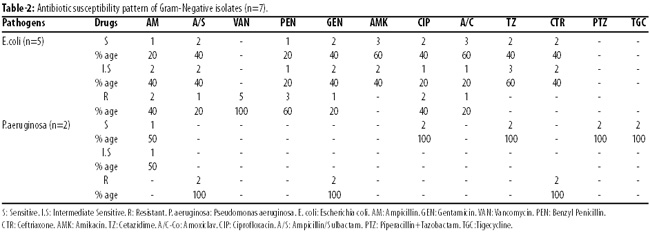
Microbiological analysis of blood samples revealed the presence of various types of bacteria. Out of the 60 samples, 53(88.3%) were Gram-positive isolates and 7(11.7%) were Gram-negative. On bacteriological examination, 39(65%) isolates of Methicillin-sensitive Staphylococcus aureus (MSSA), 2(3.3%) isolates of Methicillin-resistant Staphylococcus aureus (MRSA), 5(8.4%) isolates of Escherichia coli (E. coli), 2(3.3%) isolates of Pseudomonas aeruginosa (P. aeruginosa), 12(20%) isolates of Streptococcus species were characterised. Detailed microbiology of pathogens isolated and the antimicrobial susceptibility of Gram-positive and Gram-negative organisms causing endocarditis were noted (Table-1 and 2).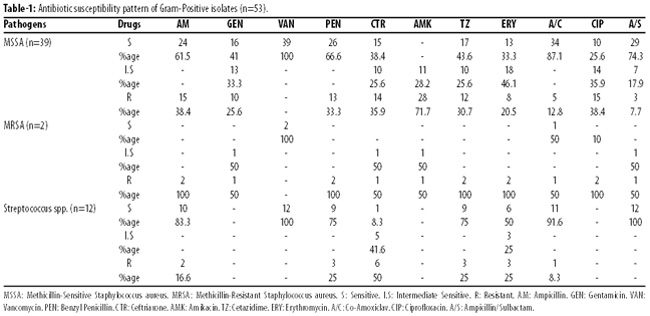
The combination of Benzyl Penicillin and Gentamicin was given to 11(18.3%) patients, while combination of Vancomycin and Gentamicin and Vancomycin alone was also given to 3(5%) and 6(10%) patients respectively.
In definite therapy, 19(31.7%) patients received B-Lactams and Aminoglycosides in combination, 3(5%) received B-Lactams in combination, 3(5%) received Glycopeptide and Betalactam in combination, 3(5%) received Vancomycin and Benzyl Penicillin, 3(5%) received Glycopeptide and Aminoglycosides in combination, 32(53.3%) received no combination (Table 3).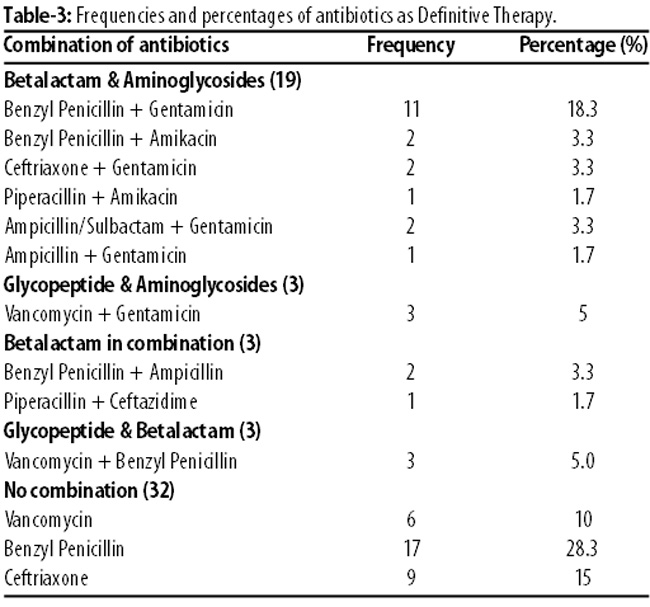
Out of 60 patients, 41(68.3%) were treated successfully with antibiotic therapy, 17(28.3%) were referred for surgery, and 2(3.3%) patients died.
Discussion
Infective endocarditis is an infection of the inner layer of the heart; usually of heart valves. Infective endocarditis is a developing disease. Male prevalence is one feature as reported by studies.10,11 But in this study, the ratio of male and female was almost equal. The reason for this difference needs further studies with larger populations.
Majority of the patients in this study (58%) were of younger age between 20-25 years. Studies carried out in Tunisia, Pakistan and India12-14 also reported below 35 years age group being the most affected. Other studies15-16 revealed that in developed countries, the ratio of relatively older patients was high. The reason for this is that in developing countries, patients of rheumatic disease are greater in number and also mainly present in young age due to untreated streptococcal throat infection. Mitral valve was most commonly involved in the process of bacterial endocarditis. This finding is similar to earlier studies performed in Pakistan13 and Saudi Arabia.17 The reason for predominance of the involvement of mitral valve was that such problems mainly occur in RHD.
In this study, 45.5% patients were culture-negative. The same findings have been reported by studies13,14 from developing countries. Only 5.2% and 18.7% cases of culture-negative endocarditis were reported by two studies.10,18 The reason for this high culture-negative ratio is mainly due to irrational use of antibiotics in developing countries.
Staphylococcus group of bacteria was mostly involved in bacterial endocarditis among culture-positive cases. Similarly, other studies19,20 also confirm that the Staphylococcus group is mostly involved and a leading pathogen in bacterial endocarditis. This finding is in sharp contrast to studies in India14 and Lebanon21 where Streptococcus was a leading cause of bacterial endocarditis. This difference is related to the time of the study since the current study was done at a later time period. Exact reasons of this change needs advanced studies and researches as well.
Empirical antibiotic therapy is started in patients of suspected endocarditis as soon as possible after taking the blood sample. The Penicillin in combination with Gentamicin and Vancomycin in case of Penicillin-allergic patients are given in empirical therapy to cover the spectra of both Gram-positive and Gram-negative bacteria.3 The same treatment was given to patients in this study. Further, once the causative organism is identified, definite therapy is started according to antibiotic susceptibility report.
Bacteriologic cure rates are high in those patients who complete their antibiotic course of therapy as Parenteral Penicillin or Ceftriaxone in Penicillin susceptible Streptococci for proper duration of time.22 Vancomycin is used in resistant cases. Streptococcus species show synergistic effect of Penicillin in combination with Aminoglycoside. Administration of Penicillin alone is helpful in patients of Penicillin-susceptible Staphylococcus aureus. Gentamicin is added in the therapy for the first three to five days to prevent the spread of infection and further damage to valves.23 This study also recommends the administration of Penicillins or Cephalosporins and Vancomycin for endocarditis due to Streptococcus and Staphylococcus aureus species.
Another considerable cause of bacterial endocarditis is MRSA. It is mostly isolated in cases where prosthetic valves are present or patient is intravenous (IV) drug user or in nosocomial endocarditis. Vancomycin is administered to treat endocarditis due to MRSA. Daptomycin is a newly approved lipopeptide that is highly bactericidal against most strains of MRSA if resistance to Vancomycin develops.24 In this study, Vancomycin for four to six weeks was administered in patients of bacterial endocarditis due to MRSA.
A study based on International Collaboration on Infective Endocarditis Prospective Cohort Study (ICE-PCS) data25 reported that E. coli and P. aeruginosa were also a common cause of endocarditis; 29% and 14% respectively. Implanted endovascular devices are main cause of endocarditis due to bacteria other than Haemophilus, Actinobacillus, Cardiobacterium, Eikenella and Kingella species (Non-HACEK). Only 8.4% cases of bacterial endocarditis due to E. coli and 3.3% cases due to P. aeruginosa were reported in this study.
Conclusion
Most patients of endocarditis had RHD and problems related to mitral valve or aortic valve. Empirical therapy was effective in most patients. MSSA was the main agent causing infective endocarditis. Vancomycin showed excellent in vitro activity against Gram-positive isolates. Gram-negative bacteria showed better in vitro efficacy with Ciprofloxacin, Ceftazidime, Piperacillin+Tazobactam, Tigecycline Amikacin and Co-Amoxiclav than other antibiotics.
References
1. Mitchell RS, Kumar V, Robbins SL, Abbas AK, Fausto N. Robbins Basic Pathology. 8th ed. Saunders/Elsevier, 2007; pp 406-8.
2. Mattu A, Goyal D, Barrett, Jeffrey W, Broder J, DeAngelis et al. Emergency medicine: avoiding the pitfalls and improving the outcomes. Malden, Mass: Blackwell Pub. BMJ Books, 2007; pp 63.
3. Baddour LM, Wilson WR, Bayer AS, Fowler VJ, Bolger AF, Levison ME et al. AHA Scientific Statement Infective Endocarditis: Diagnosis, Antimicrobial Therapy And Management of Complications. Circulation 2005; 111: e394-e434.
4. Dajani AS, Taubert KA, Wilson W. Prevention of bacterial endocarditis. Recommendations by the American Heart Association. JAMA 1997; 277: 1794-801.
5. Lin AE, Basson CT, Goldmuntz E, Magoulas PL, McDermott DA, McDonald-McGinn DM, et al. Adults with genetic syndromes and cardiovascular abnormalities: clinical history and management. Genet Med 2008; 10: 469-94.
6. Karchmer AW. Infective endocarditis. In: Libby P, Bonow RO, Zipes DP, Mann DL, Braunwald E eds. Braunwald\'s Heart Disease. A Text book of Cardiovascular Medicine. 8th ed. Philadelphia PA: Elsevier Saunders, 2008; pp 1713-37.
7. Netzer RO1, Altwegg SC, Zollinger E, Täuber M, Carrel T, Seiler C. Infective Endocarditis: Determinants of Long-Term Outcome. Heart 2002; 88: 61-6.
8. Bauer AW, Kirchy WM, Sherries JC, Turck M. Antibiotic susceptibility testing by a Standardized single disk method. Am J Clin Pathol 1966; 45: 493-6.
9. Clinical and Laboratory Standards Institute (CLSI). Performance standards for antimicrobial susceptibility testing; twenty second informational supplement M100-S22.Wayne: CLSI, 2012.
10. Chen CH, Lo MC, Hwang KL, Liu CE, Young TG. Infective endocarditis with neurological complication: 10 year experience. J Mcrobiol Immunol Infect 2001; 34: 119-24.
11. McKay G, Bunton R, Galvin I, Shaw D, Singh H. Infective endocarditis - a twelve year surgical outcome series. N Z Med J 2002; 115: 275.
12. Letaief A, Boughzala E, Kaabia N, Ernez S, Abid F, Ben Chaabane T, et al. Epidemiology of infective endocarditis in Tunisia: A 10-year multicenter retrospective study. Int J Infect Dis 2007; 11: 430-3.
13. Tariq M, Alam M, Munir G, Khan MA, Smego RA. Infective endocarditis. A five Year experience at a tertiary care hospital in Pakistan. Int J Infect Dis 2004; 8: 163-70.
14. Agarwal R, Bahl VK, Malaviya AN. Changing spectrum of clinical and laboratory profile of infective endocarditis. J Assoc Physicians India 1992; 40: 721-3.
15. Bashore TM, Cabell C, Fowler V Jr. Update on infective endocarditis. Curr Probl Cardiol 2006; 31: 274-352.
16. Murdoch DR, Corey GR, Hoen B, Miro JM, Fowler VG, Bayer AS, et al. Clinical presentation, etiology, and outcome of infective endocarditis in the 21st century: The International Collaboration on Endocarditis-Prospective Cohort Study. Arch Intern Med. 2009; 169: 463-73.
17. Nashmi A, Memish ZA. Infective endocarditis at a tertiary care centre in Saudi Arabia: Review of 47 cases over 10 years. East Mediterr Health J 2007; 13: 64-71.
18. Zamorano J, Sanz J, Almeria C, Rodrigo JL, Samedi M, Hererra D et al. Difference between endocarditis with true negative blood cultures and those with previous antibiotic treatment. J Heart valve Dis 2003; 12: 256-60.
19. Miro JM, Anguera I, Cabell CH, Chen AY, Stafford JA, Corey GR, et al. S.aureus native valve infective endocarditis: Report of 566 episodes from the International Collaboration on Endocarditis Merged Database. Clin Infect Dis. 2005; 41: 507-14.
20. Prendergast BD. The changing face of infective endocarditis. Heart 2006; 92: 879-85.
21. Kanafani ZA, Mahfouz TH, Kanj SS. Infective endocarditis at a tertiary care centre in Lebanon: predominance of streptococcal infection. J Infect. 2002; 45: 152-9.
22. Wilson WR, Zak O, Sande MA. Penicillin therapy for treatment of experimental endocarditis caused by viridans streptococci in animals. J Infect Dis 1985; 151: 1028-33.
23. Hoen B. Epidemiology and antibiotic treatment of infective endocarditis: an update. Heart 2006; 92: 1694-700.
24. Bamberger DM. Bacteremia and endocarditis due to methicillin-resistant Staphylococcus aureus: the potential role of daptomycin. Ther Clin Risk Manag 2007; 3: 675-84.
25. Morpeth S, Murdoch D, Cabell CH, Karchmer AW, Pappas P, Levine D et al. Non-HACEK gram-negative bacillus endocarditis. Ann Intern Med 2007; 147: 829-35.
Journal of the Pakistan Medical Association has agreed to receive and publish manuscripts in accordance with the principles of the following committees:


