

Chuan Hun Ding ( Department of Medical Microbiology & Immunology, UKM Medical Centre, Kuala Lumpur, Malaysia. )
Asrul Abdul Wahab ( Department of Medical Microbiology & Immunology, UKM Medical Centre, Kuala Lumpur, Malaysia. )
Najihan Abdul Samat Muttaqillah ( Department of Medical Microbiology & Immunology, UKM Medical Centre, Kuala Lumpur, Malaysia. )
Mohd Nizam Tzar ( Department of Medical Microbiology & Immunology, UKM Medical Centre, Kuala Lumpur, Malaysia. )
December 2014, Volume 64, Issue 12
Original Article

Abstract
Objective: To determine the proportion of albicans and non-albicans candiduria in a hospital setting and to ascertain if fluconazole is still suitable as empirical antifungal therapy based on antifungal susceptibility patterns of Candida species.
Methods: The cross-sectional study was conducted between December 2010 and December 2011 at UKM Medical Centre, Kuala Lumpur, Malaysia and comprised 64 urine samples from patients who were either suspected or confirmed to have urinary tract infections. Yeasts were speciated using ID 32 C and subjected to antifungal susceptibility testing using Sensititre® YeastOne YO8.
Results: Candida albicans accounted for 38(59.4%) of the isolates, Candida tropicalis 18(28.1%), Candida glabrata 6(9.4%) and Candida parapsilosis 2(3.1%). Overall, the isolates were susceptible to both amphotericin B (MIC90 1µg/ml) and to 5-flucytosine (MIC90 0.25 µg/ml), but susceptible-dose dependent towards fluconazole (MIC90 16µg/ml). Individually, Candida albicans was susceptible to fluconazole (MIC90 2µg/ml), amphotericin B (MIC90 0.5µg/ml) and 5-flucytosine (MIC90 0.25µg/ml). Candida tropicalis was also susceptible to fluconazole (MIC90 4µg/ml), amphotericin B (MIC90 1µg/ml) and 5-flucytosine (MIC90 0.125µg/ml). Candida glabrata was resistant to fluconazole (MIC90 64µg/ml), but susceptible to amphotericin B (MIC90 1µg/ml) and 5-flucytosine (MIC90 0.125µg/ml). Lastly, Candida parapsilosis was resistant to fluconazole (MIC90 256µg/ml), but susceptible to amphotericin B (MIC90 0.5µg/ml) and 5-flucytosine (MIC90 0.5µg/ml).
Conclusion: The commonest yeast associated with candiduria at the study site was Candida albicans, and fluconazole can still be used for empirical therapy of candiduria.
Keywords: Candiduria, Candida, Sensititre, ID 32 C, Fluconazole. (JPMA 64: 1375; 2014).
Introduction
Candida species have been reported as being the cause of up to 20% of urinary tract infection (UTI) episodes in intensive care units (ICUs), and they are the most prevalent organisms after Escherichia coli.1 Candida species are increasingly emerging as an important cause of infections in humans as a result of diabetes mellitus (DM), increasing use of indwelling medical devices, immunosuppressive therapy and broad-spectrum antibiotics. Candida UTIs are mainly acquired via the ascending route, with urinary catheters serving as their portal of entry.2
In asymptomatic candiduria, the presence of Candida may represent colonisation rather than infection. However, for patients being nursed in ICUs, symptoms are often lacking despite being catheterised, resulting in failure to perceive urinary frequency or dysuria as well as the inability to vocalise symptoms due to sedation or mechanical ventilation.3 Several conditions that necessitate an aggressive approach to candiduria, even among truly asymptomatic individuals include severely immunocompromised patients and neonates with low birth weight (LBW).4
The first line of treatment for symptomatic candiduria (e.g. cystitis) in many centres is with fluconazole because of the high prevalence of Candida albicans and the presumption that this species is susceptible to fluconazole. A high prevalence of non-albicans species in the urine may therefore be of concern for centres that employ fluconazole as first-line therapy because some species are either intrinsically resistant to azoles (i.e. Candida krusei) or susceptible only to high doses (i.e. Candida tropicalis and Candida glabrata). Persistent candiduria is also significantly higher with non-albicans Candida.2 To compound matters, there have also been numerous reports of azole-resistant Candida albicans in the literature for at least a decade now.5
Outside Malaysia, there have been several reports of non-albicans Candida overtaking Candida albicans as the leading cause of candiduria. For instance, at a medical college in Vellore, India, the prevalence of non-albicans candiduria was reported to be as high as 81%.6 At a general hospital in Ribeirão Preto, Brazil, a study reported non-albicans candiduria prevalence of 64%.7 Likewise, non-albicans Candida predominated (accounting for 58% of all Candida isolates) in urine samples of renal transplant recipients from a university hospital in Madison, USA.8 Many clinical laboratories in Malaysia do not speciate the Candida isolated from urine samples unless specifically requested. Thus, local changes or trends in species causing candiduria are difficult to determine.
The objective of the current study was to determine if the proportion of non-albicans candiduria was also high at a medical centre in Malaysia and if fluconazole resistance was a problem. This was of particular importance since empirical treatment of Candida UTIs at the study site was with fluconazole.
Materials and Methods
The cross-sectional study was conducted from December 2010 to December 2011 at UKM Medical Centre, Kuala Lumpur, Malaysia.
The sample size formula used was based on Schlesselman\'s method.9 Using the prevalence of albicans candiduria of 45.8% as P0 (reported as the prevalence of C albicans in literature1) and 22% as P1 (reported as the prevalence of C albicans by a study6), and taking a = 0.05 and b = 0.20, the formula yielded a sample size of 61.
A total of 64 non-duplicate Candida species isolates were collected from patients who presented for various medical and surgical conditions. These patients were either suspected or confirmed to have urinary tract infections and had their urine samples sent to the microbiology lab for culture and sensitivity. Regardless of whether the urine samples were collected from urinary catheters or were clean catch/mid-stream urine samples, patients were selected if the urine samples had pyuria, defined as having at least 10 leukocytes/mm3 urine), and had Candida sp. isolated on cysteine lactose electrolyte deficient (CLED) agar (Oxoid, UK). All samples were subjected to a microscopic cell count on an improved Neubauer counting chamber to determine if significant pyuria was present, and then cultured on CLED agar.
After overnight incubation, any yeast-like colony (dry, non-lactose fermenting) was subjected to a gram stain to ascertain if indeed it was a yeast appearing as gram-positive budding cells. Following this, colonies from the colony count section of the CLED agar (Figure-1)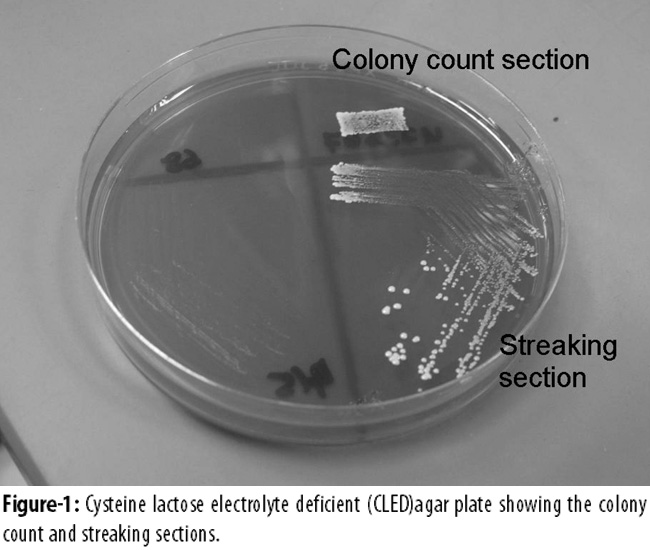
were sub-cultured onto a Chromogenic agar (CHROMagar) and Sabouraud dextrose agar (SDA) biplate (Oxoid, UK) to obtain a presumptive identification of the Candida species and also to determine if the urine sample had more than one species of Candida. The streaking section of the CLED agar was not used for subculture on to the biplate because due to the larger space this section occupies on the CLED agar, the individual colonies present here may not be representative of all the Candida species present in the urine sample.
The original urine specimen was not used for direct culture onto the CHROMagar/SDA biplate because by the time yeast colonies are visible on the CLED agar, the urine specimen would have already been kept for more than 24 hours and, hence, there will be bacterial overgrowth in the urine specimen which may overwhelm the yeast when subculture onto CHROMagar/SDA is attempted.
The yeast isolates from the CHROMagar/SDA biplate were speciated using ID32C (bioMérieux SA, France). Growth was determined to be positive or negative based upon the presence or absence of turbidity in the cupules. Identification was achieved through the use of the apiwebTM identification software by entering the 10-digit numerical profile of each isolate. Identifications reported by the software as "very good", "good", or "acceptable" were taken as correct.
Antifungal susceptibility testing was performed using the broth microdilution method with Sensititre® YeastOne YO8 (TREK Diagnostic Systems, USA) and the fluconazole, amphotericin B, and 5-flucytosine minimum inhibitory concentrations (MICs) for each Candida isolate were recorded. The MICs were interpreted according to the guidelines provided by the 2008 Clinical and Laboratory Standards Institute (CLSI) document M27-S3.10
Results
A total of four different Candida species were isolated from the 64 urine samples (Figure-2).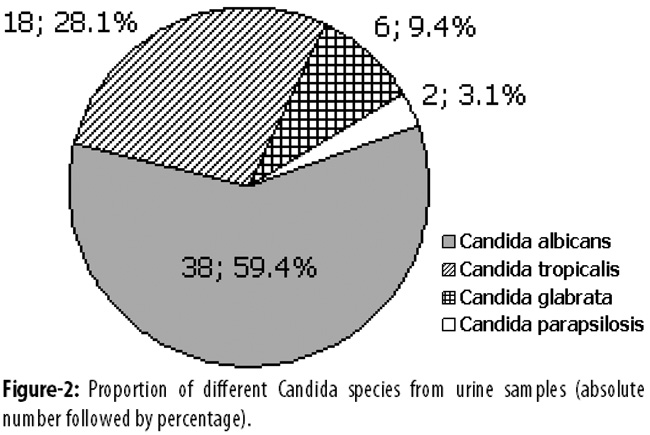
Candida albicans accounted for 38(59.4%) isolates and was the predominant Candida species, followed by 18(28.1%) Candida tropicalis, 6(9.4%) Candida glabrata, and 2(3.1%) Candida parapsilosis.
Yeast genera apart from Candida (e.g. Trichosporon) were not detected in the urine samples. All the 64 urine samples were obtained from 64 different patients and none contained more than one species of Candida.
Candida albicans and Candida tropicalis were susceptible to all 3 antifungals tested. Resistance to fluconazole was seen with all isolates of Candida glabrata and one isolate of Candida parapsilosis. Resistance to amphotericin B and to 5-flucytosine were not detected in any of the isolates (Table).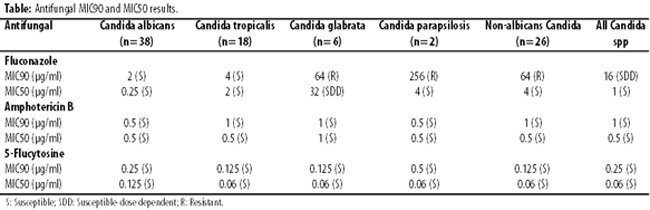
Discussion
Consistent with published literature that almost all fungal urinary tract infections are caused by Candida species,11 no fungal genus was identified in this study apart from Candida. Among other fungi that have been implicated in the literature as causative agents of fungal UTI are Trichosporon asahii11 and Cryptococcus neoformans.11 In one study, a total of 861 urine samples were analysed and Cryptococcus neoformans was isolated in only 2(0.23%) samples.11
A pus cell count of >10 leukocytes per mm3 of urine has long been established as significant pyuria when dealing with bacterial UTIs.13 Although a review of literature did not provide a specific pus cell count above which pyuria is said to be significant in cases of candiduria, this study also adopted >10 leukocytes/cm3 urine as an inclusion criterion for the study.
Two methods were employed to speciate Candida. The first was CHROMagar culture, which provided a presumptive identification of the Candida species based on the colour of the colonies; Candida albicans produces green colonies, Candida tropicalis yields metallic blue colonies, Candida parapsilosis and Candida glabrata both grow as light pink (or occasionally creamy white) colonies, and Candida krusei appears as pink and fuzzy colonies. Thus, CHROMagar is especially useful for differentiating Candida albicans from non-albicans Candida.14
Carbohydrate assimilation tests (ID32C system) were the second method of identification used instead of cornmeal agar culture because the ID32C system has the capability to identify many Candida species (in excess of 30) and several non-Candida yeasts as well. Also, there have been reports in literature of chlamydospore-negative Candida albicans,15 which could pose identification dilemmas with cornmeal agar culture. With ID32C, up to 60% of chlamydospore-negative Candida albicans can be identified correctly as Candida albicans.16 Also, on CHROMagar, all Candida albicans isolates will produce characteristic green coloured colonies regardless of chlamydospore production.16 Therefore, CHROMagar culture is a useful complement to the ID32C. In this study, none of the yeasts presumptively identified as Candida albicans through CHROMagar culture were identified differently when speciated with ID32C.
From the CHROMagar and ID32C results, the Candida species isolated from urine samples were, in decreasing order of prevalence, Candida albicans, Candida tropicalis, Candida glabrata, and Candida parapsilosis. Candida albicans accounted for 59.4% of all the isolates and the non-albicans Candida made up 40.6%. Candida krusei, notorious for its intrinsic resistance to fluconazole, was not isolated.
Although the Sensititre® YeastOne YO8 microtitre plate used in this study had the capacity to test each yeast isolate for susceptibility towards eight different antifungal agents (fluconazole, amphotericin B, 5-flucytosine, voriconazole, posaconazole, ketoconazole, itraconazole and caspofungin), MIC data were presented only for antifungal agents that could be used to treat fungal UTIs (i.e. fluconazole, amphotericin B and 5-flucytosine), as recommended by the Infectious Diseases Society of America (IDSA) in its 2009 clinical practice guidelines for treating UTIs due to Candida species.4
The fluconazole MIC90 for all Candida isolates is 16 µg/ml and this value falls within the susceptible-dose dependent range. Therefore, a reasonable approach to treating a Candida isolate which is susceptible-dose dependent to fluconazole, would be to administer enough drug until the urinary concentration exceeds the MIC90 of 16µg/ml. Fortunately, fluconazole is an antifungal with high urinary penetration. The bioavailability for orally administered fluconazole is also excellent at 95% and it has a half-life of 31 hours,17 favouring once-a-day dosing. It has been found that a fluconazole dose of 100 mg/day produces a peak serum drug level of ~6.7 µg/ml, a dose of 400 mg/day produces a peak serum level of 20-30 µg/ml, and the linear pharmacokinetics of fluconazole predicts a peak serum level of 40-60 µg/ml when administered at a dose of 800mg/day.18 While data on the peak serum drug level for a fluconazole dose of 200 mg/day was not provided in a study18 based on the known linear pharmacokinetics of fluconazole, this level should be approximately half of that corresponding to the fluconazole dose of 400 mg/day, i.e. 10-15 µg/ml.
With daily dosing, the drug trough level is approximately half of the peak level.18 It has also been reported that the concentration of fluconazole in the urine of patients with normal renal function is 10-fold higher than the corresponding serum concentration.19 Therefore, if a dose of 100mg is said to result in a peak serum concentration of 6.7 µg/ml and a trough serum concentration of 3.35 µg/ml, the corresponding urinary concentration would be in the range of 33-67 µg/ml. This is already sufficiently high to overcome the MIC90 of Candida albicans (2 µg/ml) and the MIC90 of Candida species in general (16 µg/ml), but not the MIC90 of non-albicans Candida (64 µg/ml).
To exceed the non-albicans Candida fluconazole MIC90 of 64 µg/ml, a dose of 200mg is more suitable, as the urinary concentration would be expected to be between 100-150µg/ml. A fluconazole dose of 200 mg/day is not considered high, as it has been reported that the drug is well tolerated even at a dose of 1,600 mg/day.20 Moreover, the IDSA recommends an oral fluconazole dosage of between 200-400mg/day for 2 weeks to treat symptomatic Candida UTIs in adults.4 Fluconazole is extremely well tolerated and it lacks significant toxicity, despite having been used for both treatment and prophylaxis in many patient populations for more than a decade.17
For amphotericin B, the highest MIC90 recorded was 1µg/ml and thus none of the Candida species isolated was deemed resistant to this antifungal. However, this MIC value of 1µg/ml is the highest MIC denoting susceptibility. Because the urinary penetration of systemically administered amphotericin B is poor, ranging from <20% for conventional amphotericin B to <5% for lipid preparations of amphotericin B,21 this drug can also be administered through bladder irrigation to achieve high concentrations at the site of infection. There is no role for oral amphotericin B as the bioavailability is reported to be <5%.17 While amphotericin B bladder irrigation is listed as one of the treatment options for Candida UTI, its optimal dose and duration have not been defined by the IDSA.4 On the other hand, the dose recommendation by the IDSA for intravenous amphotericin B is between 0.3-0.7 mg/kg/day, for 1-2 weeks, depending on the type of UTI.4
Conventional amphotericin B causes severe renal toxicity in up to 50% of patients when administered systemically.22 This, together with an uncertain dose and treatment duration if given via bladder irrigation, makes the drug ill-suited for treating Candida UTIs if other treatment options are available. Moreover, although the killing of amphotericin B is concentration-dependent,23 higher doses may put the patient at higher risk of drug toxicity.
The third and last antifungal recommended for treating Candida UTIs is 5-flucytosine. As presented in the Table, none of the Candida isolates tested had a resistant MIC90. Like fluconazole, 5-flucytosine is highly concentrated in the urine, can be given orally although its oral bioavailability is slightly lower at 80%.17 However, having being initially developed to be an anti-tumour agent, this drug is hepatotoxic and can cause bone marrow depression,24 such that therapeutic drug monitoring (TDM) is recommended for 5-flucytosine.25 Also, there is wide inter- and intra-patient pharmacokinetic variability with 5-flucytosine,26 necessitating TDM to ensure that dosing results in a serum concentration which is therapeutic. Oral 5-flucytosine at a dosage of 25 mg/kg four times daily for 2 weeks is one of the treatment options for Candida UTI outlined by the IDSA.4 However, the widely described occurrence of resistance has precluded the usage of 5-flucytosine as a single agent,24 and thus even if all the Candida isolates are found to be susceptible to 5-flucytosine, it should still be combined with another antifungal agent.
A small sample size was limitation of our study.
Conclusion
The study found that Candida albicans was the predominant yeast in the urine samples of patients and that fluconazole was suitable for empirical treatment of candiduria. Similar studies should be undertaken from time to time to ascertain if Candida albicans remains the predominant yeast. Should a non-albicans Candida overtake Candida albicans, the empirical antifungal therapy recommendations for candiduria may have to be reviewed.
Acknowledgements
We thank the Dean of the Faculty of Medicine, UKM, for permission to conduct this study and to the management of UKM Medical Centre for providing a research grant.
References
1. Colodner R, Nuri Y, Chazan B, Raz R. Community-acquired and hospital-acquired candiduria: comparison of prevalence and clinical characteristics. Eur J Clin Microbiol Infect Dis 2008; 27: 301-5.
2. Jain M, Dogra V, Mishra B, Thakur A, Loomba PS, Bhargava A. Candiduria in catheterized intensive care unit patients: emerging microbiological trends. Indian J Pathol Microbiol 2011; 54: 552-5.
3. Hollenbach E. To treat or not to treat - critically ill patients with candiduria. Mycoses 2008; 51: 12-24.
4. Pappas PG, Kauffman CA, Andes D, Benjamin DK Jr, Calandra TF, Edwards JE Jr, et al. Clinical practice guidelines for the management of candidiasis: 2009 update by the Infectious Diseases Society of America. Clin Infect Dis 2009; 48: 503-35.
5. Albertson GD, Niimi M, Cannon RD, Jenkinson HF. Multiple efflux mechanisms are involved in Candida albicans fluconazole resistance. Antimicrob Agents Chemother 1996; 40: 2835-41.
6. Paul N, Mathai E, Abraham OC, Mathai D. Emerging microbiological trends in candiduria. Clin Infect Dis 2004; 39: 1743-4.
7. de Oliveira RD, Maffei CM, Martinez R. Nosocomial urinary tract infections by Candida species. Rev Assoc Med Bras 2001; 47: 231-5.
8. Safdar N, Slattery WR, Knasinski V, Gangnon RE, Li Z, Pirsch JD, et al. Predictors and outcomes of candiduria in renal transplant recipients. Clin Infect Dis 2005; 40: 1413-21.
9. Dupont WD, Plummer WD Jr. Power and sample size calculations: a review and computer program. Control Clin Trials 1990; 11: 116-28.
10. CLSI. Reference method for broth dilution antifungal susceptibility testing of yeasts; third informational supplement. CLSI document M27-S3. Wayne, PA: Clinical and Laboratory Standards Institute; 2008.
11. Kauffman CA, Vazquez JA, Sobel JD, Gallis HA, McKinsey DS, Karchmer AW, et al. Prospective multicenter surveillance study of funguria in hospitalized patients. Clin Infect Dis 2000; 30: 14-8.
12. Kumar S, Bandyopadhyay M, Mondal S, Pal N. A rare case of nosocomial urinary tract infection due to Trichosporon asahii. J Global Infect Dis 2011; 3: 309-10.
13. Khattak MI, Ishaq T, Muhammad A. The clinical and etiological profile of urinary tract infection. J Postgrad Med Inst 2008; 22: 205-09.
14. Okulicz JF, Rivard RG, Conger NG, Nguyen MX, Hospenthal DR. Primary isolation of Candida species from urine specimens using chromogenic medium. Mycoses 2007; 51: 141-6.
15. Al-Hediathy SSA, Fotedar R. Recovery and studies on chlamydospore-negative Candida albicans isolated from clinical specimens. Med Mycol 2002; 40: 301-6.
16. Fotedar R, Al-Hedaithy SSA. Identification of chlamydospore-negative Candida albicans using CHROMagar Candida medium. Mycoses 2002; 46: 96-103.
17. Ashley ESD, Lewis R, Lewis JS, Martin C, Andes D. Pharmacology of systemic antifungal agents. Clin Infect Dis 2006; 43: S28-S39.
18. Pfaller MA, Diekema DJ, Sheehan DJ. Interpretive breakpoints for fluconazole and Candida revisited: a blueprint for the future of antifungal susceptibility testing. Clin Microbiol Rev 2006; 19: 435-47.
19. Weinstein RA. Nosocomial candiduria: a review. Clin Infect Dis 2001; 32: 1602-7.
20. Anaissie EJ, Kontoyiannis DP, Huls C, Vartivarian SE, Karl C, Prince RA, et al. Safety, plasma concentrations, and efficacy of high-dose fluconazole in invasive mold infections. J Infect Dis 1995; 172: 599-602.
21. Smith J, Andes D. Pharmacokinetics of antifungal drugs; implications for drug selection. Infect Med 2006; 23: 328-33.
22. Dupont B. Overview of the lipid formulations of amphotericin B. J Antimicrob Chemother 2002; 49(S1): 31-6.
23. Andes D. In vivo pharmacodynamics of antifungal drugs in treatment of candidiasis. Antimicrob Agents Chemother 2003; 47: 1179-86.
24. Vermes A, Guchelaar HJ, Dankert J. Flucytosine: a review of its pharmacology, clinical indications, pharmacokinetics, toxicity and drug interactions. J Antimicrob Chemother 2000; 46: 171-9.
25. Goodwin ML, Drew RH. Antifungal serum concentration monitoring: an update. J Antimicrob Chemother 2008; 61: 17-25.
26. Smith J, Andes D. Therapeutic drug monitoring of antifungals: pharmacokinetic and pharmacodynamic considerations. Ther Drug Monit 2008; 30: 1-6.
Journal of the Pakistan Medical Association has agreed to receive and publish manuscripts in accordance with the principles of the following committees:


