

Harun Dugeroglu ( Department of Internal Medicine, Faculty of Medicine, Yuzuncu Yil University, Van, Turkey )
Mustafa Ozturk ( Department of Endocrinology and Metabolism, Faculty of Medicine, Medipol University, Istanbul, Turkey. )
Murat Atmaca ( Department of Endocrinology and Metabolism, Faculty of Medicine, Yuzuncu Yil University, Van, Turkey. )
Ismet Seven ( Department of Internal Medicine, Faculty of Medicine, Yuzuncu Yil University, Van, Turkey. )
December 2014, Volume 64, Issue 12
Original Article

Abstract
Objective: To investigate the effects of mesterolone on prostate in patients treated for aging male syndrome.
Methods: The cross-sectional study was conducted from June to September, 2009, at endocrinology and metabolism department of Yuzuncu Yil University, Van, Turkey, and comprised patients with symptoms of aging male syndrome and/or low testosterone. They were given mesterolone 50mg/day per oral for two months. Aging Male Symptoms and International Prostate Symptom Score questionaires and prostate-related quality of life scores were completed and prostate ultrasonography (USG) was performed before and after the treatment. Total testosterone, free testosterone, gonadotropins, estradiol, prolactin, sex-hormone binding globulin, as well as total and free prostate-specific antigen were also studied.
Results: Of the 34 patients in the study, 22(64.70%) had their prostate volume increased, while 12(35.29%) had it decreased. The change, however, was not statistically significant (p<0.098). Mesterolone significantly improved Aging Male Symptoms, International Prostate Symptom and prostate-related quality of life scores (p<0.001). These improvements though significant were independent of the changes in prostate volume. Total testosterone, sex-hormone binding globulin andestradiol decreased, while free testosterone showed no change (p<0.002, p<0.001, p<0.024, p<0.337). The fraction of free testosterone increased (p<0.001), while total and free prostate-specific antigen did not change (p<0.368 and p<0.841)
Conclusion: Mesterolone proved to be a safe alternative in the treatment of Aging Male Syndrome. It also improved lower urinary tract symptoms and prostate-related quality of life.
Keywords: Mesterolone, Andropause, Prostate. (JPMA 64: 1366; 2014).
Introduction
Androgen replacement therapy (ART) in aging male has given way to much-debated concerns about effects on the prostate. Clinicians have been warned off the risk of prostate cancer on ART. Although there is no data that ART induces prostate cancer, it is currently not recommended for patients with a known prostate cancer or has a high risk based on PSA above 4ng/ml.1 Patients with severe lower urinary tract symptoms were also discouraged from ART usage. In clinical practice, androgens have been treated as a group as if all have similar effects. Indeed mesterolone has some unique properties among all. It is an old molecule with quite a limited number of clinical studies. It has dihydrotestosterone-like effects, does not aromatise to oestrogens, does not supress gonadotropins, is safe for liver and even no toxic dose has been defined.2 Its effects on prostate have not been studied before. The current study investigated effects of mesterolone in patients treated for aging male syndrome (AMS).
Patients and Methods
The cross-sectional study was conducted from June to September, 2009, at endocrinology and metabolism department of Yuzuncu Yil University, Van, Turkey, and comprised patients with symptoms of aging male syndrome and/or low testosterone(total testosterone level below 300ng/dl). Androgen deficiency symptoms were evaluated with the Androgen Deficiency in the Aging Male (ADAM) questionnaire.3 Patients who had 3 or more positive answers were found eligible. Patients with a known heart disease or those found to be suspicious for prostate cancer were excluded.
The selected patients were asked to complete the Aging Male Symptoms Questionnaire (AMSQ)4 and the International Prostate Symptom Score (IPSS) proforma5 and mark on the prostate-related quality of life (ProsQoL) score before and after two months of mesterolone 50 mg/day treatment.
Laboratory investigations, including total testosterone (TC), free testosterone (FT), Follicle-stimulating hormone (FSH), Luteinizing hormone (LH), Estradiol 2 (E2), Sex hormone binding globulin (SHBG), dehydroepiandrosterone sulfate (DHEA-SO4), prolactin, free Prostate-specific antigen (PSA), total PSA and prostate USG, were performed before and after the treatment. Free testosterone was measured with radioimmunoassay (RIA), while other hormone analysis was done by immunometric autoanalyser (Abbott Arcthitect® i4000) using commercial kits.
Free testosterone and bioavailable testosterone were also calculated using serum albumin, SHBG and total testosterone.6
During statistical analysis, post-treatment changes were compared with paired t-test. The subgroup and correlation analyses were done by Spearman analysis. P<0.05 was considered statistically significant.
Results
Of the 34 patients in the study 30(88.2%) were married while 4(11.8%) had never married. The overall mean age was 43±12 years (range: 17-66 years). Among married ones, 20(66.6%) had fathered a child, while 10(33.4%) had no child despite no contraceptive usage.
Mesterolone improved AMS, IPSS, ProsQoL scores significantly after 2 months (p<0.001) (Table-1).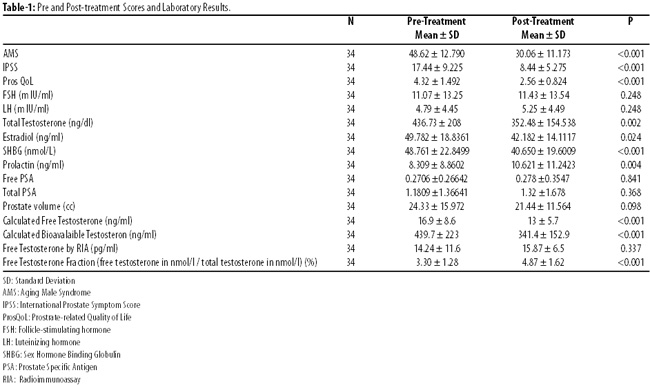
The magnitude of change of AMS was correlated with the amount of improvement in IPSS and ProsQoL (p<0.028. r=0.377; and p<0.007, r=0.456). Improvement of IPSS and ProsQoL were higher in patients with worse initial scores (p<0.001 for both; r=0.831 and r=0.843 respectively). When the 17(50%) patients were grouped as having severe lower urinary tract symptoms (LUTS) (IPSS >19) or the other 17(50%) having fewer LUTS (IPSS<19), the IPSS score decreased significantly more in patients with severe LUTS (13.1±4.5 vs 4.9±5.5; p<0.001). IPSS decreased in 29(85.3%) patients (10.8±5), increased in 4(11.8%) (2±0.81), and remained unchanged in 1(3%). In the 4 patients with increasing IPSS, the initial scores were low (mean: 4.5±5.2). Among them, only 1(25%) signed a worse ProsQoL score (by 1), 2(50%) remained unchanged and 1(25%) chose a better score (by 3). ADAM, AMS, IPSS or ProsQoL did not correlate with total or free testosterone levels. ADAM score showed some correlation only with SHBG level (p<0.035; r=0.362).
Total testosterone, SHBG, calculated FT, calculated bioavailable testosterone and estradiol decreased while FT measured by RIA did not change. FSH and LH did also had no change. The amount of decrease in total testosterone correlated with the initial testosterone level (p<0.001; r=0.706) Free testosterone by RIA increased in 25(73.52%) patients (from 11.48±3.7 to 16.08±6.4; p<0.001), decreased in 8(23.52%) (23.2±21.58 to 15.2±6.95; p<0.012) and remained unchanged in 1(3%). The fraction of free testosterone (free testosterone by RIA/total testosterone) increased in 29(85.3%) patients. Prolactin increased across the board.
Prostate volume measured by USG decreased (6.4±10.5mll p<0.009) in 22(64.7%) patients, increased (3.6±3.3ml; p<0.002) in 12(35.3%) patients (Table-2).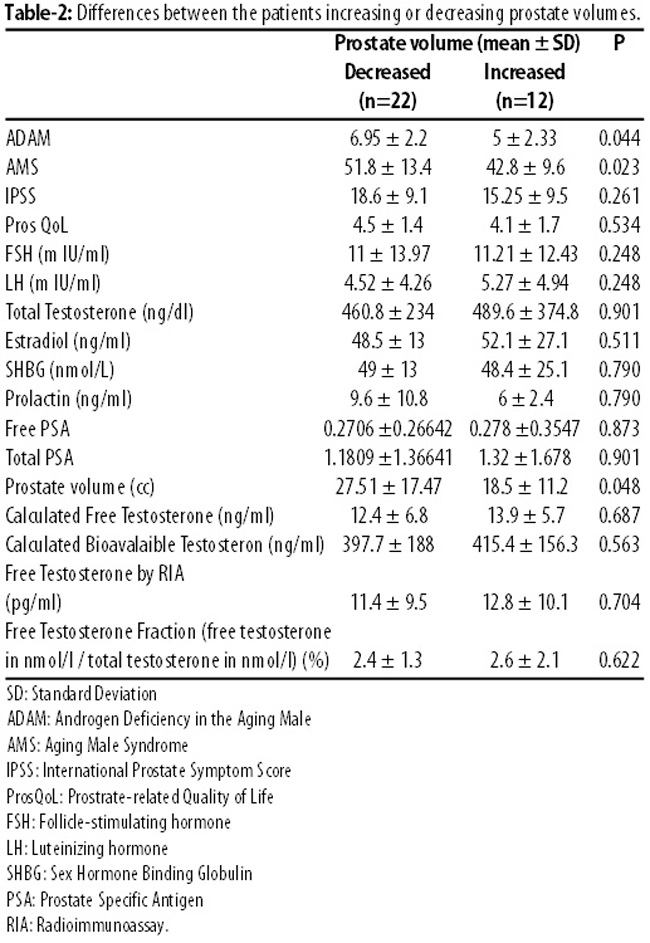
The change was not significant (p<0.098). In patients whose prostate volume decreased, ADAM score was initially higher (6.95±2.2 vs 5±2.3; p=0.044).
Amount of improvement in IPSS was not different in patients with increasing or decreasing prostate size (p<0.444). The change in IPSS correlated neither with the change of prostate volume nor with the change of PSA (p<0.411 and p<0.098 respectively).
Discussion
Mesterolone is a non-aromatising synthetic testosterone with the advantages of absence of gonadotropin suppression and toxicity.2,7,8 Most synthetic androgens cause different degrees of gonadotropin suppression and oligospermia. Mesterolone, on the other hand, does not depress spermatogenesis. It has been tried in idiopathic male infertility and it did not increase pregnancy rates but did improve sperm morphology and movement.9 Mesterolone is an old molecule and unfortunately it\'s no more an attractive subject of research even for andrologists.
Effects of mesterolone on prostate remain largely unknown. In an earlier study it was reported to increase acid phosphatase and citric acid content of the semen while decreasing fructose.10 In our study, it greatly improved lower urinary tract symptoms and related quality of life. The patients who got the most benefit from mesterolone were the ones with worse symptoms in IPSS, ADAM and AMS. ART is not recommended for patients with high IPSS scores.1 In our study, no patient with a significant IPSS score got worse. Contrary to the recommendations, the patients with highest IPSS scores were the ones with the greatest improvement. The change was independent of PSA or prostate volume. Prostate volume was decreased in majority of the patients indeed.
Risk of prostate cancer is always a concern in testosterone replacement therapy (TRT). Accordingly, we chose a younger age study population to minimise the risk of prostate cancer. In a recent meta-analysis of 22 randomised controlled trials involving 2351 patients, short-term TRT was not associated with increased risk of prostate cancer. Oral replacement regimens were found safe even in the long term.11 In our opinion non-aromatisable androgens like mesterolone should be analysed seperately from others for their prostatic effects. They may prove to be safer or even benefical regarding prostate cancer risk.
In our study, ADAM or AMS scores did not correlate with testosterone levels. Improvement of AMS and IPSS could have resulted not only from physical effects of the mesterolone, but also from psychological ones. LUTS were frequently associated with anxiety and depression.12,13 Mesterolone was reported to enhance mood in depressed men.14 It may have comparable anti-depressive effects as amitriptyline, with fewer side effects.15 ADAM or AMS scores seem to be not an efficient tool to diagnose men with androgen deficiency, but can be used to monitor treatment response in our opinion.
Mesterolone binds avidly to SHBG, with a 4-time higher affinity compared to dihydrotestosterone.16 Occupation of SHBG binding sites may increase free testosterone. In our study, free testosterone measured by RIA increased in 25 patients whereas total testosterone decreased in 27 patients. Total testosterone decreased more in patients with initially higher total testosterone. Although total testosterone decreased, gonadotropins remained stable. The fall in total testosterone might be due to suppression of SHBG by mesterolone. However, amount of decrease in SHBG did not correlate with level of fall in total testosterone (p<0.151). Mesterolone had been shown to decrease total testosterone in a previous study too.14 Gonadotropins were not supressed by mesterolone treatment. The fall of total testosterone may be due to inhibition of steroideogenesis by mesterolone in testis. Dihydrotestosterone was shown to inhibit steroideogenic acute regulatory protein (StAR) expression in Leydig cells.17 Mesterolone is an orally active a-methyl derivative of dihyrotestosterone, and it may also inhibit StAR and decrease steroid hormone levels.
Our small, non-controlled study suggests that the old mesterolone molecule merits new studies.
Conclusion
Mesterolone helps symptoms of aging male syndrome while improving LUTS. It seems to be safe even for patients with severe LUTS. It may also be tried as a therapy for LUTS.
References
1. Bhasin S, Cunningham GR, Hayes FJ, Matsumoto AM, Snyder PJ, Swerdloff RS et al. CLINICAL PRACTICE GUIDELINE Testosterone Therapy in Men with Androgen Deficiency Syndromes: An Endocrine Society Clinical Practice Guideline. J Clin Endocrinol Metab 2010; 95: 2536-59.
2. Breuer H. Gutgeman D. Activity of 1-amethyl-androstenolone (mesterolone) on steroid secretion in man. Arzneimittel-Forsch 1966; 16: 759-62.
3. Morley JE, Charlton E, Patrick P, Kaiser FE, Cadeau P, McCready D, et al. Validation of a screening questionnaire for androgen deficiency in aging males. Metabolism 2000; 49: 1239-42.
4. Heinemann LAJ, Zimmermann T, Vermeulen A, Thiel C. A New \'Aging Male\'s Symptoms\' (AMS) Rating Scale .Aging Male 1999, 2: 105-14.
5. Barry MJ, Fowler FJ, Jr, OLeary MP, Bruskewitz RC, Holtgrewe HL, Mebust WK, et al. The Measurement Committee of the American Urological Association. The American Urological Association symptom index for benign prostatic hyperplasia. J Urol 1992; 148: 1549-57.
6. Vermeulen A, Verdonck L, Kaufman JM. A critical evaluation of simple methods for the estimation of free testosterone in serum, J Clin Endocrinol Metab 1999; 84: 3666-72.
7. Spitz IM, Margalioth EJ, Yeger Y, Livshin Y, Zylber-Haran E, Shilo S. Effect of non aromatizable androgens on LHRH and TRH responses in primary testicular failure. Horm Metab Res 1984; 16: 492-7.
8. Varma TR, Patel RH. The effect of mesterolone on sperm count, on serum follicle stimulating hormone, luteinizing hormone, plasma testosterone and outcome in idiopathic oligospermic men. Int J Gynaecol Obstet 1988; 26: 121-8.
9. Gerris J, Comhaire F, Hellemans P, Peeters K, Schoonjans F. Placebo-controlled trial of high-dose Mesterolone treatment of idiopathic male infertility. Fertil Steril 1991; 55: 603-7.
10. Nikkanen V. The effects of mesterolone on the male accessory sex organs, on spermiogram, plasma testosterone and FSH. Andrologia 1978; 10: 299-306.
11. Laumann EO, Kang JH, Glasser DB, Rosen RC, Carson CC. Lower urinary tract symptoms are associated with depressive symptoms in white, black and Hispanic men in the United States. J Urol 2008; 180: 233-40.
12. Coyne KS, Wein AJ, Tubaro A, Sexton CC, Thompson CL, Kopp ZS, et al. The burden of lower urinary tract symptoms: evaluating the effect of LUTS on health-related quality of life, anxiety and depression: EpiLUTS. Br J Urol Int 2009; 103 Suppl 3: 4-11.
13. Cui Y, Zong H, Yan H, Zhang Y. The effect of testosterone replacement therapy on prostate cancer: a systematic review and meta-analysis. Prostate Cancer Prostatic Dis 2014; 17: 132-43.
14. Itil TM, Michael ST, Shapiro DM, Itil KZ.The effects of mesterolone, a male sex hormone in depressed patients (a double blind controlled study). Methods Find Exp Clin Pharmacol 1984; 6: 331-7.
15. Vogel W, Klaiber EL, Broverman DM. A comparison of the antidepressant effects of a synthetic androgen (mesterolone) and amitriptyline in depressed men. J Clin Psychiatr 1985; 46: 6-8.
16. Saartok T, Dahlberg E, Gustafsson JA. Relative binding affinity of anabolic-androgenic steroids: comparison of the binding to the androgen receptors in skeletal muscle and in prostate, as well as to sex hormone-binding globulin. Endocrinol 1984; 114: 2100-6.
17. Houk CP, Pearson EJ, Martinelle N, Donahoe PK, Teixeira J. Feedback inhibition of steroidogenic acute regulatory protein expression in vitro and in vivo by androgens. Endocrinol 2004; 145: 1269-75.
Journal of the Pakistan Medical Association has agreed to receive and publish manuscripts in accordance with the principles of the following committees:


