

Bita Fereidooni ( Tamin Ejtemaee Organ, Hamedan, Toyserkan, Iran. )
Ensiyeh Jenabi ( Department of Midwifery, Toyserkan Branch, Islamic Azad university, Toyserkan, Iran. )
December 2014, Volume 64, Issue 12
Original Article

Abstract
Objective: To investigate the rate of Omega 3 use in pregnant women and its effect on pregnancy outcome.
Methods: The study was conducted from January to April 2010 at Tamin Ejtemaee Hospital, Hamedan, Iran, and comprised women who were carrying 16 weeks of pregnancy and were referred to the study site. They were divided into 3 groups: those who did not consume fish in a month, those who consumed fish 1-3 times in the preceding month, and those who had it more than 3 times in the same period. Data was analysed using SPSS version 16.
Results: Of the 550 subjects initially approached, 20(3.6%) either declined to participate or were lost to follow-up. The final study sample, as such, comprised 530(96.4%) who were followed up until delivery. The overall mean age of the subjects was 27.98+/-5.30 years. Of the total, 21(4%) were below 18 years, 467(88%) were between 18-35 years, and 42(8%) were over 35 years pf age. Omega 3 consumption was significantly associated with neonate weight (p<0.03), pre-eclampsia (p<0.04) and pre-term labour (p<0.01).
Conclusion: Increased consumption of omega 3 can prevent low birth weight, pre-term labour and pre-eclampsia.
Keywords: Omega 3, Pregnancy outcomes, Weight of neonate. (JPMA 64: 1363; 2014).
Introduction
Fish consumption during pregnancy has been shown to be associated with positive and negative effects on reproductive outcomes and yet remains a matter of debate.1
Fish is the main source of w-3 (n-3) fatty acids, which are essential for foetal visual and neurological development. Consumption of 1-2 servings fish/week is recommended to provide 200mg long-chain marine x3 fatty acids/day, mainly docosahexaenoic acid (DHA), as part of a healthy diet for pregnant women.2
The x3 fatty acids are involved in placental flow and the process of parturition, and their intake during pregnancy is related to foetal growth and longer gestation.3 However, fish is also the main route of exposure to pollutants, such as mercury and polychlorinated biphenyls (PCBs), which mainly accumulate in large predators. Therefore, in some countries pregnant women are advised to limit the amount and to carefully select the type of fish that they eat.4,5 These recommendations are intended to provide enough DHA to the foetus while protecting the developing nervous system from mercury neurotoxicity.6
It has long been known from human studies that pregnancy outcomes are related to maternal nutrition,7-9 and maternal fish intake during pregnancy attracted much attention because fish is a rich source of proteins, vitamins, iron and long-chain unsaturated fatty acids, which are necessary for healthy foetal development.10
The hypothesis that fish oil might be protective against hypertensive disorders of pregnancy dates back to observations in the 1980s that elongated n3 fatty acids result in increased vasodilatation and decreased platelet aggregation.11
Pre-eclampsia is found in 3-10% of pregnancies worldwide and remains a major cause of maternal and foetal morbidity and mortality.11 Women who develop pre-eclampsia have been found to have lower level biochemical markers of n-3 fatty acid intake. Observational studies of fish intake and randomised trials of fish oil supplementation generally have not supported a protective effect.12
Since the negative impact of fine particulate matter on birth weight was only significant in infants born to mothers who reported low fish consumption in pregnancy, this may suggest that a higher maternal fish intake confers protection against the harmful effect of prenatal exposure to ambient toxicants. Both positive13 and inverse associations14 between fish consumption and birth size have been found in observational studies in communities with moderate fish consumption.
It was estimated that in infants whose mothers reported low fish consumption (<91 g/week), the average birth weight deficit attributable to higher prenatal exposure to fine particulate matter (>46.3mg/m3) amounts to 133g, but the interaction term between low fish consumption and prenatal exposure to fine particulate matter was insignificant.10
With respect to recent studies and different results, the purpose of the current study was to investigate the rate of fish consumption in pregnant women and its effect on pregnancy outcomes in Iran.
Subjects and Methods
The cohort study was conducted from January to April 2010 at Tamin Ejtemaee Hospital, Hamedan, western Iran, and comprised women who were carrying 16 weeks of pregnancy and had been referred to the study site. The subjects were enlisted after signing an informed consent form. Those with urinary tract illness, pre-eclampsia, eclampsia, multiple pregnancies, foetal anomalies, polyhydramnios, cardiovascular diseases, smoking, decolman, placenta previa, fish allergies and other conditions that could affect pregnancy outcome were excluded from the study.
The subjects included in the study were divided into 3 groups: those who did not consume fish in the preceding month (Group 1); those who consumed fish 1-3 times in the preceding month (Group 2); and those who had it more than 3 times in the same period (Group 3). All types of fish were included. The women were followed up until delivery.
Data including age, parity, occupation, and education were recorded. Exclusion criteria were: urinary tract illness, preeclampsia, eclampsia, multiple pregnancies, foetal anomalies, polyhidramnios, cardiovascular diseases, smoking, placenta abruption, placenta previa, allergy with fish and other disease that may affect pregnancy outcome.
A questionnaire related to fish consumption, gestational age, pre-eclampsia, eclampsia was completed by the subjects in privacy.
SPSS version 16 was used for data analysis. All hypothesis tests were two-sided and p<0.05 was considered statistically significant. Chi square test was used to evaluate pre-term labour, low birth weight (LBW) and pre-eclampsia.
Results
Of the 550 subjects initially approached, 20(3.6%) either declined to participate or were lost to follow-up. The final study sample, as such, comprised 530(96.4%) who were followed up until delivery. The overall mean age of the subjects was 27.98±5.30 years. Of the total, 21(4%) were below 18 years, 467(88%) were between 18-35 years, and 42(8%) were over 35 years of age. (Table-1)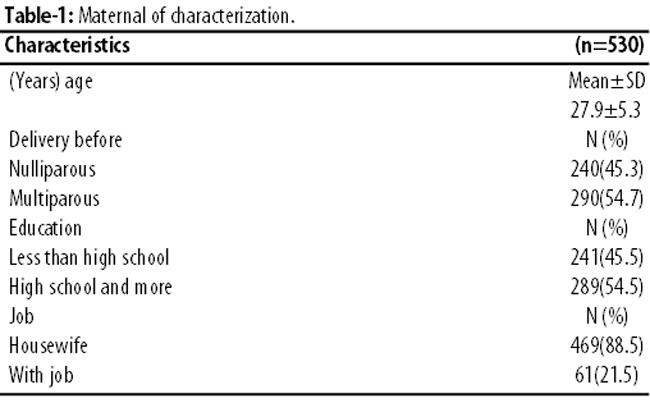
Besides, 172(32.45%) subjects were in Group 1, 282(53.2%) in Group 2, and 76(14.33%) in Group 3.
Omega 3 consumption was significantly associated with neonate weight (p<0.03), pre-eclampsia (p<0.04) and pre-term labour (p<0.01) (Table-2).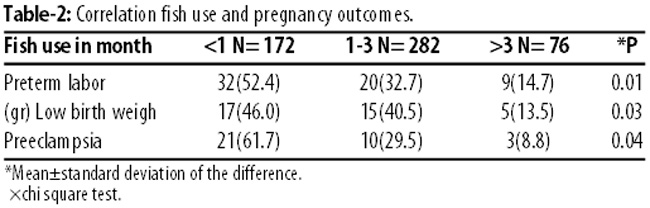
Discussion
The results of the study suggest that increased fish consumption can prevent LBW, pre-term labour and pre-eclampsia. This is in line with earlier studies.
Studies done in Faroc Islands and Denmark as well as Iran (3.15-19) showed that the longest gestational age belonged to mothers consuming fish oil, and the shortest to those consuming olive oil, and that with the use of fish oil, chances of pre-term labour decreased.12,19 The outcome related to fish oil was the same in our study.
Observational studies on fish intake and randomised trials of fish oil supplementation generally have not supported a protective effect.12 A more recent study, however, found a U-shaped association, with greater risk of hypertensive disorders among women with the lowest and highest intake of n3 fatty acids, primarily from cod-liver oil.20 Our results suggest that further investigation into potential benefits of moderate n3 fatty acid intake might be warranted.
In our study it was shown that with use of fish oil led to decreased pre-eclampsia. The result is similar to earlier studies.21-23
Our findings suggest that maternal fish consumption plays a different role in foetal weight depending on the amount and type of fish consumed. The potential effects of fish consumption on foetal weight should be taken into account when recommending fish consumption to pregnant women or those of childbearing age.
With regard to the limitations of the study heed must be paid to the differences in the types of fish used. We propose further studies in other countries with a higher sample size.
Conclusion
Higher consumption of fish by expecting women may reduce the risk of adverse health effects of prenatal exposure.
Acknowledgments
We are grateful to President and Vice-President of Research, Islamic Azad University, Toyserkan Branch, for their cooperation. Thanks are also due to all the participating women.
References
1. Mozaffarian D, Rimm EB. Fish intake, contaminants, and human health: evaluating the risks and the benefits. JAMA 2006; 296: 1885-99.
2. Koletzko B, Cetin I, Brenna JT. Dietary fat intakes for pregnant and lactating women. Br J Nutr 2007; 98: 873-7.
3. Olsen SF, Sorensen JD, Secher NJ, Hedegaard M, Henriksen TB, Hansen HS, et al. Randomised controlled trial of effect of fish-oil supplementation on pregnancy duration. Lancet 1992; 339: 1003-7.
4. US Environmental Protection Agency, Food and Drug Administration. What you need to know about mercury in fish and shellfish. 2004. (Online) (Cited 2007 Mar 13). Available from URL: http://www.cfsan.fda.gov/~dms/admehg3.html.
5. Verger P, Houdart S, Marette S, Roosen J, Blanchemanche S. Impact of a risk-benefit advisory on fish consumption and dietary exposure to methylmercury in France. Regul Toxicol Pharmacol 2007; 48: 259-69.
6. Oken E, Bellinger DC. Fish consumption, methylmercury and child neurodevelopment. Curr Opin Pediatr 2008; 20: 178-83.
7. Godel JC, Basu TK, Pabst HF, Hodges RS, Hodges PE, Ng ML et al. Perinatal vitamin A (retinol) status of northern Canadian mothers and their infants. Biol Neonate 1996; 69: 13-9.
8. Mathews F, Yudkin P, Neil A. Influence of maternal nutrition on outcome of pregnancy: prospective cohort study. BMJ 1999; 319: 339-43.
9. Rao S, Yajnik CS, Kanade A, et al. Intake of micronutrient-rich foods in rural Indian mothers is associated with the size of their babies at birth: Pune Maternal Nutrition Study. J Nutr 2001; 131: 1217-24.
10. Jedrychowski W, Masters E, Choi H, Sochacka E, Flak E, Mroz E, et al. Pre-pregnancy dietary vitamin A intake may alleviate the adverse birth outcomes associated with prenatal pollutant exposure: epidemiologic cohort study in Poland. Int J Occup Environ Health 2007; 13: 175-80.
11. Sibai B, Dekker G, Kupferminc M. Pre-eclampsia. Lancet 2005; 365: 785-99.
12. Olsen SF, Sorensen JD, Secher NJ, Hedegaard M, Henriksen TB, Hansen HS, et al. Randomised controlled trial of effect of fish-oil supplementation on pregnancy duration. Lancet 1992; 339: 1003-7.
13. Rogers I, Emmett P, Ness A, Golding J. Maternal fish intake in late pregnancy and the frequency of low birth weight and intrauterine growth retardation in a cohort of British infants. J Epidemiol Comm Health 2004; 58: 486-92.
14. Oken E, Kleinman KP, Olsen SF, Rich-Edwards JW, Gillman MW. Associations of seafood and elongated n23 fatty acid intake with fetal growth and length of gestation: results from a US pregnancy cohort. Am J Epidemiol 2004; 160: 774-83.
15. Fewtrell MF, Abbot RA, Kennedy K, Singhal A, Morley R, Caine E, et al. Randomized, double-blind trial of long-chain polyunsaturated fatty acid supplementation with fish oil and borage oil in preterm infants. J Pediatr 2004; 144: 471-9.
16. Olsen SF, Secher NJ. Low consumption of seafood in early pregnancy as a risk factor for preterm delivery: prospective cohort study. BMJ 2002; 324: 447-50.
17. Taghi Zadeh Z, Aj N, Mehran A. The correlation of fish use with decreased of preterm labor in pregnancy women. J Hayat 2007; 13: 55-61.
18. Olafsdottir AS, Skuladottir GV, Thorsdottir I, Hauksson A, Thorgeirsdottir H, Steingrimsdottir L. Relationship between high consumption of marine fatty acids in early pregnancy and hypertensive disorders in pregnancy. BJOG 2006; 113: 301-9.
19. Velzing-Aarts FV, van der Klis FR, van der Dijs FP, Muskiet FA. Umbilical vessels of preeclamptic women have low contents of both n-3 and n-6 long-chain polyunsaturated fatty acids. Am J Clin Nutr 1999; 69: 293-8.
20. Olsen SF, Secher NJ. A possible preventive effect of low-dose fish oil on early delivery and pre-eclampsia: indications from a 50-year-old controlled trial. Br J Nutr 1990; 64: 599-609.
21. Connor WE. Increased docosahexaenoic acid levels in human newborn infants by administration of sardines and fish oil during pregnancy. Lipid 1996; 31: S183-7.
Journal of the Pakistan Medical Association has agreed to receive and publish manuscripts in accordance with the principles of the following committees:


