

Naureen Mushtaq ( Department of Paediatrics & Child Health, Aga Khan University Hospital, Karachi, Pakistan. )
Muhammad Matloob Alam ( Department of Paediatrics & Child Health, Aga Khan University Hospital, Karachi, Pakistan. )
Zehra Fadoo ( Department of Paediatrics & Child Health, Aga Khan University Hospital, Karachi, Pakistan. )
December 2014, Volume 64, Issue 12
Original Article

Abstract
Objective: To evaluate presenting features, treatment modalities and response to therapy in children with idiopathic thrombocytopenic purpura.
Methods: The retrospective study was conducted at the Aga Khan University Hospital, Karachi, and comprised clinical data, presenting demographics, clinical spectrum, management and outcome of children admitted with idiopathic thrombocytopenic purpura from 2001 to 2010. SPSS 20 was used for statistical analysis.
Results: Records of 95 children between 0-15 years in the period 2001 to 2010 were reviewed. The overall mean age at the time of presentation was 6.1±3.8 years. There were 45(47.3%) male and 50(52.7%) female cases. A total of 34(35.8%) patients had history of preceding illness. Regarding clinical presentations, bruises 81(85.3%), petechial rash 75(79%), epistaxis 23(24%) were common. Median platelet count at the time of presentation was 5,000 (Inter-quartile range: 4000-13000). Spontaneous recovery was seen in 7(7.4%) children. Overall, 24(25.2%) patients received intravenous immunoglobulin G and only 19(20%) showed complete response. Besides, a total of 32(33.7%) patients did not respond and only 5(5.3%) developed chronic ailment..
Conclusion: Bruises, petechial rash and epistaxis were the common presentations. Overall prognosis was good.
Keywords: Idiopathic, Thrombocytopenic purpura, Children, Response, Treatment. (JPMA 64: 1358; 2014).
Introduction
Idiopathic thrombocytopenic purpura (ITP) is one of the most common causes of symptomatic thrombocytopenia in children.1 It is an autoimmune mediated haematologic disorder in which destruction of platelets occur resulting in isolated thrombocytopenia, generally defined as a platelet count of less than 100X109/L.2
The annual incidence of ITP is estimated to be between 1 and 6.4 cases per 100,000 children.1,3 This figure is probably an underestimate because it only involved those patients that developed symptomatic thrombocytopenia and were hospitalised. ITP is usually a self-limiting bleeding disorder of childhood, spontaneous recovery is reported in about 50% of patients.4 There is a prior history of infection present in about 60% of paediatric cases and majority of them have signs of cutaneous bleeding.5,6 In the largest case series of children with ITP from the registry of the Intercontinental Childhood ITP Study Group (ICIS group), the following bleeding manifestations were reported:5-7 cutaneous (86%), oral (19%), nasal (20%) and no bleeding (9%). Similar findings were reported in studies from Pakistan.8,9 This disease is known to affect children in younger age group and this fact is clearly highlighted in different local studies where the major affected age range was between 2 and 5 years.10,11
Most ITP cases are self-limiting and require no treatment.10 At present most of the treatment protocols concentrate on the reduction of platelet destruction and the drugs are usually immunosuppressive. However, other drugs may be used in future if the thrombopoietin (TPO) mimetic proves safe and effective in various paediatrics trials currently in progress.6
This study was conducted to report the demographics and clinico-haematological features of ITP in children and to describe the response of different treatment options and management outcome at a local hospital.
Material and Methods
The retrospective chart review of all paediatric patients aged between 0-15 year, admitted with diagnosis of ITP was done at Aga Khan University Hospital (AKUH), Karachi, between 2001 and 2010. The diagnosis of ITP was made on well-established criteria, excluding other haematological disorders by peripheral smear review and clinical features and/or bone marrow aspirate showing normal to increased megakaryocytes. Children who received any steroids before presenting to the hospital were excluded from the study.
Data was collected including demographics and clinical presentation, bleeding manifestations, history of pre-treatment with steroids, diagnostic procedure i.e., bone marrow aspiration before treatment, different treatment options used for treatment and outcomes measured in the form of response to treatment (complete remission, partial remission and non-responder) and chronic ITP. Children with a platelet count 10x109/L and/or no significant cutaneous or mucosal bleeding were observed without any treatment. Children with minor and/or mucous bleeding symptoms with platelet count of less than 20x109/L to 30x109/L were closely observed and received treatment on demand.12,14 Prednisolone at 3-5mg/kg/day for 3-7 days or intravenous immunoglobulin G (IVIG) at 0.8-1 g/kg/day were the initial therapeutic options. International Working Group (IWG) criteria15 were used for assessing response to treatment; "complete response" (CR) was defined as platelet count greater than 100x109/L. "Response" was defined as platelet count between 30x109/L and 100x109/L or doubling of the baseline count. Any platelet count lower than 30x109/L or less than doubling of the baseline count was described as "no response". "Refractory" patients included either those with failed splenectomy or those with either severe ITP or increased risk of bleeding requiring frequent therapeutic intervention.15 Chronic ITP was defined as persisting thrombocytopenia of less than 100x109/L lasting for more than 12 months.15
For statistical analysis, SPSS 20 was used. Summary statistics were used to describe the cohort. Frequencies were computed for qualitative variables and mean and standard deviation or median with inter-quartile range (IQR) were computed for quantitative variables.
Results
A total of 104 cases were detected, but 9(8.6%) had to be excluded (Figure).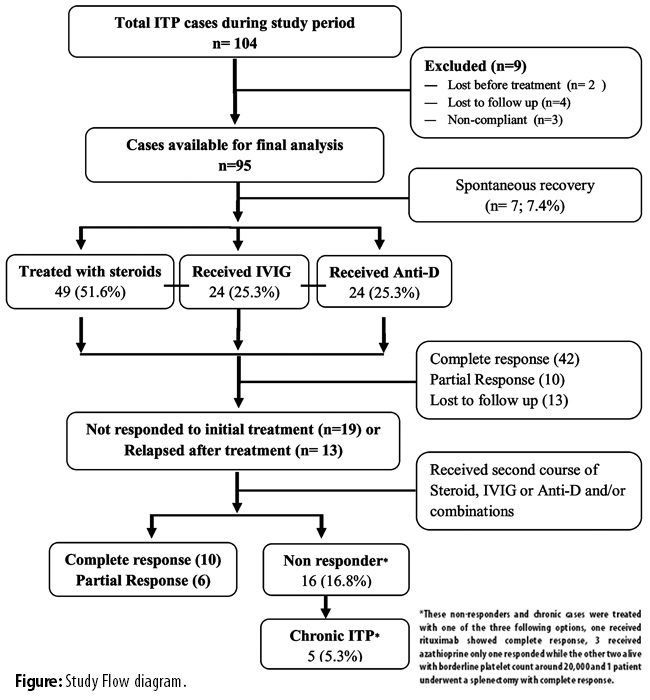
Records of the remaining 95(91.3%) children between 0-15 years were subsequently reviewed. The overall mean age at the time of presentation was 6.1±3.8 years. There were 45(47.3%) male and 50(52.7%) female cases. Of the total, 34(35.8%) patients had history of preceding illness; 17(18%) Upper Respiratory Tract Infections (URTI), 14(15%) Acute Gastroenteritis (AGE) and 3(3.2%) chicken pox. Another 23(24%) patients presented with fever. Regarding clinical presentations, bruises 81(85.3%), petechial rash 75(79%), epistaxis 23(24%) were the common presentations (Table).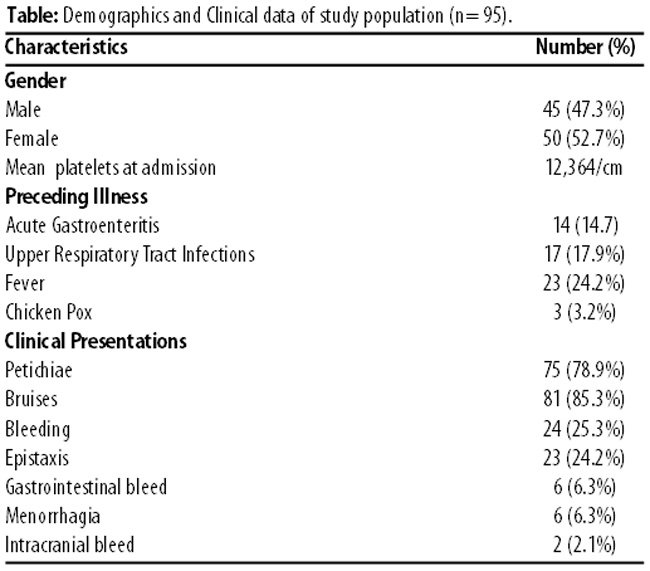
Median platelet count at the time of presentation was 5,000 (IQR; 4000-13000). Bone Marrow was done in 61(64.2%) patients and all showed plenty full megakaryocytes and no abnormal cells. Rest of the cases were diagnosed on the basis of typical clinical presentation and response to therapy.
Spontaneous recovery was seen in 7(7.4 %), while 88(92.6%) patients were treated with either one or more of the available options e.g., prednisolone, IVIG and/or Anti-D24. Of them, 80(84%) patients were initially treated with prednisolone (at a dose of 4mg/kg/day for 5 days or 2mg/kg/day for 21 days), and 49(61.3%) responded. Overall, 24(25.6%) patients received intravenous Anti-D24 and 10(41.6%) showed complete responses. Besides, 24(25.6%) received IVIG, and 19(80%) patients showed complete response. No significant toxicity and/or adverse events related to the treatment was observed except mild allergic reactions with IVIG and cushingoid effects with prolonged use of steroid, and hypertension in children who received high dose of steroids.
Overall, 16 (16.8%) patients did not respond to initial treatment and developed relapses and later on only 5(5.3 %) developed into chronic cases. They were treated with one of the three available options; 1(1.05%) received rituximab and showed complete response; 3(3.15%) received azathioprine and only 1(1.05%) responded; and 1(1.05%) patient underwent splenectomy.
Discussion
The basic aim of this retrospective single-centre study was to evaluate what are the clinical characteristics of ITP, whether bone marrow aspiration is important or not, when to treat or what was the best treatment for children with ITP, in a developing country like Pakistan.
In a study of 2031 children who had acute ITP, the mean age at presentation was 5.7 years, same as in our study which was around 6 years.6 Acute ITP was more prevalent in boys compared to girls10,16 but in our study the girls outnumbered boys. However, most of the international studies reported no gender predilection.17 In majority of studies the onset of acute ITP is preceded by an infectious illness, most often an upper respiratory tract, and our children also showed the same preponderance with infection. In ITP the clinical signs are remarkable only for the cutaneous manifestation of severe thrombocytopenia with bruises or petechial rashes present in almost all cases and our study was no exemption. Also, some patients presented with menorrhagia, epistaxis and gastrointestinal bleed in the form of per-rectal bleeding.4-6 The most feared complication anticipated in ITP is intracranial haemorrhage (ICH). The risk of ICH was 0.9% in a series of 1693 children.7-18 But in our centre we had 2 patients with ICH. This figure, however, is an overestimation, reflecting that as we are a tertiary care centre therefore it\'s likely that the most severe cases present here. Whatever the true incidence of ICH in children who have acute ITP, there is no doubt that this event is a fatal complication in this benign childhood disorder.19-21
There is a consensus that bone marrow aspiration is not necessary for children who have newly diagnosed typical ITP.13 The result of the retrospective study of bone marrow aspirates performed in children who have suspected acute ITP showed no signs of leukaemia in case of typical lab feature of ITP.21-23 A bone marrow examination therefore should be considered mandatory in typical cases of childhood acute ITP defined as those who have prolonged fever, bone pains and unexplained anaemia, neutropenia or macrocytosis. The diagnosis should be questioned, particularly in those children who fail to respond and therefore need a bone marrow for evaluation of the diagnosis.20
As acute ITP is generally a self-limiting disorder usually with mild clinical symptoms and has a low risk of bleeding, therefore, as recommended by the working party of the British Committee for standards in Haematology, it is appropriate to manage children who have acute ITP and mild clinical symptoms conservatively with a 24-hour contact point irrespective of the platelet counts.23 Based on these guidelines, intervention is reserved for the few children who have overt haemorrhage and platelet count <20X109/L, or those who have organ or life-threatening bleeding irrespective of the platelet counts. This is because of the high remission rates in most cases and the toxicities of currently available medical therapies. Treatment of ITP can be divided into medical and surgical management. Medical options for frontline drug therapies are corticosteroids, intravenous immunoglobulin and intravenous anti-D24. Corticosteroids act by impairing the clearance of opsonised platelets in bone marrow and peripheral organs and reducing antibody levels in the body. High-dose prednisolone at approximately 4mg/kg/day for 4 days can minimise side effects as well as maintain the therapeutic significance in ITP.10 In our patients we gave some high-dose 4mg/kg/day for 4 days to some patients and standard dose of 2mg/kg/day for 21 days. The other treatment options include IVIG. For immediate management, its outcome is also 60-70%. These preparations should be given slowly initially as the large protein load is most commonly associated with headache and vomiting in 24-48 hours.24,25 Usually, children are admitted and observed for 24-48 hours with initial treatment, so there is no benefit of one treatment over another. Irrespective of which regimen is used, it is important to remember that it takes several weeks for the anti-platelet immunoglobulin to go through one half-life even if autoantibody production stopped with any treatment regimen. Treatment and agents that impact platelet clearance by the spleen and reticulo-endothelial system loses their efficacy over 3-4 weeks and their platelet count may drop below 20,000/mms.26
Over the last decade, newer agents have also been introduced for chronic ITP and acute refractory ITP patients.27,28 They act by disrupting the immune dysregulation driving production of autoantibodies. These theories include humanised monoclonal antibodies that bind to immune receptors on the early B lymphocytes anti-CD20 (Rituxan). It is more successful in adults which prompted many paediatric haematologists to use this agent in children with refractory and chronic ITP in order to improve platelet count and to avoid splenectomy.29,30 Using a standard dose of 375mg/m2 in 4 weekly doses, a study demonstrated a complete response (platelets count > 150,000/mms) lasting for an average of 13 months.31 For these cases, as well as for children with resistant primary chronic ITP who failed splenectomy, the role of therapies such as mycophenolate mofetil, sirolimus and the thrombopoietins remains to be determined.27
The feature of safe and effective management of childhood ITP will be greatly expanded by the optimal application of such therapies that target the selected areas of immune dysfunction rather than using agents which result in either profound immune suppression or result in serious toxicities.31
Limitations of this study included those inherent in any single-centre, retrospective design, particularly selection bias and information bias. We were not able to assess all the variables and were limited by the completeness of documentation by the treating physician. Additionally, this single-centre study has a limited number of patients so results should be generalised with caution.
Conclusion
Bruises, petechial rash and epistaxis were the common presentations of ITP in children. Most ITP cases required treatment with either one or more of the available options. However, the overall prognosis was good.
References
1. D\'Orazio JA, Neely J, Farhoudi N. ITP in children: pathophysiology and current treatment approaches. J Pediatr Hematol Oncol 2013; 35: 1.
2. Rodeghiero F, Stasi R, Gernsheimer T, Michel M, Provan D, Arnold DM, et al. Standardization of terminology, definitions and outcome criteria in immune thrombocytopenic purpura of adults and children: report from an international working group. Blood 2009; 113: 23-86.
3. Terrell DR, Beebe LA, Vesely SK, Neas BR, Segal JB, George JN, et al. The incidence of immune thrombocytopenic purpura in children and adults: A critical review of published reports. Am J Hematol 2010; 85: 174.
4. BCSH. Guidelines for the investigation and management of idiopathic thrombocytopenic purpura in adults, children\'s and in pregnancy. Br J Haematol 2003; 120: 574-96.
5. Zeller B, Rajantie J, Hedlund-Treutiger I, Tedgård U, Wesenberg F, Jonsson OG, et al. Childhood idiopathic thrombocytopenic purpura in the Nordic countries: epidemiology and predictors of chronic disease. Acta Paediatr 2005; 94: 178.
6. Kühne T, Buchanan GR, Zimmerman S, Michaels LA, Kohan R, Berchtold W, et al. A prospective comparative study of 2540 infants and children with newly diagnosed idiopathic thrombocytopenic purpura (ITP) from the Intercontinental Childhood ITP Study Group. J Pediatr 2003; 143: 605.
7. Kühne T, Berchtold W, Michaels LA, Wu R, Donato H, Espina B, et al. Newly diagnosed immune thrombocytopenia in children and adults: a comparative prospective observational registry of the Intercontinental Cooperative Immune Thrombocytopenia Study Group. Haematologica 2011; 96: 1831.
8. Shahnaz I, Yahoob MK, Tariq IB. Children ITP experience at Pediatric department Mayo Hospital, Lahore, Pakistan. Pak Pediat J 1995; 19: 141-3.
9. Farid J, Gul N, Qureshi W, Idris M. CLINICAL PRESENTATIONS IN IMMUNE THROMBOCYTOPENIC PURPURA. J Ayub Med Coll Abbottabad 2012; 24: 39-40.
10. Kalim M, Ali L, Khattak AA. CHILDREN IDIOPATHIC THROMBOCYTOPENIA: CLINICAL PROFILE AND MANAGEMENT. J Postgrad Med Inst 2005; 19: 101-5.
11. Mohammad AJ. Thrombocytopenia in children. J Postgrad Med Inst 2004; 18: 353-8.
12. George JN, Woolf SH, Raskob GE, Wasser JS, Aledort LM, Ballem PJ, et al. Idiopathic thrombocytopenic purpura: a practice guideline developed by explicit methods for the American Society of Hematology. Blood 1996; 88: 3-40.
13. British Committee for Standards in Haematology General Haematology Task Force. Guidelines for the investigation and management of idiopathic thrombocytopenic purpura in adults, children and in pregnancy. Br J Haematol 2003; 120: 574-96.
14. Evim MS, Baytan B, Güne? AM. Childhood Immune Thrombocytopenia: Long-term Follow-up Data Evaluated by the Criteria of the International Working Group on Immune Thrombocytopenic Purpura. Turk J Hematol 2014; 31: 32-9.
15. Rodeghiero F, Stasi R, Gernsheimer T, Michel M, Provan D, Arnold DM, et al. Standardization of terminology, definitions and outcome criteria in immune thrombocytopenic purpura of adults and children: report from an international working group. Blood 2009; 113: 2386-93.
16. Al-Mulla N, Bener A, Amer A, Laban MA. Idiopathic thrombocytopenic purpura in childhood: a population-based study in Qatar. J Pediatr (Rio J) 2009; 85: 269-72.
17. Kühne T, Imbach P, Bolton-Maggs PH, Berchtold W, Blanchette V, Buchanan GR, et al. Newly diagnosed idiopathic thrombocytopenic purpura in childhood: an observational study. Lancet 2001; 358: 2122-5.
18. Goerge JN, woolf SH, Raskob GE, Wasser JS, Aledort LM, Ballem PJ, et al. Newly diagnosed idiopathic thrombocytopenic purpura: a practice guideline developed by explicit methods for the American society of Hematology. Blood 1996; 88: 3-40.
19. Del Vecchio GC, De Santis A, Giordano P, Amendola G, Baronci C, Del Principe D, et al. Acute childhood idiopathic thrombocytopenic purpura: AIEOP consensus guidelines for diagnosis and treatment. Assoc Italiana di ematol oncol pediatr. hematol 2000; 85: 40-424.
20. Shirahata A , Ishii E, Eguchi H, Okawa H, Ohta S, Kaneko T, et al. Consensus guidelines for diagnosis and treatment of childhood idiopathic thrombocytopenic purpura: Int J hematol 2006; 83: 29-38.
21. Sutor AH. Acute immune thrombocytopenia in childhood: are treating the platelet count? Semin thromb hemost 1998; 24: 545-8.
22. Cohen YC, Djulbegovic B, Shamai-Lubovits O, Mozes B. The bleeding risk and natural history of idiopathic thrombocytopenic purpura in patients with persistent low platelet counts. Arch intern Med. 2000; 160: 160-3.
23. British committee for standard in Hematology general Hematology Task force (2003) guidelines for the investigation and management of idiopathic thrombocytopenic purpura (ITP) in adults, children and in pregnancy.Br J Haematol 2003; 120: 574-96.
24. Bussel JB, Kimberly RP, Inman RD, Schulman I, Cunningham-Rundles C, Cheung N, et al. Intravenous gammaglobulin treatment of chronic idiopathic thrombocytopenic purpura. Blood 1983; 62: 480-6.
25. Bussel JB. Novel approaches to management of immune thrombocytopenic purpura: Results of recent trials. ASH Meeting Oriando (FL) USA, Dec 7-1, 2011. Blood Educ Progr 2011; Suppl 5288-305.
26. Tarantino MD, Buchanan GR. The pros and cons of drug therapy for immune thrombocytopenic purpura in children (review). Hematol Oncol Clin North Am 2004; 18: 1311-4.
27. Breakey VR, Blanchette VS. Childhood immune thrombocytopenia: a changing therapeutic landscape. Semin Thromb Hemost 2011; 37: 745-55.
28. Boruchov DM, Gururangan S, Driscoll MC, Bussel JB. Multiagent induction and maintenance therapy for patients with refractory immune thrombocytopenic purpura (ITP). Blood. 2007; 110: 3526-31.
29. Stasi R, Amadori S, Isborn, J, Newland AC, Provan D. Long-term outcome of otherwise healthy individuals with incidentally discovered borderline thrombocytopenia. PLos Med. 2006; 3: e24.
30. Sailer T, Lechner K, Panzer S, Kyrle PA, Pabinger I. the course of severe autoimmune thrombocytopenia in patients not undergoing splenectomy. Haematologica 2006; 91: 1041-5.
31. Wang T, Xu M, Ji L, Yang R. Spleenectomy for chronic idiopathic thrombocytopenic purpura in children: A single centre study in China. Acta Haematol 2006; 115: 39-45.
Journal of the Pakistan Medical Association has agreed to receive and publish manuscripts in accordance with the principles of the following committees:


