

Zulfiqar Haider ( PMRC Research Centre, Fatima Jinnah Medical College & Ganga Ram Hospital, Lahore. )
Khatoon Akhtar Bano ( PMRC Research Centre, Fatima Jinnah Medical College & Ganga Ram Hospital, Lahore. )
January 1984, Volume 34, Issue 1
Original Article

Abstract
An open 4 week study for evaluating the efficacy of Tenormin (100 mg ‘Atenolol’ once daily) with or without chlorthalidone was carried out in 52 hypertensive patients with uncomplicated mild to moderately severe essential hypertension. A tablet count at the end of study enabled patient compliance to be judged.
Of the 52 patients, 41 completed the study; 8 patients were lost to follow up and in 3 drug had to be withdrawn because of side effects. A statistically significant fall in systolic and diastolic blood pressure was observed in 15 patients taking Tenormin alone and in 26 when combined with Chlorthalidone. 84% patients showed fair or excellent compliance to therapy over this short period. 5 of 44 patients taking the drug suffered from side effects which included gastrointestinal disturbances (2), skin rash (1), retrosternal discomfort (1) and numbness of hands and feet (1) (JPMA 34 : 13, 1984).
Introduction
Hypertension is a chronic and in its early stages a symptomless disease which requires life long treatment to prevent its cardiovascular complications. A large number of patients are unable to take regular medication because of complicated treatment regimes, side effects, and the economic cost of drugs.
The pharmacodynamics of Atenolol have been summarised by Mcleod and Shand (1982).
“Tenormin” (Atenolol 100 mg), a selective beta1- adrenoceptor antagonist, is water soluble and effective in a single daily dose as an anti-hypertensive and anti-anginal agent in human beings (Petrie et al., 1980; Jackson et al., 1980). Compared to non-selective drugs, it has reduced antilipolytic effect and impair muscle glycogenolysis to a lesser degree (Smith, 1981). 60% of the drug is absorbed from gastrointestinal tract with negligible plasma protein binding and there is nonsignificantly active metabolite (Reeves et al., 1978). It’s half life is 6 to 7 hours but in anephric patients it may be more than 100 hours. Thus, the dosage should be modified in cases of renal impairment.
Atenolol does not possess significant membrane establishing activity or partial against action (Intrinsic sympathomimetic activity) (Myers and Hope-Gill, 1979). The drug has been reported to produce few side effects.
The objects of the present short term study were:
i) To confirm the anti-hypertensive efficacy of the drug.
ii) To study patients compliance with single daily dosage regime.
iii) To assess the incidence of various side effects.
Material and Methods
52 patients suffering from uncomplicated mild to moderately severe hypertension attending ‘Hypertension Clinic’ of Pakistan Medical Research Unit, Ganga Ram Hospital, were selected for the study. Baseline data included age, sex, height, weight, severity of hypertension, known duration of hypertension and history of any other concurrent medication.
Blood pressure was measured with mercury sphygmomanometer in the sitting position after 10 minutes of rest, diastolic blood pressure being taken at phase IV. Tenormin tablets (Atenolol 100 mg) once daily for 4 weeks was prescribed and provided to the patients. The patients were seen at weekly interval and chiorthalidone (25 mg/day) was added to Tenormin after 2 weeks if required for adequate control of blood pressure.
Follow up assessment. was carried out after approximately four weeks treatment. Blood pressure and pulse rate were recorded and side effects, if any, were documented. Patients compliance was assessed by means of tablet count at the end of trial.
Results
Eleven of the 52 patients could not be evaluated. Of these 11, drug was withdrawn in 3 because of side effects and the remaining 8 patients were lost to follow up.
Thus 41 patients (11 males, 30 females) were evaluated for the efficacy and compliance study.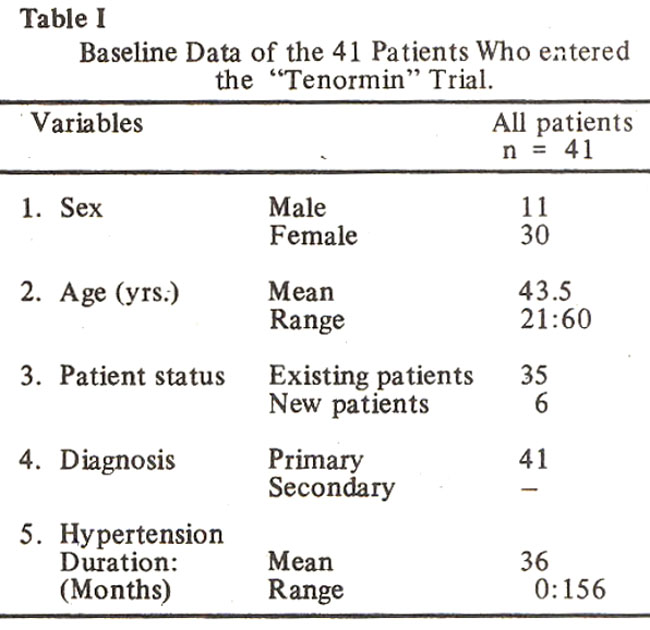
As seen in Table I majority of patients were aged between 21 60 years (mean 43.5 years). There were 6 new patients presenting with hypertension while 35 were those in whom either the control of blood pressure was inadequate or they required simplication of their anti.hypertensive regime. All these patients had primary hypertension. The mean duration of hypertension.
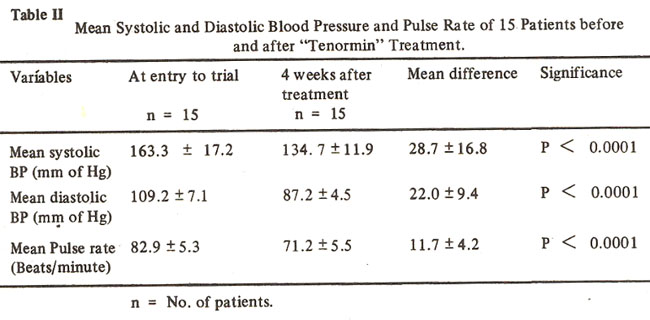
Table II shows changes in the mean systolic, diastolic blood pressure and pulse rate before and after Tenormin therapy in 15 hypertensive patients. Mean fall in the systolic blood pressure was 28.7 ± 16.8 mm of Hg and in the diastolic blood pressure 22.0 ± 9.4 mm of Hg. Pulse rate was reduced by a mean value of 11.7 ± 4.2 beats/ min. Changes in blood pressure and pulse rate were highly significant.
In 26 patients chlorthalidone (25 mgI day) was added to Tenormin in order to get ade. quate control of blood pressure. As is obvious from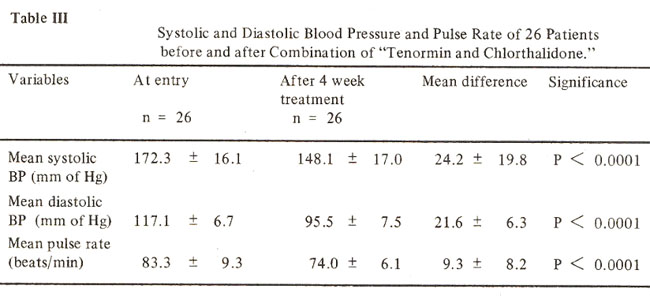
Table III mean systolic and diastolic blood pressure came down by 24.2 ± 19.8 and 21.6 ±6.3 mm of Hg respectively. Reduction in the mean pulse rate was 9.3 ± 8.2 beats/mm. These changes were statistically significant.
Side effects were observed in 5 cases taking Tenormin alone before the combination of chlorthalidone (Table IV).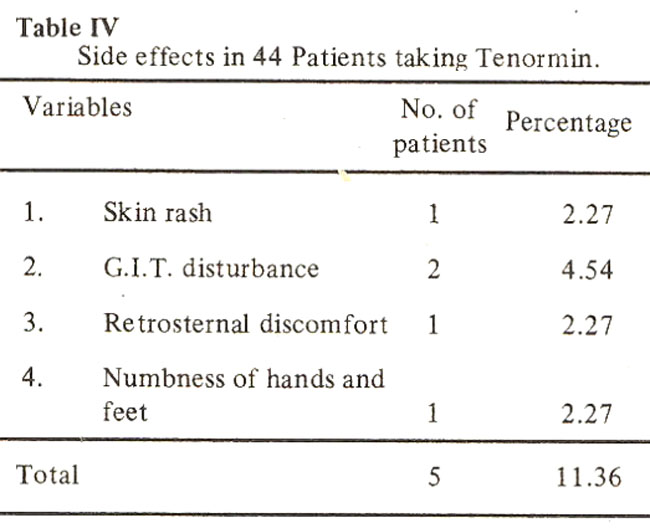
Three patients could not tolerate therapy which had to be discontinued because of severe allergic skin rash (1 patient), abdominal pain and loose motions (1 patient) and retrosternal discomfort (1). Mild side effects were reported by two patients which disappeared on continuation of therapy and included numbness of hands and feet in one and feeling of nausea in the other.
Discussion
This was an open study for the evaluation of anti.hypertensive effect of Tenormin (Atenolol 100 mg) either singly or in combination with a diuretic (Chlorthalidone). Results showed significant fall in both systolic and diastolic blood pressure with Tenormin when used singly or in combination with a diuretic in mild to moderately severe hypertension. Good control of blood pressure was obtained in 84% patients. Our findings are in keeping with other studies which confirm the effectiveness of Atenolol in reducing bloodpressure (Petrie et al., 1975, 1980; Zacharias, 1977). Certain comparative studies carried out abroad have confirmed significantly better anti-hypertensive effect of Atenolol and low incidence of side effects (Wilcox, 1978).
In this study side effects were observed in 11.36% patients. Drug was withdrawn in three patients; in one because of severe allergic skin rash, in another because of loose motions and nausea while the third patient who complained retrosternal discomfort stopped the medication by his own and we did not compel him to take it again. Two other patients had mild side effects which disappeared on continuation of therapy.
The problem of compliance is one that everybody has rightly stressed as being very important and is one of the weakest aspects of the attack on hypertension. However, in this study 84% patients showed good compliance to therapy probably because of the simplicity of once daily regime. Also, this was only a short term study.
It is, concluded from the results of this small study that once daily Tenormin is a simple, safe and effective anti-hypertensive therapy with a potential for good compliance because of once daily dosage. All these benefits of Tenormin therapy have to be weighed against its cost (Rs.4/- per tablet) which might be important in countries with limited economic resources.
Acknowledgements
We thank Mr. Nasiruddin for typing the manuscript and the Imperial Chemical Industries (ICI) for their assistance and supply of the study drugs. Thanks are also due to Mr. Iftikhar Alunad Khan for his statistical assistance.
References
1. Jackson, G., Schwartz., J., Kates, R.E., Winchester, M. and Harrison, D.C. (1980) -Atenolol; once-daily caidioselective beta blockade for angina pectoris. Circulation, 61: 555.
2. McLeod, A.A. and Shand, D.G. (1982) Atenolol; a long-acting beta-adrenocaptor antagonist. Ann. Intern. Med., 96: 244.
3. Myers, M.G. and Hope-Gill, H.F. (1979) Effect of d and dl-propranolol on glucose-stimulated insulin release. Clin. PharmcoL Ther., 25: 303.
4. Petrie, J.C., Galloway, D.B., Webster, J., Lewis, J.A. and Simpson, W.T. (1975) Atenolol and bendrofluazide in hypertension. Br. Med. J., 4: 133.
5. Petrie, K.C., Jafférs, T.A., Robb, O.J., Scott, AIC. And Webster, J., (1980) Atenolol, sustained release oxprenolol, and longacting propranolol in hypertension. Br. Med. J.,280: 1573.
6. Reeves, P.R., Mcainsh, J., Mcintosh, D.A.D. and Winxow, M.J. (1978) Metabolism of atenolol in man. Xenobiotica, 8: 313.
7. Smith, U. (1981) Effect of beta-adrenoceptor blocking agents on the reaction tohypoglycaemia and the physical working capacity. Cardiovasc. Rev. Rep., 2 : 563.
8. Wilcox, R.G. (1978) Randomised study of six beta-blockers and thiazide diuretic in essential hypertension. Br. Med. J., 2:383.
9. Zacharias, F’.J. (1977) Clinical review of Atenolol as an anti-hypertensive. Proc. R. Soc. Med., 70 : SuppL 5.
Journal of the Pakistan Medical Association has agreed to receive and publish manuscripts in accordance with the principles of the following committees:


