

Tariq Nishtar ( Dept. of Medicine, Khyber Medical College Med. 'A' Unit, Lady Reading Hospital, Peshawar )
A.A.Qazilbash ( Khyber Medical College, Med. 'A' Unit, Khyber Hospital Peshawar. )
January 1984, Volume 34, Issue 1
Original Article

Abstract
200 cases of Hypertension were studied in hospital to document its clinical features, biochemical profile and complications. 168 (84%) were diagnosed as Primary hypertension and 32 (16%) as secondary hypertension. The male female ratio in the two groups was similar. The ages were 50.2 ± 7.56 and 48.5 ±6.52 for males and females respectively in the Primary hypertension group and 44.3 ± 5.10 and 39.1 ± 8.99 respectively in the secondary hypertension patients. The proportion of asymptomatic cases was the same in the two groups. Visual symptoms and Orthropnoea were more common in the secondary hypertension group. The various complications /associated problems encountered were Renal Failure 16.5%, cerebrovascular accidents 8%, congestive Cardiac failure 9.5% and Ischaemic Heart Disease 14.5%. The results are compared with reports from else where in Pakistan (JPMA 34 : 4, 1984).
Introduction
In this hospital based study of hypertension its common clinical features and various complications were documented with the aim of providing guidelines for diagnosis and management of cases. The results are compared with reports from other workers in different parts of Pakistan.
Material and Methods
All cases of hypertension admitted to two medical wards of Khyber and Lady Reading Hospitals from Jan. 1979 to Dec. 81 were included in the study. However in the final analysis 200 cases had complete records and these are being reported.
Blood pressure measurement was done with a standard mercury sphygmomanometer in both the supine and sitting positions. Readings of over 160 mm of Hg systolic and 90 mm of Hg diastolic for three consecutive days were taken as hypertension. A detailed history was taken and complete physical examination was done on all cases.
Investigations:- In addition to the routine investigations like Hb, full blood count, ESR, urine examination (Sp. gr. Albumin, sugar, pus cells crystals and casts) ECG and x-ray abdomen, serum electrolytes, blood urea and creatinine levels were done in all patients. Intravenous pyelograms were done on patients with suspected renal pathology with normal blood urea while renal scans were carried out in those with raised blood urea level.
Criteria for diagnosis of secondary hypertension:-
1) Renoparenchymal disease:-
1. Ch. glomerulonephritis was diagnosed when persistent or intermittent albuminuria or haematuria or both were present without any other cause for the abnormality (Bergiund et al., 1976).
2. Ch. Pyelonephritis required a history of recurrent urinary tract infections and lowered concentration ability of the kidney (Berglund et al., l976) Renal scarring on NP strengthened the diagnosis.
3. Diabetic nephropathy was diagnosed on the basis of history and urine examination results.
4. Polycystic disease of the kidney was diagnosed on clinical examination and NP.
II. Coarctation of the aorta was diagnosed on clinical examination and chest x-ray findings.
Results
During the study period hypertension formed 10% of the total admissions to the two general Medical wards in which the study was being conducted. Of the 200 patients included in the study, 115 (57.5%) only were receiving treatment at the time of admission but their pressure was not satisfactory. (42.5%) patients were not on sive therapy.
On the basis of clinical presentation and detailed investigations listed above, 168 (84%) patients were diagnosed as suffering from primary hypertension and 32 (15%) cases were labelled secondary hypertension (Table-I).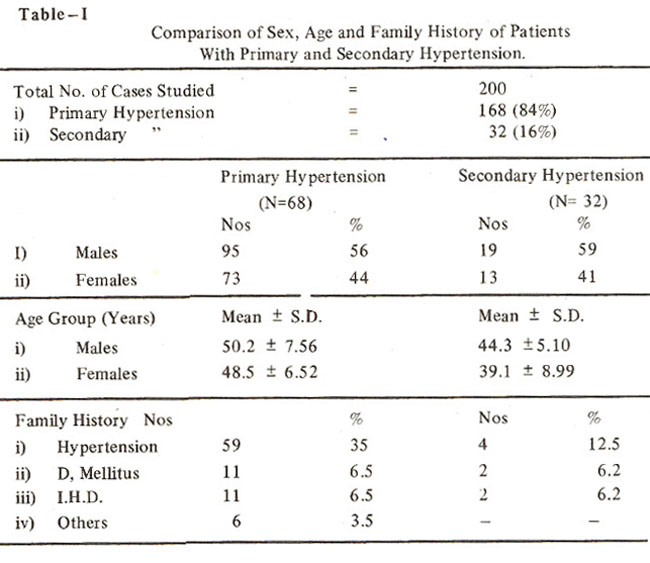
The underlying causes of secondary hypertension were Ch. pyelonephritis in 19 cases, 14 (43.7%) males and 5 (38.5%) females. Ch. glomerulonephritis was responsible in 13 cases, 7 (53.8%) males and 6 (46.2%) females. One patient each of coarctation of aorta (male) diabetic nephropathy(male) and polycystic diseases of the kidneys (female) were diagnosed. Two cases, a male and a female were of uraemia and in these the underlying pathology was not clear.
Table-I compares the two groups as regards sex, age and family history. The sex distribution in the two groups is similar while as regards age, the secondary hypertension group are somewhat younger especially the female cases. A family history of hypertension was present in 35% of the Primary hypertension group and 12.5% of the secondary hypertension group. Positive family history for lschaemic heart disease and diabetes mellitus was of the same proportion in the two groups.
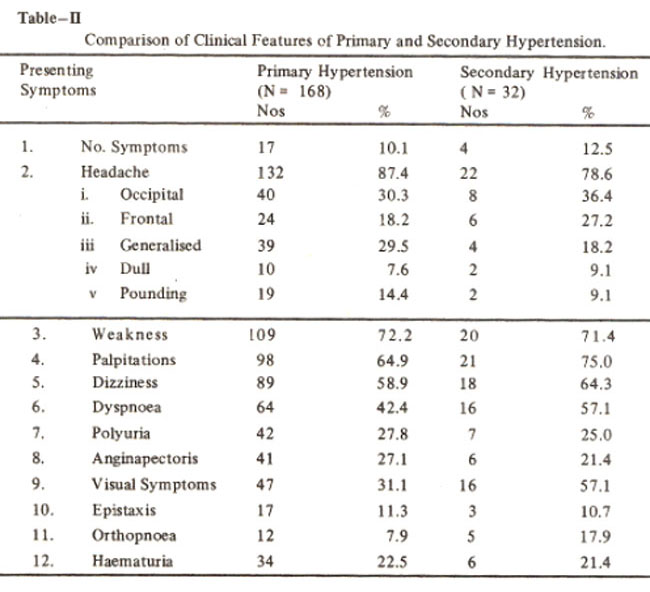
In Table-II the clinical features of the two groups are given 10.1% of primary hypertension and 12.5% of the secondary hypertension group were asymptomatic. The other features were also almost the same except for visual symptoms which were present in 31.1% of Primary and 57.1% of secondary hypertension group and orthopnoea which was complained of by 7.9% of Primary and 17.9% of the secondary hypertension patients.
The biochemical values of the two groups are compared in Table-III.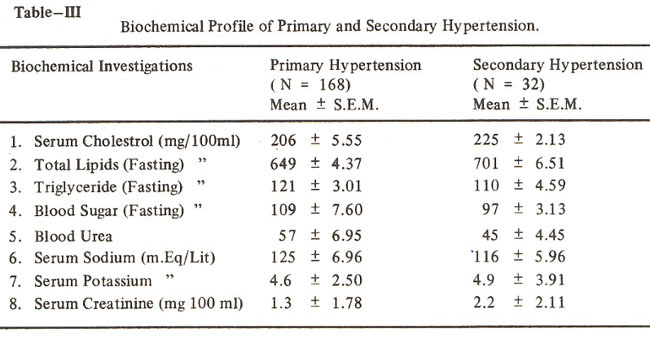
Serum cholestrol was 206 ± 5.55 mg/100 ml for Primary and 225 ± 2.13mg/lOOm! for the secondary hypertension patients. Total lipids and triglycerides were 649 ± 4.37mg/100ml and 121 ± 3.01 mg/100 ml for the primary hypertension patients respectively and 701 ± 6.51 mg/100ml and 110 ± 4.59 mg/100ml respectively for the secondary hypertension cases. The fasting blood sugar of the primary hypertension group was 109 ± 7.60 while that of the secondary hypertension group was 97 ± 3.13 mg/100ml. Blood urea was 57 ± 6.95 and 45 ± 4.45 mg/l00 ml in primary and secondary hypertension cases respetively. Semm sodium was 125 ± 6.96 mEq/100ml and 116 ± 5.96 mEq/100ml while potassium was 4.6 ± 2.50 and 4.9 ± 3.9/mEq/100 ml respectively in the two groups. Serum creatinine levels were 1.3 ± 1.78 mg/ 1 00ml and 2.2 b± 2.11 mg/ 100m! respectively.
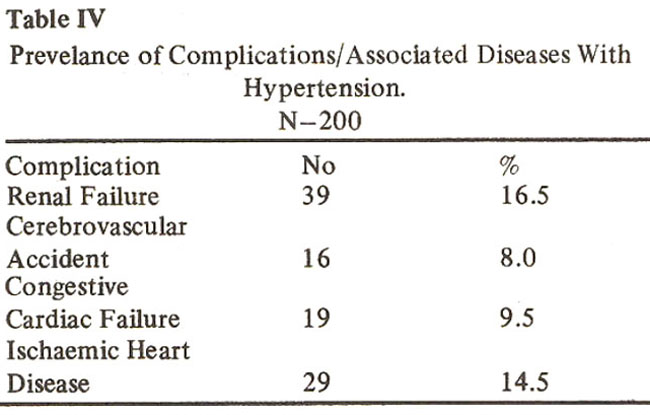
Table IV shows the various complications in the 200 patients understudy. Renal failure was present in 39 (16.5%) , cerebrovascular accidents in 16 (5%), congestive cardiac failure in 19 (9.5%) and Ischaemic heart disease in 29 (14.5%) cases.
Discussion
Previous community studies have shown that hypertension is a common problem in Pak. istan (Syed et al., 1973; Arshad Mirza, 1976; Ilyas et al., 1980): In this study hypertension constituted 10% of all admissions to the two general medical wards in which the study was conducted. This figure is higher than that of a similar report of Rab and Shah (1977) (5.5%) and ilyas et al.,(1977) (7.8%). Since hospital based figures are known to be biased, there is no need for speculation as to the reason for the differences in the three reported figures. However these figures support the community reports regarding the high prevalence of the problem. That a fair proportion of hypertensives may be asymçtomatic, has been stressed by the report of the US Joint National Committee on the Detection, Evaluation and Treatment of high blood pressure (JAMA, 1977) and this is one of the reasons for inadequate control of blood pressure in diagnosed cases Burgiand et al. (1976) reported inadequate therapy in 54% of dignosed cases in their community study. In this study 57.5% of cases admitted to hospital were on treatment but with inadequate control of their blood pressure.
Our prevalence of 16% of secondary hypertension amongst the hospital admitted cases of hypertension is much higher than the 5.8% reported figure of Bergiund et al. (1976) in their community based study and 22/300 patient reported by Haider et al. (1977). Both these authors have stressed the need for economy in the investigations of hypertensives for the purpose of discovering an underlying cause since the cost of investigations is high and yield of surgically correctable causes is very low.
The prevalence of various complications and associated problems seen in our cases is similar to that reported by Haider and Bano (1980) in their patients with moderate hypertension.
Since a fair proportion of cases are asymptomatic as pointed out earlier, the patients have to be made aware of the importance of following the physicians direction as regards therapy and followup in order to minimize the risk of complications. This point has been stressed by the US Joint Committee report (1977) on the detection, evaluation and treatment of hypertension
In conclusion we would like to repeat that hypertension is a common clinical problem with a good proportion of asymptomatic cases. Therapy is generally not adhered to regularly and the control of blood pressure is not satisfactory in a large proportion of cases. The prevalence of complications therefore is very high.
References
1. Bergiund ,G., Anderson, 0. and Wilhlmsen, L. (1976) Prevalence of primary and secondary hypertension; studies in a random population sample. Br. Med. J., 2: 554.
2. Syed, S.A., Raza, M. and Hashmi, J.A. National Institute of Cardiovascular Diseases Monograph, Karachi, 1973, PP-2.
3. Arshad Mirza , M. (1976) Prevalence of hypertension Pak. Armed For. Med. J., 27:1.
4. Ilyas ,M. Sherazi, S.H., Shah, M., Shahid, M.A., Lawrance, V., and Ara, G.(1980) Peshawar hypertension study epidemiologic profile of juvenile and in-service population. JPMA., 30: 174.
5. Rab, S.M. and Shah, M.A. (1977) Incidence, mortality and morbidity of hypertension in a large general hospital in Karachi. Jpn. Circ. J., 41: 1126.
6. Illyas , M., Sherazi, S.H. and Khan, S.M. (1977) Epidemiologic profile and complications of hypertension. Jpn. Circ. J., 41: 1143.
7. Haider, Z., Bano, K.A., Zubair, M., and Shahid , M. (1977) Diagnostic evaluation of hypertension; Pilot study in a hypertension clinic. Pak. J. Med. Res., 16 : 1.
8. Haider, Z. and Bano, K.A. (1980) A follow up study of patients with mild and, moderate hypertension. JPMA, 30: 227.
9. Report of Joint National committee on detection, evaluation and treatment of high blood pressure: A co-operative study. 1977 (Special communication) JAMA ., 237:3.
Journal of the Pakistan Medical Association has agreed to receive and publish manuscripts in accordance with the principles of the following committees:


