

Anjum Shahid ( PMRC Research Centre, Jinnah Postgraduate Medical Centre, Karachi. )
Huma Qureshi ( PMRC Research Centre, Jinnah Postgraduate Medical Centre, Karachi. )
Sarwar J. Zuberi ( PMRC Research Centre, Jinnah Postgraduate Medical Centre, Karachi. )
January 1984, Volume 34, Issue 1
Original Article

Abstract
Blood ammonia nitrogen was determined in 36 cases of hepatic coma and 63 cases of liver disease.
Significant elevations (PL 0.001) were noted in coma due to hepatitis and cirrhosis and the mortality rate was 89% and 9 1.3% respectively. Raised ammonia nitrogen in hepatic coma is a sign of grave prognosis (JPMA 34 : 9, 1984).
Introduction
Ammonia is a key intermediate in the metabolism of nitrogen. The gastrointestinal tract is the major portal of entry of ammonia which arises from the bacterial hydrolysis of urea (Dintzis and Hastings, 1953) and deamination of dietary proteins. The ammonia is carried to the liver where it is extracted (Islami et a!., 1956; Artz et al., 1958., Nelson and Seligson, 1953) and stored as glutamine until utilized for the synthesis of urea or protein (Duda and Handler, 1956). Besides removing ammonia from the circulation, the liver also liberates ammonia in the course of deaminatmg aminoacids and degrading other nitrogen compounds (Fahey et at., 1957; Bessman, 1956).
Although kidney is the primary site for the excretion of nitrogen and ammonium ions from the body, it also contributes to the blood ammonia level.
A relationship between ammonia intoxication and hepatic coma is suggested by the reproduction of the syndrome of impending hepatic coma in patients with liver disease by substances from which ammonia can be derived (Phillips et al., 1952) and is supported by demonstration of deranged ammonia metabolism in liver disease (White et a!., 1955). The finding of elevated ammonia concentration in hepatic coma (Schwartz et al., 1953) has encouraged incrimination of ammonia in the genesis of the syndrome (McDermott et al., 1954; Riddel and McDermott, 1954).
The present study was undertaken to define ammonia pattern encountered in patients with hepatic coma. In this paper blood ammonia nitrogen level in patients with liver disease, with and without coma is reported.
Material and Method.
Blood ammonia nitrogen was determined in 36 comatose, 9 cases of coma due to hepatitis (group I) and 27 due to cirrhosis (group II) and 63 control subjects, comprising of 31 cases of hepatitis and 32 cirrhotics.
Ammonia was determined in whole blood by the Berthelot reaction after fixation and elution of the ammonium ions in the sample on to ion exchange resin (Bio Merieux Kit).
Patients were classified into four grades of hepatic coma according to Conn et al. (1977) classification.
Results
Blood ammonia nitrogen levels in liver disease and hepatic coma is presented in the accompanying table.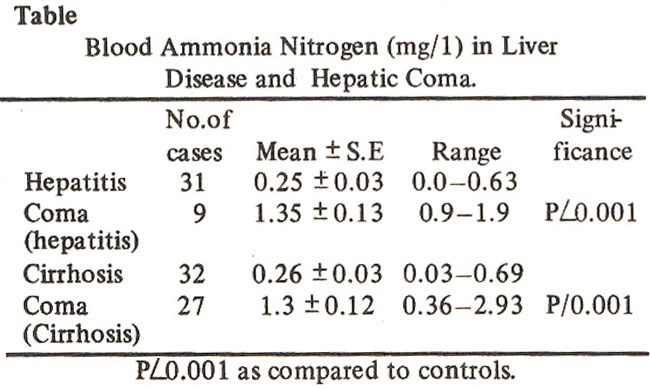
Blood ammonia nitrogen was significantly elevated (PLO.001) in patients with group I and group II coma. The mortality rate was 89% and 91.3% respectively.
Group I coma had elevated blood ammonia nitrogen in all the patients studied whereas in group II coma raised levels were found in 85% cases and normal concentration in 15%.
Discussion
Portrl systemic encephalopathy comprises of five major features, of which ammonia intoxication is the only specific feature.
Abnormalities in ammonia metabolism are involved in the pathogenesis of hepatic coma, so much so that to some authors ammonia intoxication and hepatic coma have become synonymous (Vanamee and Poppel, 1960; Summerskil et al., 1957; Sherlock, 1958).
Patients with liver disease without coma had ammonia concentration within normal limits (Summerskil et a!., 1957; Stahl, 1963). In the present study, patients with hepatitis and cirrhosis had mean values within normal limits, however, in one cirrhotic the value was beyond the upper limit and the follow up showed that he had a massive upper gastrointestinal bleed within a week and went into coma and died.
Blood ammonia was elevated in patients with hepatic coma (Summerskil et al., 1957; Singh et al., 1954; Riddel and McDermott, 1954; Traeger et al., 1954; Phear et al., 1955). In viral hepatitis the mean levels were high in patients with signs of encephalopathy. The failing liver in patients with severe hepatitis allows ammonia to pass into the peripheral blood (Phear et al., 1955). In the present study, ammonia nitrogen showed significant elevation in patients with group I coma and raised concentration was found in all cases. The mortality rate was 89%.
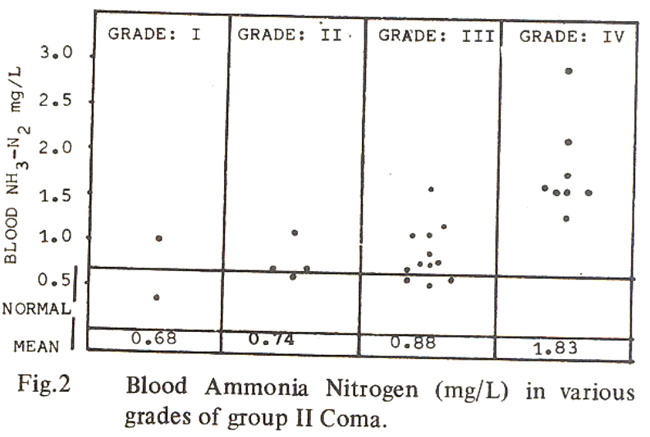
Elevated blood ammonium levels have been reported during episodes of spontaneous hepatic coma complicating cirrhosis (Traeger et al., 1954; Riddel and McDermott, 1954; Sherlock et al., 1954; Phear et al., 1955). In this study cirrhotic patients with encephalopathy had significant elevation in blood ammonia nitrogen level and the mortality rate was 91.3%. In group II coma the scatter was wide and 15% of the values were in the normal range regardless of the degree of neurological involvement. Similar findings have been reported earlier (Phear et al., 1955; Summerskil et al., 1957).
There is some association between blood ammonia nitrogen level and the severity of hepatic coma. A trend for increased mean value was observed with the grade of coma in both hepatitis and cirrhosis (Figure 1 and 2).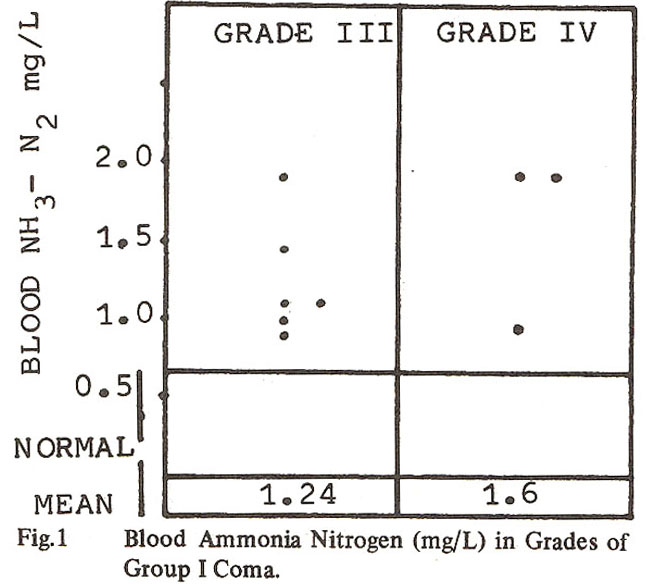
Ammonia toxicity is a relative one, may be due to metabolic or organic derangement of the central nervous system (Stahl, 1963).
Multiple measures capable of reducing high blood ammonia are needed in the management of hepatic coma. Gastrointestinal bleeding with the collection of blood in the gut is apt to raise blood ammonia level and thus grave the prognosis. Active measures should be taken to stop bleeding either by injection of pitressin intravenously if available or by the passage of Sangstaken tube or by the dependent drainage of blood and gastric contents via ryles tube. Thorough cleansing of bowel by a massive load of plain water through ryles tube has been used by few western physicians but its utility must be weighed against the chances of water retention in cirrhotics or chest congestion. Bowel wash-outs with 1% acetic acid are good in removing ammonia from the gut. Purgatives, laxatives, lactulose and neomycin are also known to be effective and should be used promptly.
Protein is known to cause hepatic coma because of degradation of the proteins and the release of ammonia but such is not the cause in our patient population. Most of our cases were undernourished and hypo-proteinemic to begin with and protein restriction in such cases would cause gross catabolism and utilization of one’s flesh for food. Therefore, a minimum of five grams of proteins/day is advised which should be increased as the recovery proceeds. Effective measures should be taken to replace the fluid and blood loss and correct electrolytes at the earliest.
Blood ammonia determination can be a useful method in the clinical and investigative assessment of encephalopathy. However, even the most simple methods are full of pitfalls and if not measured promptly after withdrawal, values spontaneously and artifactually increase.
References
1. Artz, C.P., Stanley, T.V., Eure, W.R., Langford, H.G., and Snavely, J.R. (1958) Inflow and outflow changes in ammonia concentration of liver, muscle and brain. Surgery, 44: 22.
2. Bessman, S.P. (1956) Ammonia metabolism in animals. McElroy, W.D. and Glass, B. (eds). Symposium on inorganic nitrogen metabolism. Baltimore. John Hopkins Press. P. 408.
3. Conn, H.O., Leevy, C.M., Vlahcevic, Z.R., Rodgers, J.B., Maddrey, W.C., Seeff, L. and Levy, L.L. (1977) Comparison of lectulose and neomycin in the treatment of chronic portal systemic encephalopathy. A double-blind controlled trial. Gastroènt., 72: 573.
4. Dintzis, R.Z. and Hastings, A.B. (1953) The effect of antibiotics on urea breakdown in mice. Proc. Nat. Acad. Sc., 39: 571.
5. Duda, G.D. and Handler, P. (1956) Kinetics of ammonia metabolism inVWO. J. Biol. Chen., 232: 303.
6. Fahey, J.L., Nathams, D., and Rairigh, D. (1957) Effect of L. arginine on elevated blood ammonia levels in man. Amer. J. Med., 23: 860.
7. Islami, A.H., Pack, G.T., Miller, R.R., Vanamee, P., Randell, H.T. and Roberts, K.E. (1956) Post operative course following total right hepatic lobectomy. Surgery, 39: 551.
8. McDermott, W.V., Adams, R.D. and Riddell, A.G. (1954) Ammonia metabolism in man. Ann. Surg., 140: 539.
9. Nelson, R.M. and Seigson, D. (1953) Studies on blood ammonia in normals and shock stages. Surgery, 34: 1.
10. Pheai, E.A., Sherlock, S., and Summerskil, W.H.J. (1955) Blood ammonium levels in liver disease and hepatic coma. Lancet, 1: 836.
11. Phillips, G.B., Schwartz, R., Gabuzda, G.J. and Davidson, C.S. (1952) The syndrome of impending hepatic coma in patients with cirrhosis of the liver given certain nitrogenous substances. New. Engl. J. Med., 247: 239.
12. Riddel, A. G., and McDermott, W.V. (1954) Hepatic Coma. Lancet, 1: 1263.
13. Schwartz, R., Phfflips, G.E., Gabuzda, G.J., and Davidson, C.S. (1953) Blood ammonia and electrolytes in hepatic coma. J. Lab. Clin. Med., 42: 499.
14. Sherlock, S., Summerskil, W.H.J., White, L.P. and Phear7 L.A. (1954) Portal systemic encephalopathy. Neurological complications of liver disease. Lancet, II: 453.
15. Sherlock, 5. (1958) Pathogenesis and management of hepatic coma. Amer. J. Med., 24: 805.
16. Singh, I.D., Barclay, J.A., and Cooke,W.T. (1954) Blood ammonia levels in relation to hepatic coma and the administration of glutamic acid. Lancet. 1: 1004.
17. Stahl, J. (1963) Studies of the blood ammonia in liver disease. Ann. Int. Med., 58: 1.
18. Summerskil, W.H.J., Wolfe, S.J. and Davidson, C.S. (1957) The metabolism of ammonia and alpha keto acids in liver disease and hepatic coma. J. Clin. Invest., 36: 361.
19. Traeger, H.S., Gabuzda, G.J., Ballou , A.N. and Davidson,C.S.(1954) Blood ammonia concentration in liver disease and liver coma. Metabolism, 3:99.
20 Vanamee, P. and Poppel, J.W. (1960) Hepatic coma. Med. Chin. N.Amer., 44: 765.
21 White, L.P., Phear, L.A., Summerskil, W.H.J. and Sherlock, S. (1955) Ammonia tolerance in liver disease. Observation based on catheterization of the hepatic veinsJ. Chin. Invest., 34:158.
Myocardial Infarction Left right, left right, left right, March three miles in a day and night, And miss the fat in your daily diet, And never even touch a Red and White, Then your coronary arteries left and right. Small remain smooth, shiny and bright But if you worry, fret and lust, And let your soleus rest and rust, And smoke three packs a day you must.
Then be prepared for the worst.
Incomplete Abortion
The womb is empty, the soul departs,
For some life ends before it starts,
The bud withers before it blooms,
It’s enough to bleed the stoniest hearts.
A little bit of placental tissue,
Is all that is left of a living issue.
Sultan Zuberi
Abbasi Shaheed Hospital Karachi.
Journal of the Pakistan Medical Association has agreed to receive and publish manuscripts in accordance with the principles of the following committees:


