

M. Hussain ( Department of Biochemistry, Ayub Medical College, Abbotabad. )
Nazakat Begum ( Department of Gynaecology and Obstetrics, Ayub Mecical College, Abbotabad. )
Farooq Akhtar ( Government College Nowshera, N.W.F.P. )
August 1985, Volume 35, Issue 8
Original Article

Abstract
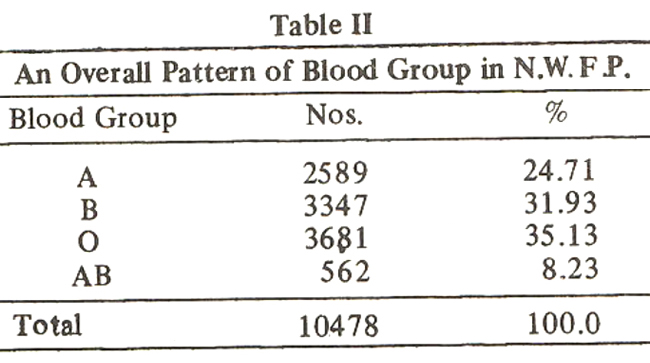
A study of ABO blood group and Rh (D) factor, was carried out on 10478 cases. ‘0’ had the highest (35.13%) and blood group ‘AB’ the lowest (8.23%) frequency.Blood group 24.71% and 31.93%respectively. An overall 94.1 % of population was Rh (D)positive.
Blood group A and B were
A comparision of the ABO blood group and Rh(D) factor of the N.W.F.P., with that of Karachi population, shows that there has not been much difference between these two populations. (JPMA 35: 253, 1985).
Introduction
Before Landsteiner,s1 discovery of AB agglutinogen system, people had a knowledge of the frequent disastrous result of blood transfusion in the hospitals. Decastello and Sturli2 completed the ABO blood group system. Blood groups are genetically inherited3 and therefore its irnportance cannot be ignored in tracing ancestral relationships of human population. Also in medicine the relationship of blood group to disease is sought. after.
In most parts of Pakistan blood group data is not available, therefore a study was undertaken to collect blood group data in N.W.F.P. The data obtained from this study pertain to the ABO and Rh (D) system which will serve as a useful baseline for comparision with other population groups in Pakistan.
Material and Methods.
The data of blood groups and Rh (D) factors was collected from the records of different hospitals excluding C.M.H., in N.W.F.P., and the data of the hospitals was considered typical of the population living in that area. In those areas where there was not much data available from the hospital, the blood group data was collected by testing the blood of the students in the schools and colleges. The blood samples were collected by finger prick directly on the slides.
ABO and Rh (D) blood grouping was done by tile technique using Anti A, Anti B grouping sera from National Blood Laboratories Limited Rawalpindi, and Anti D grouping serum from DADE Division American Hospital supply corporation Miami, Florida, U.S.A.
Results
Of 10.478 subjects screened, 24.71% had group A, 31.93% group B, 35.13% group 0, and 8.23% group AB. Ninety four percent were Rh (D) positive and 6% negative (Table I & II).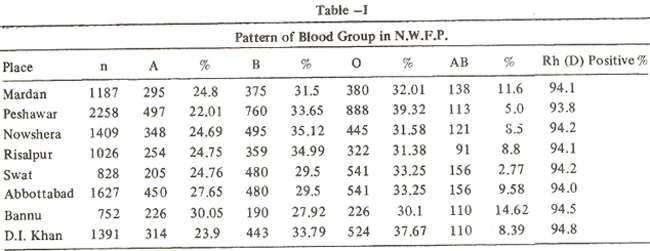
The frequency of various blood groups in this series was compared with other countries and Karachi (Table III).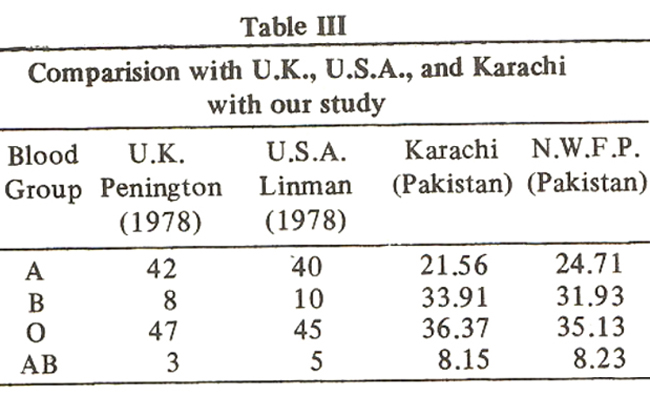
Discussion
Since the discovery of human ABO blood group system1 its medical significance has been much appreciated. Indeed several workers in different parts of the world are working on the inheritance of blood groups and the relationship between inheritance of disease and blood groups. Thus Jorgensen4 advanced a theory that ,O, group individuals are more physically fit than group A individuals and that the ‘O’ groupers have got a 60% better chance of reaching 75 years age. Aird5 has shown relationship between cancer the stomach and ABO groups and Jorgensen6 between blood groups and leukaemia. Similar relationship between blood group and diseases has been shown by others7,9 Most recently, Mourant10 has given a detailed account of the importance of ABO blood groups in organ transplant. This study shows interesting varities in
ABO blood group frequencies in Pakistani population as compared to Europeans and Americans.
This may perhaps explain the observed variations in disease patterns between the various populations. No differences were found in the N.W.F.P. and Karachi which is a cosmopolitan city suggesting that the iiattern in there two Pakistani population may represent the picture in the sub continent.
References
1. Landsteiner, K, Zur Kenntnis der antifermentativen, Lytischer and agglutinnativan wirlangen des. Blutsewms under Lymphe. Zbp. Bakt., 1900;27: 357.
2. Decastello, A.v. and Sturli, A. Ueberdie, isoag. glutinine in serum gesunder and Kranker Meuseum, Munch med. Wschr 1902; 1090.
3. Bernstein, F. Ergebnisee einer biostatischen Zusaminenfassender Betrachtuny ulcer die erbiehen Blutstrukturen des Menschen II Kin. Wschr., 1924;3.
4. Jorgensen. G. The ABO blood group-polymorphism in the multifactorial genetic system. Humangentlk, 1967; 264.
5. Aird, I., Bental, H.H. and Robert, J.A.F. A relationship between cancer of stomach and the ABO blood groups. Br. Med. J., 1953; 799.
6. Jorgensen, G. ABO blood groups in Leukaemia. Nature (Lond), 1965 ; 207: 108.
7. Woolf, B. On estimating the relation between blood group and disease. Ann. Human Genet., 1955; 19: 251.
8. Vogal. F. PettenKofer, HJ. and Heimbold, W. On the population genetics of ABO-Blood group 2. Gene frequency and epidemic diseases. Acta Genet (Basel), 1960; 10: 267.
9. Vogal, F. and Kruger, U.J. Statistischa Beziechungen Zwischer der ABO-Blutg ruppen and Krankheiten mit Ausnahme der lnfektionskrank heiten. Blut (Druek, 1968).
10. Mourant, A.E., Kopect A. C. and Domaniewska, S.K. distribution of the human blood groups and Biochemical polymorphism, 2nd ed. London, Oxford University Press, 1976.’
Journal of the Pakistan Medical Association has agreed to receive and publish manuscripts in accordance with the principles of the following committees:


