

Abdul Aziz ( King Edward Medical College & Mayo Hospital, Lahore. )
Mohammad Ishaq ( King Edward Medical College & Mayo Hospital, Lahore. )
Razia Akhwand ( King Edward Medical College & Mayo Hospital, Lahore. )
August 1985, Volume 35, Issue 8
Original Article

Abstract
Infectivity of Sputum smear positive patients with tuberculosis for household contacts was assessed before diagnosis and during domiciliary treatment. Intracutaneous tuberculin test, sputum and radiological examinations were done in all cases and their house-hold contacts initially; and were repeated for contacts every six months during two years follow-up.
Initially 244 (56%) contacts gave positive tuberculin reaction and 36 (8.3%) revealed lung lesions. Tuberculin conversion was detected in 14% cases during 6-month follow-up. Thereafter infection incidence reduced considerably over the following 18 months. risk before diagnosis and treatment of the index case, cooperative patients. (JPMA 35 249, 1985).
Introduction
Clinical trials for treatment of pulmonary tuberculosis patients at home were compared with those in sanatorium. No difference was noticed in the two groups as regards quiescence of disease after one year’s chemotherapy or in the occurance of relapse at the end of five years follow up.1 Concern exists about the infectivity of sputum positive pulmonary tuberculosis patients with or without treatment living in their homes, to their family contacts. Riley and Co-workers2 in animal experiments observed that sputum smear positive tuberculous animals without treatment were more infectious when compared to those on chemotherapy. Yeager and associates3 on daily sputum smear microscopy of patients receiving chemoth erapy observed a sharp reduction in the number of bacilli excreted in sputum within two weeks of the start of treatment. Riley and Co-workers4 have reported the presence of tubercie bacilli and chemotherapeutic agents in the droplets of sputum of those on anti tubercular drugs; with evaporation, the drugs become concentrated and thus renders the organism nonviable. No dif. ference has been observed in domiciliary and hospital treated pulmonary tuberculosis patients and adequate chemotherapy to infectius patients in reducing transmission of infection in the community5,6
This study shows that the contacts were at major and it also supports domicifiary chemotherapy for Tuberculosis in Pakistan occurs early in life, and figures as high as 71%, and 68% in 15 19 year age-group have been reported. The overall infected population being 60% and 54% pectively7,8 According to National Tuberculosis Prevalance Surveys the bulk of infectious patients are treated at home because of shortage of hospital beds. The disease mostly affects the lower socioecnomic groups living in poor hygienic counditions and over crowded houses. A “Contact Case Study” was carried out at Mayo Hospital, Lahore, to determine the prevalence of tuberculosis infection and disease among family contacts of those receiving treatment versus those not on treatment.
Material and Methods
Individuals were divided into 2 groups.
(a) Freshly diagnosed smear positive cases, irrespective of the duration of illness (index cases).
(b) Family members living with index cases.
Seventy eight patients i.e., 43 males (including 5 children) and 35 females (6 children) formed the index cases (Table I).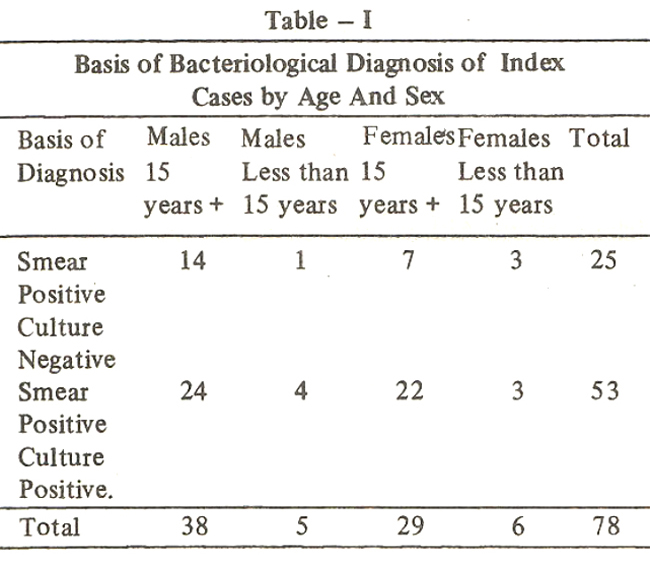
All index cases had positive smear and their sputa were cultured on L.J. medium Each case had an X.-ray chest done in PA view, and an intracutaneous skin (Mantoux) test was performed on forearm with 1 TU of purified protein derivative (PPD) RT 23 with tween 80 in 0.1 ml of solution. Tr-nsverse diameter of induration was read after 72 hours. An induration of 10 mm plus diameter was read as positive (reactor) whereas diameter of 9 mm or less was taken as negative (non reactor) tuberculin test.
These 78 index cases had 434 family contacts. Each contact underwent sputum exami. nation, an Initial PA radiograph of chest which was repeated every 6 months for 2 years, a Mantoux test, which was repeated on all available contacts six.monthly except for those who showed conversion on the previous testing. Contacts showing abnormal radiographs were further investigated and their sputum specimens were examined for mycobacterium tuberculosis by smear and culture examinatuion.
Index cases were treated by a daily triple drug regimen of isoniazid 300 mg, ethambutol 25 mg/kg for the first two months followed by 15 mg/kg and streptomycin 1Gm I.M., for six months; and thereafter isoniazid and ethambutol for next 6 months. The dosage for children was adjusted according to their weight. Index cases were periodically clinically examined and any complication arising was taken care of.
Results
All 78 Index cases were sputum positive on direct microscopy and 53 had positive culture. Mantoux test was positive in 76 and negative in 2 patients (Table II).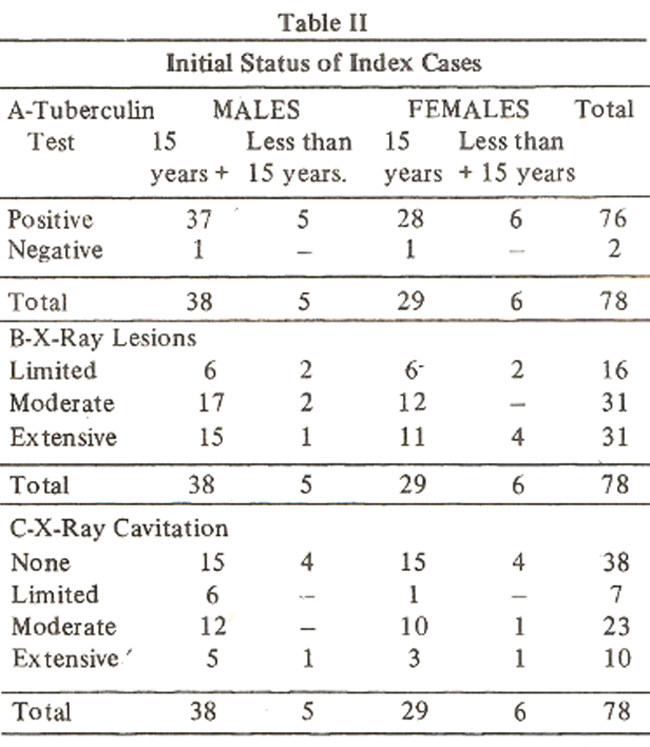
Similar tuberculin response has previously been reported.9,10
Chest X’rays were done in all index cases. Sixteen has limited (upto 2 interspaces area) and 31 moderate (lesion whose total extent even if bilateral did not exceed an area equivalent to the whole of one lung ) to extensive lesions (involving a total area greater than that of one lung on PA radiograph) disease (Table II).
Of 78 index cases 40 showed cavitation which was limited in 7 (diameter upto 2 cm), moderate in 23 (diameter between 2 and 4 cm) and extensive (diameter larger than 4 ems) in ten cases (Table Il-C). Thirty eight patients showed no cavitation. Of 434 family contacts, 244 (56%) gave positive and 190 (44%) a negative tuberculin reaction, giving a fairly high percentage of tuberculous infection among the contacts of active pulmonary tuberculosis patients (Table III).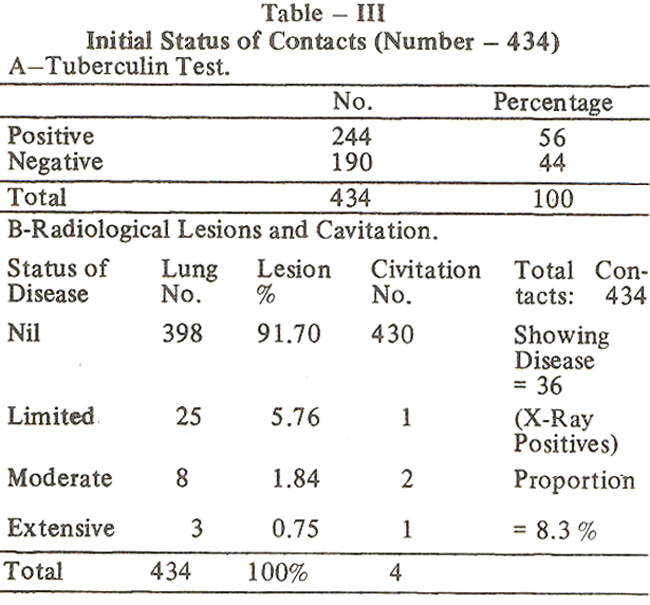
Thirty six (8.3%) contacts revealed radiologically lung lesions simulating tuberculosis and 4 of them showed cavitation (Table 111-B). Seven contacts were both smear and culture positive while 3 were smear negative but culture positive.
During follow up, the number of contacts kept on decreasing due to migration, marriage, and other socio economic reasons, so at the end of 6, 12, 18 and 24 months, the number of 292, 229, 179 and 122 respectively with domiciliary chemotherapy to all the index cases and follow-up of contacts upto 24 months; out of 292 contacts at month 6, 120 were tuberculin negative at 0 month and 17 (14%) of them were converted to positive reaction at 6 months. Similarly from among the family contacts at month 12, 18 and 24, 76, 54 and 47 were eligible for tuberculin testing,, being tuberculin negative at the previous 6 monthly check-up. Tuberculin conversion among them was seen in 4 (5%), 2 (4%) and 1 (2%) contacts respectively.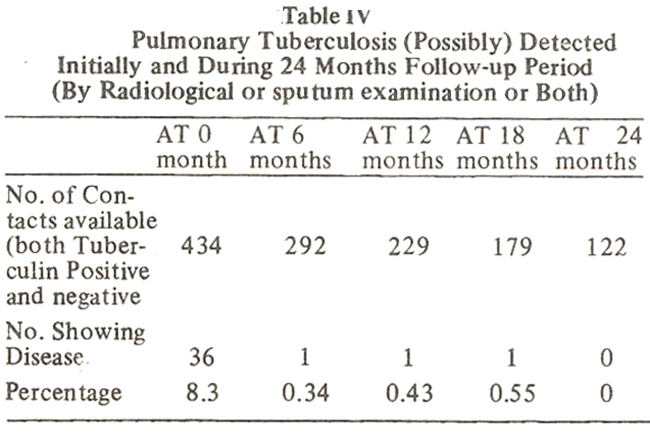
(Table IV) As for the disease one case each developed disease at 6, 12 and 18 months from the 292, 229. and 179 contacts available for check-up. No disease was found at the last 24 month check-up (Table V).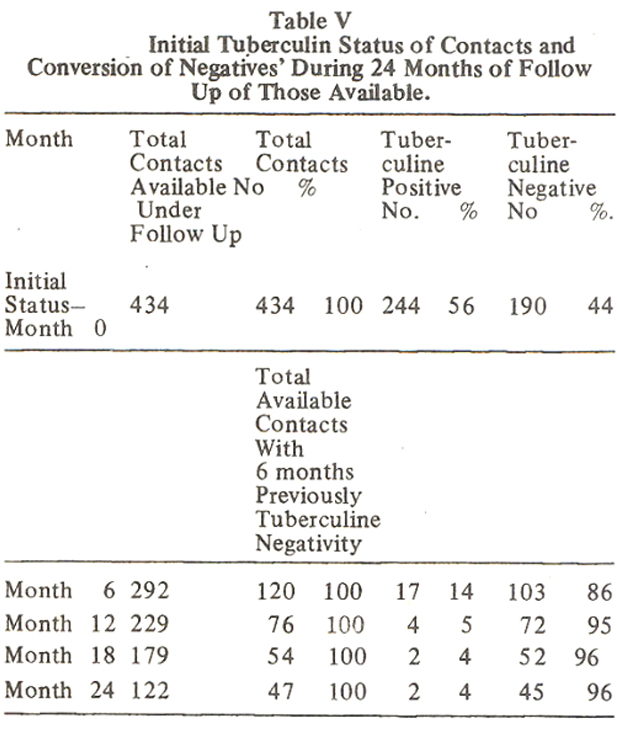
Discussion
From 434 contacts of 78 house-holds 36 (8.3%) cases showing disease were detected on the basis of radiographic abnormality at the time of initial examination and 13 of them had positive sputum by smear and/or culture examinations. It was not possible to select a matched control group for comparison. Forty four percent contacts were negative at the time of initial tuberculin testing. These contacts were at risk of contracting disease either by exposure to index case before diagnosis and treatment, exposure to the index case during treatment, or by exposure to undiagnosed infectious persons around them. The radiographic abnormality must have been present for sometime before the initial exarnination; and the infection must have been there some weeks or months earlier still. Therefore it is reasonable to conclude that the high frequency of infection (56%) and disease (8.3%) had occured before the diagnosis of index case.
It is likely that 17 (14%) of the 120 contacts who were tuberculin negative initially but converted at month 6 may also have been infected before the diagnosis of index case. Possibly they harbored infection at the time of initial tuberculin testing, but did not show an immune response until subsequent testing after the index case started chemotherapy. That some contacts might have been infected by another source in the community can also be a possibility. Thereafter the infection rate among contacts was between 4 and 5% at 6-monthly tuberculin testing and even in this case, the possibility of infection from environmaental source instead of the index case cannot be ruled out. The majority of contacts were adult and some of them could have been infected at their working places. However the possibility that some contacts might be infected by the patients excreting tubercie bacilli and on chemotherapy cannot be ruled out altogether because exact timing of infection among contacts was not possible.
As for the disease, three contact cases subsequently developed disease over 18 months (none in the fourth 6.month period). These cases may have been infected from index cases before they were diagnosed and were incubating disease which became apparent during the follow up period.
Kamat and associates11 in their clinical study compared the risk of infection to contacts of patients treated at home with those treated in a sanatorium and found no significant difference. They also concluded that the major risk of infection from an index case to his family contacts is before he is diagnosed and treatment commenced. Gunnels and Co-workers12 found no difference in risk of infection to house-hold contacts living with tuberculous patients receiving chemotherapy and discharged from hospital irrespective of their sputum status being positive or negative at the time of discharge. They concluded that contacts were at major risk before diagnosis and treatment of index cases. Brooks and associates13 found that patient with pulmonary tuberculosis transmits disease when he is not receiving adequate treatment and that infectiousness from the patient is rapidly reduced when he receives effective chemotherapy.
This study offers reasonable evidence that risk of infection to house-hold contacts is gradually reduced when a sputum positive pulmonary tuberculosis patient is receiving treatment at home. Therefore the present study supports a policy of domiciliary chemotherapy for pulmonary tuberculosis patients.
References
1. Tuberculosis Chemotherapy Centre, Madras. Concurrent comparison of home and sanatorium treatment of pulmonary tuberculosis in South India. Bull. W.H.O., 1959;21:51.
2. Riley, R.L. Mills, C.C., 0’ Grady, F,, Sultan, L.V., Wittstadt, F. and Shiv Pun, D.N. Infectiousness of air from a tuberculosis ward. Am, RespirDis., 1962;85: 517.
3. Yeager, H. Jr., Lacy, J. Smith, L.R. and LeMaistre, C.A. Quantitative stuies of mycobacterial populations in sputum and saliva. Am. Rev. Respir. Dis., 1967;95:998.
4. Riley, R.L., Mifis C.C., Nyka, W., Weinstock, N., Storey, P.E., Sultan, L.V., Riley, M.C., and Wells, W.F. Arial dissemination of pulmonary tuberculosis; a two-year study of contagion in a tuberculosis ward. Am. J. Hyg., 1959; 70:185.
5. WHO Expert Committee on Tuberculosis eighth report. W.H.O. Tech. Rep. Ser., 1964; 290:13.
6. WHO Expert Committee on Tuberculosis ninth report. W.H.O. Tech. Sen., 1974; 552 : 18.
7. Report of the Tuberculosis Survey in Karachi, Rawalpindi and Lahore Division of West Pakistan Directorate of Tuberculosis Control, Government of Pakistan, October, 1962, p. 9.
8. Kaleta, J. and Chaudhry, N.A. Epidemiological situation of tuberculosis in Pakistan. Results of the National Tuberculosis Prevealence Survey 1974-7 8. Documents on tuberculosis in Pakistan, Documents presented at the XIV National Tuberculosis Conference, Lahore, April 1982, p 1-8.
9. Springett, V.H. Intradermal tuberculin test. Tubercle 1980;60 : 196.
10. Aziz, Abdul. Intradermal tuberculin test. Tubercle, 1981;61: 181.
11. Kamat, S.R., Dawson, J.J. Y., Davadatta, S., Fox, W., Janardhanam, B., Radhakrishna, S., Rama `krishnan, C.V., Somasundaram, P.R., Stott, H. and Velu, S.A. controlled study of the influence of segregation of tuberculous patients for one year on the attack rate of tuberculosis in a 5-year period in close family contacts in South India. Bull. W.H.O., 1966; 34: 517.
12. Gunnels, J.J., Bates, J.H. and Swindoll, H. Infectivity of sputum positive tuberculous patients on chemotherapy. Am. Rev. Respir. Dis., 1974; 109: 323.
13. Brooks, S.M., Lassiter, N.L. and Young, E.C. A pilot study concerning the infection risk of sputum positive tuberculous patients on chemotherapy. Am. Rev. Respir. Dis., 1973;108:799.
Journal of the Pakistan Medical Association has agreed to receive and publish manuscripts in accordance with the principles of the following committees:


