

Y. Najam ( Departments of Pediatrics, Shifa International Hospital, Islamabad. )
M. Khan ( Departments of Pediatrics, Shifa International Hospital, Islamabad. )
F. Ilahi ( Departments of Biochemistry, Shifa International Hospital, Islamabad. )
A. Alam ( Departments of Biochemistry, Shifa International Hospital, Islamabad. )
January 2003, Volume 53, Issue 1
Original Article

Abstract
Objective:To evaluate the distribution of Thyroxin (T4) and Thyroid Stimulating Hormone (TSH) values in children of various age groups attending our hospital.
Method:We have retrospectively reviewed the T4, TSH levels recorded at our hospital in children from birth to 5 years and evaluated the reference intervals for T4 TSH amongst different ages. Non parametric methods were used to establish a 97.5th, 95th, 50th, 5th and 2.5th centiles.
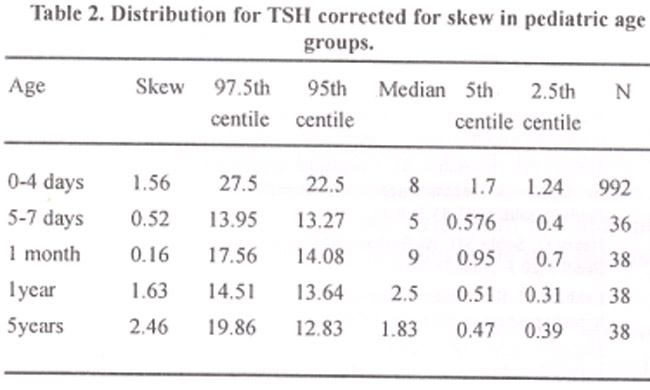
Results: In T4 (n=1148) and TSH (n=1142) samples reviewed a TSH surge following delivery showed a sharp decline in the first 4 days of life. This was followed by a more gradual downward trend. Data on T4 estimations showed a similar but more gradual downward trend in advancing age groups. The 5th - 95th centile reference range for TSH showed values between 1.7--22.5 (O--4days; n=992), 0.6--13.3 (5--7days; n=36), O.9--14.O (lweek--1 month; n=38), 0.5--i 3.6 (1 month-I year; n=38) and 0.4--12.8 (1—5 years; n38) microlU/mL.
The 5th - 95th centile reference range for T4 showed values between 10.7-25.0 (0-4days; n=995), 6.5--20.4 (5-
-7 days; n=35), 8.0-18.1 (iweek--imonth; n=38), 6.0—16.1 (Imonth--iyear; n=4i), 6.9-i 5.3 (i--S years; n=39) micro gm/dI.
Conclusion:We recommend using separate T4 and TSH reference values for children in different age groups. Further large-scale studies should be done in Pakistan to establish these reference values within age groups. A national center for neonatal thyroid screening is highly recommended JPMA 53:26;2003).
Introduction
National neonatal thyroid screening programs have existed in many countries since the 1970’s, contributing to early detection and treatment of congenital hypothyroidism, a serious and potentially treatable condition. 1 These programs also provide an important source for accumulation of useful information in respect to the thyroid profiles for specific populations and age groups. There exists however considerable diversity within these screening programs in the methodology and the process employed. Standardization and uniformity of reference values for T4 and TSH has been a major problem with these programs because of intrinsic variations in the T4 and TSH values in different age groups, the sample sizes, the geographic and demographic variables.
Most programs have overcome this problem by standardizing and centralizing the screening process to one or more designated laboratories. Variation in day to day values can be over come by laboratories with a very large daily turnover calculating reference values on a frequent (even daily) basis.2 Data collected has to be kept under continuous periodic evaluation,
We do not have a national neonatal screening program for congenital hypothyroidism in Pakistan. One reason for this could be the financial implications of such a venture. In 1995 our hospital started screening all newborns for TSH and T4 to detect cases of congenital hypothyroidism as early as possible. The program has since been under a process of continuous evaluation and development. Setting up of reference values has been one of the problems that we have come across repeatedly. The low turn over at the start of the program meant that reference values had to be established for neonatal age groups by statistically arriving at values based on a small sample size and correlating these values with authenticated references intervals within the various age groups.
Patients and Methods
We analyzed all T4 and TSH evaluations done at Shifa Laboratories between October 1995 - October 1998. Shifa Laboratory has a Murinex regulated quality control program. We use a chemiluminiscent enzyme immunoassay based technology called Immulite for processing the T4 and TSH samples. Venous samples are analyzed in batches once a week.
We reviewed 1148 T4 and 1142 TSH samples from children from birth to 5 years. All statistical calculations were done using Microsoft Excel statistical package. Data for T4 showed a normal distribution pattern. The data for TSH however had an obvious skew, which was corrected by the use of non-parametric tests i.e., we used the median and the centiles instead of using the Mean and Standard deviations. Extreme outlying values from both T4 (values greater than 35 and less than 3) and TSH (Values greater than 45 and less than 0.2) were excluded. The total data excluded was very small (T4 0.6% and TSH+ 0.8%) and represented extreme outlying values only. We used the middle 90% (5th-95th centiles) data as the reference values instead of the traditional middle 95% (2.5th-97.5th centiles) (Figures 1-4). These measures may lead to a marginal under estimation of our reference values with a slightly larger number of false positives but would reduce the number of false negative interpretations.
Results
Data was evaluated for 97th, 95th, 50th, 5th and 2.5th centile for age groups 0-4 days, 5-7 days, upto I month, upto 1 year and upto 5 years (Tables 1 and 2).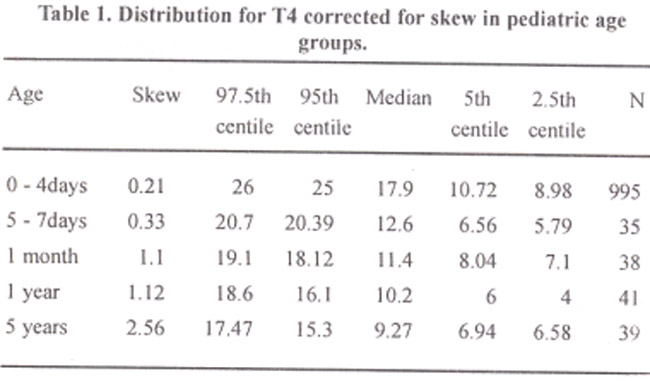
Similar calculations were also done from birth upto 7 days age. Data was plotted on to centile charts for the respective groupings using the 5th and 95th centiles (Figures 1-4).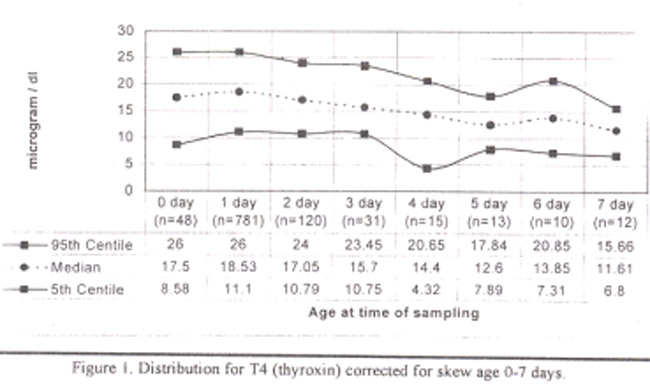
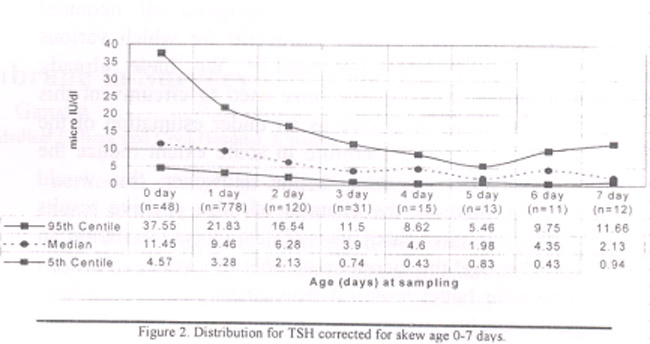
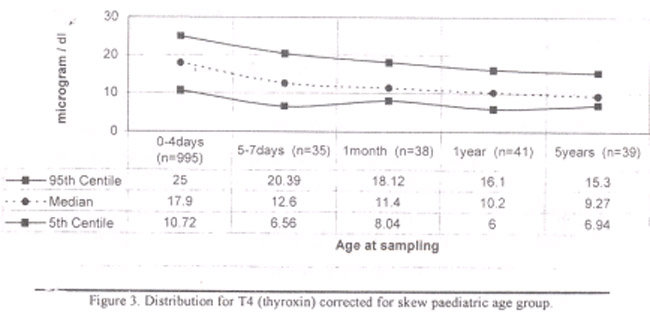
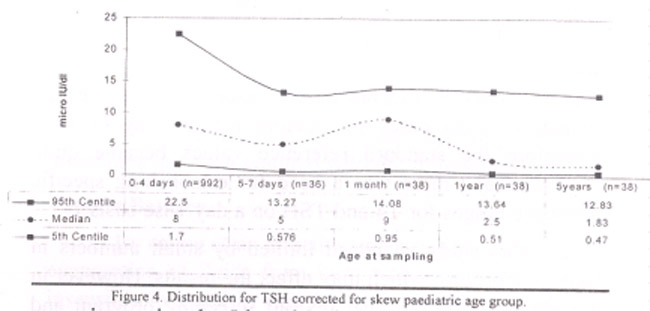
Our data confirms a variation in the reference values of T4 and TSH within age groups which is more significant in the first week of life. The post delivery TSH surge causes a sharper downward sloping of the curves. The variation in the first 4-5 days is more marked in TSH than in T4 values. This necessitates the need to have different reference values for interpretation of results for various pediatric age groups.
Discussion
We have tried to evaluate and form a set of reference values for various pediatric age groups specific to our own context. However, this process is not simple. We have to be cautious while establishing reference values because of the implications of false positives and negative results. The false negatives being more significant in case of neonatal screening programs since the consequences would be devastating. This problem has plagued all neonatal screening programs around the world for which various remedies have been proposed.2-4 We have already mentioned the methods we have used to circumvent this problem which would give us an under estiniation of the reference ranges and therefore to some extent reduce the chance of false negative results. However, this would potentially increase the chances of false positive results which may in most cases necessitate a repeat evaluation. In balance we feel the increased number of repeat evaluations will be a far better trade off than missing cases with false negative results.
The TSH curves in our results show a very sharp decline in the upper reference values in the first four days of life. This decline is also evident in the T4 results but it is not as marked. This is an expected phenomenon because of the post delivery surge of TSH. The fetal thyroid gland begins producing hormones from the 20th week of gestation. However there is a surge in the level of TSH immediately after birth which attains its peak about 30 minutes after delivery and thereafter begins to recede over the first four days. This necessitates the collection of blood samples after the 4th day of life in most neonatal screening programs. Recent studies have shown some success in identifying congenital hypothyroidism even from cord blood samples with a 95% capture rate provided there were well established reference values.5 Our screening program for specific reasons involved collection of samples after the first 24 hours of life but before discharge from hospital (which in most cases was before the 4th day of life). Therefore the standard reference values became quite redundant and there was a need for establishing specific reference ranges for T4 and TSH on a day wise basis.
This study is indeed limited by small numbers in sonic age groups, which may effect the results. However in the absence of a national thyroid screening program and keeping in mind the fact that regular screening is being done in very few hospitals around the country, this data we feel is very important. A review of the literature showed only two Pakistani studies, both hospital based, where data from neonatal thyroid screening had been analyzed (one of these is our own).6,7 The incidence of congenital hypothyroidism in Pakistan is unknown. Recent studies indicate it to be much higher than the usually accepted incidence of 1:4000 births.6-8 Cost factors preclude most hospitals from implementing a neonatal screening program. However, there is a need to conduct similar studies in the hospitals and laboratories where such tests are being done. This would help in establishing not only the magnitude of the problem but also reference values specific to our own demographic conditions.
There is a bias in our study in the older age groups where T4 and TSH evaluation is done mainly in children who either have some thyroid problem or are suspected of having thyroid problems. The numbers of tests done here would play an important role. We are limited by the fact that the total numbers of patients in these groups is small. The possibility of establishing a mass screening program in these age groups is almost nil. Therefore we have to make do with whatever data is available and derive conclusions from that in correlation with established international reference values. Also it is recommended that institutions operating such programs should periodically review their data in collaboration with other centers to establish reference ranges.
References
1.Barnes ND. Screening for congenital hypothyroidism: the first decade. Arch Dis Child 1985;60:587-92.
2.Novogroder M. Neonatal screening for congenital hypothyroidism. Pediatr Clin North Am 1980;27:881-90.
3.Willi SM, Moshaung T Jr. Diagnostic dilemas: results of screening tests for congenital hypothyroidism. Pediatr Clin North Am 199 1;38:555-6.
4.Verkerk PH, Buitendijik SE. Congenital hypothyroidism screening the cutoff for thyrotropin measurement: recommendations from Netherlands. Am J Public Health 1993,83:868-71.
5.Henry G, Sobki SH, Al-Beshara NM, et al. Thyroid function in cord blood. Saudi Med J 2000;21:36-9.
6.Lakhani M, Khurshid M, Naqvi SH, et al. Neonatal screening for congenital hypothyroidism in Pakistan. J Pak Med Assoc 1989;39:282-4.
7.Najam Y, Khan M, Ilahi F, et a!. Neonatal thyroid screening - the Shifa expenence. J Pak Med Assoc 2002;52:58-61.
8.Henry 0, Sobki SU, Othman JM. Screening for congenital hypothyroidism. Saudi Med J, 2002;23:529-35.
Related Articles
Journal of the Pakistan Medical Association has agreed to receive and publish manuscripts in accordance with the principles of the following committees:


