

Z. Habib ( Departments of Pediatrics and Physical Therapy, Aga Khan University Hospital, Karachi, Pakistan. )
S. Ibrahim ( Final year medical student, Aga Khan University Hospital, Karachi, Pakistan. )
S. Akram ( Departments of Pediatrics, Aga Khan University Hospital, Karachi, Pakistan. )
B. Hasan ( Departments of Pediatrics, Aga Khan University Hospital, Karachi, Pakistan. )
January 2003, Volume 53, Issue 1
Original Article

Abstract
Objectives: To (a) describe the effect of temperature rise on seizure recurrence in the ER (b) investigate the effect of age, gender, family and developmental history, type, duration and multiple seizures, past history and number of seizures and treatment given (either late or early) on seizure recurrence in the ER and (c) explore prognostic indicators for seizure recurrence.
Methods: Data from 352 children [ages 3 - 84 months; 220 males (62.5%) 132 females (37.5%)] was taken using chart reviews for the years January 1998 - August 2000 inclusive, from the Pediatric department of the Aga Khan University Hospital. Descriptive statistics, Chi-square, and Discriminant Analysis were used.
Results: Of the 52 (16%) cases that had seizure recurrence in the ER, majority (36.5%) occurred in >38.50 < 39.50C temperature range. The percentage declined to 15% at higher temperatures. Bivariate tests showed that age, family and developmental history, type of seizure and treatment given did not affect seizure recurrence in the ER. Past history number of seizures (p = .006), duration of seizure (p <0.001), past history of seizures (p=0.004) and multiple seizure (p=0.024) were factors significantly associated with seizure recurrence in the ER at the bivariate level of analysis. Duration of seizure was the most important prognostic indicator for FS recurrence in the ER at the multivariate level with f3 = .79.
Conclusion: Duration of seizure (>5 minutes) was the most important prognostic factor for FS recurrence. Early treatment did not affect recurrence,suggesting timely anti-pyretic vs. anti-leptic medication use (JPMA 53:11,2003).
Introduction
Febrile seizures (FS)are the most common convulsive disorder affecting 2-5% of all young chidlren.1,2 According to a consensus conference held by the National Institutes of Health, Bethesda, Maryland (1980), FS is described as "an event in infancy or childhood usually occurring between 3 months and five years of age, associated with fever, but without evidence of intra-cranial infection or a defined cause] " Febrile seizures are a benign disorder with an unknown etiology. They can be broadly classified into two groups: (a) Simple febrile seizures -generalized, <15 minutes and a total duration of 30 minutes in series; (b) Complex febrile seizures - focal or generalized, >15 minutes; >30 minutes in duration when in series.3
Febrile seizure recurrence rates in the third world range from 21%-29.3% as indicated by studies conducted in Nigeria and the Middle East.4-6 In the west, however, recurrence rates are much more varied, ranging from 30%-50%.7-12 One study in particular, conducted in the Netherlands, found the rate of recurrence of febrile seizures to be as high 52%.13
There are many well-established risk factors for recurrence of febrile seizures (both simple and complex); of these, age of onset is one of the most consistent and strongest predictor of recurrence.1 Berg et all conducted a meta-analytic study of 14 published reports and concluded that an age of less than one year for the onset of the first FS distinguished between groups of children with approximately a 30% versus a 50% risk of recurrence.7 Multiple studies both in the East and the West have confirmed this positive correlation of age with recurrence. 5,8,9,12-15 In our study we focused on recurrence of febrile seizures within the hospital, after the child presented to the emergency room (ER).
Another important and well-documented association is one of temperature with recurrence of seizures. A rise in temperature by one degree almost doubled the risk of recurrence.15 A positive association was found between a shorter duration of fever and an increased risk of recurrence.15 Several studies12,13 have shown that a low degree of fever while in the emergency department was a strong independent predictor of recurrent FS. Offringa et al12 documented an association between temperature rise and increase in the recurrence rate of FS, but to an extent. Higher temperatures (40°C) were associated with a lower risk of recurrence.6El-Radhi et al18 documented a 66% risk of recurrence in children whose temperature at time of seizure recurrence was <40°C compared to 10% for those children whose temperature was >40°C.
Other factors associated with recurrence of both simple and complex FS include a (a) positive family history9,10-12,1317 which was associated with an absolute recurrence risk of 20%9 (b) a positive correlation with the previous number of recurrences of seizures7,10,14,15, whereby a greater number of previous recurrences resulted in a greater rate of recurrence of FS and (c) duration of seizure which is another well established risk factor for recurrence7. In addition, children who have experienced a complex febrile seizure have been shown to have a greater rate of recurrence.4,5,7,15
No data exists on factors affecting risk of recurrence of FS in Pakistani children. This descriptive, retrospective study is the first to address such issues. Specifically, the objective/purpose of our study was to (a) describe the effects of temperature rise on FS recurrence in the hospital ER, (b) investigate the effect of age, gender, family and developmental history, type, duration and multiple seizures, past history of seizures, past history of number of seizures and treatment given on FS recurrence in the hospital (ER) and (c) explore prognostic indicators for FS recurrence in the hospital (ER).
Materials and Methods
Sample and subjects
This was a descriptive, retrospective study and a sample of convenience was used. It consisted of data from 352 children [ages 3 - 84 months; 220 males (63.5%) and 132 females (37.5%)] gleaned from chart reviews for the years January 1998 - August 2000 inclusive, from the Pediatric department of the Aga Khan University Hospital (AKUH) in accordance with the ICD-9C classification/coding system.
Inclusion criteria
All children admitted to the AKUH Pediatric ward between the ages of 3 - 84 months, with a diagnosis of FS in the period between January 1998 - August 2000 inclusive.
Exclusion criteria
(a) children with a diagnosis of FS less than three months and greater than 84 months (b) those presenting with afebrile seizures and/or history of prior convulsions secondary to underlying neurological pathology like meningitis, encephalitis etc. (c) those with seizures secondary to electrolyte derangement and (d) seizures due to metabolic causes.
Operational definition
For the purpose of our study, recurrence of FS was defined as subsequent FS following a previous episode, with a seizure free period of unspecified duration between the two events.
Procedures and variables used in the study
A data collection form was designed by one of the authors (Dr. SI). Appendix A contains the details of this form. Variables used in the study were dichotomized and included the following: (a) family history (positive, negative) (b) developmental history (normal, delayed), (c) type of seizure (general, focal), (d) multiple seizures (0 = single seizure, 1 = multiple seizure), (e) past history of seizure (YIN), (0 past history number of seizures, (0 = one seizure, 1 = > one seizure), (g) age (0 = 24 months, 1 = > 24 months, (h) treatment given (1 = early in the ER 2 = late), and (i) temperature (° C) categorized as 0 = > 35 < 36.5 , 1 = >36.5 <37.5, 2 = >37.5 <38.5, 3 = >38.5 <39.5, 4 => 39.5 < 40.5, 5 = >40.5 < 41.5 and 6 = >41.5 respectively.19,20
Data/statistical analysis
Statistical package SPSS 10.0 for windows was utilized for analysis. Bivariate statistical test of chi-square was used to analyze and describe the effect of temperature rise on seizure recurrence in the ER and investigate the effect of age, gender, family and developmental history, type, duration and multiple seizures, past history of seizure, past history number of seizures and treatment given on seizure recurrence in the ER.
In order to explore poor prognostic factors/indicators for seizure recurrence in the ER, a Discriminant Analysis was used. The dependent variable (DV) was seizure recurrence in the ER, which was dichotomized as Y/N. The predictor variables (independent variables [IV]) included past history number of seizures, multiple seizures, duration of seizures, developmental history and maximum temperature at the time of seizure respectively. A subject to variable ratio was calculated for sampling adequacy.2
Results
Descriptive statistics
Demographics: The mean age of children in our sample for febrile seizure (FS) was 24.3 months (median 17 months, SD = 19.3 months). There was a preponderance of male children in the sample; 220 (63.5%) males vs. 132 (37.5%) female children; the ratio of M: F being 1.7:1.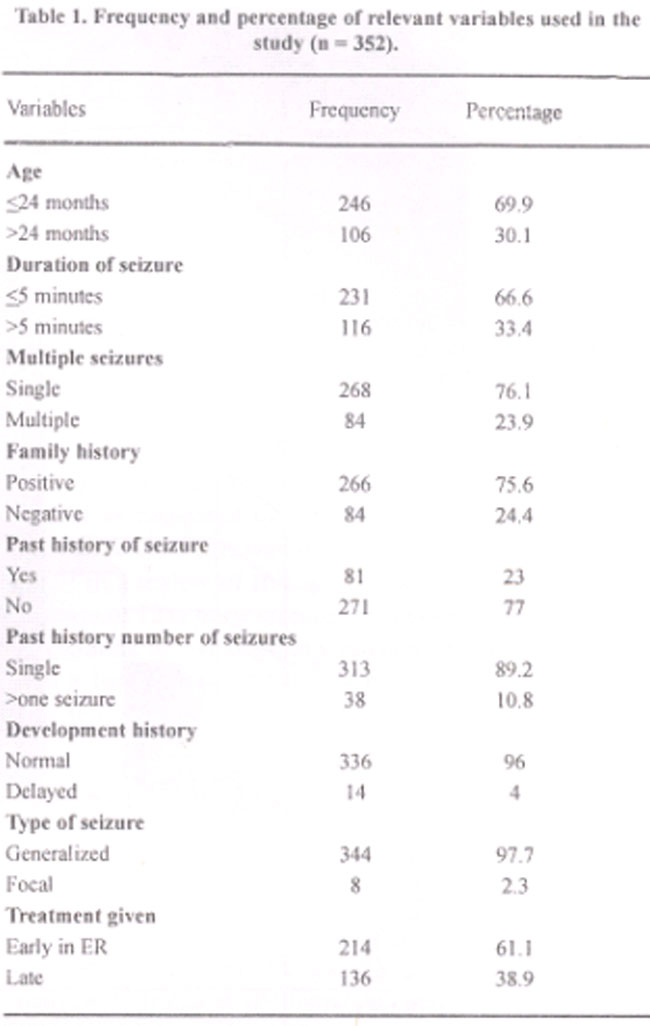
Table 1 gives details of the frequency and percentages of the variables used in the study. From Table 1 it is clear that the majority of our cohort were <24 months, had a single generalized seizure episode lasting <5 minutes. Majority also had normal developmental history but a positive family history of FS, with no past history of previous seizure episodes. Fifty-six (16% of the total sample) cases of children had recurrence in the ER; of these, 32 (57%) were males and 22 (43%) females. The ratio of M:F being 1.3:1.
Temperature: Of the 52 cases (16%) who had recurrence of FS in the ER, 27% had temperature in the >37.5 to 38.5°C range, and 36% occurred in the >38.5 to 39.5°C temperature.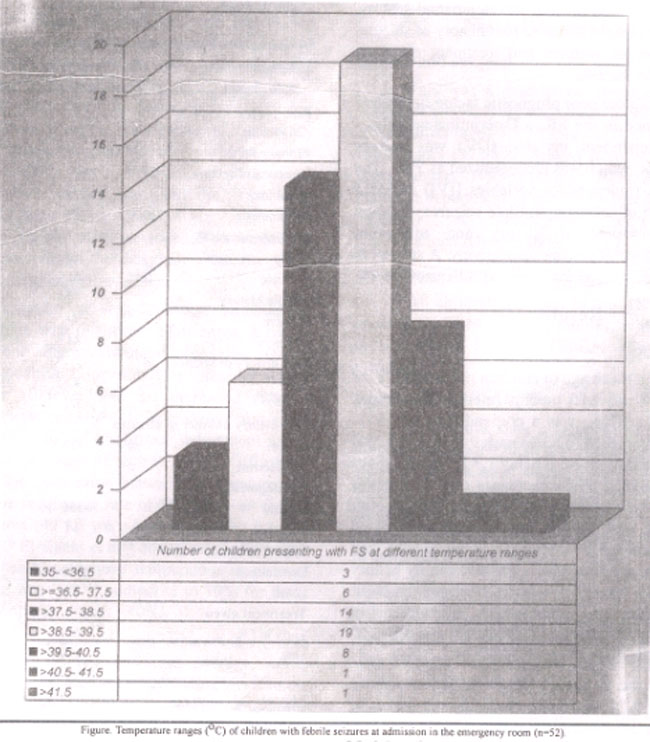
See Figure for details of distribution of FS at admission to the ER, at various temperature ranges.
Bivariate analysis: Duration of seizures (>5 minutes), past history of seizures, past history number of seizures, and multiple seizure was significantly associated with FS recurrence in the ER. (Table 2).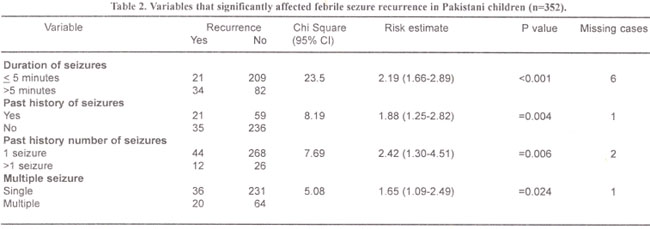
Age, gender, family history, developmental history and type of seizure was not associated with FS recurrence in the ER at the bivariate Overall predicted accuracy 67%.
level of analysis in our cohort. In addition, early treatment given for FS control did not significantly affect recurrence of FS in the ER.
Males presenting with FS had a higher odds of a past history of seizures 1.59 (CI 1.03 - 2.47, p .03) than females. A total of 81 children (23% of the sample) had past history of FS; of these 59 (73%) were males and 22 (27%) were females.
Multivariate analysis (discriminant analysis): The subject to variable ratio was 58, which is adequate for sampling adequacy.21 From the total of 352 cases, 279 valid cases were used in discriminant analysis. At the univariate analysis level, all the four-predictor variables (namely duration of seizure, past history number of seizures, multiple seizures, and maximum temperature at the’time of seizure) were statistically significant with p< .05.
The omnibus F test (which is the main test for hypothesis for discriminant analysis), was also significant with Wilks lambda = .904, x2(5) = 27.76, p <0.001 This means that the set of predictor variables named above correctly classified the children in our cohort into the two groups viz, those who had a recurrence of FS in the ER and those who did not. Duration of FS had the highest beta value (ß = .797). This means that at the multivariate analysis level, duration of seizure was again the most important predictor for FS recurrence.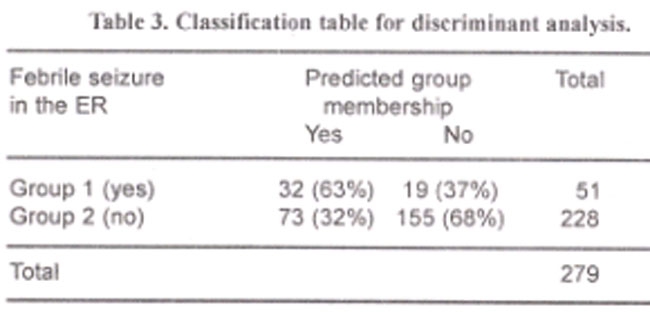
Table 3 gives details of the classification table for discriminant analysis. Predicted accuracy of our model using the four variables named above was adequate at 67%. This means that duration of FS, past history number of FS, multiple FS and maximum temperature at the time of seizure correctly distinguished our sample into the two groups for recurrence in the ER (YIN), 67 % of the time.
Discussion
Age and age-range
We looked at a wide age range (3 months - 84 months) to study FS recurrence in Pakistani children. Several other studies4,9,10,22-25 have also evaluated FS recurrence beyond five years of age. Age at the time of first FS is perhaps the single most consistent predictor of recurrent FS.7 However, age was not statistically significant at the bivariate level of analysis in our cohort. This could be attributed to three possibilities (a) a wide age range used (b) the age range was dichotomized into <24 months and>24 months and (c) our age data was negatively skewed.
Gender
A definite male predominance for recurrence of febrile seizures in the ER was seen not only in our study (M:F = 1.3:1), but in other studies as well. Bessisso et al4 found the male gender to be a statistically significant risk factor for recurrence of ES (M: F = 2.25:1; p= 0.02). This is also supported by Aierede et al.6 Offi’inga et al12, in a metaanalysis, quoted a slight predominance of recurrence of febrile seizures in males. In contrast to this, Rantala et al10 found the female gender to be at a 1.32 times greater risk of having a recurrence of febrile seizures.
Recurrence rate
In general, a range of FS recurrence rate/risk (21% -47%) have been quoted in literature from several studies.4,9,10,22-24,26 In a population based study by Stanhope et al22, the recurrence risk was found to be 29.2%. Our study shows lower recurrence risk (16%), although this may be attributed to the fact that we only looked for recurrence within the ER and ours was a retrospective cohort study not representative of the Pakistani population. Nelson et al23 documented a cumulative recurrence risk of 34.9%. Their study was a cohort study with a sample size of 1706 and the duration of their follow-up was seven years of age. Franzenten et al24 in a clinic-based study, with a sample size of 197, found the cumulative recurrence risk to be similar (34.5%). Their duratioMn of follow-up was also seven years of age. Wallace26 in a clinic-based study (n 116), reported a cumulative recurrence risk as high as 47.4%. However, this could be due to the age range the authors followed (18 - 38 months), since it is known that the risk of FS is highest during the first two years of life. Bessisso et al4 found the recurrence within a year of onset of FS to be 21%. In a prospective cohort study by Berg et al9, the recurrence rate for FS was quoted as 31.8%. Their follow-up period was greater than five years. These studies suggest that the recurrence rate declines with increasing age.
Tern perature
Western based studies have proven time and again that the risk of recurrence decreases with higher temperatures (>40 degrees Celsius) and that it is at lower temperatures when the risk of recurrence of febrile seizures increases.6,8,9,12-14,18 Airedi6 found a ten times higher risk of recurrence in children with a temperature of <40 degrees Celsius as compared to those with a temperature of >40 degrees Celsius. This was also stated by Berg et al9 Offringa et al12 in a review of five studies, which showed a pooled increase of 12% in recurrence rate between children with a temperature of <40 degrees Celsius as opposed to children with a temperature of >40 degrees Celsius at the time of their febrile seizure.
Family history
As with age, family history of FS was not statistically significant at the bivariate level of analysis in our study. Perhaps dichotomization of the variable could be one reason for lack of significance. Several studies have evaluated the association between family history (basically first degree relative) and recurrence of FS. In a metaanalysis, Offringa et al12 found an overall FS recurrence of 43% in children who had a positive family history (1st degree relative) as opposed to a 32% recurrence in those without a positive family history. Berg et aP3 compared the risk of recurrence of FS at one year of age in children with a positive family history and those without. At one year, the risk of recurrence was 36% (95% CI) for those with a positive family history versus 20% (95% Cl) for those without, Van Stuijvenberg et al8 in contrast, found a relative risk of only 0.8 (95% CI) between positive family history (first degree relative) and recurrence of FS.
In a prospective study of family history and recurrence of FS, van Esch et al14 found a 52% recurrence with a positive family history of FS (first-degree relative). In another prospective study by Berg et al9, children who had a first degree relative with a positive history of FS were 1.62 times more likely to have a recurrence of FS themselves compared to those without a positive family history of FS.
Neuro-developmental history
Few studies have demonstrated a positive association between neuro-developmental abnormality and recurrence of FS.7,17 A review of these suggests that there is definitely an increased risk of FS recurrence with developmental delay/neurological abnormality, however, the magnitude of the risk is unclear. Berg et al17 found neuro-developmental abnormality to be a positive predictor of unprovoked seizures. Both Wallace26 and Wolf27 reported significant association between developmental /neurological abnormality and FS recurrence. The former author reported an overall estimate of 59% of her patients as having persistent neurological deficits; of these, 55.9% who were considered “normal” had recurrence of FS versus only 3 5.4% who were considered “normal”.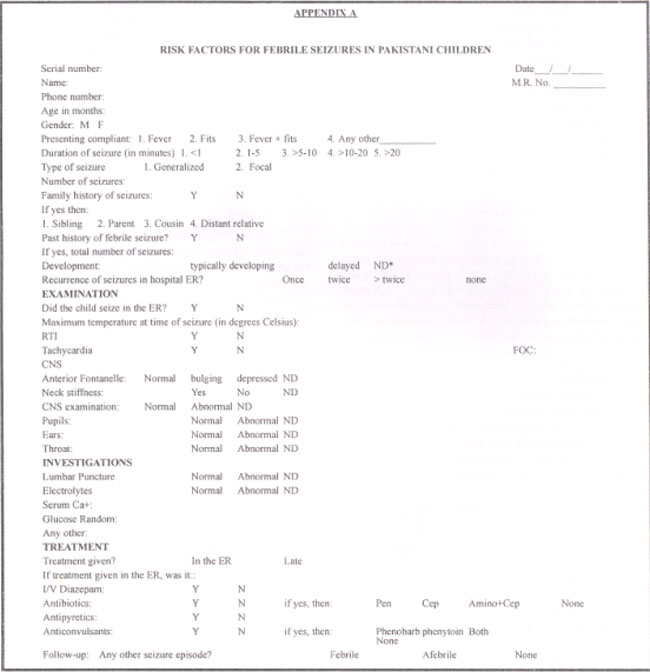
Duration of seizure
Shirts et al28 found that prolonged febrile seizures of
>1O minutes were associated with a higher recurrence risk of 39.7% compared with 28.7% for <1O minute duration. Thorn29 reported a 25% higher recurrence risk of FS in children whose first FS lasted 5 minutes or longer compared with those in whom the first FS was less than five minutes (46.5% Vs 21.6% respectively). This is supportive of our results, which showed that duration of seizure was the single most important factor affecting recurrence both at the bivariate and multivariate level of analysis.
Conclusion
Duration of seizure >5 minutes was the most important prognostic factor affecting FS recurrence in the ER in our cohort. Recurrence of FS in the ER in our sample can be modest’y predicted using the four factors identified in our study. Apparently the well-established risk factors, viz, age, family history and type of seizure were not relevant in our cohort.
Limitation of Study
In our sample, risk factors for recurrence of FS in the ER was studied, which limits the scope of our study.
Clinical Significance
Early treatment given in the ER did not affect recurrence in our study. This has implications in terms of prophylaxis for FS control/recurrence, suggesting timely anti-pyretic Vs anti-leptic medication use.
References
1.Hirtz, DO. Febrile Seizures. Pediatr Rev 1997;l 8:5-8.
2.Rantal H. Preventive treatment for recurrent febrile seizures. Ann Med 2000;
3:177-80.
3.Van Stuijvenberg M, de Vos S. Tjiang GC, et al. Parents fear regarding fever and febrile seizures. Acta Paediatr 1999; 88: 6 18-622.
4.Bessisso MS, Elsaid MF, Almula NA, et al. Recurrence risk after a first febrile convulsion. Saudi Med J 200 1;22:254-8.
5.Al-Eissa YA. Febrile Seizures: rate and risk factors of recurrence. J Child Neurol 1995;10:315-9.
6.Airedi Al. Febrile convulsions: factors and recurrence rate. Trap Geogr Med
1992;44:233-7.
7.Berg AT, Shinnar S. Hauser WA, et al. Predictors of recurrent febrile seizures:
a meta-analytic review. J Pediatr 1990;116:329-37.
8.van Stuijvenberg M, Steyerbcrg EW, Derksen-Lubsen G, et al. Temperature,
age, and recurrence of febrile seizure. Arch Pediatr Adolesc Med 1998;
152:1170-5.
9.Berg AT, Shinnar S. Darefsky AS, et a1. Predictors of recurrent febrile seizures. Arch Pediatr Adolesc Med.,1997;151:371-8.
10.Rantala H,Uhari M. Risk factors for recurrence of febrile convulsions. Acta Neurol Scand.,1994;90:207-10:
11.van Esch, A, Steyerberg EW, Berger MY, et al. Family history and recurrence of febrile seizures. Arch Dis Child 1994;70:395-9.
12.Offiinga M, Bossuyt PMM, Lubsen J, et al. Risk factors for seizure recurrence in children with febrile seizures: a pooled analysis of individual patient data from five studies. J Pediatr1994;124:574-84.
13.Berg AT, Shinnar S, Hauser WA, et al. A prospective study of recurrent febrile seizures. N Engi J Med 1992 327:1161-3.
14.Laditan AA. Seizure recurrence after a first febnle convulsion. Ann Trop Paediatr 1994;14:303-8.
15.Tarkka R, Rantala H, Uhari M, etal. Risk of recurrence and outcome after the first febrile seizure, Pediatr Neurol 1998;18:218-20.
16.Berg AT, Shinnar S. Unprovoked seizures in children with febrile seizures:
short-term outcome. Neurol 1996;47:562-8.
17.Berg AT, Shinnar S, Shapiro ED, et al. Risk factors for a first febrile seizure:
a matched case-control study. Epilepsia 1995;36:334-41.
18.El-Radhi AS, Withana K, Banajen S. Recurrence of febrile convulsions related to the degree of pyrexia during the first attack. Clin Pediatr
1 986;25:3 11-3.
19.Ragnav T. Hypothermia: Epidemiology and prevention. In: Costello A, Manandhar D, eds. Improving newborn infant health in developing Countries. London: Imperial College Press, 2000, chapter 9.
20.World Health Organization. Thermal protection of the newborn: a practical guide. In: Matemal and newborn health and safe motherhood program, Division of Reproductive Health., Geneva: WHO,1997, p.2.
21.Hair, iF, Anderson RE, Tatham RL, et al. Multivariate data analysis. Englewood Cliffs, Prentice Hall, 1995.
22.Stanhope JM, Brody JA, Brink E, et al. Convulsions amount the chamarro people of Guam, Mariana Islands. Am J Epidemiol 1972;95:299-304.
23.Nelson KB, Ellenberg JH. Prognosis of children with febrile seizures. Pediatr1978;61 :720-7.
24.Frantzen E, Lennox-Buchthal M, Nygaard A, et al. A genetic study of febrile convulsions. Neurology 1 970;20:909- 17.
25.Webb DW, Jones RR, Manzur AY, et al. Retrospective study of late febrile seizures. Pediatr Neurol 1999;20:270-3.
26.Wallace SJ. Recurrenceoffebrileconvutsions. Arch Dis Child 1974;49:763-5.
27.Wolf SM, Carr A, Davis DC et al. The value of Phenobarbital in the child who has had a single febrile seizure: a controlled prospective study. Pediatr
1977;59: 378-85.
28.Shirts SB, Hause, WA, Annegers JF, et al. Risk of recurrence of febrile seizures in a population-based cohort of children. Neurology 1987;37:149.
29.Thorn I. Prevention of recurrent febrile seizures: intermittent prophylaxis with diazepam compared with continuous treatment with Phenobarbital. In:
Nelson KB, Ellenberg JH (eds). Febrile seizures. New York: Raven Press, 1981, pp.119-26.
Related Articles
Journal of the Pakistan Medical Association has agreed to receive and publish manuscripts in accordance with the principles of the following committees:


