

R. Taj ( Department of Psychiatry, Pakistan Institute of Medical Sciences, Islamabad. )
K.S. Sikander ( Department of Psychiatry, Pakistan Institute of Medical Sciences, Islamabad. )
January 2003, Volume 53, Issue 1
Original Article

Abstract
Objective: To see the effects of maternal depression on breast feeding behavior.
Design: This is a cross-sectional study.
Place and duration: The study was carried out at the OPO of the Children’s Hospital Pakistan Institute of Medical Sciences Islamabad from October to mid November 2001.
Subject/Methods: One hundred mothers with children of breast feeding age from 2 months to 2 years were interviewed. These women were visiting the OPD of the Children’s Hospital Pakistan Institute of Medical Sciences, Islamabad for medical check up of their children. The interview included the administration of the Urdu version of Hospital Anxiety and depression Scale (HADS).
Results: Thirty eight percent of the women had stopped breast feeding and their mean score on HADS was 19.66. whereas 62% of the women were breast feeding their children with a mean score of 3.27 on HADS. Out of the non breast feeding mothers 36.8% reported that their depressive symptoms preceded cessation of breast feeding.
Conclusion: Maternal depression effects the breast feeding behavior of the mother. It causes mothers to stop breast feeding their children (JPMA 53:8;2003).
Introduction
Community studies in Pakistan show 44%-72% prevalence rates of depressive illness in women.1,2 Studies carried out in different parts of the world indicate that women are twice as much affected by depressive illness during the reproductive years as compared to men.3
Maternal depression can effect the whole family and more so the breast fed infant , in fact maternal depression can itself effect breast feeding. Up to 40% of women stop breast feeding in the first three months after delivery due to depression.4,5 Even a higher number of mothers stop breast feeding their infants by the sixth month post delivery.6
Early cessation of breast feeding depends on a number of factors apart from depression. These factors reside in the woman’s social environment, such as, mother hood at a younger age, less information seeking by the mother, lower family income, poor maternal health, poor emotional support and in case of working women, returning to work.4-6
Breast feeding has nutritional advantages for the infant in the first 6 months of life.7It also effects the cognitive development of the infant in the first 6 months of life.8 Furthermore it has psychological benefits for both mother and child.9 Breast feeding is a part of the care giving and hence one of the factors influencing bonding with the child and vise versa, this forms the basis of the attachment theory. Maternal depression effects this relationship negatively.10
Different studies show that breast feeding is associated with better maternal health during breast feeding period and after weaning. The longer a woman breast feeds before she weans lesser the emotional stress, lower levels of anxiety and depression, increased self esteem and coping capacity and better social health.6 Furthermore maternal distress and depression may be associated with inhibition of lactation.” The current study aims at finding the effect of maternal depresson on breast feeding behaviour.
Patients and Methods
Criteria
A non-probability sample of 100 women visiting the OPD of the Children’s Hospital, Pakistan Institute of Medical Sciences, islamabad for the check-up of their children of breast feeding age (2 months to two years ) were selected for the study. Informed consent and sociodemographic information regarding age, residence, education, number of children and employment status were obtained.
The sample was collected over a period of 6 weeks, starting from October to mid November 2001. These women were administered the Urdu version of Hospital Anxiety and Depression Scale (HADS).12 The cut-off points being 7/8 below which a clinically significant syndrome is unlikely and 10/Il above which a clinically significant syndrome is probable. 13 Data was analyzed on SPSS statistical package. Percentages were used to describe characteristics amongst the groups of non-lactating and lactating mothers. Whereas t-test and Chi-square statistics were used to match the groups of mothers on variables.
Women who were not breast feeding their children due to local breast problems such as mastitis, nipple problems, history of past and current medical or psychiatric illnesses. Similarly women, currently on treatment, where breast feeding was withheld due to drugs being secreted in breast milk, e.g. ischaemic heart disease, schizophrenia and major depressive illness, and those who could not breast feed due to medical problems, were excluded.
Results
Out of the 100 mothers, the mean HADS score of those who had stopped breast feeding was 19.66±5.44 and of the 62 mothers who were breast feeding their children as per routine was 3.27±5.98. When the non-lactating and lactating groups of mothers were matched on the variables of age, parity, education and income no statistically significant difference was seen. t-value for age was 1.60 (p> 0.05). t-value for income was 0.02 (p>O.05 ) and Chi-square
value for parity was 0.05( p>0.O5) and Chi-square value for education was 0.08 (p> 0.05) as shown in tables 1, 2, 3 and 4.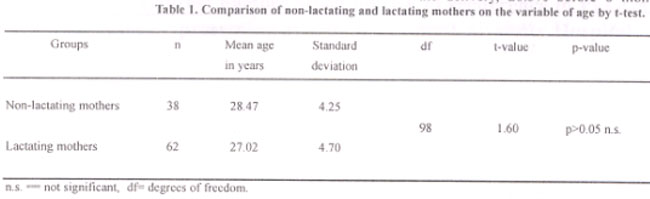
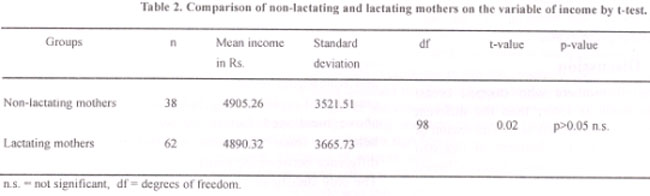
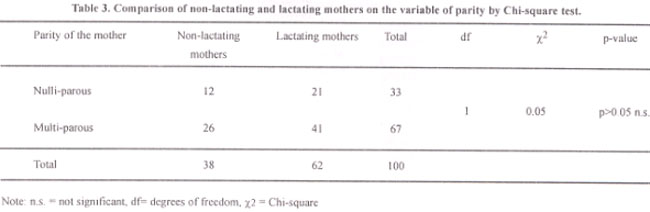
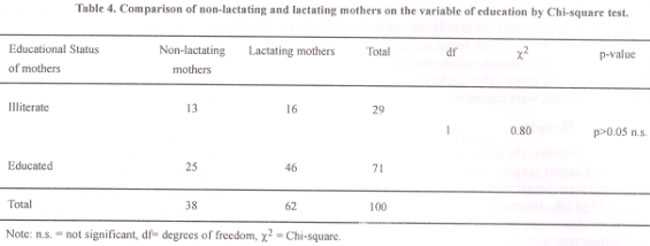
Whereas the t-value of the score of HADS of the non-lactating and lactating mothers was statistically very significant i.e., 14.09 (p<0.001) as shown in table 5.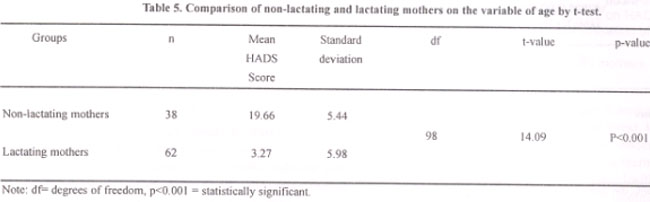
Of the 38 mothers who had stopped breast feeding, 14 had symptoms preceding breast feeding, 7(18.4%) reported it to be simultaneous (cessation of breast feeding and depressive symptoms), 6 (15.7%) mothers reported their depressive symptoms to precede cessation of breast feeding and 11(28.9%) mothers could not remember exactly as to when did they stop breast feeding before or after experiencing the depressive symptoms.
Out of the total non-lactating mothers, 31.5% mothers had stopped breast feeding after 6 to 12 months of the delivery, 26.3% before 6 months, 26.3%, 12 to 18 months post delivery and 15.7% stopped breast feeding 18 to 24 months after delivery. The niean age of the non-lactating mothers was 28.4±4.25 years.
Discussion
The percentage of mothers who stopped breast feeding in the current study is lower than the different studies carried out else where in the world.4-6 The reason of this might be that majority of the mothers in Pakistan practice the common cultural and religious value of breast feeding their infants for at least 24 months.
The other reason may be that majority of mothers cannot afford the alternatives to breast milk due to economic reasons. Majority of the mothers who stopped breast feeding reported, that their depressive symptoms preceded the cessation of breast feeding. This is in keeping with the studies reviewed.14 Out of the 62 lactating mothers, 17 of them in spite of being marginally distressed, were still lactating their children with a mean score of 12.2 on HADS.. whereas the remaining 45 mothers who were also lactating had zero score on HADS. These 17% of the mothers are perhaps potential non-lactating mothers if their depression were to increase.
Thirty six percent of the mothers stopped lactating6-12 months after delivery, whereas 26.3% mothers stopped
breast feeding before 6 months post delivery. This again is in keeping to the trend seen in the studies reviewed.4-6
The breastfeeding behaviour of mothers apart from depression depends on age, parity, socio-economic status and educational level. All of these factors can influence cessation of breast feeding. In the current study none of the above mentioned factors influenced the breastfeeding behavior, since there was no statistically significant difference between the non-lactating and lactating mothers. The only statistically significant difference was seen in the mean scores on HADS amongst the two groups of mothers. Perhaps the most important factor in our setup effecting breast feeding is matcrnal depression.
Nevertheless, this study points to an important area of maternal mental health and more detailed research is needed to see the different factors that influence breast feeding behaviour of mothers apart from maternal depression.
Keeping in view the findings of the current study, that maternal depression leads to cessation of breast feeding, these should be used to develop better liaison between psychiatry and other medical professionals for early detection and appropriate intervention. Reproductive psychiatry clinics, proving services to women who experience emotional problems during their reproductive life cycle, is a necessity.
References
1.Ahmed I, saeed k, Mumford DB, et al social stress and psychiatric morbidity in rural Pakistan. J Coll Physicians Surge Pak 2001;11:239-41.
2.Rumford DB, Nazir M, Jilani FM. Stress and psychiatric disorder in the Hindu Kush, a community survey of mountain villages in Chitral, Pakistan. Br J Psychology 1996;168:299-307.
3.Kalyarii S, Saced K, Rebman IUD, et al. Incidence of depression in Pakistani women during postnatal period. J Coll Physicians Surg Pak 2001;11:246-8.
4.Bick DE, MacArthur C, Lancashire RJ. What influences the uptake and early cessation of breast feeding? Midwifery 1998;14:242-7.
5.Gallery JR, Hussain RH, I3iggs MA, et al. Maternal moods predict breast feeding in Barbados.J Derv Behav Pediatr 1999;20:80-7.
6.Papinczak TA, Turner CT. An analysis of personal and social factors influencing initiation and duration of breast feeding in a large Queensland maternity hospital. Breastfeed Rev 2000;8:25-33.
7.Canadian Paediatric Society Nutrition Committee. Can J Public Health 1979;70:376-85.
8.Galler JR, Harrison re, Ramsey F et al. Maternal depressive symptoms affect infant cognitive development in Barbados. J Child Psycho\' Psych 2000;41:747-57.
9.World Health Organization. Indicators for assessing breast feeding practices: report of an information meeting. Geneva: WHO 1991, pp. 11-12.
10.Pridhain KF, Schroeder M, Brown R, et al. The relationship of a mother\'s working model of feeding behavior. J Adv Nurs 2001;35:741-50.
11.Mezzacappa ES, Guethlein W, VazN et al. A preliminary study of breast feeding and maternal symptoinatology. Ann Behave Med 2000;22:71-9.
12.Mumford DM, Tareen 1AK, Bajwa MAZ, et al. The translation and evaluation of an Urdu version of the Hospital Anxiety and Depression Scale. Acta Pysch Scand 1991:83:81-5.
13.Zigmond AS, Snaith RP. The Hospital Anxiety and Depression Scale. Act Psychiatr Scand 1983;67:361-70.
Misiri S, Sinclair DA, Kuan AJ. Breast feeding and post partum depression: Is there a relationship? Can J Psych 1997;42:1061-5.
Related Articles
Journal of the Pakistan Medical Association has agreed to receive and publish manuscripts in accordance with the principles of the following committees:


