

T.M. Karima ( Hera General Hospital*, Makkah, Saudi Arabia. )
S. Z. Bukhari ( King Faisal Hospital, Makkah, Saudi Arabia. )
M. I. Patani ( King Faisal Hospital, Makkah, Saudi Arabia. )
K.A.A. Yasin ( King Faisal Hospital, Makkah, Saudi Arabia. )
K.A. Al-Afif ( King Faisal Hospital, Makkah, Saudi Arabia. )
P.H. Hafiz ( King Faisal Hospital, Makkah, Saudi Arabia. )
January 2003, Volume 53, Issue 1
Original Article

Abstract
Objective:To describe the epidemiological, clinical and laboratory features of meningococcal disease and explore the factors responsible for its morbidity and mortality among the pilgrims during Hajj 2000.
Setting: This study was conducted at King Faisal Hospital, Makkah, Saudi Arabia.
Method: Any patient suspected of meningococcal disease during the period of pilgrimage presenting with fever, head ache, signs of meningeal irritation and turbid CSF, confirmed on gram stain smears, Latex agglutination test and culture was included in this study. Their clinical features, management and outcome was recorded and analysed.
Results:Of 105 confirmed cases of meningococcal disease, 64% had predominantly meningitis, 36% meningococcaemia and meningitis. Meningococcal rash was found in 2% and co-morbidity in 18% of cases. Antibiotics used empirically were benzylpenicillin or ceftriaxone along or in combination. Overall case facility rate was 34%. Delay in diagnosis, delay of antibiotic administration, older patients and patients with serious concurrent medical problems, were the factors leading to higher than expected mortality rate. Maximum number of patients were Pakistanis (18%) followed by Indians (15%) and Indonesians (12%). Overall serogrouping was as follows: group A (44), W135 (19), B (1) and untypable (1). Serogroup W135 appeared more invasive and more fatal.
Conclusion: Quadrivalent vaccine ACYW135 is recommended for pilgrims to enter Saudi Arabia and for mass vaccination in local population (JPMA 53:3;2003).
Introduction
Hajj, the fifth pillar of Islam, is the journey to the holy city Makkah (Mecca) for the purpose of performing religious rituals. It is obligatory, once in a lifetime to all adult healthy Muslims who can afford it. Makkah is frequently affected by epidemics of meningococcal disease due to gathering of more than two million Muslims from all over the globe. The maximum temperature during study period ranged 38°C to 42°C and humidity 70%.
Text Box: Vol. 53, No.1, January 2003 3Two clinical overlapping syndromes, meningitis and meningococcaemia may occur simultaneously. Meningitis alone occurs most frequently. Meningococcaemia with intravascular haemolysis and toxaemia leads to shock and coma. Fulminating septicaemia cases often die within 24 hours of being apparently well and may never reach hospital alive. The fatality of untreated cases is about 50% and it declines to 10% in those cases, which were treated early.1,2 The case fatality rate (CPR) in meningococcal meningitis is 10-15 % but can be as high as 50-60% with fulminant meningococcaemia.1
According to Word Health Organization higher CPR (37-60%) has been reported in the developing countries while in developed countries, it is 319%.3
Aim of this study was to describe clinical features, laboratory diagnosis, management, and sequelae of meningococcal disease and to explore the epidemiological factors responsible for its emergence among the pilgrims. The study included pilgrims who performed Hajj between 9th and 12th day of 12th lunar month (Dhul Hajj), and umrah pilgrims who came during Ramadan 9th lunar month and stayed at Makkah to perform Hajj.
All suspected and microbiologically confirmed cases of meningococcal disease from other government and private hospitals and health centers of Makkah region were referred to King Faisal Hospital (KPH) for management. KPH is the only government referral hospital for infectious diseases in the holy city of Makkah.
Patients and Methods
It is a descriptive study in which all adult patients with meningococcal disease admitted at KFH between the period February and April 2000 during the annual pilgrimage were included. Personal data, like age, sex, nationality, status of residence and clinical informations such as fever, vomiting, skin rash, neck stiffness, antibiotic intake prior to admission, vital signs, signs of meningeal irritation, treatment, and prognosis of the patient were recorded. Cerebrospinal fluid (CSF) examination findings, which included total and differential cell count, sugar and protein estimation, gram staining, latex agglutination test and culture, were noted. Blood culture and gram stain of needle aspiration from the meningococcal rash were also recorded.
A suspected case of meningococcal disease was defined as any person during the period of pilgrimage presenting with sudden onset of fever, headache, signs of meningeal irritation and turbid CSF. Microbiological confirmation was made by the recovery of meningococci from, gram stain smears, latex agglutination test, and culture. When the above 3 parameters were negative, typical meningococcal rash was incorporated to confirm the meningococcal disease. Processing of CSF and blood culture specimens and identification of the organism was made by the standard bacteriological techniques4-6 and antimicrobial susceptibility testing was performed according to National committee for clinical laboratory standard (NCCLS) recommendation.? Bacterial antigen detection was done by Wellcogen bacterial antigen Kit. Serogrouping was performed by using antisera manufactured by Murex.
Results
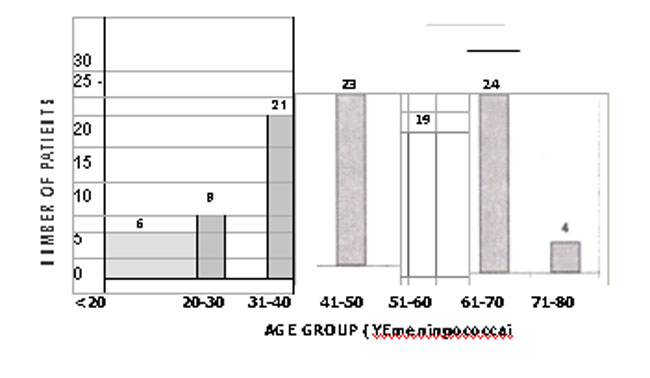
Maximum number of patients were
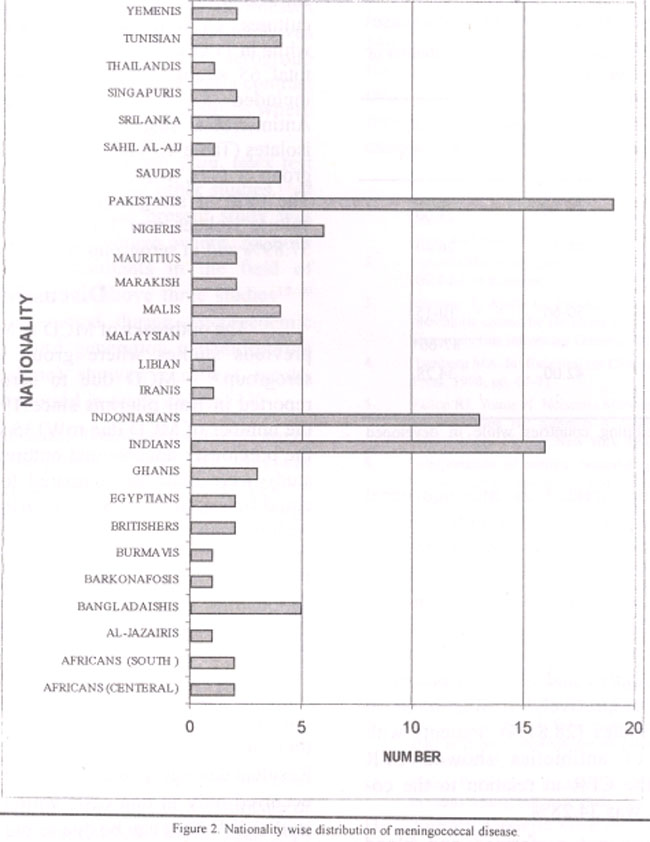
Pakistani nationals, 19 (18.09%) followed by Indians 16 (15.24%) and Indonesians 13 (12.38%). The nationalIschemic distribution of MCD is given in Figure 2.
Informations about the immunization status were not available in majority of the patients.
Symptoms of meningitis as fever, headache, vomiting and signs of meningeal irritation were found in 67 (63.81%) cases and 38 (36.19%) had menigococcaemia and meningitis. Meningococcal rash was found in 30 (28.57%) cases and 8 (7.62%) had fulminant meningococcaemia.
Associated medical illnesses (co-morbidity) as diabetes mellitus, hypertension, ischemic heart disease and renal failure were prsent in 19 (18.09%) cases. Delay in administration of antibiotics, was found in 9 (8.57%) cases
and these patients were not treated as meningococcal disease prior to admission. As regards outcome, 68 (64.76%) patients improved while 36 (34.28 %) died and residual damage occurred in 1 (0.95%) patient.
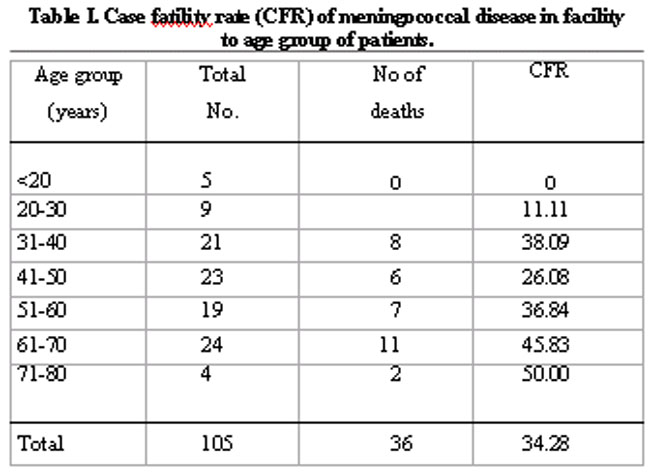
Table 1 illustrates CFR in relation to age groups of the patients. CFR in commonly affected nationality groups was as follows: Pakistani 31.58%, Indian 37.50%, and Indonesians 30.77%. The CFR in meningitis, and meningococcaemia was 29.83% and 42.10% respectively. It was more in females (41.30%) than in males (28.81%). Patients with delay in administration of antibiotics showed CFR (66.66%).
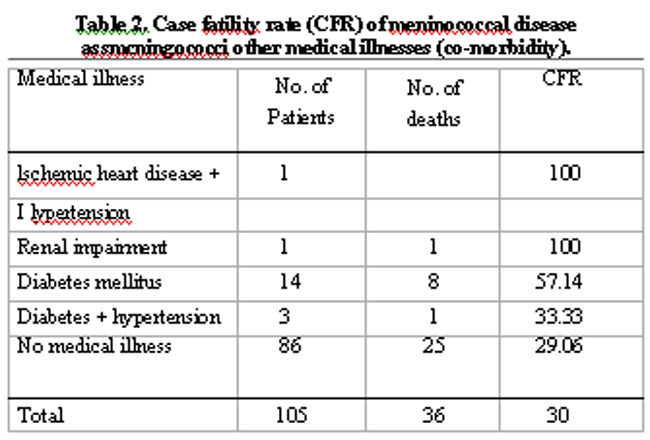
Table 2 shows the CFR in relation to the co-morbidity. The overall CFR was 34.28%.
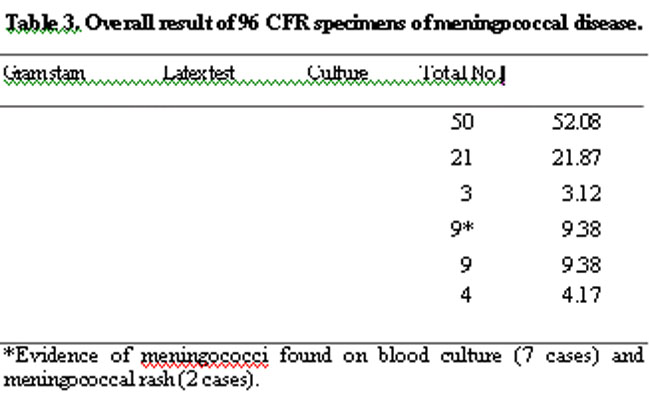
Text Box: 6 J Pak Med AssocLumber puncture was not performed and blood culture samples were not taken in 9 (8.57%) cases, as the patients were received in shock. Amongst the 96 cases where a lumber puncture was performed, the macroscopic examination of the CSF revealed that 89(92.71%) specimens were turbid and 7(7.29%) were clear in appearance. On microscopy, 93 (96.87%) showed raised white cell count with more than 80% polymorphonuclear leukocytes (PNL) and 3 (3.12%) were normocellular <5/cmm. Total protein level of >50mg% was detected in 93 (96.87%) cases. Decreased glucose concentration <50% of the blood glucose level were seen in 92 (95.83%) of the samples. Of 96 CSF samples, gram stain demonstrated gram-negative diplococci (GNDC) in 74 (77.08%) smears, latex test was positive in 84 (87.51%) samples and cultures were positive in 54 (56.25%) cases. In 9 instances, gram stain, latex and culture were negative, but GNDC were seen on gram staining by needle aspiration from the meningococcal rash in 2 cases. The overall result of gram stain, latex and culture of 96 CSF samples is given in Table 3.
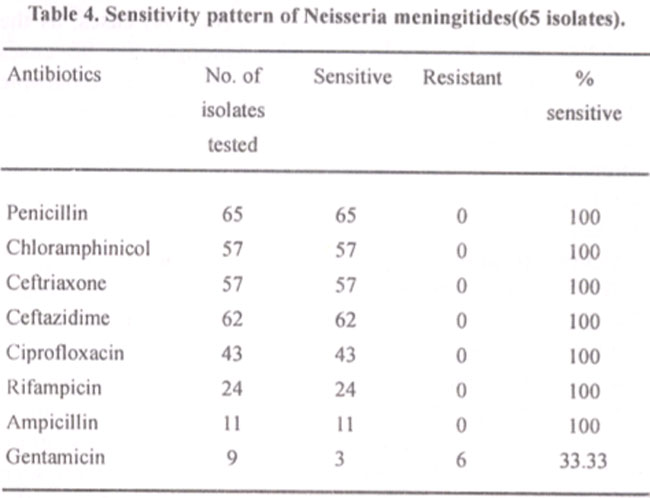
Total 70 blood cultures were received, 25 (35.71%) showed growth of N. meningitidis. Out of 25 positive blood cultures, 14 were associated with positive CSF cultures while in 11 cases only blood culture was positive. Therefore total 65 strains of N. meningitidis were isolated which included 54 CSF and 11 blood culture isolates. Antimicrobial susceptibility testing was performed on 65 isolates (Table 4).
The overall serogrouping was as follows: group A (44), W135 (19), B (1) and untypable strain (1). The ratio of serogroup W135 versus group A onserogroup.s-10 isolates was 1.3:1. CFR in serogroup W135 was 57.89% and in serogroup A 22.73%.
Discussion
The outbreaks of MCD in Makkah were described in previous studies where group A emerged as a main serogroup.8-10 MCD due to serogroup W135 has been reported in Hajj pilgrims since 1995, but in present study the number of MCD due toW135 was high as compared to the previously documented outbreak.” The patients in this study were older as compared to other studies.12,13 This could be explained that the pilgrims from the subcontinent perform Hajj at an older age due to financial constrains. The male and female ratio was comparable to other studies.9,10,14 Pakistanis, Indians and Indonesians, were the common nationalities affected in our study due to ill health, poverty and poor hygiene. Similar obsevation was made by one of the previous documented outbreak in Makkah.10
Cases presenting with typical symptoms of meningitis in our study like neck stiffness, were less than that of one10 and more than another similar study. 15 Residual damage, neurological sequelae in the present study occurred only in one case, which is much less than other studies.12,14This can be due to our higher CFR.
Comparison of CFR in MCD of our study with other studies1,3,10,12,14 is given in Table 5.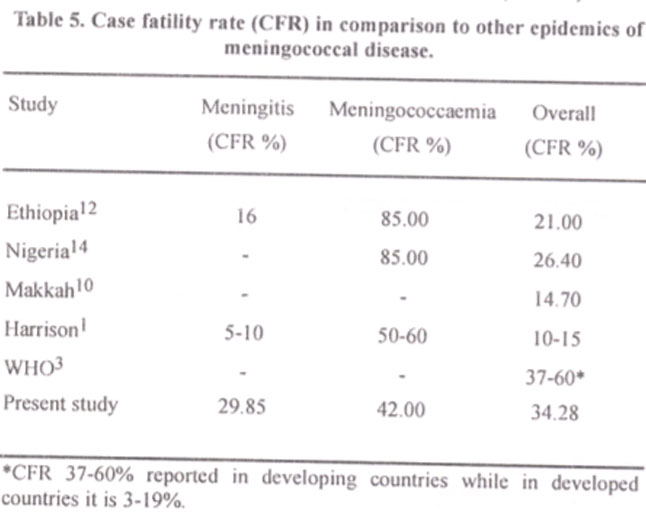
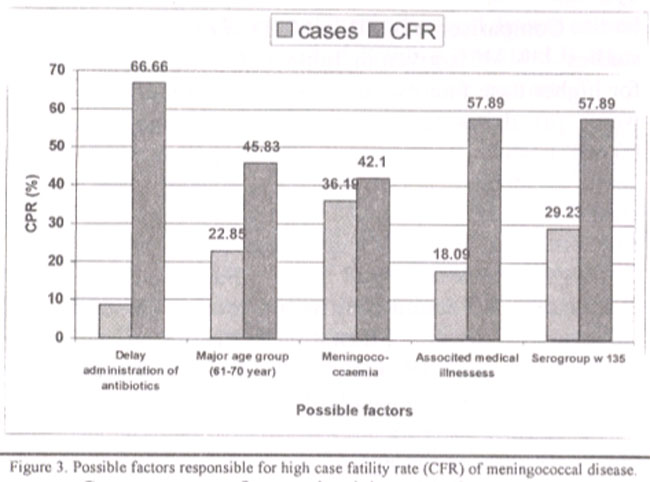
The factors responsible for higher case fatality rate in the present study (Figure 3) were: (a) delay in administration of antibiotics (CFR 66.66%) which is comparable with another study.16 This could be explained due to delay in admission through Health Centers and Hajj Mission dispensaries of various embassies and delayed diagnosis because the patients of meningococcaemia were not diagnosed on CSF examination but found positive on routine blood cultures, (b) major age group (CFR of 45.83%) patients in this group were older than 15-19 years in Ethiopia study2 where CFR was 21%. Similarly in Khartoum epidemic13 major affected age group was 20 years and CFR was 6.3%. The age group above 60 years is the age of physiological death, where a minor ailment can prove fatal, (c) a high rate of meningococcaemia, i.e., 38(36.19%) patients, of these 16 (42.10%) died which is the main contributory factor of our high overall CFR which is contrary to reported figure by Salih et al13 where meningococcaemia was found only in 3.7% of the total cases, (d) associated medical illnesses were found in 19 (18%) patients of our study and CFR was 57.89% which affected the overall CFR, (e) serogroup W135 in our study (29.23%) with CFR 57.89 was a contrast to other documented epidemics in Makkah8-10 where serogroup A was isolated from all patients.
The rate of positive results of gram stain, latex test and culture in our study are higher than other studies.17-19 This may be due to the fact that the present study was conducted during the annual pilgrimage where 24 hour services of specialists and consultants in the field of microbiology was provided while above three studies17-19 under discussion were conducted during interepedemic period. Penicillin G and third generation cephalosporine (cefiriaxone and ceftazidime) showed excellent results against meningococci as reported in other studies.12,20
The government of Saudi Arabia requirements are of bivalent A/C vaccine for the pilgrims since 1987. /this was after a large epidemic of group A MCD in Makkah.10 During Hajj 2000, the A/C vaccine was not 100% protective and did not eliminate carriage of the organism, therefore close contacts of the pilgrims within Saudi Arabia or returning from Saudi Arabia were at risk. There was no pilgrim from United States (US) affected in our study. Probably they received quadrivalent ACYW135 vaccine, which is the only vaccine, licensed in the United States.21 The vaccination status of the pilgrims in our study was not available; therefore we were unable to explain the occurrence of MCD (group A) in this outbreak. It could be due to the failure of A/C vaccination or due to non-vaccination, because most of the pilgrims get a certificate of vaccination without being vaccinated. More than 300 laboratories confirmed cases of men ingococcal disease caused by serogroup W135 reported in Saudi Arabia and 9 other countries among Hajj pilgrims and their close contacts.22
The emergence of serogroup W135 was probably due to lack of protection of pilgrims, as they were not vaccinated by quadrivalent vaccine. Although serogroup A was a major group of this epidemic, but group W135, appeared more invasive and more fatal. Delay in diagnosis, and antibiotic administration, older patients and patients with serious concurrent medical problems were factors leading to a higher than expected mortality rate in MCD in our study. The prompt administration of antibiotics in cases of suspected MCD is recommended for successful management. It is recommended to initiate a protocol for using quadrivalent meningococcal vaccine (ACW135) in place of AC bivalent vaccine for Hajj pilgrims for entry to Saudi Arabia and for the local residents.
Acknowledgements
We are grateful to Dr. Osman Abdurahman AlMaimani, Director Health Affairs, Health Directorate, Ministry of Health, Makkah Al-Mukarmah, Saudi Arabia, for his continuous support and cooperation in carrying out this study. We are also thankful to Dr. Osman Saleh, Infection Control officer for providing the list of confirmed cases of meningococcal disease.
References
1.Solberg CO. Meningococcal meningitis. In: Fauci AS, Braunwald E, Isselbacher KJ, et al. Harrison’s Principles of Internal Medicine. 14th ed. New York: McGraw-Hill, 1998, pp. 910-14.
2.Apicella MA. Meningococcal infections, In: Goldman L, Bennett C, (eds). Ceccil text book of medicine. 21st ed. Philadelphia: W.B. Saunders, 2000, pp. 1655-59.
3.Popovic 1, Ajello G, Facklam R. Laboratory manual for the diagnosis of meningitis caused by Neisseria meningitidis, Streptococcus pneumoniae, and Haemopholius influenzas Geneva: WHO., 1999, pp. 19-22.
4.lsenberg MA. In: Essential for Clinical Microbiology. Washington DC: ASM Press, 1998, pp. 67-72.
5.Fallon Rj, Young H. Ncisseria,Moraxella, Acinetobacter. In: Collee JO, Fraser AG, Marmion BP, Simmon A. Mackie and McCartney practical medical microbiology. 14th ed. New York: Churchill Livingstone, 1996, pp. 285-89.
6.Interpretation of aerobic bacterial growth on primary culture media. In:
Essential procedures for clinical microbiology. Isenberg HD. Washington 1)C:
ASM Press, 1998, pp. 5 1-57.
7.National committee for clinical laboratory standards (NCCLS). Performance standards for antimicrobial susceptibility testing by disk diffusion method.
2000;20:2.
8.Moore PS, Harrison LH, Telzak EE, et al, Group A meningococcal carriage in travelers returning from Saudi Arabia. JAMA 1988; 260: 2686-89.
9.Novelli VM, Lewis RG, Dawood ST. Epidemic group A meningococcal disease in Hajj pilgrims. Lancet 1987; 2: 863.
10.Al-Gahtani YM, El-Bushra HE, Al-Qarawi SM, et al. Epiderniological investigation of an outbreak of meningococcal meningitis in Makkah, Saudi Arabia, 1992. Epidiom Infect 1995; 115:399-409.
11.YousufM, Nadeem A. Fatal meningococcaemia due to group WI 35 amongst Hajj pilgrims - implications of future vaccination policy. Ann Trop Med Parasitol 1995; 89:321-22.
12.Fekade D, Zawde D. Epidemic meningococcal meningitis in adults Ethiopians in Addis Ababa, Ethiopia, 1988. Ethiop Med 31992; 30:135-42.
13.Salih MA, Ahmad HS, Karrer ZA, et al. Features ofa large epidemic of group A meningococcal meningitis in Khartoum, Sudan in 1988. Scand J Infect Dis 1990: 22:161-70.
14.Angyo IA, Okpeh ES. Clinical predictors of epidemic outcome in meningococcal infection in Jos, Nigeria. East Afr Med J 1997; 74:423-26.
15.Ragunathan L, Ramsay M, Borrow R, et al. Clinical features, laboratory findings and Management of meningococcal meningitis in England and Wales: Report of a 1997 Survey. J Infect 2000, 40:74-79.
16.Wilks D, Lever AM. Reasons for delay in administration of antibiotics to patients with meningitis and meningococcaemia. J Infect 1996; 32:49-51.
17.Vadher PJ, Vaidya NS, Soni P, et al. Bacteriological study of meningococcal meningitis. J Postgrad Med 1991 ;37:76-78.
18.Aguiar-Nogueire J, Lecour H, Luz-Dias M. Use of latex agglutination test in rapid diagnosis of acute meningitis. Enferm Infect Microbiol Clin l989;7:186-88.
19.Soomro AA, Khan JI, Maqbool S. Comparison of conventional bacteriological methods with latex agglutination technique for diagnosis of pyogenic meningitis in children. Pak 3 Med Res 1995; 34:208-11.
20.Knapp JS, Koumans EH. Neisseria and Branhamella. In: Murray RR, Baron EJ. Pfaller MA, et al. 7th ed:Manual of clinical Microbiology. Washington DC: ASM press, 1999 pp. 586-603.
21.Popovic T, Sacehi CT, Reeves MW. Neisseria meningitidis serogroup W135 associated with ET-37 complex. Emerging infectious disease. CDC Atlanta, 2000;6:10-1 1.
22.Samuelsson S. Handysides S, Ramsay M, et al. Meningococcal infection in pilgrims returning from Hajj: update from Europe and beyond. Eurosurveillance Weekly 2000;17:1-5.
Journal of the Pakistan Medical Association has agreed to receive and publish manuscripts in accordance with the principles of the following committees:


