

Mehmet Yigit ( Department of Emergency Medicine, Fakulty of Medicine, Bezmialem Vakif University, Istanbul, Turkey. )
Nazmiye Tanrikulu ( Agri State Hospital, Emergency Service, Agri, Turkey. )
Kenan Ahmet Turkdogan ( Department of Emergency Medicine, Fakulty of Medicine, Bezmialem Vakif University, Istanbul, Turkey. )
Eda Yigit ( Department of Emergency Medicine, Fakulty of Medicine, Bezmialem Vakif University, Istanbul, Turkey. )
February 2015, Volume 65, Issue 2
Case Reports

Abstract
Lightning strikes especially occur during spring and summer months in the afternoons when there is heavy rain. In deaths resulting from lightning strike, there may either be no evidence on the dead person\'s clothes or body, or there may be burnt or torn patches on their clothes and lichtenberg figures specific to lightning strikes on their bodies. In such cases that also have a comorbid of cognitive dysfunction, since there is generally amnesia, having these figures during the physical examination has a valuable place in early diagnosis and quick treatment. This paper presents a case of lightning strike that was found to have Lichtenberg figures on the back and right leg after secondary examination.
Keywords: Emergency service, Lichtenberg figure, Lightning strike.
Introduction
Lightning is the discharge of the electrical potential forming in the atmosphere between clouds and the earth. It follows a zigzag path and comes down in branches.1 As a result of lightning strike, there may be no symptoms in the person while broad burns, fumigations on hair and injuries in many organs resulting from the electric current passing through the body may be seen.2
Lightning strikes occur, especially during spring and summer months, in the afternoons when there is heavy rain. About 20-30% of the people who are injured as a result of lightning strike die, while those who survive develop various sequelae such as peripheral neuropathy and defects in cognitive functions in the long run. In deaths resulting from lightning strike, no symptoms may be found on the person\'s clothes or body while in some cases there may be burnt or torn places on the person\'s clothes and fernlike figures specific to lightning strikes on their bodies.3 In the autopsy of deaths resulting from lightning strike, the symptoms detected in internal organs are not diagnostic alone. Internal organs are reported to have hyperaemia, oedema, fluid and bleeding.3 Because of this, in cases of lightning strike, the person\'s clothes and crime scene investigation have an important place in early diagnosis and treatment.1
We present a case who was brought to the hospital in an injured state as a result of lightning strike and whose diagnosis of amnesia was made on the basis of physical examination.
Case Report
A 32-year-old male patient, who was found in an unconscious state by his friend, was bought to our hospital. His physical examination revealed that his general condition was moderate, his consciousness was blurred and he responded to painful stimulus. His Glasgow Coma Score (GCS) was 14 and he had burnt lesions on his back and right leg. His vital findings: blood pressure 100/55mmHg, pulse 115 beat/minute, respiratory rate 16. His laboratory examinations were: alanine transaminase (ALT) 57, aspartate aminotransferase (AST) 60, creatine kinase (CK) 1952, CKMB 42, Troponin I 0,612. The patient was taken to the intensive care unit (ICU) where he was monitored and broad lumen vascular access was established. When the patient was undressed for secondary examination, 3 Lichtenberg figures on his back and 1 Lichtenberg figure on the lateral aspect of his right leg were observed; thus, hydration was started (Figures-1 and 2).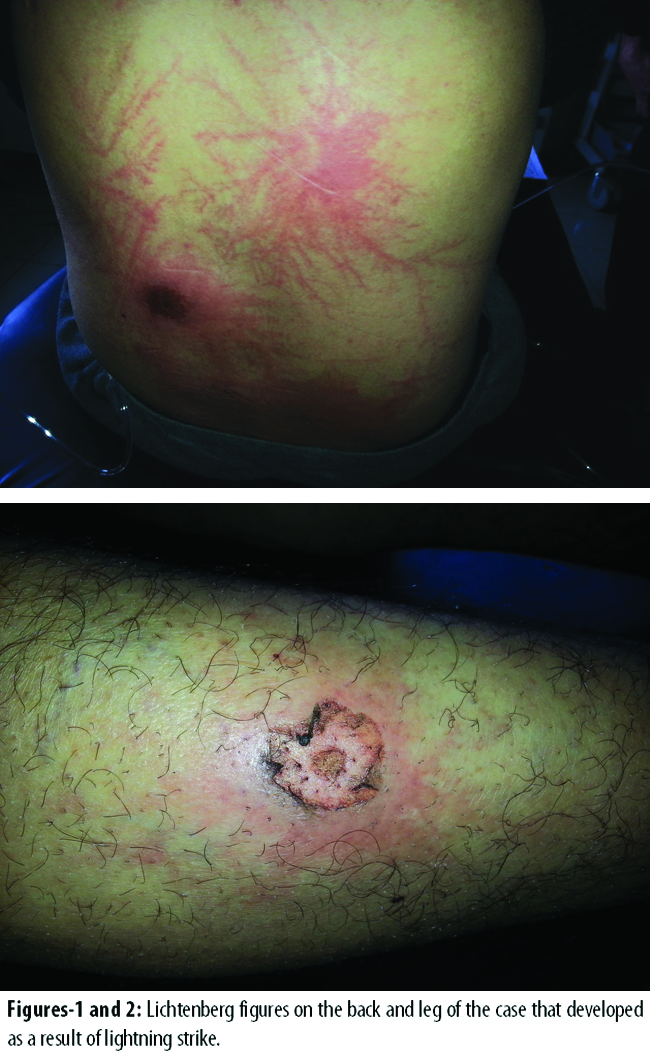
His electrocardiogram (ECG) was taken and bladder catheter was inserted. His ECG showed normal sinus rhythm. After anaesthetic consultation in the ICU, his consciousness level became clear on the second day of hospitalisation. His anamnesis revealed that rain had started suddenly while he was tending animals with his friend and he could not remember what had happened afterwards. During the observation in the ICU, no other abnormality was noted on the patient\'s physical examination. He recovered well and acquired full consciousness.
Discussion
In Turkey, there is no reliable data about deaths resulting from lightning strikes. In a study conducted in Diyarbakir, it was reported that 10(0.7%) of the 1441 cases whose autopsies were done by Diyarbakir Forensic Branch Office between 1996 and 1998 had died as a result of lightning strike.4
People who work or do activities outdoors, such as campers, walkers, farmers, construction workers, golfers and hunters are the most common victims of lightning strikes.5 Since our case was a shepherd, he was among the risky group in terms of lightning strike.
Various physio-pathologic mechanisms get involved in lightning strike. These are injuries resulting from the initial explosion, an injury process following this, falls and thermal and sometimes transfer injuries in tissues. Unlike being exposed to artificially-produced electricity (it generally lasts longer and causes advanced destruction in deep tissues), a person is exposed to lightning strike for a very short period of time and most of the current passes from the surface of the body.6 Injuries resulting from lightning strike are complex and the resulting situations range from temporary burnt areas similar like trees to death.7 In this case, the diagnosis was made by Lichtenberg figures before anamnesis.
After a lightning strike, there may be broad burnt patches on a person\'s clothes, metal objects on or inside clothes (buttons, zip, belt clips, even the money in pockets) may show signs of being exposed to extreme heat, metallic objects may show characteristics of combining and getting magnetic properties, clothes may be torn or the person may be totally undressed, and if electricity goes off through the feet, skin or shoes may be torn at the point of exit. Burnt clothes, synthetic materials that melt with heat or metallic objects such as belt clip can cause burns on skin.8 The symptoms in our case were burnt clothes or hair, magnetisation on clothes and belts which are the typical symptoms of lightning strike.
When the geography of Turkey and socioeconomic and educational levels of the people are taken into consideration, the number of injuries or deaths resulting from lightning strikes may be more than the estimated number.4 Thus, early diagnosis of injuries resulting from lightning strikes and starting treatment early is important.
Conclusion
Since the first anamnesis is not generally taken from the patient, most of the time, there are some delays in making a diagnosis. Thus, in patients whose anamnesis is not fully taken, secondary examination should be certainly made and the cases should be reviewed in detailed physical examination.
References
1. Butun C, Beyaztas FY, Yilmaz R. Lightning-related Death. Turk Arch Ped 2012; 47: 60-3
2. Knight B. Forensic Pathology. 2nd ed. London: Edward Arnold, 1996, 330-1.
3. Whitcomb D, Martinez JA, Daberkow D. Lightning injuries. South Med J 2002; 95: 1331-4.
4. Dogan KH, Demirci S, Gunaydin G. Deaths caused by lightning strike: Case report of three cases. Genel Tip Derg 2007;17: 217-22.
5. Aslar AK, Soran A, Yildiz Y, Isik Y. Epidemiology, morbidity, mortality and treatment of lightning injuries in a Turkish burns units. Int J Clin Pract 2001; 55: 502-4.
6. DiMaio DJ, DiMaio VJM. Forensic pathology. Florida: CRC Press; 1993, 367-76.
7. Settle JAD, Burns. In: Mason JK, Purdue BN, editors. The pathology of trauma. 3rd ed. London: Arnold Publishers; 2000, 211-29.
8. Eke M, Soysal Z. Fiziksel Etkenlerle Olusan Zararlar. Içinde: Soysal Z, Çakalir C, editörler. Adli tip. Cilt II. 1.baski. Istanbul: Istanbul Üniversitesi Cerrahpasa Tip Fakültesi Yayinlari; 1999. 607-765.
Journal of the Pakistan Medical Association has agreed to receive and publish manuscripts in accordance with the principles of the following committees:


