

Farah Gul Khan ( Department of Nephrology, Sindh Institute of Urology and Transplantation (SIUT), Karachi. )
Ejaz Ahmed ( Department of Nephrology, Sindh Institute of Urology and Transplantation (SIUT), Karachi. )
February 2015, Volume 65, Issue 2
Original Article

Abstract
Objective: To study the causes and outcome of Acute renal failure (ARF) in diabetes mellitus.
Methods: This prospective study was conducted at nephrology unit of SIUT Karachi, Pakistan from November 2012 to May 2013. All adult patients with known underlying diabetes presenting with suspected ARF were included in the study. The treatment options were conservative and dialysis. Renal biopsy was performed in selected patients. All patients were followed for a period of six weeks for outcome of renal failure i.e. recovery, dialysis dependency and death.
Results: A total of 95 patients with suspected ARF were enrolled during this period. We found sepsis as the single most common factor causing ARF in 66 (69.5%) patients and the most common focus of infection was found to be urinary tract in 47 (71.2%) patients. Other factors leading to ARF included volume depletion in 19 (20%), cardio renal in 13 (13.7%), acute glomerulonephritis in 3 (3.15%) and contrast exposure in 2 (2.1%) patients. In all 72 (75.8%) patients required dialysis, while 23 (24.2%) were managed conservatively. Eventually 62 (67.39%) patients recovered, 14 (15.21%) became dialysis dependent, and 16 (17.39%) died. Among those who expired, all underwent dialysis and sepsis was the leading cause of death in 13 (81.25%) patients.
Conclusion: Infection, especially of urinary tract is the leading cause of ARF in Diabetics. Outcome is favourable in those who dot require dialysis.
Keywords: Acute Renal Failure, Diabetes mellitus. (JPMA 65: 179; 2015).
Introduction
Acute renal failure (ARF) is one of the most common problems encountered by nephrologists in patients admitted in hospital. It is associated with a high rate of morbidity and mortality (exceeding 30%) especially when the need for dialysis arises.1,2 Even moderate decline in kidney function leads to prolonged length of stay in hospital, increased costs and significantly increased risk of death.3,4
Diabetes mellitus has been recognized as a risk factor for contrast induced nephropathy and other types of ARF.5 The presence of underlying diabetic nephropathy may predispose to ARF resulting from adverse effects such as sepsis, hypotension or exposure to nephrotoxic agents. The increased incidence of cardiovascular disease among diabetic patients may also lead to renal insufficiency as a result of complications of renal artery atherosclerosis or ischaemic heart disease. Diabetic patients presenting with renal failure are often assumed to have advanced diabetic nephropathy. Little effort is made to find out reversible component of renal failure, even in those with recognizable acute insult preceding presentation.
A literature search revealed few studies on this topic of acute renal failure in diabetes. This study was conducted to find out the factors leading to ARF in patients with underlying diabetes mellitus and its outcome at our institution.
Patients and Method
This prospective study was conducted at nephrology unit of Sindh Institute of Urology and Transplantation (SIUT) Pakistan, from November 2012 to May 2013. SIUT is a big tertiary care center for nephro-urology patients. All adult patients with known underlying diabetes presenting with suspected acute renal failure in the setting of recognizable acute insult were included in the study. For the purpose of this study ARF was considered
A) Definite: when
1. Diabetic patients with known baseline creatinine experienced > 50% increase in serum creatinine during acute illness requiring hospitalisation.
2. When baseline values were not available ARF was considered to be present at the end of six weeks if
u Patient requiring dialysis became dialysis free.
u Patient treated conservatively experienced > 50% reduction in serum creatinine from admission value.
B) Probable: when
Diabetic patients presenting with renal failure following an acute insult, in whom baseline creatinine was not known, and who failed to recover renal function or died during treatment before recovering renal function during first six weeks.
Following patients were excluded from the study;
1. Patients with known diabetes with documented progressive decline in renal function requiring dialysis.
2. Patients with known diabetes, admitted with renal failure, in whom renal functions were never checked in the past and had no preceding history of any acute event.
3. Diabetic patients with renal transplant.
A detailed history was taken regarding duration of diabetes, smoking, associated hypertension, coronary artery disease, any intervention done, drug history especially of ACEI/ARB, NSAIDS and diuretics. Last outpatient serum creatinine if available and serum creatinine on admission were noted. Blood culture, urine culture and kidney ultrasound were done in all patients included in the study. Ultrasound was done to see the size, echotexture, presence or absence of pelvicalyceal system dilation and stones. The treatment options were conservative and/or dialysis. Duration of dialysis in weeks required for individual patient was also noted. Renal biopsy was performed in selected patients in whom no cause of renal failure was established. All patients were followed for a period of six weeks.
The outcome of the patients was recorded under three categories.
1. Recovered.
u Renal functions return to baseline with/without dialysis.
u > 50% reduction in serum creatinine from the admission value.
u Patients requiring dialysis become dialysis free.
2. Dialysis dependent.
3. Died, despite all of above.
All the data was recorded in the pre-designed proforma and SPSS 10 was used for the analysis of frequency of variables.
Results
A total of 95 patients (58 males and 37 females) with suspected ARF were enrolled during this period, 77 patients (81%) had definite ARF and 18 patients (18.94%) had probable ARF. Three patients subsequently lost to follow up, were excluded from outcome analysis. Baseline characterists are shown in Table-1.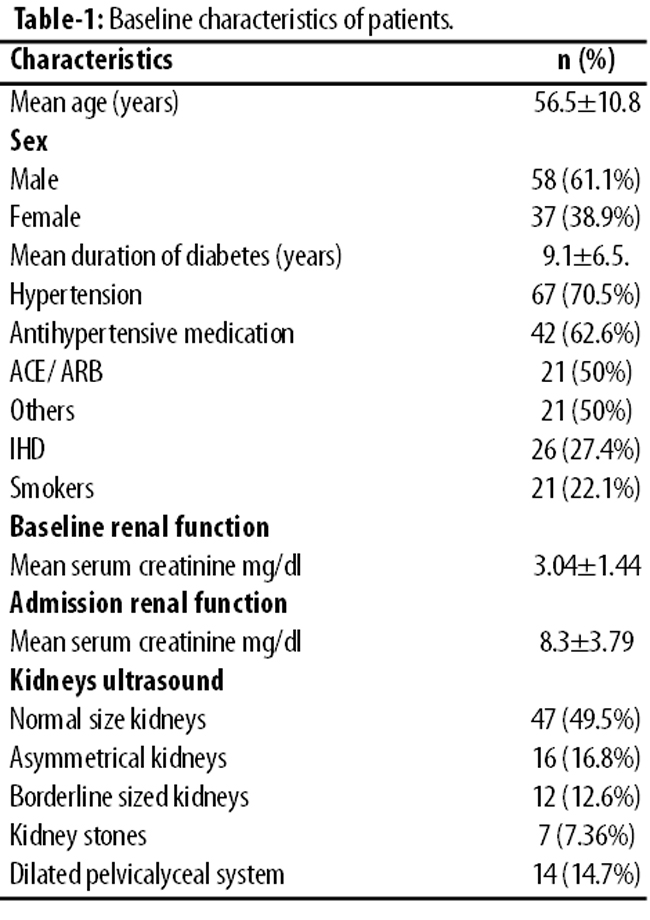
Baseline renal function was known in 45 (47.4%) patients with mean creatinine value of 3.04 mg/dl ±1.4. In 50 (52.6%) patients baseline renal function was not available.
Factors leading to ARF were multifactorial in the majority with sepsis playing a role in more than half patients [66 (69.5%)]. Focus of infection was urinary tract in 47 (71.2%), skin/soft tissue in 13 (19.6%), respiratory tract in 7 (10.6%), liver/GIT in 3 (4.5%) and malaria in 2 (3.03%) patients. Other factors leading to ARF included volume depletion in 19 (20%), cardio renal in 13 (13.7%), acute glomerulonephritis in 3 (3.15%) and contrast exposure in 2 (2.1%) patients (Table-2).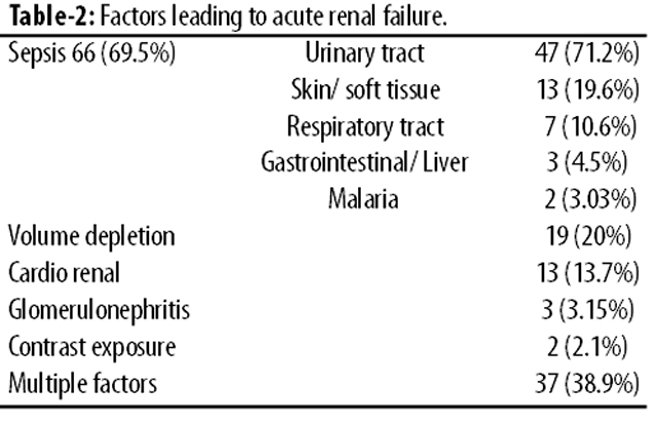
In 4 out of 19 patients with volume depletion, overzealous administration of diuretics was responsible for ARF, while 2 had gastroenteritis. In remaining 13 patients, volume depletion was associated with other major factors leading to ARF. We found ARF in 13 (13.7%) patients secondary to cardiac pathology, 6 had acute cardiac event, while remaining 7 had congestive cardiac failure, underlying dilated cardiomyopathy or a combination of both. Majority of these patients had superimposed sepsis as well. Surprisingly 9 patients recovered (69.2%), 2 died and 1 became dialysis dependent. The cause of ARF remained unknown in 4 patients so we proceeded with renal biopsy. MCGN was the cause in 2 patients, Crescentic GN was found in 1 patient, biopsy of 1 patient showed diabetic changes. The most common pathogens isolated from the blood/urine of patients admitted with sepsis were gram negative bacilli [35 (53%)], followed by staphylococcus aureus [5 (7.57%)] and enterococcus [2 (3%)]. Two patients also grew yeast in blood. E coli accounted for 82.8% cases of gram negative sepsis, majority of the isolated strains were resistant and of urinary tract origin, whereas, methicillin resistant staphylococcus aureus was responsible for soft tissue infection.
According to the mode of treatment used, patients were divided in two groups: dialysis and conservative treatment: 72 (75.8%) patients required dialysis, while remaining 23 (24.2%) were managed conservatively. 47 (65.3%) patients remained on dialysis for < 2 weeks, and 25 (34.7%) remained dialysis dependent for > 2 weeks (2-6 weeks). Outcome of study is as follows; 62 (67.39%) patients recovered, 14 (15.21%) became dialysis dependent and 16 (17.39%) died. Among those who recovered by the end of the study, 41 (66.12%) patients required temporary dialysis while 21 (33.8%) were managed conservatively (Table-3).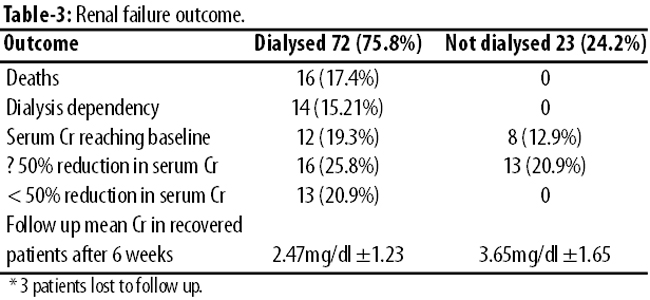
Among those who expired, all underwent dialysis and sepsis was the leading cause of death in 13 (81.25%) patients. Follow up mean creatinine in recovered patients after 6 weeks came out to be 2.47mg/dl±1.23 treated conservatively, whereas in patients requiring dialysis it was 3.65mg/dl±1.65.
Discussion
As far as we know this is the first detailed study of causes and outcome of acute renal failure in patients with diabetes mellitus in Pakistan. In hospitalised patients, the most common renal complication encountered by nephrologists is ARF, and more research is required to find out its risk factors and outcome especially in patients with diabetes mellitus. This study included 95 diabetic patients with suspected ARF admitted in the nephrology unit of our hospital over a period of 6 months. Due to several reasons a diabetic patient may develop ARF. In our study we found that sepsis was the single most common factor causing ARF. It is a common belief that there is an association between diabetes mellitus and increased susceptibility to infections, but data supporting this are few.6 Muller et al in his study found that patients with type 1 and type 2 diabetes mellitus are at increased risk of respiratory tract infection, urinary tract infection and skin and mucous membrane infection compared with control hypertensives.7 Two multicenter studies by Brivet et al and Uchino et al also reported sepsis as the commonest causative factor for ARF (48%) in mixed population treated in ICU.8,9 The most common focus of infection in our study was found to be urinary tract [47 (71.2%)] followed by skin/ soft tissue infection [13 (19.6%)]. Underlying DM predisposes to an enhanced susceptibility for the development of a UTI with a complicated course.10,11 Diabetic patients suffer more frequently with complicated infections compared with non-diabetic patients. Carton et al in his study in bacteremic patients demonstrated that two third of the patients had DM and the most prevalent site of infection was urinary tract.12 It has been suggested that in patients with DM, peripheral neuropathy and diabetic cystopathy are associated with the pathogenesis of UTI.13 Not all studies have shown this relationship, and a more important role of increased bacterial adherence to uroepithelium, and decreased urinary cytokine secretion has been identified in diabetics in the pathogenesis of UTI.14 The second most common focus of infection was found to be skin/ soft tissue which accounted for 13 (19.6% %) patients. It is reported that gram negative wound infections occur three times more frequently in diabetic than in non-diabetic individuals.15
The second common cause of renal failure in our study was found to be volume depletion [19 (20%)] either as unifactorial, or together with other contributory factors as multifactorial. Rashid et al reported gastroenteritis (32%) as the main factor leading to ARF, followed by sepsis (21.3%) in a study conducted in general population of Pakistan.16 Our experience is similar to a study from India that found that sepsis (52.9%) and urinary tract obstruction (50%) are the major causes of ARF in diabetic patients followed by NSAIDS (40%) and gastroenteritis (12.9%).17 In our study NSAIDS may well have contributed to ARF in some patients, but as most of the patients were illiterate, and unaware of the names of analgesics they had been on, we could not ascertain its exact contribution.
In this study we found acute glomerulonephritis in 3 (3.15%) patients. Vakrani et al in his study of 70 diabetic patients with ARF showed 2.8% cases of diffuse proliferative glomerulonephritis (DPGN) in diabetic patients undergoing biopsy.17 In another study by Prakash et al with 260 type 2 diabetics, screened for evidence of non-diabetic renal disease and ARF, renal disease other than diabetic nephropathy was found in 32 (12.3%) patients.18
Our results suggest that patients with diabetes are at increased risk of ARF requiring dialysis (75.8%). ARF requiring dialysis is associated with a very high risk of mortality and morbidity and this risk even becomes greater when there is a combination of diabetes, hypertension or congestive heart failure.19 ARF requiring dialysis has been found to be associated with high number of "in hospital" deaths and progression to chronic kidney disease and end stage renal disease in 5-20% of survivors within a few years.20 We found that there were no deaths in 21 patients treated conservatively, whereas, 16 patients died among 71 dialysed patients. So overall, 62 (67.3%) patients recovered. In a study conducted in diabetic patients by Vakrani et al, 64.3% patients recovered from acute renal failure.17 Mortality of ARF in hospitalised patients in different studies is reported from 14-70%.21 In this study mortality rate was found to be 17.39%. Many factors seem to affect the outcome of ARF other than the original disease like age of the patient, health status and hospital course.
Limitations
The outcome of this study is limited by the fact that it was primarily conducted in a tertiary care center, so preferentially those diabetic patients with ARF requiring dialysis may have been over represented.
Baseline creatinine was not known in 52.6% patients, so some of our patients who were categorized as probable ARF, and who either died or became dialysis dependent may have been incorrectly placed in this category.
Conclusion
Diabetic patients are predisposed to develop acute renal failure. Infection especially of urinary tract is the commonest cause of acute or acute on chronic renal failure. With appropriate antibiotic treatment renal functional improvement occurs in majority. Dialysis requirement adversely effects patients survival. Every effort should be made to find out the reversible component of renal failure in diabetic patients presenting acutely as treatment of acute insult may obviate the need of dialysis or shorten its duration.
References
1. Lameire N, Van Biesen W, Vanholder R. Acute renal failure. Lancet 2005; 365: 417-30.
2. Waikar SS, Curhan GC, Wald R, McCarthy EP, Chertow GM. Declining mortality in patients with acute renal failure, 1988-2002. J Am Soc Nephrol 2006; 17: 1143-50.
3. Chertow GM, Burdick E, Honour M, Bonventre JV, Bates DW. Acute kidney injury, mortality, length of stay, and costs in hospitalized patients. J Am Soc Nephrol 2005; 16: 3365-70.
4. Lassnigg A, Schmidlin D, Mouhieddine M, Bachmann LM, Druml W, Bauer P, et al. Minimal changes of serum creatinine predict prognosis in patients after cardiothoracic surgery: a prospective cohort study. J Am Soc Nephrol 2004; 15: 1597-605.
5. Arnaoutakis GJ, Bihorac A, Martin TD, Hess PJ Jr, Klodell CT, Ejaz AA, et al. RIFLE criteria for acute kidney injury in aortic arch surgery. J Thorac Cardiovasc Surg 2007; 134: 1554-60.
6. Joshi N, Caputo GM, Weitekamp MR, Karchmer AW. Infections in patients with diabetes mellitus. N Engl J Med 1999; 341:1906-12.
7. Muller LM, Gorter KJ, Hak E, Goudzwaard WL, Schellevis FG, Hoepelman AI, et al. Increased risk of common infections in patients with type 1 and type 2 diabetes mellitus. Clin Infect Dis 2005; 41: 281-8.
8. Brivet FG, Kleinknecht DJ, Loirat P, Landais PJ. Acute renal failure in intensive care units - Causes, outcome, and prognostic factors of hospital mortality: a prospective multicenter study. Crit Care Med 1996; 24: 192-8.
9. Uchino S, Kellum JA, Bellomo R, Doig GS, Morimatsu H, Morgera S, et al; Beginning and Ending Supportive Therapy for the Kidney (BEST Kidney) Investigators. Acute renal failure in critically ill patients: a multinational, multicenter study. JAMA 2005; 294: 813-8.
10. Johnson JR, Roberts PL, Stamm WE. P fimbriae and other virulence factors in Escherichia coli urosepsis: association with patients\' characteristics. J Infect Dis 1987; 156: 225-9.
11. Hoepelman AIM, Van Buren M, Van den Broek PJ, Borleffs JC. Bacteriuria in men infected with HIV-1 is related to their immune status (CD4_/ cell count). AIDS 1992; 6: 179-/84.
12. Carton JA, Maradona JA, Nuno FJ, Fernandez-Alvarez R, Pérez-Gonzalez F, Asensi V. Diabetes mellitus and bacteraemia: a comparative study between diabetic and no diabetic patients. Eur J Med 1992; 1: 281-7.
13. Patterson JE, Andriole VT. Bacterial urinary tract infections in diabetes. Infect Dis Clin North Am 1997; 11: 735- 50.
14. Hoepelman AI, Meiland R, Geerlings SE. Pathogenesis and management of bacterial urinary tract infections in adult patients with diabetes mellitus. Int J Antimicrob Agents 2003; 22: S35-43.
15. Wheat LJ. Infection and diabetes mellitus. Diabetes Care 1980; 3: 187-97.
16. Rashid N, Ejaz A, Waseem S. Factors determining outcome of acute renal failure patients. J Pak Med Assoc 2005; 55: 526-30.
17. Vakrani GP, Ramakrishnan S, Rangarajan D. Acute Renal Failure in Diabetes Mellitus (Prospective Study). J Nephrol Ther 2013; 3: 137.
18. Prakash J, Sen D, Usha, Kumar NS. Non-diabetic renal disease in patients with type 2 diabetes mellitus. J Assoc Physicians India 2001; 49: 415-20.
19. Girman CJ, Kou TD, Brodovicz K, Alexander CM, O\'Neill EA, Engel S, et al. Risk of acute renal failure in patients with type 2 diabetes mellitus. Diabet Med 2011; 29: 614-21.
20. Lo LJ1, Go AS, Chertow GM, McCulloch CE, Fan D, Ordoñez JD, et al. Dialysis-requiring acute renal failure increases the risk of progressive chronic kidney disease. Kidney Int 2009; 76: 893-9
21. Kelly KJ, Molitoris BA, Barretti P, Soares VA. Acute Renal failure in the new millennium: time to consider combination therapy. Semin Nephrol 2000; 20: 4-19.
Related Articles
Journal of the Pakistan Medical Association has agreed to receive and publish manuscripts in accordance with the principles of the following committees:


