

Sohail Athar ( Department of Medical Oncology, Shaukat Khanum Memorial Cancer Hospital and Research Centre (SKMCH), Lahore. )
Neelam Siddiqui ( Department of Medical Oncology, Shaukat Khanum Memorial Cancer Hospital and Research Centre (SKMCH), Lahore. )
Sulaman Raza Rai ( Department of Medical Oncology, Shaukat Khanum Memorial Cancer Hospital and Research Centre (SKMCH), Lahore. )
Narjis Muzaffar ( Department of Medical Oncology, Shaukat Khanum Memorial Cancer Hospital and Research Centre (SKMCH), Lahore. )
Abdul Hameed ( Department of Medical Oncology, Shaukat Khanum Memorial Cancer Hospital and Research Centre (SKMCH), Lahore. )
February 2015, Volume 65, Issue 2
Original Article

Abstract
Objective: To determine the impact of Rituximab and international prognostic index score on survival in diffuse large B-cell lymphoma patients.
Method: The retrospective study was conducted at Shaukat Khanum Memorial Cancer Hospital and Research Centre, Lahore, from January to May 2013 and comprised record of patients with diffuse large B-cell lymphoma who were treated from 2007 to 2010. Baseline international prognostic index score, stage at presentation were noted and the records were divided into two groups A and B on the basis of the type of chemotherapy. SPSS 19 was used for statistical analysis.
Results: Of the 93 patients in the study whose records were reviewed, 54(58%) were men. Overall median age was 43 years (range: 18-76). Stages at presentation were stage-I 14 (15.1%), stage-II 41 (44.1%), stage-III 20 (21.5%) and stage-IV 18 (19.4%). International prognostic index risk categorisation was low risk 59(63.4%), low intermediate risk 23(24.7%), high intermediate risk 10(10.8%) and high risk 1(1.1%). There were 31(33%) patients in Group A and 62(67%) in Group B. Median follow-up was 3.9 years (range: 1.2-6.1). Overall survival at 4 years was 66.4%; for Group A 65.3% and for Group B 66.7% (p<0.4). On the basis of risk categories, overall survival was statistically significant (p<0.001) between the groups.
Conclusion: International prognostic index risk categorisation had statistically significant impact on survival. However, there was no evidence of a significant survival benefit between types of chemotherapy. Further controlled trials are needed in this regard.
Keywords: Diffuse large B cell lymphoma, Rituximab, Outcome, Survival, Chemotherapy, Extranodal. (JPMA 65: 170; 2015).
Introduction
Diffuse large B cell lymphoma (DLBCL) is a heterogeneous disease in terms of morphology, behaviour and genetics. It is the commonest histological subtype of Non Hodgkin lymphoma (NHL), accounting for 25-40% of all NHL cases.1-3 It is classified as an aggressive type of lymphoma.1 Median age at presentation is 64 years with slight male predominance. Clinical presentation is variable and dependent on the site of involvement. Most patients present with nodal enlargement and B symptoms (weight-loss, fever, drenching night sweats).2,4
Extranodal disease (gastro-intestinal, liver, lung, breast) is present in 40% cases.5-7 Most cases (60%) present with advanced stage (i.e. cannot be contained in one radiation field), with bone marrow involvement in 30% of cases and can present with discordant histology like follicular lymphoma.8 DLBCL arises from mature B cell resembling centroblasts or immunoblasts with presence of B cell antigens on immunohistochemistry i.e. (CD19, CD20, CD22, and CD79a) as well as CD45 on tumour cells. Using gene expression profiling (GEP) by means of deoxyribonucleic acid (DNA) microarray technology, DLBCL has been subdivided into germinal centre DLBCL and non-germinal centre DLBCL.9
In 1993, International prognostic index (IPI) was proposed which predicts the survival of patients with NHL. It consists of five factors: age >60 years, serum lactate dehydrogenase (S.LDH), performance status >2, extranodal sites >1, and stage of disease III-IV. Using IPI, four prognostic groups are formed depending on the number of risk factors present, low-risk group (LR) with 0-1 prognostic factors, low intermediate risk group (LIR) with 2 prognostic factors, high intermediate risk group (HIR) with 3 factors, and high risk group (HR) with 4-5 factors. Five-year survival using the IPI prognostic groups has been reported to be: 73%, 51%, 43% and 26% for the four groups respectively.10
Age-adjusted IPI is used for patients with age <60 years in which all the above factors are included except age and extranodal sites. One point is given to each factor so the total score ranges from 0 to 3 with LR score 0, LIR score 1, HIR 2, and HR score 3. Five-year overall survival (OS) is 83%, 96%, 46% and 32% respectively.10
Recently, enhanced IPI — National Comprehensive Cancer Network-IPI (NCCN-IPI) has been proposed in which all factors which were part of original IPI were used but further characterization of age, lactate dehydrogenase (LDH) and extranodal sites are proposed.11 First change was in age group i.e. <40y 0 point, 41-60y 1 point, 61-75y 2 points and >75y 3 points. Second change was in the LDH ratio (LDH-R) i.e. LDH-R <1 0 score, LDH-R >1-3 score 1, LDH-R >3 score 2. Third change was in extranodal sites with 1 score being given to lymphomatous involvement in bone marrow, central nervous system (CNS) liver, gastrointestinal (GI) tract and lung. The risk groups, as such, are: LR (0-1 score), LIR (2-3 score), HIR (4-5 score) and HR >6. Five-year OS for the four groups has been reported to be 96%, 82%, 64% and 33% respectively.11
Poor survival in patients with age >60 could be due to multiple co-morbidities, and poor tolerance to chemotherapy. Moreover, a recent study showed that activated B cell (ABC) DLBCL is more prevalent in old age which carries poor prognosis.12
Over-expression of c-MYC and B-cell lymphoma 2 (BCL-2) by immunohistochemistry has shown poor survival after being treated with Rituximab-based chemotherapy.13 Moreover, mutation in p53 also results in poor OS.14 A study has proposed two gene score (TGS) using expression of tumour cell biomarker LIM domain only 2 (LMO2) with micro environment marker tumour necrosis factor (TNF) receptor superfamily member 9 (TNFRSF9) to predict outcome in DLBCL, but this needs further validation.15
Chemotherapy with or without radiation was the standard of care for the treatment of DLBCL before the addition of Rituximab anti-CD20 antibody in the management of this disease. DLBCL is treated with combination of treatment modality i.e. chemotherapy and radiation therapy depending upon the disease extent. Anthracyclin-based chemotherapy consisting of Cyclophosphamide, Doxorubicin, Vincristine and Prednisolone (CHOP) is the most widely used and recommended treatment for DLBCL with 3-year OS of 52%.16 After the introduction of anti-CD20 monoclonal antibody, Rituximab is used in combination with chemotherapy (Chemoimmunotherapy R-CHOP). Studies from Western world suggest that survival of patients with DLBCL has improved significantly and chemoimmunotherapy is the current standard of care.17
Patients and Methods
The retrospective study was conducted at Shaukat Khanum Memorial Cancer Hospital and Research Centre, Lahore, from January to May 2013 after approval was obtained from the institutional review board and comprised record of patients with DLBCL who were treated from 2007 to 2010. Data collection was done through the computerised database system. Patient\'s medical record number, age and gender were recorded. Baseline pathology reports, computed tomography (CT) scan reports and bone marrow biopsy were reviewed. Ann Arbor staging was used to stage the disease. Serum LDH, performance status, bone marrow involvement and type of chemotherapy were also recorded. On the basis of data, IPI risk categorisation was done.
Data was analysed using SPSS 19. OS was calculated from the date of registration to the last date of follow-up or death. OS was estimated using Kaplan Meier survival curves which were compared using the log-rank test.18,19
Results
Of the 93 patients in the study whose records were reviewed, 54(58%) were men. Overall median age was 43 years (range: 18-76). Stages at presentation were stage-I 14 (15.1%), stage-II 41 (44.1%), stage-III 20 (21.5%) and stage-IV 18 (19.4%). IPI risk categorisation was LR 59(63.4%), LIR 23(24.7%), HIR 10(10.8%) and HR 1(1.1%). CHOP chemotherapy Group A had 31(33%) patients, while R-CHOP Group B had 62(67%) (Table-1).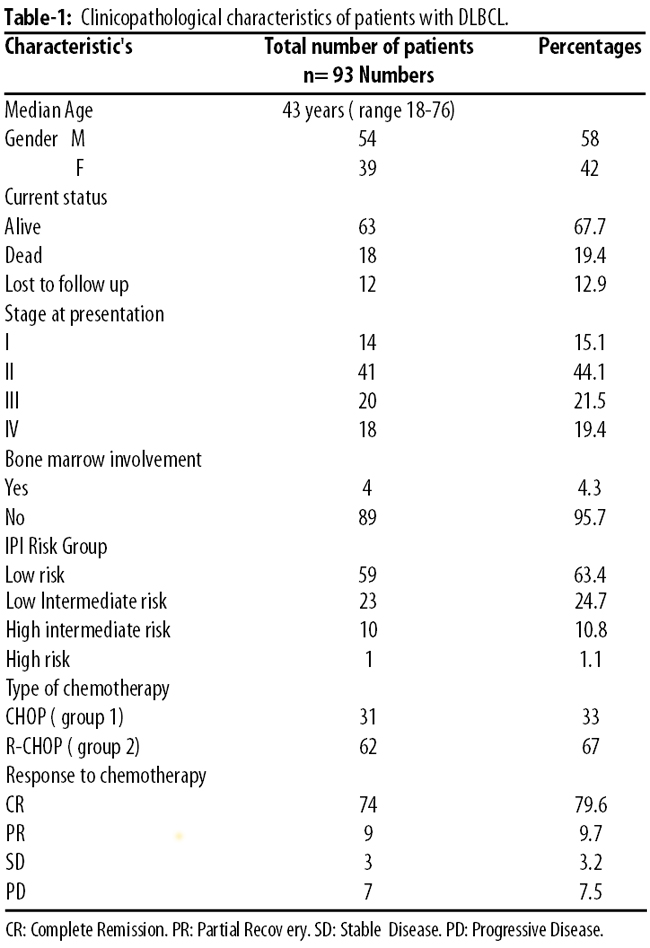
According to IPI scores in Group A, there were 18(58.06%), 8(25.80%), 4(12.90%) and 1(3.2%) patients in LR, LIR, HIR and HR category respectively. In Group B, there were 41(66.12%) patients in LR, 15(24.19%) in LIR, 6(9.6%) in HIR, while there was no patient with HR characteristics (Table-2).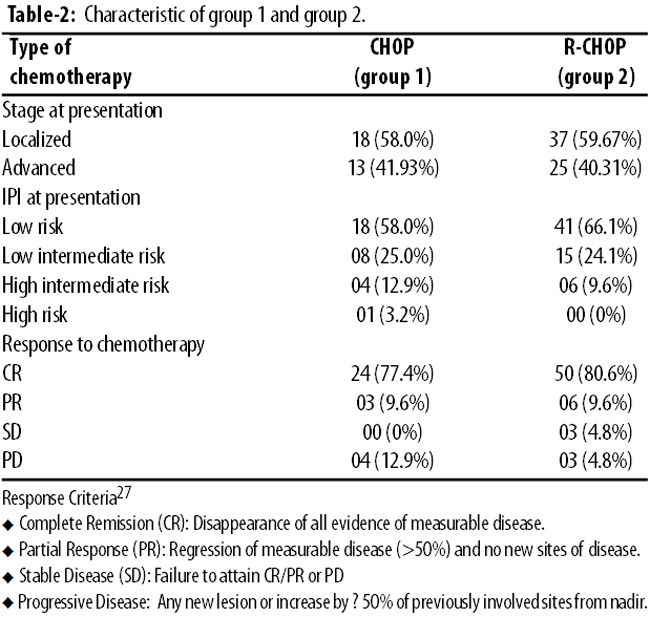
Consolidative radiation therapy was used in 15(16%) patients; 7(46.66%) in R-CHOP group and 8(53.33%) in the CHOP group. Patients were given minimum four and maximum eight cycles of chemotherapy.
Median follow-up was 3.9 years (range: 1.2-6.1). At the time of analysis, 63(68%) were alive, 18(19%) were dead and 12(12.9%) had been lost to follow-up. Median survival for all patients was not reached. Kaplan Meir estimated OS at 4 years in both group was 66.4% (Figure-1).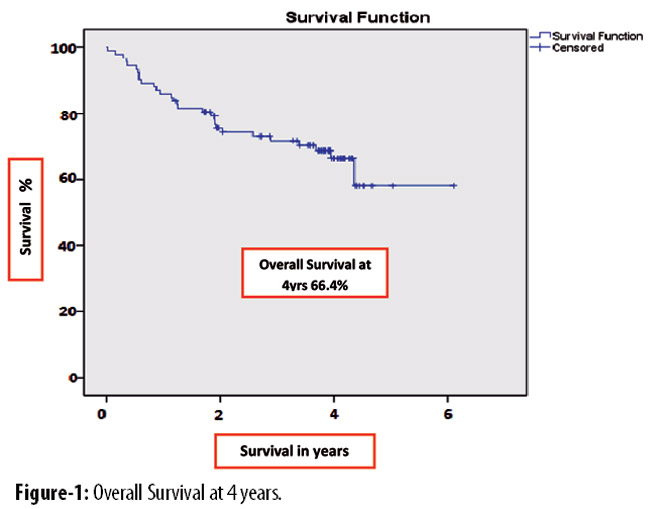
At 4 years, OS for Group A and Group B were 66.3% and 66.7% (p=0.4) (Figure-2).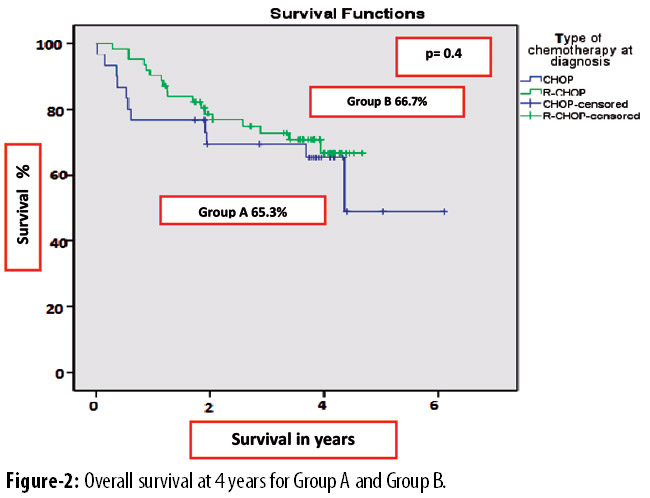
At 4 years, OS for LR, LIR, HIR/HR groups were 79.2%, 54% and 27%, respectively and it was statistically significant (p<0.001) (Figure-3).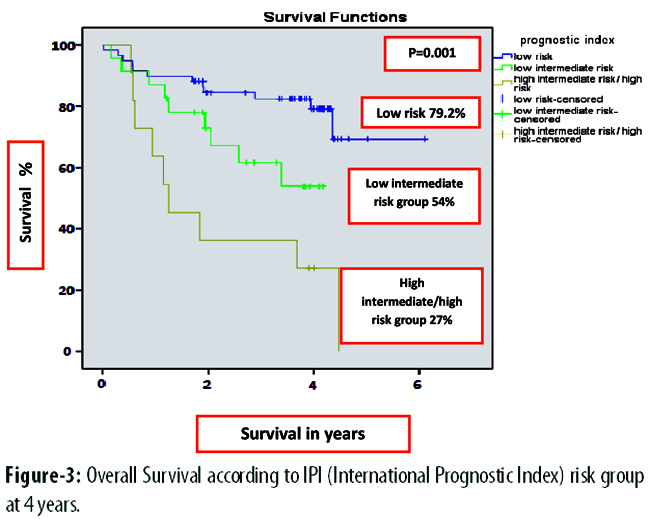
Discussion
The retrospective study added to knowledge available on DLBCL, which is the most common type of NHL worldwide and there is some concern about rising number of patients with this aggressive nature of disease in our population.20 CHOP chemotherapy has been the standard first-line chemotherapy for several decades with complete response rate (CRR) of 41%, 3-year disease-free survival (DFS) of 41% and 3-year OS of 54%.16
In GELA trial, combination of anti-CD20 antibody and CHOP chemotherapy showed survival advantage in patient with age >60 years with 5-year OS of 58% in R-CHOP vs 45% in CHOP alone, with no clinical significant toxicity upon adding Rituximab with CHOP chemotherapy.21,22
In 2006, MInT trial was conducted in younger patient age <60 years. Adding Rituximab to CHOP chemotherapy resulted in increase of 3-year event-free survival (EFS) to 79% in R-CHOP group and 50% in CHOP group. Similarly, 3-year OS was 93% in R-CHOP vs 84% in CHOP. The update result for MInT trial has been published in 2011, which shows better 6-year EFS in patients treated with R-CHOP i.e. 74.3% vs 55.8% in CHOP group.23
The role of maintance Rituximab after R-CHOP combination was addressed in 2006, and showed no improvement in failure-free survival (FFS). However, FFS was improved by using maintance Rituximab after CHOP chemotherapy.24
IPI has been validated to predict survival in patients with DLBCL in pre-Rituximab era. A study to evaluate utility of IPI during Rituximab era analysed data from three trials and found that IPI still remains an important tool to predict EFS, DFS and OS in all four groups, while Rituximab significantly improves outcome in all groups of IPI.25
In our study, median age at presentation was 43 years, which is younger than the Western world with male predominance of 58% which was similar to Western data.2,26 In this analysis, only 8(8.6%) patients were >60 years of age. Literature shows 30-40% patients present with localised disease, while 60-70% patients present with advanced disease.27 In our cohort 59% patients presented with localised disease, while 41% presented with advanced disease. Since the majority of patients belonged to low to low intermediate group, treating these patients with R-CHOP did not give survival benefit in our study. The retrospective nature and its small sample size are the main limitations of the study.
Conclusion
IPI remains an important tool to predict survival. R-CHOP is the standard of care for CD20 positive NHL, but in under-resourced countries CHOP alone may be used in low-risk patients, while R-CHOP can be used in the high-risk group. Further prospective studies are required to validate these results.
References
1. Swerdlow SH, Campo E, Harris NL, Jaffe ES, Pileri SA, Stein H, et al. World Health Organization Classification of Tumors of Haematopoietic and Lymphoid Tissues, IARC Press, Lyon 2008.
2. Morton LM, Wang SS, Devesa SS, Hartge P, Weisenburger DD, Linet MS. Lymphoma incidence patterns by WHO subtype in the United States, 1992-2001. Blood 2006; 107:265-76.
3. Armitage JO, Weisenburger DD. New approach to classifying non-Hodgkin\'s lymphomas: clinical features of the major histologic subtypes. Non-Hodgkin\'s Lymphoma Classification Project. J Clin Oncol 1998; 16:2780-95.
4. A clinical evaluation of the International Lymphoma Study Group classification of non-Hodgkin\'s lymphoma. The Non-Hodgkin\'s Lymphoma Classification Project. Blood 1997; 89:3909-18.
5. Møller MB, Pedersen NT, Christensen BE. Diffuse large B-cell lymphoma: clinical implications of extranodal versus nodal presentation--a population-based study of 1575 cases. Br J Haematol 2004; 124:151-9.
6. Daum S, Ullrich R, Heise W, Dederke B, Foss HD, Stein H et al. Intestinal non-Hodgkin\'s lymphoma: a multicenter prospective clinical study from the German Study Group on Intestinal non-Hodgkin\'s Lymphoma. J Clin Oncol 2003; 21:2740-6.
7. Vitolo U, Ferreri AJ, Zucca E. Primary testicular lymphoma. Crit Rev Oncol Hematol 2008; 65:183-9.
8. Sehn LH, Scott DW, Chhanabhai M, Berry B, Ruskova A, Berkahn L et al . Impact of concordant and discordant bone marrow involvement on outcome in diffuse large B-cell lymphoma treated with R-CHOP. J Clin Oncol 2011; 29:1452-7.
9. Frick M, Dörken B, Lenz G.The molecular biology of diffuse large B-cell lymphoma. Ther Adv Hematol 2011; 2:369-79.
10. Shipp MA, Harrington DP, Anderson JR, Armitage JO, Brittinger G, Cabanillas F, et al. A predictive model for aggressive non-Hodgkin\'s lymphoma. The International Non-Hodgkin\'s Lymphoma Prognostic Factors Project. N Engl J Med 1993;329:987-94.
11. Sarkozy C, Coiffier B. Diffuse large B-cell lymphoma in the elderly: a review of potential difficulties. Clin Cancer Res 2013; 19:1660-9.
12. Green TM, Young KH, Visco C, Xu-Monette ZY, Orazi A, Go RS et al. Immunohistochemical double-hit score is a strong predictor of outcome in patients with diffuse large B-cell lymphoma treated with rituximab plus cyclophosphamide, doxorubicin, vincristine, and prednisone. J Clin Oncol 2012; 30:3460-7.
13. Young KH, Leroy K, Møller MB, Colleoni GW, Sánchez-Beato M, Kerbauy FR. Structural profiles of TP53 gene mutations predict clinical outcome in diffuse large B-cell lymphoma: a ninternational collaborative study. Blood 2008;112:3088-98.
14. Alizadeh AA, Gentles AJ, Alencar AJ, Liu CL, Kohrt HE, Houot R et al. Prediction of survival in diffuse large B-cell lymphoma based on the expression of 2 genes reflecting tumor and microenvironment. Blood. 2011;118:1350-8.
15. Zhou Z, Sehn LH, Rademaker AW, Gordon LI, Lacasce AS, Crosby-Thompson A et al. An enhanced International Prognostic Index (NCCN-IPI) for patients with diffuse large B-cell lymphoma treated in the rituximab era. Blood 2014;123:837-42.
16. Fisher RI, Gaynor ER, Dahlberg S, Oken MM, Grogan TM, Mize EM et al. Comparison of a standard regimen (CHOP) with three intensive chemotherapy regimens for advanced non-Hodgkin\'s lymphoma. N Engl J Med 1993; 328:1002-6.
17. Sehn LH, Donaldson J, Chhanabhai M, Fitzgerald C, Gill K, Klasa R,et al. Introduction of combined CHOP plus rituximab therapy dramatically improved outcome of diffuse large B-cell lymphoma in British Columbia. J Clin Oncol 2005; 23:5027-33.
18. Kaplan GL, Meier P. Nonparametric estimation from incomplete observations. J Am Stat Assoc 1958; 53: 457-81.
19. Peto R, Pike MC. Conservatism of the approximation ? (O-E) 2/E in the log-rank test for survival data or tumor incidence data. Biometrics 1973; 29: 579-84.
20. Abid MB, Nasim F, Anwar K, Pervez S. Diffuse large B cell lymphoma (DLBCL) in Pakistan: an emerging epidemic? Asian Pac J Cancer Prev 2005; 6:531-4.
21. Coiffier B, Lepage E, Briere J, Herbrecht R, Tilly H, Bouabdallah R et al. CHOP chemotherapy plus rituximab compared with CHOP alone in elderly patients with diffuse large-B-cell lymphoma. N Engl J Med 2002; 346:235-42.
22. Feugier P, Van Hoof A, Sebban C, Solal-Celigny P, Bouabdallah R, FerméC et al. Long-term results of the R-CHOP study in the treatment of elderly patients with diffuse large B-cell lymphoma: a study by the Groupe d\'Etude des Lymphomes de l\'Adulte.J Clin Oncol 2005; 23:4117-26.
23. Pfreundschuh M, Kuhnt E, Trümper L, Osterborg A, Trneny M, Shepherd L et al. CHOP-like chemotherapy with or without rituximab in young patients with good-prognosis diffuse large-B-cell lymphoma: 6-year results of an open-label randomised study of the MabThera International Trial (MInT) Group. Lancet Oncol. 2011; 12:1013-22.
24. Habermann TM, Weller EA, Morrison VA, Gascoyne RD, Cassileth PA, Cohn JB et al. Rituximab-CHOP versus CHOP alone or with maintenance rituximab in older patients with diffuse large B-cell lymphoma. J Clin Oncol 2006; 24:3121-7.
25. Ziepert M, Hasenclever D, Kuhnt E, Glass B, Schmitz N, Pfreundschuh M et al. Standard International prognostic index remains a valid predictor of outcome for patients with aggressive CD20+ B-cell lymphoma in the rituximab era. J Clin Oncol 2010; 28:2373-80.
26. Shenoy PJ, Malik N, Nooka A, Sinha R, Ward KC, Brawley OW et al. Racial differences in the presentation and outcomes of diffuse large B-cell lymphoma in the United States. Cancer 2011; 117:2530-40.
27. Cheson BD, Pfistner B, Juweid ME, Gascoyne RD, Specht L, Horning SJ et al. Revised response criteria for malignant lymphoma. J Clin Oncol 2007;25 :579-86.
Related Articles
Journal of the Pakistan Medical Association has agreed to receive and publish manuscripts in accordance with the principles of the following committees:


