

Bulent Bahceci ( Departments of Psychiatry, Recep Tayyip Erdogan University, School of Medicine, Rize, Turkey. )
Erman Bagcioglu ( Departments of Psychiatry, Afyon Kocatepe University, School of Medicine, Afyonkarahisar, Turkey. )
Mehmet Hanefi Kokacya ( Departments of Psychiatry, Mustafa Kemal, University, School of Medicine, Hatay, Turkey. )
Aziz Ramazan Dilek ( Departments of Microbiology, Recep Tayyip Erdogan University, School of Medicine, Rize, Turkey. )
Ilkay Bahceci ( Departments of Microbiology, Recep Tayyip Erdogan University, School of Medicine, Rize, Turkey. )
Salih Selek ( Departments of Psychiatry, Medeniyet University, School of Medicine, Istanbul, Turkey. )
February 2015, Volume 65, Issue 2
Original Article

Abstract
Objective: To determine whether serum prolidase levels are associated with the etiopathogenesis of schizophrenia.
Methods: The study was conducted at the psychiatry outpatient clinics of the University Hospitals of Recep Tayyip Erdogan and Afyonkocatepe in spring 2013. It comprised patients with schizophrenia who were consecutively recruited from the Psychiatry outpatient clinics of the hospital. An equal number of healthy individuals were recruited from the community. Each patient underwent a detailed diagnostic evaluation by psychiatry residents by using the Structured Clinical Interview for Diagnostic and Statistical Manual of Mental Disorders-IV. Serum prolidase activity and oxidative parameters were measured in patient and control groups. The severity of psychotic symptoms was assessed using the positive and negative syndrome scale. SPSS 16 was used for statitistical analysis.
Results: There were 30 subjects in each group, with 18(60%)females among the patients and 21(70%) among the controls. Serum prolidase level was significantly higher in schizophrenia patients compared to the controls (p<0.001). Total Oxidative Stress and Oxidative Stress Index parameters were found to be significantly different between the patients and the controls (p=0.024 and p
Keywords: Prolidase activity, Schizophrenia, Proline, Glutamat. (JPMA 65: 131; 2015).
Introduction
Schizophrenia is a severe mental disorder, which is characterised by thought disturbance, abnormal perception, impaired cognition and bizarre behaviour.1 Though genetic and environmental factors have been known to contribute to the clinical phenotype, the exact aetiology and pathophysiology of schizophrenia have not been fully elucidated.2
Prolidase is an essential cytosolic enzyme that specifically splits imidodipeptides with C-terminal proline or hydroxyproline.3 The enzyme is widely distributed in the body, including the plasma, brain, thymus, uterus and heart.4 It is an important enzyme in proline nutrition and in the recycling of proline for protein synthesis.5 Its main physiological activity is related to collagen synthesis and cell growth.6 In addition, prolidase is thought to be involved in the regulation of various hormone-releasing factors and neurotransmitters in the brain.7 Disruptions in proline metabolism were found to have an association with behavioural difficulties, mental retardation, autism spectrum disorder and schizophrenia.8,9 Prolidase activity has been found to be distributed throughout regional and subcellular spheres of brain.10 It was shown that maintenance of proline levels are regulated by prolidase in brain.7
Experimental studies indicate that there is interaction between proline and the N-methyl-D-aspartate (NMDA) receptor.11,12 Proline may contribute to mental retardation and seizure by activating the NMDA receptors.13 A study14 suggested that extracellular proline regulates the basal function of some glutamate synapses. It has been known that glutamate is a major excitatory neurotransmitter, which is thought to be connected to schizophrenia.15,16 Most studies reported that the dysfunction of glutamatergic neurotransmission may play an important role in the pathogenesis of schizophrenia. In particular, the hypofunction of NMDA receoptors is considered to be a key factor in schizophrenia.17,18 Recently, increased serum levels of prolidase have been demonstrated to be associated with bipolar affective disorder19 and Alzheimer\'s disorder,20 which are also related to glutamatergic transmission.21,22 Considerable evidence has been accumulated to indicate a correlation between oxidative stress (OS) and prolidase activity in clinical studies.23,24 Therefore, we hypothesised that the prolidase activity may be impaired in patients with schizophrenia and there may be an association between prolidase activity and OS in these patients. We evaluated serum prolidase levels and oxidative parameters in patients with schizophrenia and healthy controls in order to determine whether the serum prolidase levels are associated with the etiopathogenesis of schizophrenia, and whether there is a relationship between prolidase activity and oxidative parameters in these patients.
Patients and Methods
The case-control study was conducted in spring 2013 after approval from the institutional ethics committee. The study comprised patients with schizophrenia who were consecutively recruited from the Psychiatry outpatient clinics of the hospital. An equal number of healthy individuals were recruited from the community. Informed written consent was obtained from all the subjects. All patients underwent a detailed diagnostic evaluation by psychiatry residents in accordance with the Structured Clinical Interview for Diagnostic and Statistical Manual of Mental Disorders (DSM)-IV (SCID-I) criteria.25 The exlusion criteria included patients who had any other comorbid psychiatric disorder and those with a history of inadequate cardiac function, renal dysfunction, diabetes, liver disease and any cancer. The severity of psychotic symptoms was assessed using the positive and negative syndrome scale (PANSS), validity and reliability studies of whose Turkish version have already been conducted.26
The controls were matched for age and gender. The controls had no clinical psychiatric disorder. They had not taken any psychotropic drugs for at least two months prior to the study. Their psychiatric conditions were evaluated by the same psychiatrists in accordance with SCID Axis-I, and they were all free of Axis-I disorders. They had no past neurological, endocrinological, hepatic and renal diseases.
Serum prolidase activity was measured in the two groups. Venous blood samples were immediately centrifuged and stored at -20°C for analysis. Serum Xaa-pro dipeptidase/prolidase (PEPD) was measured using an enxyme-linked immunoabsorbent assay (ELISA) test kit (Human Xaa-Pro Dipeptidase/Prolidase (PEPD) ELISA Kit, Cusabio biotech)according to the manufacturer\'s procedure. This assay employed the quantitative sandwich enzyme immunoassay technique. Absorbance (OD) of each well was determined at 450nm by a microtiter plate reader (Multiskan GO, Thermo Scientific) within 5 minutes. Standard curves were fitted using Titri ELISA software. The fitted curve was then used to convert sample OD readings to PEPD concentrations.
Serum total anti-oxidant capacity (TAC) was measured using a novel automated measurement method developed by Erel.27 This method involves the production of a potent biological hydroxyl radical. In the assay, ferrous ion solution (present in Reagent 1) is mixed with hydrogen peroxide (present in Reagent 2). Thus, it is possible to measure the anti-oxidative effect of the sample against the potent free radical reactions initiated by the production of the hydroxyl radical. The assay is characterised by excellent precision values of less than three percent. The results were expressed as mmolTroloxEq/L.
Total oxidant status (TOS) of serum was determined using a novel automated measurement method, developed by Erel.28 Oxidants present in the sample oxidise the ferrous ion-o-dianisidine complex to ferric ion. The oxidation reaction is enhanced by glycerol molecules, which are abundantly present in the reaction medium. The ferric ion makes a coloured complex with xylenol orange in an acidic medium. The colour intensity, which can be measured spectrophotometrically, is related to the total amount of oxidant molecules present in the sample. The assay was calibrated with hydrogen peroxide and the results were expressed in terms of micromolar hydrogen peroxide equivalent per liter(mmol H2O2Equiv/L).
Percent ratio of TOS level to TAC level was accepted as Oxidative stress index (OSI). For its calculation, the resulting unit of TAC was changed to mmol/L, and the OSI value was calculated according to the following formula: OSI (arbitrary unit)= TOS (mmol H202 Equiv./L)/ TAC (mmolTroloxEq/L).29
Statistical analysis was performed using SPSS 16. Mean ages were compared by student\'s t test, Pearson\'s chi-square or linear by linear association tests was used to compare the gender, education, marital status and work status differences between the two groups. Normality assumptions of continuous variables were checked via Shapiro-Wilk\'s test. Normality was not assigned in TAS, TOS and OSI, therefore non-parametric Mann Whitney U test was applied. Student\'s t test was employed to compare prolidase values between schizophrenia patients and controls. Correlation analysis was performed by spearman test. Results were considered significant at p<0.05.
Results
There were 30 subjects in each group, with 18(60%) females among the patients and 21(70%) among the controls. Likewise, there were 21(70%) unmarried/single individuals among the patients and 13(43.3%) among the controls. Demographic variables did not show any statistically significant difference between the groups except for the marital status (p=0.018) (Table-1).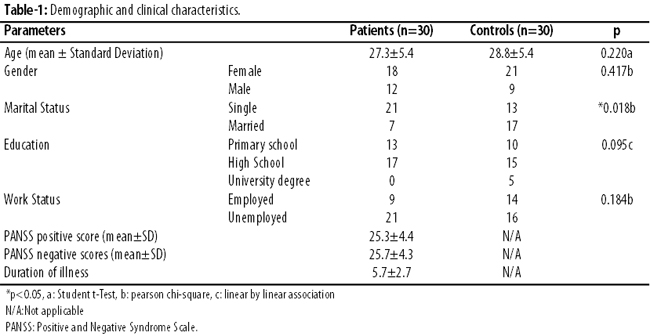
The mean serum prolidase activity levels in patients with schizophrenia and controls were 555.68±81.34 U/L and 364.08±58.2 U/L, respectively. Mean serum prolidase activity difference between the two groups was statistically significant (p<0.001) (Figure-1).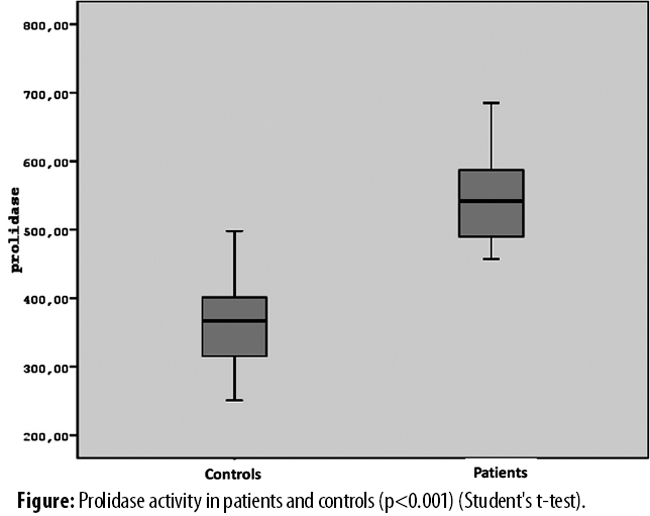
TOS levels and OSI were significantly higher in patients with schizophrenia compared to controls (P=0.024 and <0.001, respectively). TAS was significantly lower in the patients group (p=0.002) (Table-2).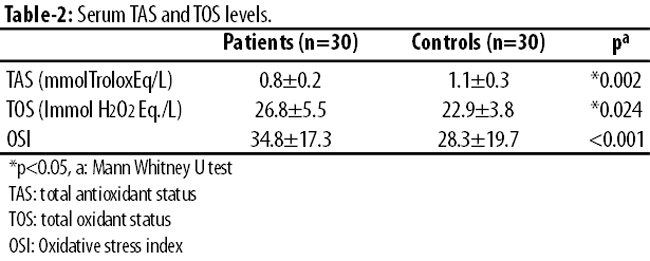
The mean serum prolidase level did not show any correlation with TAS, TOS levels and OSI in patients (Table-3).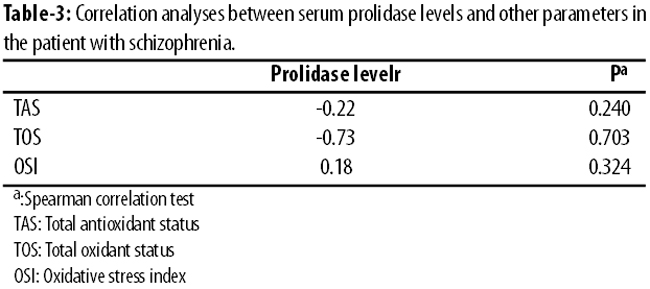
Discussion
As the results show, the study found that the levels of serum prolidase, TOS and OSI in patients were significantly higher than those in the controls. TAS levels were significantly decreased in the patients, and, finally, that serum prolidase levels were not correlated with TAS and TOS levels and OSI.
There is evidence that proline plays a role as a neuromodulator in synaptic transmission.30 A pioneering study performed in rats31 observed that proline is normally present in cerebrospinal fluid (CSF) and inhibit glutamate release. Another study32 found that elevated proline levels induce glutamatergic signalling in the hippocampus and increased glutamatergic tone causes release of dopamine in the prefrontal cortex. Chronic administration of proline in rats leads to a significant impairment of learning/memory.33
One study34 observed that plasma proline level was negatively correlated with intelligence quotient (IQ) in patients with mental disorders. It has been recently hypothesised that prolidase deficiency may lead to mental retardation by the high amount of proline residues.35 Studies36,37 suggest that hyperprolinaemia may be associated with schizophrenia and schizoaffective disorders. Another38 suggests that elevated proline is risk factor for schizophrenia. Our findings together with the earlier ones support the notion that disruptions in the proline pathway might have an association with schizophrenia.
Our study found that oxidative imbalance is present in patients with schizophrenia. This finding is consistent with previous studies.39-41 Most studies showed that there is a relationship between OS and increased prolidase activity in some diseases such as ovarian cancer, mitral stenosis and helicobacter pylori infection.42-44
The assessment of prolidase activity in neuropsychiatric disorders has been so far limited to a few studies. One study19 found high serum prolidase activities in patients with bipolar affective disorder compared with controls, and suggested that it may be associated with OS. Another one20 found increased serum prolidase activities and lower total antioxidant levels in patients with Alzheimer\'s disease compared to healthy controls. Based on these results, researchers noted that OS may be the reason behind elevated prolidase levels.
Our study found that there was no correlation between the oxidative parameters and prolidase activity. This could mean that there is no direct association between OS and prolidase activity in schizophrenia. Taking these findings into account, increased prolidase activity in patients with schizophrenia may be due to the relevance between OS, proline metabolism and glutamate transmission. In schizophrenia, it was demonstrated that there was glutamate exitotoxicity-induced OS.45,46 A study8 reported that proline may also decrease glutamate uptake in presynaptic neurons, causing exitotoxic cell death by overstimulation of NMDA. A study47 suggested that the induction of OS may occurr secondary to NMDA receptor stimulation by proline in the brain. It seems that more research is needed to clarify the detail of the mechanism.
In terms of limitations, our sample size was small. Besides, we assessed only one time point for the measurement of prolidase levels. Replication with large samples and longitudinal follow-up will be needed to overcome the limitation. Finally, we did not study plasma proline concentrations.
Conclusion
Serum prolidase level was significantly higher in schizophrenia patients compared to the healthy subjects in our study. This finding, together with those of previous studies, implies that prolidase activity, glutamate transmission and OS may be inter-related in the etiopathogenesis of schizophrenia.
References
1. Berstein HG, Bogerts B, Keilhoff. The many faces of nitric oxide in schizophrenia. A review. Schizophr Res 2005;78:69-86.
2. Harris LW, Guest PC, Wayland MT, Umrania Y, Krishnamurthy D, Rahmounne H, et al. Schizophrenia: Metabolic aspects of aetiology, diagnosis and future treatment strategies. Psychoneuroendocrinology 2012;38:752-66.
3. Kurien BT, Patel NC, Porter AC, D\'Souza A, Miller D, Matsumoto H, et al, Scofield RH. Prolidase deficiency and the biochemical assays used in its diagnosis. Anal Biochem 2006;349:165-75.
4. Zanaboni G, Dyne KM, Rossi A, Monafo V, Cetta G. Prolidase deficiency: biochemical study of erythrocyte and skin fibroblast prolidase activity in Italian patients. Haematologica 1994;79:13-8.
5. Palka JA. The role of prolidase as an enzyme participating in the metabolism of collagen. RoczAkad Med Bialymst 1996;41:149-60.
6. Wu G, Bazer FW, Burghardt RC, Johnson GA, Knabe DA, Li P, et al. Proline and hydroxyproline metabolism: implications for animal and human nutrition. Amino Acids 2011;40:1053-63.
7. Chi H, Liu G, Tong J, Nakayama K, Yamashita K, Kitaoka N, et al. Aktivity of prolidaseisoenzymes in the rat brain: subcellular and regional distribution during development. Brain Res 2009;1303:8-14.
8. Wyse AT, Netto CA. Behavioral and neurochemical effects of proline. Metab Brain Dis 2011;26:159-72.
9. Mitsubuchi H, Nakamura K, Matsumoto S, Endo F. Inborn errors of proline metabolism. J Nutr 2008;138:2016S-2020S.
10. Hui KS, Lajtha A. Prolidase activity in brain: comparison with other organs. J Neurochem 1978; 30:321-7.
11. Henzi V, Reichling DB, Helm SW, Mac Dermott AB. L-proline activates glutamate and glyncine receptors in cultured rat dorsal horn neurons. Mol Pharmacol 1992;41:793-810.
12. Ortiz JG, Cordero ML, Rosado A. Proline-glutamate interactions in the CNS. Prog Neuropsychopharmacol Biol Psychiatry 1997;21:141-52.
13. Martin D, Ault B, Nadler JV. NMDA receptor-mediated depolarizing action of proline on CA1 pyramidal cells. Eur J Pharmacol 1992;219:59-6.
14. Cohen SM, Nadler JV. Proline-induced potentiation of glutamate transmission. Brain Res 1997;761:271-82.
15. Tsai G, Coyle JT. Glutamatergic mechanisms in schizophrenia. Annu Rev Pharmacol Toxicol 2002;42:165-79.
16. Paz RD, Tardito S, Atzori M, Tseng KY. Glutamatergic dysfunction in schizophrenia: from basic neuroscience to clinical psychopharmacology. Eur Neuropsychopharmacol 2008;18:773-86.
17. Nudmamud S, Reynolds GP. Increased density of glutamate/N-methyl-D-aspartate receptors in superior temporal cortex in schizophrenia. Neurosci Lett.2001;304:9-12.
18. Kantrowitz JT, Javitt DC. N-methyl-d-aspartate (NMDA) receptor dysfunction or dysregulation: the final common pathway on the road to schizophrenia? Brain Res Bull 2010;83:108-21.
19. Selek S, Altindag A, Saracoglu G, Celik H, Aksoy N. Prolidase activity and its diagnostic performance in bipolar disorder. J Affect Disord.2011;129:84-6.
20. Arikanoglu A, Akil E, Varol S, Yucel Y, Yuksel H, Cevik MU, et al. Relationship of cognitive performance with prolidase and oxidative stress in Alzheimer disease. Neuro Sci 2013;34:2117-21.
21. Palomino A, Gonzalez-Pinto A, Aldama A, Gonzalez-Gomez C, Mosquera F, Gonzalez-Garcia G, et al. Decreased levels of plasma glutamate in patients with firs-episode schizophrenia and bipolar disorder. Schizophr Res 2007;95:174-8.
22. Cowburn RF, Hardy JA, Roberts PJ. Glutamatergic neurotransmission in Alzheimer\'s disease. Biochem Soc Trans 1990;18:390-2.
23. Hilali N, Vural M, Camuzoglu H, Camuzoglu A, Aksoy N. Increased prolidase activity and oxidative stress in PSOS. Clin Endocrinol (Oxf) 2013;79:105-10.
24. Toy H, Camuzoglu H, Arioz DT, Kurt S, Celik H, Aksoy N. Serum prolidase activity and oxidative stress markers in pregnancies with intrauterine growth restricted infants. J Obstet Gynaecol Res 2009;35:1047-53.
25. First MB, Spitzer RL, Gibbon M, Williams JBW. Structured Clinical Interview for DSM-IV Axis I Disorders. Washington DC: American Psychiatric Press, Inc, 1997.
26. Kostakoglu AE, Batur S, Tiryaki A. Pozitifve Negatif Sendrom Ölçeginin (PANSS) Türkçe Uyarlamasinin Geçerlikve Güvenilirligi. Türk Psikoloji Dergisi 1999; 14: 23-32.
27. Erel O. A novel automated metdod to measure total antioxidant response aganist potent free radical reactions. Clin Biochem.2004;37:112-9.
28. Erel O. A new automated colorimetric method for measuring total oxidant status. Clin Biochem 2005;38:1103-11.
29. Harma MI, Harma M, Erel O. Measuring plasma oxidative stres biomarkers in sport medicine. Eur J Appl Physiol 2006;97:505.
30. Crump FT, Fremeau RT, Craig AM. Localization of the brain-specific high-affinity I-proline transporter in cultured hippocampal neurons:molecular heterogeneity of synaptic terminals. Mol Cell Neurosci 1999;13:25-39.
31. Cohen SM, Nadler JV. Proline-induced inhibition of glutamate release in hippocampal area CA1. Brain Res 1997;769:333-9.
32. Vorstman JA, Turetsky BI, Sijmens- Morcus ME, de Sain MG, Dorland B, Sprong M, et al. Proline affects brain function in 22q11DS children with the low activity COMT 158 allele. Neuropsychopharmacology 2009;34:739-46.
33. Moreira JCF, Wannmacher CMD, Costa SM, Wajner M. Effect of proline administration on rat behavior in aversive and nonaversive task. Pharmacmacol Biochem Behav 1989;32:885-90.
34. Raux G, Bumsel E, Hecketsweiler B, Van Amelsvoort T, Zinkstok J, Manouvrier-Hanu S, et al. Involvement of hyperprolinemia in cognitive and psychiatric features of the 22q11 deletion syndrome. Hum Mol Genet 2007;16:83-911.
35. Lupi A, Tenni R, Rossi A, Cetta G, Forlino A 2008. Human prolidase and prolidase deficiency: an overview on the characterization of the enzyme involved in proline recycling and on the effects of its mutations. Amino Acids 2008;35:739-52.
36. Jacquet H, Raux G, Thibaut F, Hecketsweiler B, Houy E, Demilly C, et al. PRODH mutations and hyperprolinemia in a subset of schizophrenic patients. Hum Mol Genet 2002;11:2243-9.
37. Jacquet H, Demily C, Houy E, Hecketsweiler B, Bou J, Raux G, et al. Hyperprolinemia is a risk factor schizoaffective disorder. Mol Psychiatry 2005;10;479-85.
38. Cleland CL, ReadLL, Beraldi AN, Bart CP, Pappas CA, Panek LJ et al. Evidence for association of hyperprolinemia with schizophrenia and a measure of clinical outcome. Schizophr Res 2011; 131:139-145.
39. Akyol O, Herken H, Uz E, Fadillioglu E, Unal S, Sogut S, et al. The indices of endogenous oxidative and antiocidative processes in plasma from schizophrenic patients. The possible role of oxidant/antioxidant imbalance. Prog Neuropsychopharmacol Biol Psychiatry 2002;26:995-1005.
40. Bitanihirwe BK, Woo TU. Oxidative stress in schizophrenia: an integrated approach. Neurosci Bio behav Rev 2011;35:878-93.
41. Fendri C, Mechri A, Khiari G, Othman A, Kerkeni A, Gaha L. Oxidative stress involvement in schizophrenia pathophysiology: a review. 2006;32:244-52.
42. Camuzoglu H, Arioz DT, Toy H, Kurt S, Celik H, Aksoy N. Assessment of preoperative serum prolidase activity in epithelial ovarian canser: Eur J Obstet Gynecol Reprod Biol 2009;147:97-100.
43. Aslan M, Nazligul Y, Horoz M, Bolukbas C, Bolukbas FF, Aksoy N, et al. Serum prolidase activity and oxidative status in Helicobacter pylori. Clin Biochem 2007;40:37-40.
44. Rabus M, Demirbag R, Yildiz A, Tezcan O, Yilmaz R, Ocak AR, et al. Association of prolidase activity, oxidative parameters, and presence of atrial fibrillation in patients with mitral stenosis. Arch Med Res 2008;39:519-24.
45. Sullivan EM, O\'Donnell P. Inhibitory interneurons, oxidative stress, and schizophrenia. Schizophr Bull 2012;38:373-6.
46. Wood SJ, Yucel M, Pantelis C, Berk M. Neurobiology of schizophrenia spectrum disorders: the role of oxidative stress. Ann Acad Med Singapore.2009;38:396-6.
47. Delwing D, Bavaresco CS, Wannmacher CM, Wajner M, Dutra-Filho CS, Wyse AT. Proline induces oxidative stress in cerebral cortex of rats. Int J Neurosci 2003;21:105-10.
Related Articles
Journal of the Pakistan Medical Association has agreed to receive and publish manuscripts in accordance with the principles of the following committees:


