

Abdus Salam Khan ( Department of Pharmacy, Gomal University, District Head Quarter Hospital, Dera Ismail Khan. )
Hayatullah Khan ( Glinical Laboratory, District Head Quarter Hospital, Dera Ismail Khan. )
June 1987, Volume 37, Issue 6
Original Article

Abstract
Frequency of various organisms and their sensitivity pattern was studied in 79 patients with urinary tract infection. Seventyfive percent had E. Coli, 15% Proteus and 6.3% Pseudomonas infection. Furadantin was most effective against E. Coli and Tobramycin against Proteus infections. Tobramycin and Gentamycin were equally effective against Pseudomonas infection (JPMA 37 : 154, 1987).
INTRODUCTION
In urinary tract infection micro-organisms may be present only in the urine (bacteriuria). or there may be evidence of infectiQn of an organ, urethritis, prostatitis, cystitis or pyelonephritis. Infection in any part of. the urinary tract may spread to any other part of the tract.
Virtually any organism introduced into the urinary tract may cause urinary tract infection however, in majority of cases especially escherichia coil (serotypes, 1,2,6,7,8,11,15) and pseudomonas. Other organisms (e.g. staphylococcus saprophyticus and strepto-coccus faecalis) occasionally appear.
MATERIALS AND METHODS
Seventy nine outdoor patients of either sex suffering from urinary tract infection were included in the study. Basal clean catch midstream specimens of urine were obtained in sterilized bottles. With one mm sterilized wire loop the urine samples were taken from uncentrifuged specimens and were streaked on Maconkey agar. The plates were kept in incubator at 37°C for 18-24 hours.
The number of colonies were counted and 50 or more colonies were considered as significant growth (more than 105 organisms/mi).
The inoculum was taken with the help of sterilized wire loop and transferred to nutrient broth. The broth suspension was poured into the sensitivity agar plate and about 7-8 different antibiotics impregnated discs were placed in each plate. The plates were incubated at 35°C for 18-24 hours.
The zone of inhibition for each antibiotic was measured in mm with the help of a ruler.
RESULTS
The causative micro-organisms in 79 cases of urinary tract infection were E. Coil (74.7%), Proteus (15.2%), Pseudomonas (6.3%) and Strep. faecalis (3.8%). Their sensitivity pattern is shown inTables 1 II and III.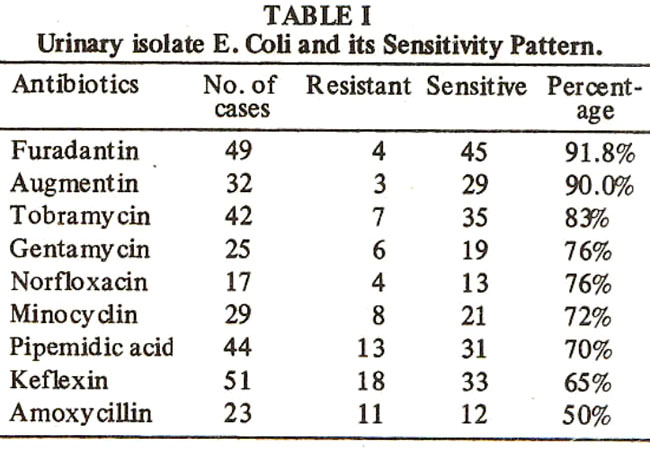
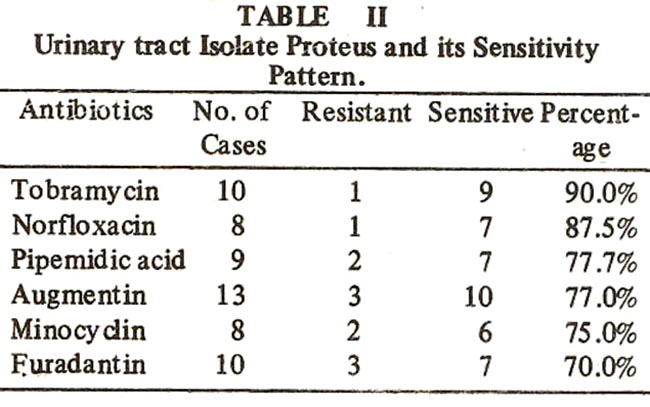
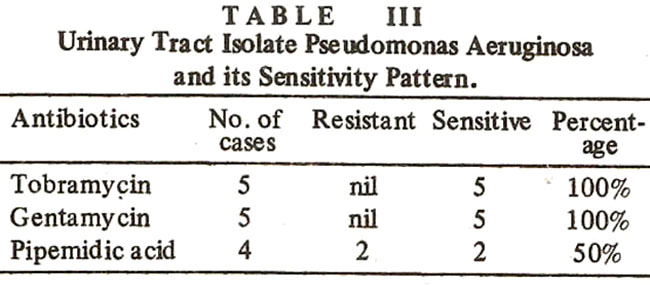
Furadantin, Augmentin and Tobramycin were most effective in E. Coli, Tobramycin and Norfioxacin against Proteus and Gentamycin and Tobramycin against Pseudomonas infections.
DISCUSSION
It is well established that Escherichia coli is the commonest urinary tract pathogen2 in this study too, E. Coil was the causative agent in 75% of the cases. The other organisms isolated were proteus, pseudomonas aeruginosa and streptococcus faecalis. All these patients were suffering from recurrent urinary tract infections.
In chronic and recurrent urinary tract infections, bacteriological help is essential for drug resistance is common and mixed infections occur. In this study cotrimaxazole was found to be the least effective against E. Coli, proteus and pseudomonas when compared to other antibiotics commonly used in urinary tract infection.
Nitrofurantoin, Augmentin, Tobramycin, Gentamycin and Norfioxacin were found to be the most active, Minocyclin and pipemidic acid moderately active and Keflexin Amoxycillin and Cotrimaxazole were least active against E. Coli. Tobramycin and Norfioxacin showed best activity against proteus. Augmentin, pipemidic acid and Minocyclin were also active against proteus group of organisms.
Tobramycin and Gentamyciti were the only drugs effective against pseudomonas aeruginosa. Pipemidic acid also showed some activity against pseudomonas. The clear difference in antibacterial activity of Amoxycillin and augmentin is due to the synergistic effect of clavulanic acid. The clavulanic acid inhibits the enzymes, B lactamases3.
The present study indicates that, resistance to older antibiotics has developed through various mechanisms. Therefore the haphazard use of antibiotics should be discouraged. At present, it seems preferable, certainly from the point of discouraging resistance for patients with recurrent urinary infections,to receive under laboratory and medical supervision, appropriate and varying therapy for specific episodes of infection.
REFERENCES
1. Krupp, A. M., Chatton, J. M., Werdegar, D. Current medical diagnosis and treatment. Los Altos, California, Lange, 1985.
2. Stamm, WE., Counts, G.W., Running , K.R., Fihns, S., Turck, M. and Holmes, K.K. Diagnosis of coliform infection in acutely dysuric women. N.Engl. J. Med., 1982; 307 :463.
3. Ninane, G., Joly, J., Kraytmàn, M. and Piot, P. Bronchopulmonary infection due to B-lactamaseproducing Branhamella catarrhalis treated with amoxydilhin clavulanic acid. Lancet, 1978; 2:257.
Journal of the Pakistan Medical Association has agreed to receive and publish manuscripts in accordance with the principles of the following committees:


