

Syed Muhammad All Bukhari ( Departments of Anaesthesia Shaikh Zayed Medical Complex and District Headquarter Hospital, Bahawalpur. )
Altaf Hussain Rathore ( Departments of Anaesthesia Shaikh Zayed Medical Complex and District Headquarter Hospital, Bahawalpur. )
Muhammad Abdullah Khan ( Rahimyar Khan and Department of Surgery, Quaid-i-Azam Medical College, Bahawalpur. )
June 1987, Volume 37, Issue 6
Original Article

Abstract
Minimal incidence of awareness of events during general anaesthesia was studied in 100 cases. Various regimens for general anaesthesia were used for different groups of patients. Awareness (consciousness) and oxygen followed by Halothane and gas oxygen during general anaesthesia was minimal during ether
mixture (JPMA 37 : 146, 1987).
INTRODUCTION
Awareness of operative events during general anaesthesia is an unpleasant experience for the patient especially if he feels pain as well. As the depth of general anaesthesia is increased the patient’s state changes1. Awareness is classified firstly into conscious awareness with normal recall from long term memory to, secondly, into conscious awareness with grossly impaired recall of perioperative events to, thirdly, unconscious awareness, where some stimuli perceived by brain may be stored in long term memory but do not subsequently enter consciousness. Finally, perception of stimuli by the brain is severely attenuated and registration of memory is abolated which is the ideal depth of general anaesthesia. In the third state,though, patient will not be able to recall the perioperative vents but the high level stimuli will be stored in subconscious memory and subsequently influence behaviour2,3. At present the anaesthetist’s main source of information on the depth of anaesthesia is the patient’s somatic and autonomic responses to surgical stimuli. In the modern practice of anaesthesia the responses are modified by neuromuscular blocking drugs and drugs affecting autonomic nervous system. Presence and absence of these responses does not correlate with conscious awareness4. There is no clinical criteria by which the anaesthetist could be definite about the consciousness of the patient. The objective of the present study was to know the frequency of consciousness of patients under various methods of general anaesthesia and to find out a method by which the depth of the anaesthesia can be measured.
MATERIAL AND METHODS
One hundred patients between 15-60 years, operated for different diseases, were included in this study. They were given atropine 1 mg by intravenous route just before anaesthesia. Induction of anaesthesia was done with 5 mg/kg of Injection Pentothal Sodium and intubation by using short acting muscle relaxant (Suxamethonium 1 mg/kg body wt.). The relaxation was maintained by long acting muscle relaxant i.e. pancuronium bromide (Pavulon) in a dose of 8-10 mg after intubation. Reversal of paralysis was done at the end of operation by using a mixture of Injection Prostigmine (0.04 mg/ kg body wt) and atropine (0.02 mg/kg body wt). All were given intermittent positive pressure respiration (IPPV). Each patient was thoroughly inquired about the events occurred during anaesthesia and surgery after full recovery from anaesthesia (after 48 hours). The patients were divided in following five groups according to various regimens of general anaesthesia.
Group I
Forty patients were given Oxygen and Nitrous Oxide in a ratio of 50:50 to a maximum of 20:80 (in two stout patients only) by Boyl’s apparatus.
Group II
Thirty patients were given a mixture of Oxygen, Nitrous Oxide and Flouthane through Boyl’s apparatus in following concentration:- 02 50:N2 0 with 0.5-1.5% Halothane
Group III
Ten patients were given a mixture of Nitrous Oxide and Oxygen through Boyl’s apparatus in a ratio of 50:50 along with a bolus dose of I/V pethidiné 50-70 mg at the start of operation and an additional dose of 30 mg during operation.
Group IV
Ten cases were given IPPV by Ambu bag sothat they were breathing ordinary air. They were given I/V 5 mg Inj. Diazepam at the start of operation along with intermittent dose of Pethidine to a maximum of 100 mg. No other drug was used as anaesthetic agent.
Group V
Ten patients were given Oxygen and Ether through Boyl’s apparatus.
RESULTS
The grouping of patients and their awareness during anaesthesia is shown in the table In Group I,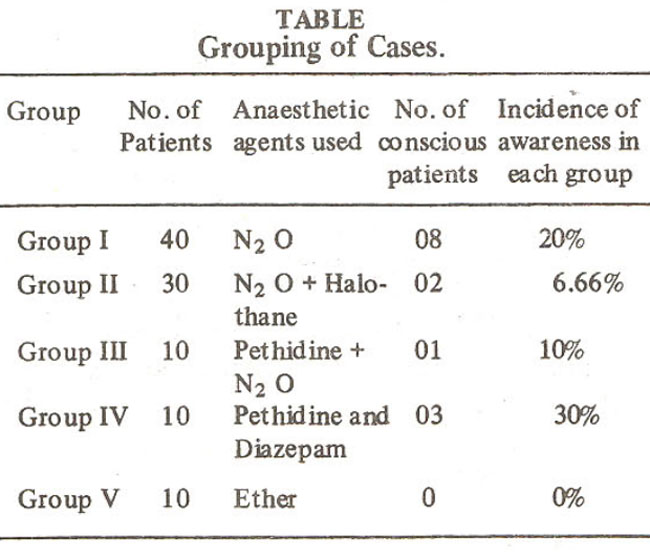
20% cases complained of awareness of events during surgery and anaesthesia and two (5%) also complained of mild pain at operation site.
In Group II, two patients (6.66%) had blurred memory of events during operation and anaesthesia while in Group III, 10% were aware of surgical events.
Three cases (30%) had complete consciousness of operation and one patient had severe pain as well in Group IV. None of the patients in Group V had any degree of consciousness.
DISCUSSION
In the present study, painful memory was not much of a pmblem because pain disappears in an early stage of anaesthesia, so called stage of analgesia. The commonest recollection of the events during anaesthesia had been hearing as well in Group IV. None of the patients in Group V had any degree of consciousness.
memory which goes in accordance with the experience of Benett et al5 The auditory pathway continues to function during certain stages of anaesthesia but its activity is reduced by most of anaesthetics6,7. Auditory pathway has its relay stations in well defined anatomical structures of the brain stem and cortex. Some anaesthetic agents spare the brain stem part of auditory response but cortical component is depressed by all the anaesthetics. Volatile anaesthetics, ether, halothane, enflurane, isoflurane and intravenous thiopentone and methohexitone affect both the brain stem as well as the cortical part of auditory response8, whereas other agents like Nitrous Oxide attenuate the cortical waves but has no effect on the brain stem9. That is why awareness during general anaesthesia was minimum with ether and halothane but was more when Nitrous Oxide alone was used specially when it was not combined with any opiate. The awareness was maximum when pethidine was used with diazepam which has an amnestic effect10 What could be the cause of 6.66% of awareness in patients who got halothane? They probably did not have proper depth of anaesthesia. There is, therefore, a need for development of techniques to monitor the depth of anaesthesia in paralysed patients. Until now autonomic activity of an awake, paralysed and terrified patient like dilatation of pupils, rapid bounding pulse, sweating, unexplained rise of blood pressure and sometimes, staring of eyes are mostly relied upon11 Tunstall 12 made his paralysed obstetric patients move their forearms isolated by tourniquet from the effect of neuromuscular blocking agents by verbal command. Miller and Watkinson13 were not convinced by the hand movements by verbal command but they relied more upon the movements in response to the noxious stimuli of intubation and surgery to judge the depth of anaesthesia. Until more research is done to ewlve a foolproof method to judge the depth of anaesthesia, the anaesthetists could be well advised to give volatile anaesthetics to minimise the trauma of awareness during anaesthesia to their patients.
REFERENCES
1. Jones, J.G. and Komeczko, K. Hearing and memory in anesthetised patients. Br. Med. J., 1986; 292: 1291-93.
2. Dixon, N.F. The conscious.unconscious interface; contributions to an understanding. Arch. Psychol., (Frankt),1983; 135:55.
3. Sokoloff, L. Localization of functional activity in the central nervous system by measurement of glucose utilizationwith radioactive deoxyglucose. J. Cereb. Blood Flow Metab., 1981; 1 :7.
4. Hug, C.C. Jr. Lipid solubility, pharmacokmetics and the EEG; are you better off today than you were four years ago? Anesthesiology, 1985; 62 :221.
5. Bennett, H.L., Davis, H.S. and Giannini, JA. Nonverbal response to intraoperative conversation. Br. J.Anaesth., 1985;57:174.
6. Dorfman, L.J. Sensory evoked potentials; Clinical applications in medicine. Annu. Rev. Med., 1983; 34:473.
7. Woods, D.L., Hillyard, S.A. and Hansen, J.C. Event-related brain potentials reveal similar attentional mechanisms during selective listening and shadowing. J. Exp. Psych.(Hum. Percept), 1984; 10:761.
8. K.riss, A., Prasher,B.R. and Frau, R.T.C. Brainstem and middle latency auditory EP’s evoked during unilateralelectroconvulsion therapy (ECT), in Second International evoked potentials sympo sium. Edited by Nodar, R.H. and Barber, C. Vol. 2. Boston, Butterworth, l984;p. 582.
9. Lader, M.H. and Norris, H. Effect of nitrous oxide on the auditory evoked response in man. Nature, 1968; 218:1081.
10. Frith, C.D., Richardson, JT., Samuel, M., Crow, T.J. and Mckenna, PJ. The effects of intravenous diazepam and hyoscine upon hwnan memory. QJ. Exp. Psychol. (A), 1984; 36:133.
11. Lee, J. A., Atkinson, R.S. and Rushman, GB. Synopsis of anaesthesia, 9th ed. Bristal, Wright, 1982, p. 168.
12. Tunstail, M.E. Detecting wakefulness during general anaesthesia for caesarian section. Br. Med. J., 1977;1:1321.
13. Millar, K. and Watkinson,N. Recognition of words presented during general anaesthesia. Ergonomics, 1983; 26 :585.
Journal of the Pakistan Medical Association has agreed to receive and publish manuscripts in accordance with the principles of the following committees:


