

Iftikhar Ali Rana ( Food Technology and Nutrition Research Laboratories, National Agricultural Research Centre, Islamabad. )
Musarrat Gilani ( Food Technology and Nutrition Research Laboratories, National Agricultural Research Centre, Islamabad. )
Saeeda Jafri ( Food Technology and Nutrition Research Laboratories, National Agricultural Research Centre, Islamabad. )
May 1990, Volume 40, Issue 5
Original Article

ABSTRACT
The nutritional status and proximate composition, fatty acid profile and mineral composition of milk from 26 wives of army personnel of low income group from Rawalpindi was investigated. The body mass index ranged from 13.5 to 23.7, hemoglobin from 8.6 to 14.8G/dl, serum protein from 4.8 to 7.5G and serum albumin from 3.3 to 4.8G%. Milk protein content varied from 0.6 to 2.4%, fat from 1.0 to 3.7 mg. Palmitic acid was the major fatty acid in milk whose concentration ranged from 34.4 to 47.1mg and the linoleic acid from 6.9-15.4 mg%. The calcium content of milk varied from 7.9 - 87.1 mg%, iron from traces to 0.44 mg% and zinc from 0.02-1.28 mg% (JPMA 40: 109, 1990).
INTRODUCTION
Milk is the sole natural food for the human infant in the first few months of life. After about three to six months, it is desirable to give supplementary foods and gradually wean the infant on to a mixed diet. In this process, milk slowly loses its dominant place in the infant’s diet, but for the first two years of life, it is important that milk should remain the largest single item of food. Human milk provides about 70 Kcal/100g Energy needs depend upon body weight which varies from 120 to 100 Kcal/Kg body weight, the need declining as the age advances. Healthy infants at 2,4,6 months need about 780, 880 and 1000 ml of milk daily. A mother can be expected to provide 800 ml daily but the yields vary greatly. Most mothers could meet the needs of their baby till 4 months but only a minority till 6 months. In many countries, including Pakistan, it is a custom to feed infants solely at the breast for much longer, and that is why according to Waterlow2 growth rate is the same in these countries for the first four months as for babies in the United Kingdom and thereafter it falls markedly. Hussain3 has reported the proximate composition of mature human milk from Pakistani women. The present work was, therefore, carried out to investigate the nutritional status and the nutritive value of milk from a group of mothers from low income group, as nutritionally this is one of the most vulnerable groups of the population in this country.
PATIENTS AND METHODS
\'Twenty six wives of army personnel belonging to lower formations, delivering at the gynae and obstetrics department of the Military Hospital, Rawalpindi were selected for the study. The blood and milk samples were collected between 2 to 6 days after delivery. Body weight was measured using Krupps weighing machine (Ireland) and height using a measuring scale with a sliding head piece. Information regarding the age of the mother, family income and the number of children was collected from hospital records and through personal interviews. Hemoglobin, serum protein, albumin and globulin levels were determined according to standard methods4,5. The proximate composition of human milk was carried out according to AOAC6, the protein content using Kjeltec Autoanalyzer 1030, fatty acid profile using Shimadzu GC-9A gas chromatograph aided by Schimadzu C-R3A Chromatopak integrator using hydrogen as the carrier gas, calcium and trace mineral using Perkin Elmer 4000 Atomic Absorption Spectrophotometer and sodium and potassium contents using Klina Flame photometer (Beckman). The body mass, index (BMI) was calculated using the formula BMJ = Weight in Kgs/ (Height in meter) 2.
RESULTS
The data regarding age, height, weight, body mass index, number of children and family income of subjects is shown in Table 1.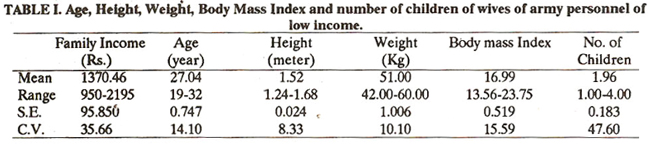
The average family income was Rs. 1,370 per month with 46.2% of the families having an income of less than Rs.1,000 per month. The body mass index showed that 46.2% females were underweight for height (Body Mass Index under 19) and 34.6% of these were severely underweight (Body Mass Index under 16). Anaemia was present in 23.1% women and low serum proteins and globulins in 58% cases while 11.5% had low serum albumin too (Table II).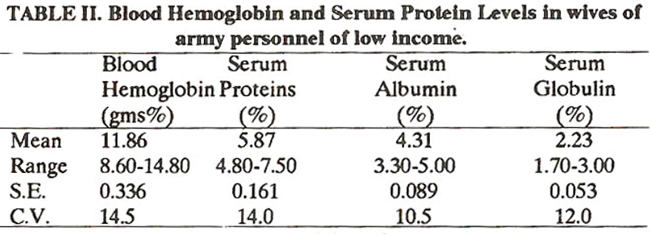
The proximate composition data on transitional milk (Table III)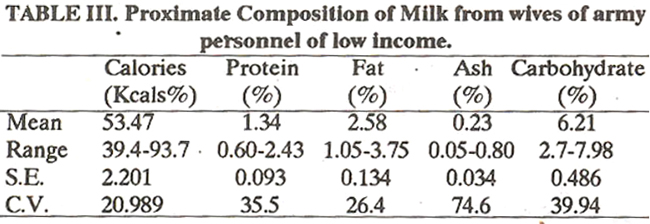
showed that 88.5% of the milk samples were low in energy, 23.1% low in protein, 73.1% low in fat and 61.5% low in carbohydrate compared to the values reported for Pakistan3 and East Asia7. The fatty acid profile (Table IV)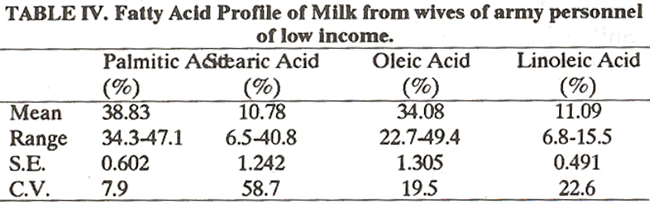
of the milk showed that linolenic was present in trace amounts in all the milk samples, while 15.4% samples were low in linoleic acid. Rest of the fatty acids were in the normal range. Of the mineral contents (Table V)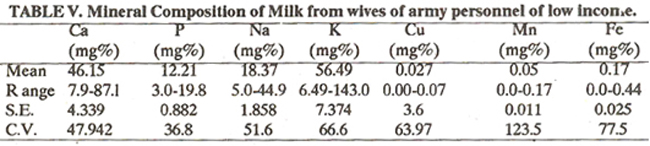
80.8% samples were low in zinc, 72% low in iron, 34.6% low in -phosphorus and 11.5% low in copper.
DISCUSSION
The present study reports the nutritional status and nutrition value of transitional milk from wives of army personnel of low income from Rawalpindi. The average fat and energy contents of the milk from British women8 is higher than that found in the present study. This indicates the better nutritional status of the British women in general. The average milk protein content in the present study is however similar to that reported in many other studies3,7,9,10. Longitudinal study on 60 Bangladesh mothers from an underprivileged periurban community showed higher average fat (2.804%), carbohydrate (7.92%) and energy contents (61 Kcals) in human milk10 than that found in the present study. The fatty acid profile of human milk in the present study was similar to that reported by others3,7,8 except for low levels of linoleic acid in 15.4% of the samples. However, because of the lower fat contents, even when compared to Bangladesh women from an underprivileged periurban community, the actual fatty acid contents were lower than that found by others3,7,8. Smith et al11 determined the fatty acid profile of pooled banked milk from United Kingdom and found that linoleic, linolenic and lauric acids were 11.2, 1.2 and 2.7% of fatty acids compared with 7.2, 0.8 and 5.4% previously reported by the U.K. Department of Health and Social Security8. Dorea et al12 carried out longitudinal study of major milk constituents from Smothers of high and8 of low socioeconomic status in Brazil and found that there was no significant difference in total solids, lipids, total nitrogen and ash between the groups except in ash at 15 and 45 days of lactation. There was no difference in those values in hind milk between the groups but the combined results showed a significant increase in lipids at day 45. Of hind milk samples taken from the groups of low socioeconomic status, 29% had milk fat below 3.0%. Changes in the milk fat from foremilk to hindmilk were on average 224%. Vitamin and trace element content of human milk in USSR revealed iron content of 0.162 ± 0.008 mg%, 27.9 ± 3.6 ug% copper and 7.7 ± 0.5 ug% iodine13. The milk composition from mothers of term and preterm infants in Uruguay showed no significant difference in lactose, proteins, total saturated and unsaturated fats, 8 fatty acids sodium, potassium, calcium, urea, osmolarity and buffer capacity 3 to 8 days postpartum14. Kosta et al15 investigated the trace element content of colostrum, transitional milk (3-14 days postpartum) and mature milk (1-8 months postpartum) from Yugoslavian mothers and found a progressive decrease in zinc from 62 + 37mg/Kg in colostrum to 34 + 16 mg/Kg in transitional milk and 10.8 + 8.1 mg/Kg in mature milk. There were no clear trends for the other elements like arsenic, cadmium, copper, mercury, iodine, manganese, tin and vanadium when examined. Raghuvanshi et al16 collected breast milk from well nourished and undernourished mothers from 3 to 15 days of loctation, living in 3 villages of Kashi district, India found that the values for total nitrogen, non-protein nitrogen and lactoferrin were slightly higher in the undernourished than in the well-fed women during the first fifteen days. The latest national nutrition survey17 shows that breastfeeding is practised throughout the country, although less in cities. The average duration of breast feeding is approximately 15-18 months. Most children (68%) ages 7-9 months do not consume any food apart from milk. Even by 12-17 months, 30-50% eat no food. Calorie deficiency is far more serious than protein deficiency in relation to protein-energy malnutrition in young children. Iron deficiency is extremely high in pregnant/lactating women as well as in very young children and there are high levels of anaemia in these groups. The poor quality of human milk as well as the cow and buffalo milk available to the general population and the defective weaning practices go a long way it deteriorating the nutritional status of the child population in this country. Thus only 27% children are normally nourished in Baluchistan, 31% in NWFP, 36% in Sind and 49% in Punjab. The present study indicates that the wives of low income employees of Pakistan Army are nutritionally no better than women form similar socio-economic groups in the country and this is also reflected in the poor quality milk secreted by these women.
REFERENCES
1. Whitebead, R.G. Nutritional aspects of human location. Lancet, 1983; 1: 167.
2. Waterlow. J.C. Observations on the sucklings dilemma a personal view. J. Hum. Nutr.,1981; 35: : 8$.
3. Hussain, T. Food composition tables for Pakistan, Islamabad. Planning and Development Division, Government of Pakistan, 1985.
4. Hainline, A. Hemoglobin, in fundamentals of clinical chemistry, Edited by Norbert W. Tietz. Philadelphia, Saunders 1976, p. 268.
5. Reinhold, J.G. Total protein, albumin and globulin, in fundamentals of clinical chemistry. Edited by Norbert W. Tietz, Philadelphia, Saunders, 1976, p. 210.
6. Association of Official Agricultural Chemists official methods of analysis of the association of official agricultural chemists. Edited by William Horwitz, 11th ed. Washington, D.C., Author, 1970, p. 245.
7. Leung. W.W., Butrum, LR., Rao, H. N. and Polaccbi, W. Food composition tables for use in East Asia. U.N. Food and Agriculture organization, Rome-00100, Italy, 1972.
8. Department of Health and Social Security. The composition of mature human milk. Report on Health and Social Subjects No. 12 London, HMSO, 1977.
9. Clark, R.M., Ross, S.A., Hill, D.W. and Ferris AM. Withinday variation of taurine and other nitrogen substances in human milk. J. Dairy Sci., 1987; 70: 776.
10. Brown, K.H., Akhtar, N.A., Robertson, A.D. and Ahmed, M.G. Lactational capacity of marginally nourished mothers; relationship. between maternal nutritional status and quantity and proximate composition of milk. Pediatrics, 1986; 7& 909.
11. Smith, L, Harkes, A and D\'Souza, S.W. Fat content and fatty acid composition of poole banked milk. Br. Med. 3., 1964; 288:283.
12. Dorea, J.G., Harner, M.R., Bezerra, V.LVA and Compante, M.L. Longitudinal study of major milk constituents from two socio- economic groups of mothers in BraziL Nutr. Rep. Intern., 1984; 29:699.
13. Borbiev, S.U. Vitarr n and trace element composition of human milk and of national types of infant formulae in the Naryn region (USSR). Zdravookhranenie Kirgbizu, 1982; 1:26.
14. Martell, M., Rubino, M.M., Alallon, W. and Korc, B. Composition of milk from mothers with term and preterm infants. Arch. de ped. del Urug., 1961; 52: 155.
15. Kosta, I., Byrne, A.R. and Dermelj. M. Trace elements in some buman milk samples by radiochemical neutron activation analysis. Sci, Total Environ., 1983; 29: 261.
16. Raghubanshi, R.S., Agarwal, K.N. and Franason, G.B. Breast milk total nitrogen, nonprotein nitrogen and lactofemn content. Indian. Pediatr., 1988; 25: 149.
17. Khan, M.R. and Malik, Z.R. National Nutrition Survey: Final report, Islamabad. Nutrition Division, National Institute of Health, Government of Pakistan 1988.
Journal of the Pakistan Medical Association has agreed to receive and publish manuscripts in accordance with the principles of the following committees:


