

Saadiya Rasul ( Departments of Obstetrics and Gynaecology, The Aga Khan University Hospital, Karachi-5. )
Shahbanu Rizvi ( Departments of Pathology, The Aga Khan University Hospital, Karachi-5. )
Mohammad Khurshid ( Departments of Obstetrics and Gynaecology, The Aga Khan University Hospital, Karachi-5. )
Javaid Rizvi ( Departments of Obstetrics and Gynaecology, The Aga Khan University Hospital, Karachi-5. )
May 1990, Volume 40, Issue 5
Original Article

ABSTRACT
Sera of 2000 pregnant women attending the antenatal clinic of the Aga Khan University Hospital were tested for rubella antibodies. Of these 1684(84.2%) were Immune and 316(15.8%) were susceptible to rubella. Majority (99.8%) of the women were Asian in origin. Susceptibility decreased with increasing age and parity. We conclude that apart from vaccination of all young children greater attention should be paid to immunization of women of child-bearing age (JPMA 40 :102,1990).
INTRODUCTION
Rubella (German measles) has been directly responsible for much pregnancy wastage and severe congenital malformation in the live born infant including congenital deafness, mental retardation, cerebral palsy, eye defects. Congenital rubella syndrome is preventable. In Great Britain the protective strategy employed is to allow wild rubella virus to circulate among children so that approximately 50% of women can enter their child-bearing years with naturally acquired immunity. Immunization of all school girls aged 10-14 years is then employed with the aim of giving vaccine induced immunity to the remaining 50% (Department of Health & Social Security 1970). In addition, vaccination is offered to all women of child-bearing age who have been shown to lack antibodies against rubella,1 Overall the incidence of congenital rubella has been declining over the past few years due to active immunization programmes in the Western countries. The incidence of Congenital Rubefla Syndrome (CRS) in U.S.A. in 1981—1983 was 0.9 - 1/1000. 2 Its incidence in Australia has declined from 2.05/100000 live births to 0.043/100000 between 1963 — 1983 following an active rubella screening and immunization programme. 3 There is little epidemiological data available in Pakistan regarding susceptibility to rubella in pregnancy and the incidence of congenital rubella syndrome in the new born. Of the two studies carried out in Pakistan the immunity to rubella in 262 married women, was 72%4 in one while in another it was 77% in pregnant and 51.7% in pre-pubertal females5.
PATIENTS AND METHODS
Routine antenatal screening for rubella on all women attending the antenatal clinic at the Aga Khan University Hospital (AKUH), Karachi was carried out. A total of 2000 patients were screened from January1987 to October 1988. Three ml of blood was drawn from patients at their first visit to the antenatal clinic and rubella IgG and 1gM antibodies screening tests were done by the ELISA Technique (Rubazyme, Abbott Laboratories).
RESULTS
The results of the study are shown in tables 1 and II.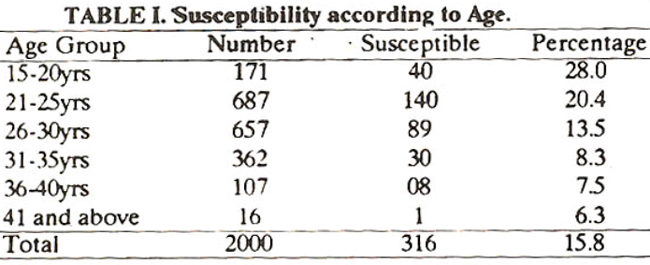
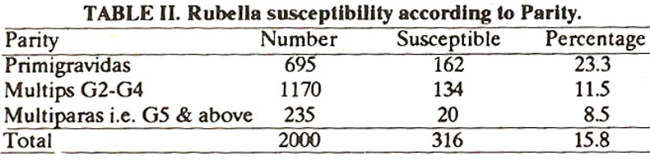
Of 2000 antenatal population screened, 15.8% were found susceptible to rubella, and the susceptibility decreased with increasing age and parity. Majority (99.8%) of the females were of Asian origin. Patients who were susceptible to rubella were offered immunization using live attenuated rubella vaccine, (RA 27/3M strain USTAR — Rudivax). This is a safe non communicable and effective method of prevention6-8.
DISCUSSION
Congenital rubella syndrome is an important cause of preventable congenital defects in the newborn. Worldwide efforts have been made to reduce the risk of foetal anomalies by immunizing the susceptible female population of child bearing age. In the western world today the incidence of women susceptible to rubella vary between 2.7 — 7.3%9,10. Ours is a descriptive study of rubella immunity status in women visiting the antenatal clinics at a private hospital. These women are mostly urban, better educated and relatively affluent. Therefore this data cannot be extrapolated to draw conclusions about the immunity status in the whole female population of Pakistan. Further studies are required, but this can serve as a model to conduct similar studies in defined geographical areas. We found that 84.2% women of child bearing age were immune to Rubella. However, the percentage of susceptible women is a cause of concern. Two previous studies4,5 have shown a susceptibility rate of 28% in married women and 23% in pregnant women. Our figures are lower (15.8%) than these studies, but if age and parity specific data are taken into account, the highest susceptibility rate was in women between 15 and 20 years of age (28.0%) and among primigravidas (23.3%). The incidence of susceptibility declines with increasing age and parity. Parity has been shown to be an important factor in assessment of rubella status and may reflect postpartum immunization. 11 Another factor is the exposure of parous women to young children in their own and in neighbouring households. Such children may transmit wild rubella virus. This source has previously been shown to explain the association between poliovirus infection and parity12 and is a factor which must be controlled in further studies of rubella. The implications and consequences of the congemtal rubella syndrome for the foetus are well known13 and can present substantial physical, emotional and financial hardships for the children and the family. In order to reduce the number of patients at risk, considerable efforts would be required and, until high vaccination rates become the rule throughout the country, the seropositivity rates of women seeking antenatal care may not improve. Such improvements cannot be achieved locally but will require intervention and support at national/governmental level. Two main approaches have been used10 and can be adopted. The first one is vaccination of all young children in order to prevent the spread of rubella to adult pregnant women. The other is to vaccinate all teenage girls, thus giving individual protection against rubella during their fertile period. In Pakistan there is a major drive for immunization in children. These programmes are supported by grants from the government and the WH.O., but rubella immunization is not included in their regular regimen.
ACKNOWLEDGEMENT
We wish to thank Mr. Jack Fernandes (Assistant Librarian, AKUH) for his help and Miss Nargis Amirali for her secretarial assistance.
REFERENCES
1. Lever. A.M., Ross, M.G., Baboonian. C. and Griffiths, PD. Immunity to rubella among women of child-bearing age. Br. J. Obstet. GynaecoL. 1987; 94: 20&
2. Leads from the MMWR. Rubella and congenital rubella-United States, 1980-1983. JAMA., 1983: 250: 2104.
3. Stanley, F.J., Miora, SM.. Wilson, G. and Worthington. S. The decline in congenital rubella syndrome in Western Australia. Am. J. Public Health, 1986; 76: 35.
4. Ishtiaq, A. Rubella susceptibility; a study of 200 college students and hospital employees. Pharma News, 1987; Feb. 15.
5. Azmi, F., Iqbal, J., Rab, A., Khan, MA. and Amin, A. Prevalence of antirubella antibodies in pregnant and pre pubertal females; a preliminary study. JPMA., 1987; 37:
6. Gudmundadottir, S., Ntonsdottir, A.. Gudnadottir, S., Elefsen, S., Einarsdottir, B., Olafsson, 0. and Gudnadottir, M. Prevention of congenital rubella in Iceland by antibody screening and immunization of seronegative females. Bull. WHO., 1985; 63: 83.
7. Hinman. A.R. Prevention of congenital rubella infection; symposium summary. Paediatrics, 1985; 75:1162.
8. Black, N.A., Kurtz, J.B., Lacey, A., Parson, A., McWhinney, N. and Mayon-Wbite, R.T. Postpartum rubella immunization; a controlled trial of two vaccines. Lancet, 1983; 121:990.
9. Miller, C.L., Miller, E. and Waight P.A. Rubella susceptibility and the continuing risk of infection in pregnancy. Br. Med. J. (Clin. Res.), 1987; 294: 1277.
10. Leader, A., Taylor, P.J. and Daudi, PA. Thevalue of routine rubella and syphlitic serology in the infertile couple. Fertil. Steril., 1984; 42: 140.
11. Miller, CL, Miller, E., Sequeira, P.J.L, Cradock-Watson, J.E., Longson, M. and Wtsebarg. E.C. Effect of selective vaccination on rubella susceptibility and infection in pregnancy. Br. Med. J., 1985; 291: 1398.
12. Seigal, M. and Greenberg, M. Incidence of poliomyelitis in pregnancy; its relation to maternal age, panty and gestational period. N. Engi. J. Med.. 1955; 253:841.
13. Joncas, J.H. Preventing the congenital rubella syndrome by vaccinating women at risk. Can. Med. Assoc., J., 1983; 129 : 110.
Journal of the Pakistan Medical Association has agreed to receive and publish manuscripts in accordance with the principles of the following committees:


