

Imran Ahmad Qureshi ( Department of Physiology, Basic Medical Sciences Institute, Jixmah Postgraduate Medical Centre, Karachi. )
Xiao Rong Xi ( Pakistan and Shanghai Medical University, Shanghai-200032, P.R. China. )
Xiang Dong Wu ( Pakistan and Shanghai Medical University, Shanghai-200032, P.R. China. )
Nusrat Pasha ( Department of Physiology, Basic Medical Sciences Institute, Jixmah Postgraduate Medical Centre, Karachi. )
Yang Bin Huang ( Pakistan and Shanghai Medical University, Shanghai-200032, P.R. China. )
February 1998, Volume 48, Issue 2
Original Article

Abstract
The present study investigated whether a correlation between days of the menstrual cycle and variations in intraocular pressure exists or not, The number of days since the beginning of last menses was recorded alongwith intraocular pressure for 1,459 women, Measurements were taken by Goldmann applanation tonometer. The differences among various days of menstrual cycle were statistically insignificant. The highest mean lOP occurred between 20th and 22nd day and the second peak from 13th to 15th days of the cycle. The lowest mean lOP was found from 16th to 19th days of the cycle. This study concludes that intraocular pressure varies with the various days of the menstrual cycle, but fluctuations are statistically insignificant and cannot affect the diagnoses of glaucoma (JPMA 48:37,1998).
Introduction
An elevated intraocular pressure (lOP), just prior to or during menstruation has been reported by several workers1-4. However, two studies have failed to find any relation between intraocular pressure and days of menstrual cycles5,6. It has been noted that intraocular pressure is a dynamic function and is subject to many influences both acutely and over the long term. Recently, it has been shown that mild exertion such as walking decreases lOP7. Many investigators have reported that lOP varies diurnally8. Drinking water, coffee or alcohol, before measurement of lOP, has a significant effect on it9. Several studies have shown that intraocular pressure is positively correlated with systemic blood pressure10. Acute hyperglycaemia decreases11, while chronic hyperglycaemia in diabetes increases lOP12. Mean values of lOP are different in different races13. Stoupel et al14 found a significant effect of environmental factors on intraocular pressure. Due to differences in inherent constitution, diet and environmental conditions, there is a clear need for well collected population-based data in different countries and ethnic groups. Association of TOP with menstrual cycle had not been described in Pakistani women. Moreover, the inconsistent findings in previous studies, regarding the relationship between days of the menstrual cycle and variations in intraocular pressure, may be due to negligence of above mentioned variables. Therefore, after taking into account all those factors that can affect intraocular pressure, this study was planned to determine whether if any relation between days of the menstrual cycle and variations in lOP exists or not.
Subjects and Methods
All experimental procedures were adhered to the Declaration of Helsinki of the World Medical Association. Apparently normal 1459 volunteers’ women, who were from different hospitals, colleges, schools, universities and factories, were studied. After their consent, a medical histoiy was taken from each subject, including questions concerning previous ocular diseases, presence of diabetes mellitus and the occurrence of glaucoma in the family. The criteria met by the subjects were absence of ocular complaints including refractive errors; absence of any history of eye surgery and diabetes; nonnal body temperature and blood pressure; moreover, not taking contraceptives in any form. The number of days since the beginning of the last menstrual period was recorded. The subjects were asked not to eat or take tea and have complete rest atleast 30 minutes before the measurement of lOP. The blood pressure was taken in sitting posture. In this study, only healthy subjects were included. If subject had an TOP reading above 21 rnrnHg, or a difference of 5 mmHg between the two eyes. or if they had a history of haloes or attacks of blurred vision, they were excluded from this study and were asked to see the opthalmologist for further examination. The subjects were exanuned at a fixed time between 1000 and 1200 hours to minimize the effect of diurnal variations. After installation ofO.25% fluorescein sodium and 0.4% benoxinate hydrochloride (fluress) eye drops, the lOP was measured with the Goldmann applanation tonometer (Goldmann Topcon, Gennany), first in the right eye and then in the left. The measuring drum was turned until the inner borders of the fluorescein rings (adjusted for equal size) just touched each other at the midpoint of the ocular pulse and the overlap and separation of the mires with each pulse swing was equidistant from the midpoint on both sides. The measuring drum was not to be observed until this defined point was reached. Three consecutive readings of each eye were taken. After each reading the tonorneter was removed from the contract and the measuring scale was returned to 10 minHg. The practice of returning the tonometer to 10 mmHg, after each reading minimized observer bias.
Statistical analyses: The mean of the three readings was computed separately for each eye. No statistical difference was found between fellow eyes of each pair, so the data were pooled for statistical analysis. Intraocular pressures were measured in whole numbers, but for statistical accuracy, the mean values have been expressed upto one decimal point. For all variables descriptive statistics (mean, standard deviation, standard error of mean) were calculated by Statistical Analysis System 761). All data are expressed as mean and standard error of mean. Significance of the difference was calculated by applying the two-tailed unpaired Student’s t-test.
Results
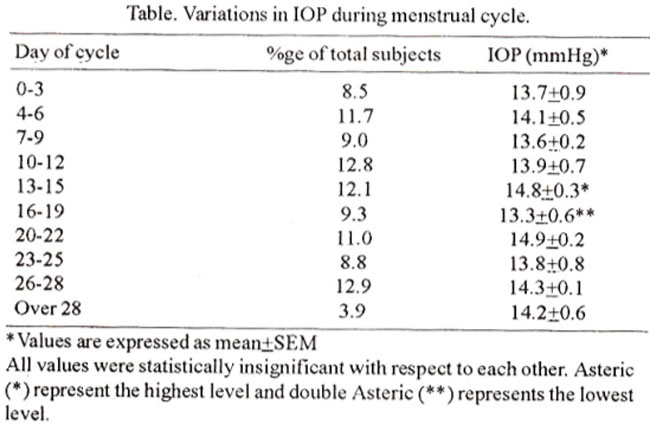
The data is summarized in Table which shows that although fluctuations in intraocular pressures were presentbut the values were statistically insignificant. As compared to first day of menstrual cycle the highest lOP occurred from 20th to 22nd days and the second peak from 13th to 15th days of the cycle. The lowest lOP wasfoundfmm l6thto l9th days of the cycle.
Discussion
The present study reports the lOP changes with the days of the menstrual cycle. The results of the present study are different from previous studies1-4. In Bedford glaucoma survey, Bankes et al1 found that the lowest mean lOP coincided with the 21st to the 24th days, while the highest occurred from the 9th through the 12th days, with another peak, from the 25th through the 28th days of the menstrual cycle. Salvati3 noted an increase in lop during menstruation. Dalton4 noted an increased incidence of glaucoma symptoms and elevated intraocular pressure in female glaucoma patients just before and during menstruation. The cyclic changes in estrogens and proystemnes during the menstrual cycle are well documented5,6,16. The first peak of mean TOP, occurred from the 20th through the 22nd days, may be due to highest concentration of progesterone, which occurred during this period of menstrual cycle. The second peak of mean lOP, occurred from the 13th thmugh the 15th days, maybe because of ovulation. Luteinizing hormone (LH) is necessary for ovulation process. Approximately two days before ovulation, for the reasons that are not completely known at present, the rate of secretion of LH by the anteriorpituitaiy gland increases markedly, rising six-to tenfold and peaking about 16 hours before ovulation. The LH has the specific effect on the granulosa and theca cells of converting them more to progesterone secreting cells and less estrogen secretion. Therefore, the rate of secretion of estrogen begins to fall approximately one day prior to ovulation, while small amounts of progesterone begin to be secreted16. Near ovulation, the higher levels of LH ‘nay be a cause of higher lOP value. Till now, there is no information regarding whether LH plays any role in the physiologic regulation of lOP. Therefore, the present study suggests another study to see the effect of LH on TOP. Alternatively, increased body temperature, experienced by most of the women17 is a more likely explanation for rise of intraocular pressure near ovulation.
In this study, the lowest mean lOP occurred from the 16th through the 19th days of the cycle. The concentrations of estrogen and progesterone are nearly equal during this period of menstrual cycle16. These hormones can decrease intraocular pressure by increasing the outflow facility18. Variations in the outflow facility, over the course of a month in females has been noted2,5,6,18, but in males these were absent19. Several investigators have tried to find the correlationbetween outflow facility and level of hormones during the cycle, but theirfindings are not consistent, evencontradicting eachother. Becker and Friedenwald18 noted a relatively increased facility of outflow during progestational phases of the menstrual cycle and a decreased facility during estrogenic postmenstrual period. Paterson and Miller2 noted an increased facility of outflow during estrogenic and estrogenic progesterone phases of the menstrual cycle. Several studies have reported the effect of pharmacological doses of progesterone and estrogen (alone or in combination) on Lop values, but their results are not consistent and even contradictory. Progesterone administered systemically20 and orally21 lowered lOP, by increasing facility of oufflow 18. However, Siebenbiedel22 noted no effect of progesterone on JOP Estrogen increases23 or decreases24 intraocular pressure. However, Avasthi and Luthra20 noted no effect of estrogen on lOP. Similarly, progesterone estrogen combinations increase22 and decrease intraocular pressure. Despite some findings to the contrary. it would appear that phannacological doses of progesterone and estrogen (alone or in combination) can influence the intraocular pressure. The effect of physiological hormonal changes associated with the menstrual cycle on intraocular pressure has been studied very seldom. This study concludes that intraocular pressure varies with the days of menstrual cycle, but fluctuations are statistically insignificant and cannot affect the diagnoses of glaucoma. Recently, it has been suggested that hereditary factors may play some role in the determinaion of TOP25. The effect of physiological hormonal changes associated with the menstrual cycle on lOP canbebetter studied intwins. Therefore, the present study suggests a similar study in twin sisters.
Acknowledgements
The authors gratefully acknowledge to Professor Dr. Ahmad Kamal Ansari, Professor Abdul Baseer and Professor Dr. Mohammad Nawaz for their guidance and technical assistance and Mrs. Lu Huijuan for her statistical service.
References
1. Bankes, J.L.K.. Perkins, ES., Tsolakia, S. et al. Bedford glaucoma Survey. Br. Med. J;1968;1 :791-796.
2. Paterson, GD. and Millar, S.J.H Hormonal influence in simple glaucoma: A preliminary report. Br. J. Ophthaimol., 1963;47:129- 137.
3. Saivati, ML. Influence de Ia menstruation sur La tension oeulaire. Ann. Ocul., 1923;1 60:568-569.
4. Dalton, K. Influence of menstruation on glaucoma. Br. 3. Ophthahnoi., 1967;5l :692-695.
5. Feldman, F., Bain, 3. and Matuk, A.R. Daily assessment of ocular andhormonal variables throughout the menstrual cycle. Arch. Ophthalmol., 1978;96:18351838.
6. Green, K., Cullen, PM. and Phillips. C.I. Aqueous humour turnover and intraocular pressure during menstruation. Br. 3. Ophthalmol., 1 984;68 :736-40.
7. Qureshi, L.A. The effects of mild, moderate and severe exercise on intraocular pressure in glaucoma pstients. Jpn. J. Physiol., 1995 ;45 :561-569.
8. Wilenaky, J.T. Gieser, D.K., Ditsche, M.L. et al. Individual variability in the diurnal intraocular pressure curve. Ophthalmology, 1993; 100:940-944.
9. Buckingham, T. and Young, R. The rise and fall of intraocular pressure: The influence of physiological factors. Ophthalmic. Physiolo. Opt., 1986;6:95-99.
10. Klein, BE. and Klein, R. Intraocular pressure and cardiovascular risk variables. Arch. Ophtalmol., 981 ;99:837-839.
11. Poinoosawmy, D. and Winder, A.F. Ocular effect of acute hyperglycaemia. Br. J. Ophthalmol., 1984;68:585-589.
12. Williama,B.1., Peart, W.S. andLetley, E. Abnormal intraocuiar pressure control in systemic hypertension and diabetes mellitus. Br. J. OphthalmoL., 1980;64:845-851.
13. Kasa, M.A,,Zimmerman, T.J. and Alton, E. Intraocular pressure and glaucoma in the Zuni Indians. Arch. Ophthalmol., 1978;96,2212-2213.
14. Stoupel, E., Goldenfeld, M, Shimshoni, M. et al. Intraocular pressure in relation to four levels of daily geomagnetic and extreme yearly solar activity. Int.J.Biometeorol., 993;37:42-45.
15. Barr, A.J, Goodnight, J.H., Sail, J.P et al. A User’s Guide to SAS 76. Raleigh, SAS Institute. 1976.
16. Guyton, A.C. The adrenocortical hormones. In: Guyton textbook of medical physiology. Eight ed., Philadelphia, W.B. Saunders Compamy. 1991. pp.842-854.
17. Erickson, O.F. and Schreiber, J.R. Morphology and physiology of the ovary. In: Principles and practice of endocrinology and metabolism. Edited by Becker, K.L. Philadelphia, J.B. Lippincott Company. 1990, pp. 864-869.
18. Becker, B. and Fricdenwald, J.S. Clinical aqueous outflow. Arch. Ophthalmoi., 1953;50:557-571.
19. Kaas, MA. and Sears. M.L. Hormonal regulation of intraocular pressure. Sun’. Ophthalmoi., I 977;22: 153-176.
20. Avasthi, P. and Luthra, M.C. Effect ofsex hormones on intraocular pressure. lot. Surg., 1 967;48:350-355.
21 Cowen, P.M. Treatment of glaucoma with norethisterone. Trans. Aust. Coil. Ophthalmol., 1 970;2:68-69.
22. Siebenbiedel, H. The treatment ofgiaucoma with proluton. Deutsch. Ges. West., 1952;7:374-375.
23. Medgyaszar, A. Intraocular pressure and hormonal therapy. Ophthalmologica., 1963;1 45:243-248.
24. Trlester, G. and Mannor, S. Intraocular pressure and estrogen and combined estrogen-progestin treatment in normal human eyes. Arch. Ophthalmoi., 1970;83:311 -3 18.
25. Kalenak; J.W. and Paydar, F. Correlation of intraocular pressure in pairs of monozygotic and dizygotic twins. Ophthalmology, 1995,102:1559-1564.
Journal of the Pakistan Medical Association has agreed to receive and publish manuscripts in accordance with the principles of the following committees:


