

Saeeda Sherwani ( Department of Biochemistry, University of Karachi, Karachi. )
Nazar Hasnain ( Department of Biochemistry, University of Karachi, Karachi. )
Qadir-Uddin ( Department of Biochemistry, PCSIR Laboratories Complex, Karachi. )
February 1998, Volume 48, Issue 2
Original Article

Abstract
Magnesium (Mg) was assessed at term in maternal and cord blood in 52 women and 15 age matched non pregnant controls and its correlation was studied with Zn, Cu, Ca and P. Mean Mg levels in maternal and cord blood when compared with controls was not significantly different. A negative correlation was observed between birth weight and Mg levels. The levels were higher (P<0.05) in the cord blood of new borns weighing less than 3 kgs as compared to those weighing more than 3 kgs. Mg levels were significantly higher in the cord blood of primiparas (P<0.05) and mothers aged less than 20 years (P<0.05). A positive correlation was observed between Mg and zinc (P<0.01). Mg levels did not differ between a male and female child (JPMA 48:32,1998).
Inroduction
During pregnancy a reduction in serum magnesium has been observed1-3 , but some workers have reported no such change. Hypomagnesemia in pregnancy has been attributed to haemodilution1 and estrogen2, but its clinical significance remains unexplained. De Jorge et al1 found apparent hypomagnesemia dependent on the period of gestation. Correction of haemodilution by Hytten and Paintin’s formula showed hypomagnesemia in the first 120 days of gestation after which serum magnesium returned to normal1. Magnesium sulfate is a tocolytic agent having minimal adverse effects in managing patients at risk for premature deliveiy. Tocolytic effects of magnesium sulfate were first reported by Spisso et al4 who demonstrated the inhibition of myometrial contraction with Mg in vitro. Moreover, in patients with pregnancy induced hypertension, prolonged labourwas noted whenmagnesium sulfate was used to prevent convulsions. The delay in labour correlated to serum Mg levels. Magnesium sulfate has been extensively used for the prevention of convulsions in patients with severe pre-eclampsia and eclampsia5. The availability of Mg is inversely correlated with the occurrence of pre-eclampsia5, therefore, substitution of magnesium is recommended in pregnancies atrisk likeprematurity, dystrophy andgestosis. In a double blind study of 568 women in Germany, the outcome of pregnancy was significantly improved with Mg supplementation which was thus recommended throughout pregnancy6. This study was conducted to assess the Mg status in the local population during pregnancy and levels were checked in maternal and cord blood at deliveiy.
Patients and Methods
Fifty-two mothers and their newborns were studied from January, 91 to January, 93 at the Department of Gynaecology and Obstetrics, JPMC, Karachi. All pregnancies were clinically normal and all women belonged to lower socio-economic group. No supplement was given during the course of pregnancy. Fifteen age matched non-pregnant women were studied as controls. Age, parity, obstetric history and social status of the mothers were noted to assess the maternity pattern and after delivery birthweight and sex of the new born were recorded. Blood was drawn from the mothers at the time of delivery and from the cord immediately after delivery, while the placenta was still not separated. Blood was collected in tubes coated with 0.2 ml 10% EDTA and stored at -20°C. For the estimation of Mg each sample was digested with equal volume of concentrated nitric acid on a sand bath until a clear yellow solution was obtained. This was diluted with water. Hitachi Z-8000 Atomic Absorption Spectrophotometer with flame atomization was used for the determination of Mg10. Statistical analysis was performed with package statistical Ver 4, Stat soft corporation U.S.A. Student t-test was applied to assess the differences between the Introduction means. Pearson Product Moment correlation coefficient (r) was used to determine the correlation between variables.
Results
There was no statistical difference between mean Mg concentration in the blood of maternal, cord blood or ili controls (Table I).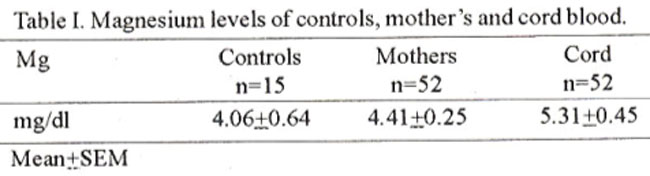
Maternal age ranged from 15 to 42 years (mean 25.3 years). Mg levels were significantly high in the cord blood of primiparas and mothers below 20 years of age and babies weighing 3 kgs or less (Table II).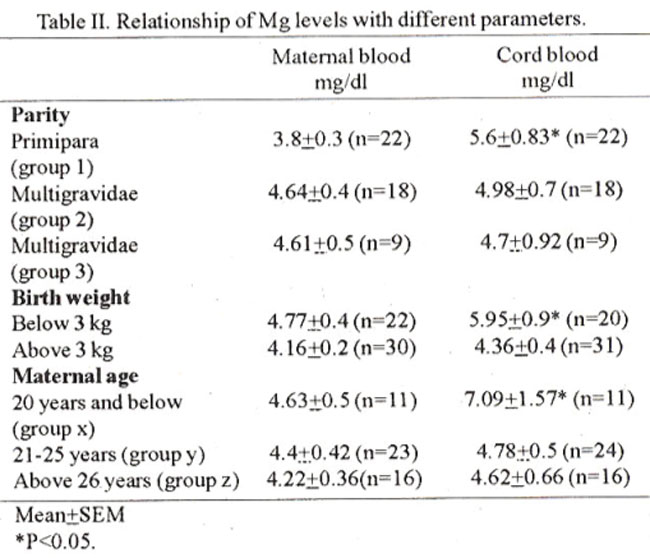
A linear correlation was analysed between Mg and zinc, copper, calcium andphosphorus. Apositive correlationwas observed between Zn and Mg (P<0.01). In. maternal blood whereas in cord blood there was no significant correlation (Table III).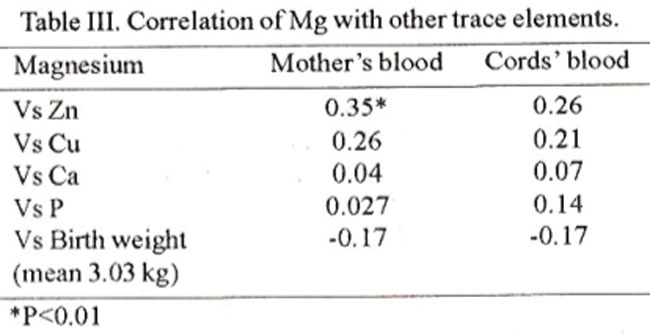
A negative correlation was observed between birth weight and Mg in maternal as well as cord blood (Table IV).
There was no difference in the Mg levels amongst male and female newborns.
Discussion
Magnesium levels in maternal and cord blood were not significantly different from the non-pregnant controls in this study which confinus the previous findings that Mg levels rise to non-pregnant levels during labour3. Hypomagnesernia during pregnancy, observed by others12 is attributed to hernodilution and estrogen levels, depending on the time of gestation. Hypomagnesaemia is also observed in pregnant diabetic women7 and diabetic children8. In this study Mg levels were found more pronounced when compared with other studies for Europeans, Africans and American women3,9,10 (Table IV), but were in accordance with results obtained by Manser and Khan11 on the local population. In a comparative study between Asian immigrants, West Indians and native Europeans living in Birmingham, mean Mg level was higher in Asian mothers than other ethnic groups12. The high level found in the present study and in other South Asian women could be attributed to high consumption of dal (cracked legumes cooked to a soup like consistency) and to a raised Mg level in the water supply as has been reported by Manser et al11. The water supply in Karachi has not been analyzed but the glacial sources inHunza, Pakistan have been reported to contain 1.260 mgfL of Mg13. Current evidence in a
stuay in U K. suggests that pregnancy associated growth is unlikely to cause maternal Mg deficiency and that there is no such requirement for Mg supplementation during pregnancy14. Similarly, the present study shows an adequate Mg status in the local population and no call for supplementation in normal pregnancy. Since Mg supplementation is highly recommended for pregnancies at risk like prematurity, dystrophy and gestosis as well as pre-eclampsia and eclarnpsia5 further investigations in the local population are required.
References
1. De.Jorge, F.B., Delascio, D., Cintra, A.B.U. et al. Magnesium concentration in the blood serum of normal pregnant women, Am. J. Obstet. Gynecol., 1965;25 :253-4.
2. Dale, E. and Simpson, G. Serum magnesium levels of women taking an oral or long-term injectable progestational contraceptive, Am. J. Obstet. Gynecol., 1972;39: 115-9.
3. Dawson. E.B., Clark, B.S. and MeGanity, W.J. Plasma vitamins and trace metal changes during teenage pregnancy. Am. J. Obstet. Gynecol., 1969;.104:953-8.
4. Spisso, KR., Herbert, G.M. afid Thiagarajah, S. The use of magnesium sulfate as the primary tocolytic agent to prevent premature delivery. Am. J. Obstet. Gynecol., 1982; 142:840-5.
5. Frolich, E.P. Evaluation of computerizisd axial tomography ofeclamptic women with seizures refractory to magnesium therapy. Am. J. Obstet. Gynecol., 1988;158:445,
6. Jasper, V., Spatling, L., Fallenstein, F. et al. Magnesium, calcium, hemoglobin, hematocrit, estriol and human placental lactogen with magnesium substitution in pregnancy. Geburtshife. Frauen heilkund., 1 990;50:628-33.
7. Shafique, M., Misbah-ul-Ain, Ashraf, M. et al. Hypomagnesaemia during diabetic pregnancy. A risk factor for ischaemic heart disease. Pak. Heart J., 1992;25:44-6.
8. Shafique, M. Misbah-ul-Ain, Ashraf, M. et al. Hypomagnesaemia and hypermagnesemia on type-I (insulin dependent)Diabctes mellitus. Pak. Pediatr. J., 1992;4:189-93.
9. Dawson, E.B.. Clark, SB. and McGanity, W.J. Plasma vitamins and trace metal changes during teenage pregnancy Am. 3. Obstet. Gynecol., 1969;104:953-58.
9. Schramel, P.,Hasse, S. and Klose, B .J. Mineral and trace element concentration in human breast milk, placenta, maternal blood and the blood of the new born.Biol. Trace Element Res., l988;l 6:67- 75.
10. Manser, W.T. and Khan, A. Trace element studies on Karachi population. Normal ranges for blood copper, zinc and magnesium for adults. J. Pak. Med. Assoc., 1989;39:43-9.
11. Ward, R.J.,Abraham, R., Mcfaydyen, JR. et al. Assessrnentoftrace metal intake and status in a Gujrati pregnant Asian population and their influence on the outcome of pregnancy. Br.J. Obstet. Gynecol., 1 988;95 :676.82.
12. Keller, W.D. Chemical analysis of water used in Hunza Pakistan. In: Hemphill DD ed. Trace substances in environmental health. XIII Columbia MO University ofMissouri, 1979, pp. 130-7.
13. Husain, S.M. and Sibley, C.P. Magnesium and pregnancy. Miner. Electrolyte Metab., 1993,19:295-307.
Journal of the Pakistan Medical Association has agreed to receive and publish manuscripts in accordance with the principles of the following committees:


