

Sher Mohammad Khan Paindakhel ( Nuclear Medicine Division, IRNUM, University Campus, Peshawar. )
August 1981, Volume 31, Issue 8
Original Article

Abstract
Survey for prevalence goitre was conducted in Kalam and in area North of Kalam. Three hundred and twenty one school children were examined. There were21.18 percent with palpable goitre (JPMA31:l78, 1981).
Introduction
Endemic goitre is prevalent in the Northern areas of Pakistan (Swat, Dir, Chitral and Gilgit). All these areas are grouped together for an increased prevalence of goitre, but a closer study shows that there are pockets of endemic areas. A review of the various surveys conducted in the past has been reported by Mahmud et al (1978). The object of this study was to survey the relatively inaccessible areas of Swat, Kohistan for prevalence of goitre.
Material and Methods
Three hundred and twenty one children were examined for the presence of goitre. The goitre was graded into palpable (grade 1) and visible (Grade 2). The areas selected were Kalam, Usho, Utror and Gabral. Kalam is about 200 miles and Gabral about 285 miles from Peshawar. The areas are mountainous and they have a heavy snowfall in winter. Gabral is divided into two parts, Kohistan Gabral and Gujar Gabral. The Kohistanis who are fair skinned and number about 600 live on the west bank of the river. The Gujars live on the east bank. The Gujars are nomadic peoples and are dark skinned. They migrate to the plains of Mardan and Peshawar alongwith their livestock in September or October and make the return journey in March or April. According to the 1973 census there were 3500 Gujars. In Utror a village "dispensary" was established in 1972. It was manned by a "dispenser", The record book did not contain entry for goitre in the column of diseases. Presumably no one with visible goitre had visited the dispensary over eight years.
Results
The prevalance of goitre in school children from Kalam and North Kalam is shown in the accompanying table.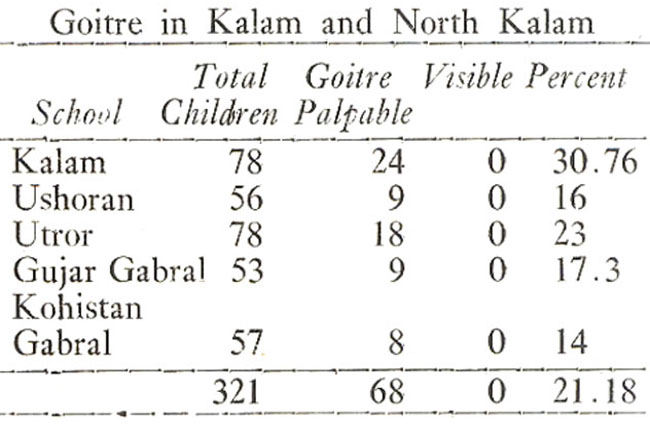
In Kalam 78 children were examined. Their ages varied from 5 to 11 years. All were boys. There were 24 (30.7%) with palpable goitre and none with visible goitre.
In Ushoran Primary school 9(16%) of 56 children had palpable goitre. Their ages varied from 5-11 years. In Utoro 79 children were seen with ages varying from 5 to 13 years; eighteen (23%) of these children had grade 1 goitre. Fifty two children were examined in Gujar Gabral and there were 9 with palpable goitre (17.3%) and none with visible goitre. In Kohistani Gabral, 57 children were seen which included one girl. Their ages ranged from 5-11 years. Eight children (14%) had palpable goitre. Again, there were none with visible goitre.
Discussion
Epidemiologic surveys of endemic goitre are generally based on the classic study of Perez et al (1960). The most vigorious methods consist of examining the entire population but this is often difficult because of social and organizational difficulties. This survey as well as other surveys were confined to a particular class of population such as school children. This age group is accessible and available for long term study as they are particularly affected by goitre.
The overall prevalence of goitre in Kalam and North of Kalam in school children aged between 5-11 years was 21.18%. There was no visible goitre. This showed that goitre endemia does exist, but is not so severe as there were no visible goitres.
References
1. Perez, C, Scrimshaw, N.S. and Munoz, J.A. (1960) Technique to endemic goitre surveys, in endemic goitre, Monography Series No. 44. pp. 369-383 W.H.O. Geneva.
2. Mahmud, S.H. and Ullah, H. (1978) Goitre in Pakistan: Planning and Development Division (Nutrition cell) Government of Pakistan.
Journal of the Pakistan Medical Association has agreed to receive and publish manuscripts in accordance with the principles of the following committees:


