

S.A. Nasir ( Department of Medicine, Nishtar Medical College Multan. )
T. Burke ( CIBA (GEIGY) Hong Kong. )
August 1981, Volume 31, Issue 8
Original Article

Abstract
Twenty-six patients suffering from mild to moderate hypertension were randomly assigned to one of two antihypertensive regimens, and active therapy continued for six weeks. The first regimen consisted of TRASICOR (oxprenolol) 80 mg twice daily plus HYGROTON (chlorthalidone) 20 mg once daily, while the second regimen consisted of methyldopa 250 mg thrice daily plus HYGROTON 20 mg once daily. The clinical protocol allowed contingency for doubling initial dosage after four weeks to obtain optimal antihypertensive effect.
While both regimens resulted in antihypertensive effect, greater therapeutic efficacy was demonstrated in patients receiving TRASICOR, and effective reduction of blood pressure with initial single dosage was achieved in 85% of patients in the TRASICOR group compared to only 46% in those receiving metholdopa. Multiple unwanted effects were reported in 62% of patients receiving methyldopa. Unwanted effects were reported in 31% of patients receiving TRASICOR, and in all instances these were solitary.
Those factors of primary importance in maintaining long-term control of hypertension are briefly discussed, with particular exphasis on the central role of patient compliance (J.P.M.A. 31:172, 1981).
Introduction
During recent years several extensive studies demonstrated the value of effective treatment in reducing morbidity and mortality in patients with mild to moderate hypertension. (Vet. Admin. Coop. Study Group; 1970; Hypertension Detection and Follow up Programme Coop. Group, 1979; Report the Aust. Therap. Trial in mild Hypertension Report, 1980) However even with the therapeutically effective regimens now available, success depends upon good patient compliance, a factor largely determined by freedom from troublesome unwanted effects. Irrespective of antihypertensive efficacy, a regimen is unlikely to achieve long-term success in controlling hypertension unless patient compliance can be secured through acceptable tolerability. This open, between-patient study, compared over a six weeks period, both the efficacy and tolerability of two antihypertensive regimens, a beta-blocker plus thiazide diuretic versus methyldopa plus the same diuretic, all medication administered in free combination.
Patients and Methods
Twenty-six hypertensive patients, (WHO Stage I and II) were randomly assigned to one of two regimens. The two regimens were TRASI-COR (oxprenolol) 80 mg twice daily plus HY-GROTON (chlorthalidone) 20 mg once daily, and methyldopa 250 mg thrice daily plus HY-, GROTON 20 mg once daily respectively. Prior to commencing active therapy all patients underwent a placebo wash-out period of two weeks duration. All patients were reviewed regularly at once weekly intervals, and the clinical trial protocol allowed the standard intial dosage to be doubled after four weeks of active therapy if satisfactory control of blood pressure had not been achieved by that time. Satisfactory blood pressure control was defined as a resting supine diastolic blood pressure equal to or less than 90 mm Hg on two consecutive visits.
At each visit supine and standing blood pressure, pulse-rate and body weight were recorded, and an assessment of tolerability was made by recording the nature, duration and severity of unwanted effects reported by patients.
Electrocardiographic tracings and standard haem-atological and biochemical laboratory investigations were performed pre-treatment, and every two weeks thereafter. The pre-treatment particulars of the two treatment groups arc shown in Table I.
Both groups were similar in distributionwith regard to population size, sex, height, and previous exposure to antihypertensive therapy. The known duration of hypertension was twice as long in TRASICOR group, (10 months and 4.8 months respectively), and contained twice as high a frequency of smokers, (31% and 15% respectively), as the methylopda group. However the mean age in the methyldopa group was 5 years older and mean body-weight 4.5 kilograms heavier than in the TRASICOR group. Pre-treatment pulse-rate was slightly higher in the methyldopa group, (93 per minute and 89 per minute respectively), as was average pre-treatment diastolic blood pressue, (methyldopa; 108 supine, 108 standing. TRASICOR, 104 supine, 104 standing).
Results
1. Hypotensive Effect
While both methyldopa and TRASICOR in combination with a thiazide diuretic were effective in lowering blood pressure, greater efficacy occured in the TRASICOR group, (Table II, Graph 1).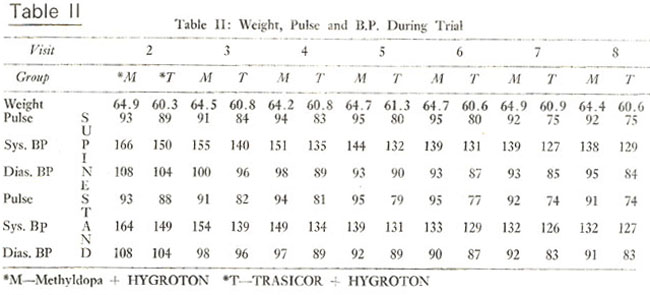
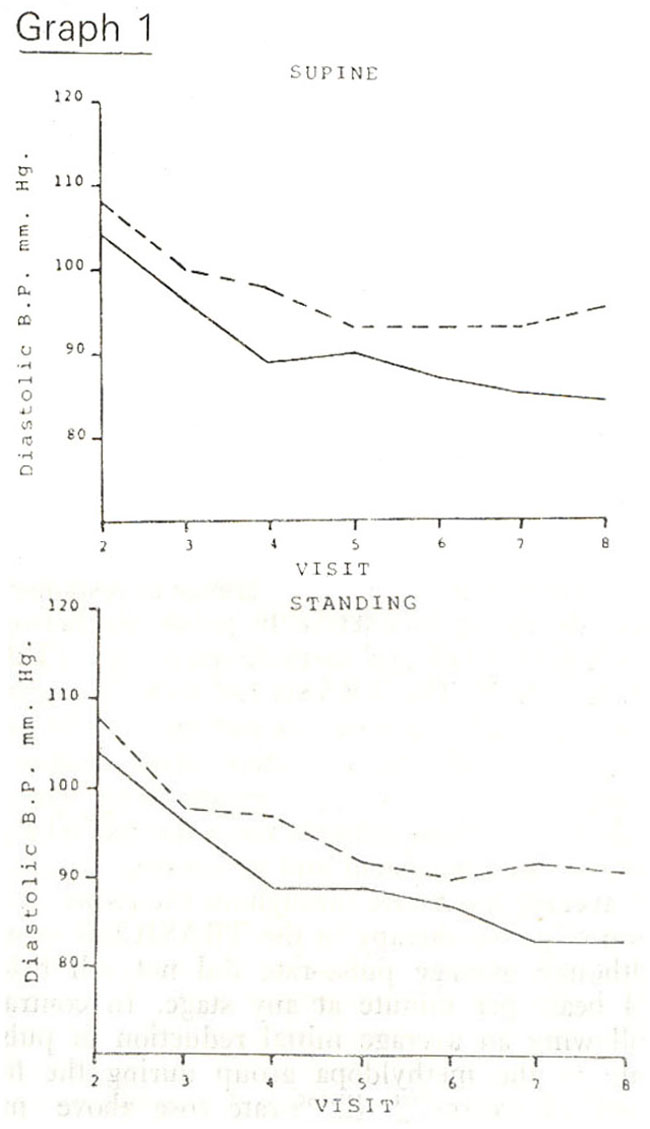
The TRASICOR treatment group showed an average reduction in both supine and standing diastolic blood pressure equal to or less than 90 mm Hg after four weeks of active treatment, and this was sustained throughout the remainder of the trial period. In the methyldopa treatment group the average supine and standing diastolic pressure reduction did not attain 90 mm Hg at any stage during the course of the study. There was a statistically significant greater reduction in diastolic blood pressure after two weeks of active therapy in the TRASICOR group compared to those receiving methyldopa, (P<0.5, Fisher\'s Exact Probability Test). The absolute average reduction in diastolic blood pressure for both treatment regimens between the beginning and end of active therapy, expressed as a percentage, is shown in Table III.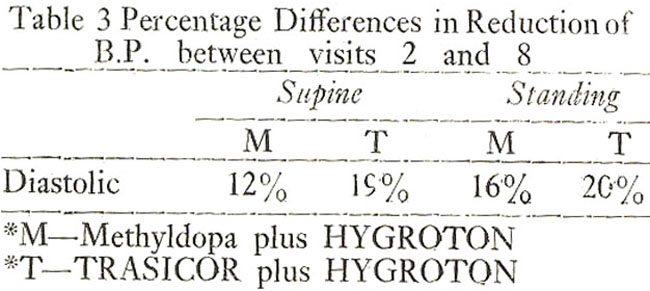
2. Pulse Rate
There was a marked difference in response as regards average reduction in pulse-rate between the TRASICOR and methyldopa groups, (Table II, Glaph 2).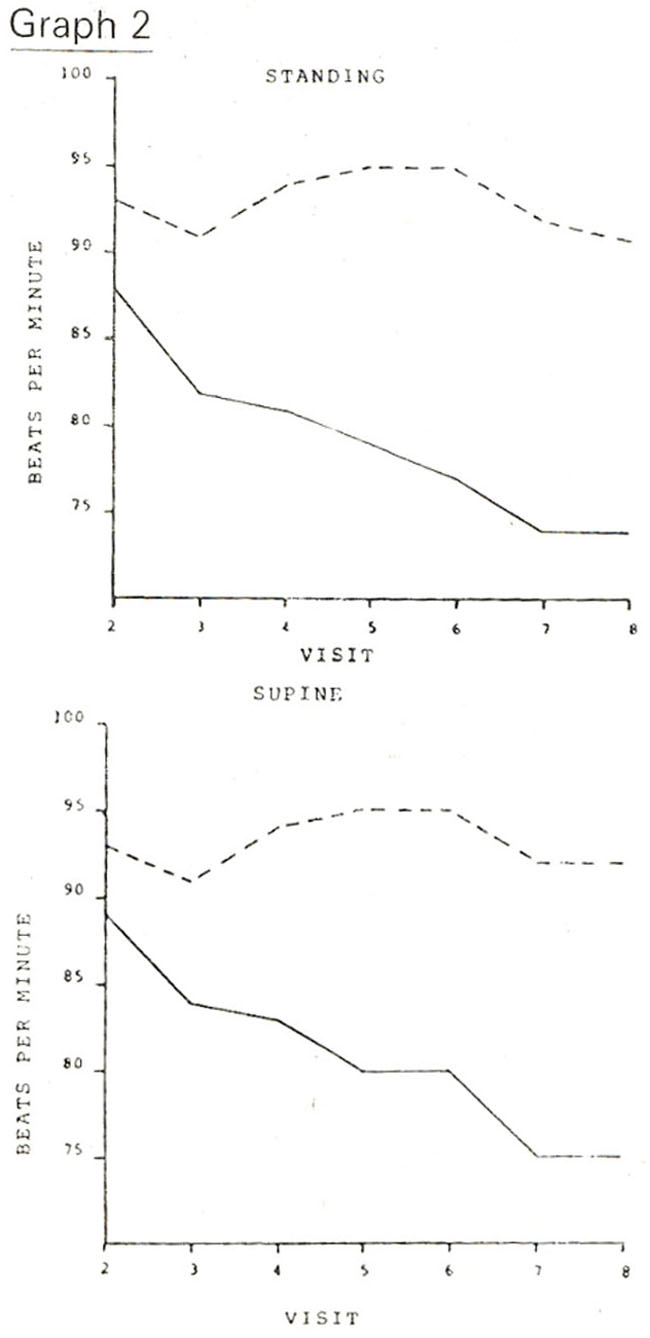
The TRASICOR treatment group showed a 14% average reduction between the beginning and end of active drug treatment, compared to only 1% corresponding average reduction in those patients receiving methyldopa. There was a persistent and progressive reduction in average pulse-rate throughout the entire duration of active therapy in the TRASICOR group, although average pulse-rate did not fall below 74 beats per minute at any stage. In contrast, following an average inilial reduction in pulse-rate in the methyldopa group during the first week of treatment, pulse-rate rose above pre-treatment levels for the following three weeks, before again beginning to fall. There was a highly significant statistical difference for both average supine and standing pulse-rate for each treatment group through the trial period as a whole, (p<0.0001, F Test For Analysis of ariance).
3. Relationship of Dosage to Therapeutic Effect
Details of dosage required for both treatment groups are shown in Table IV.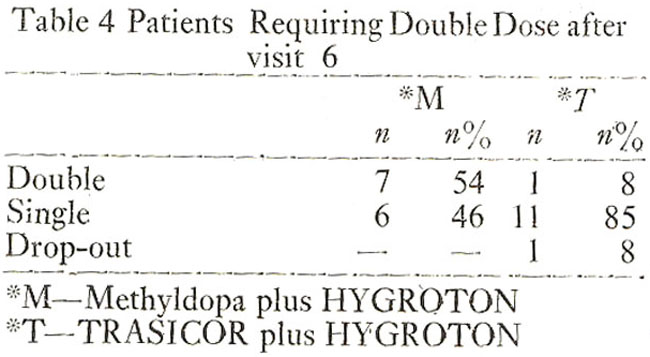
In the TRASICOR, group effective reduction in blood pressure was achieved with initial dosage in 85% of patients, and doubling of this to obtain optimal effect was required in only one patient out of thirteen (8%). With the methyldopa group "satisfactory" reduction of blood pressure with initial dosage was obtained in only 46% of patients, and 54% required double dosage to obtain greater effect.
4. Tolerability
Details of the nature, frequency and severity of unwanted effects reported in both treatment groups are recorded in Table V.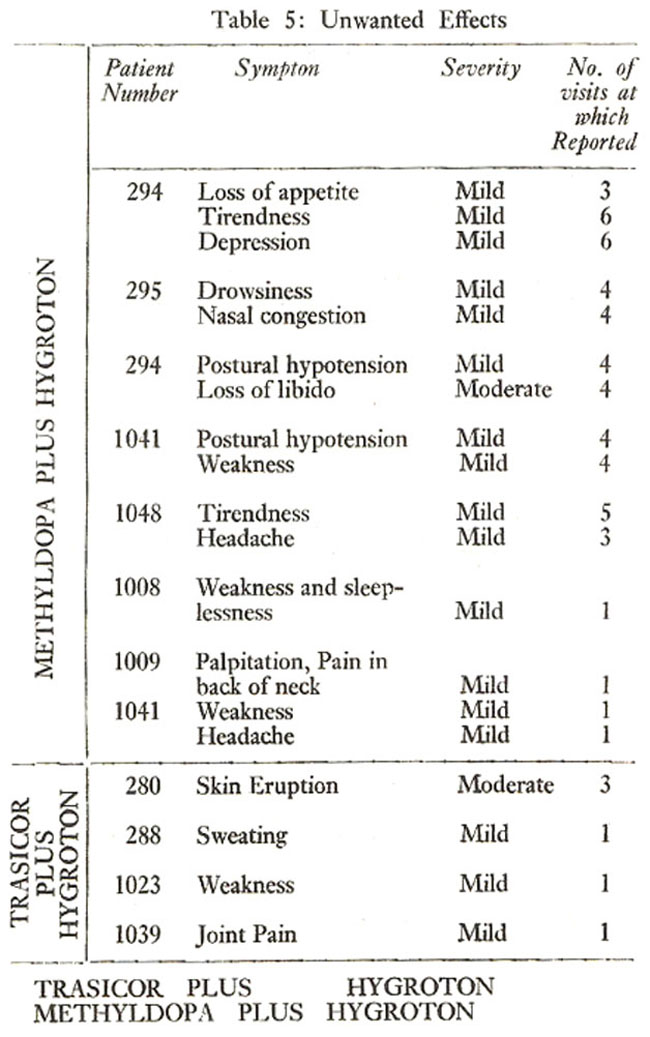
Unwanted effects were reported in eight out of thirteen patients in the mthyldopa group (62%), and in all of these they were mutiple with two or three unwanted effects being reported in each effected patient. Unwanted effects were reported in our out of thirteen patients in the TRASICOR group, (31%), but only a single unwanted effect occurred in each effected patient. The difference in frequency of multiple unwanted effects in patients receiving methyldopa compared to their absence in the TRASICOR group showed high statistical significance (p-0.002, Fisher\'s Exact Probability Test).
Electrocardiographic recordings and biochemical estimations were normal throughout inboth treatment groups at all examinations. The only haematological abnormality was a moderately elevated eosinophil count in 96% of the total trial population, present during the pre-rrcatment phase, and ascribed to concomitant parasitic infestation.
Discussion
While hypotensive effect was demonstrated with both antihypertensive regimens, superior efficacy and with single standard initial dosage occurred in the treatment group receiving TRASICOR. The findings are similar to those reported by Mabadeje (1977) and in this connection Lund-Johansen\'s (1978) conclusion that the haemodynamic profile of beta-blockers seems to be more uniform and predictable than the case with methyldopa is relevant.
The rise in average pulse-rate during the middle three weeks of active treatment in the group receiving methyldopa but not in those receiving TRASICOR can be explained in terms of the pharmacological actions of both drugs. Thiazide diuretics are useful and safe antihypertensive drugs, as evidenced by their widespread use in this indication. However in some patients reflex sympathetic stimulation resulting from decreased plasma volume and possible elevated levels of plasma noradrenaline may result in increased heart rate, although antihypertensive effect remains unaffected (Lake et al., 1979; Frolich et al., 1960; Shah et al., 1978; Tobian, 1967). Any such sympathetic reflex-induced tachycardia would be neutralised by beta-blocking drugs, both as a result of their inherent negative chronotropic property as well as through their action on peripheral adrenoceptors in blocking the effect of increased levels of circulating catecholamines. Methyldopa, which is believed to act centrally, would be unlikely to modify reflex-induced tachycardia by these mechanisms. For these reasons beta-blocking drugs, quite apart from their own potent and effective antihypertensive action, are finding an increasing role in modern combination therapy regimens with diuretic and vasodilators. Not only do beta-blockers effectively neutralise unwanted effects resulting from homeostatically-in-duced reflex sympathetic nervous stimulation through their unique pharmacological properties mentioned above, but in combination therapy they exert a "synergistic" hypotensive effect without producing postural hypotension (Jaylor, 1979). Equally important is the growing evidence pointing to beta-blocking drugs having a cardioprotective action independent from antihypertensive effect, which affords protection against myocardial infarction in those patients who are at risk (Gross, 1978).
It is generally recognised that the commonest cause of failure to achieve long-term control of hypertension is not necessarily lack of therapeutic efficacy in the drugs used, but rather through failure of patients to comply with medication. Once embarked upon antihypertensive therapy must be continued for life. It is therefore of utmost importance that the therapeutic regimen selected should produce minimal unwanted effects if optimal patient complicance is to be achieved. Similarly, it has been shown that patient compliance decreases sharply as the number of tablets to be taken daily increases. (Smith and Shead, 1974; Caldwell et al., 1970). These factors are highly relevant with regard to findings in the present study. Unwanted effects were twice as frequent in those patients receiving methyldopa compared to TRASICOR, and in addition multiple side effects were reported in all those patients in the methyldopa group in whom unwanted effects were reported. Similarly, while only 8% of patients in the TRASICOR group required an increase in dosage to achieve optimal therapeutic effect, the corresponding proportion in the methyldopa group was 54%. These findings suggest that long-term patient compliance, and hence satisfactory blood pressure control, would would have been more likely in those patients receiving TRASICOR.
References
1. Caldwell, J.R., Cobb, S.,Dowling, M.D.(1970). The dropout problem in anti-hypertensive treatments; a pilot study of social and emotional factors influeneing a patients abilitity to follow antihypertensive. J. Chronic Dis., 22:579.
2. Frohlich, E.D., Schnaper, H.W., Wilson, I.M. and Freis,, E.D. (1960) Haemodynamic alterations in hypertensive patients due to cholorothiazide. N. Engl. J. Med., 262:1261.
3. Gross, F. The cardioprotective action of beta-blockers. Huber, Bern, 1978.
4. Hypertension Detection and Follow-Up Program Co-Opera-tive Group (1979) Five-year findings of the hypertension detection and follow-up program I. Reduction in mortality of persons with high blood pressure, including mild hypertension. JAMA., 242:2562
5. Lake, C.R., Ziegler, M.G., Coleman, M.D. and Kopin, I.J. (1979) Hydrocholorothiazide-Induced sympathetic hyperactivity, in hypertensive patients. Clin. Pharmacol. Ther., 26:428.
6. Lung-Johansen, P. (1978) Alpha-methylodpa and beta-blockers in hypertension; a comparison of their haemodynamic effects. Clin. Exp. Pharmacol. Phys., Suppl. 4, 23.
7. Mabadeje, A.F.B. (1977) Corntrolled Clinical Trial between Oxprenolol and Methylodpa in Hypertensive Nigerians. Curr. Ther. Res., 22:391.
8. National Health Foundaton of Australia (1980) The Australian Therapeutic Trial in Mild Hypertension. Report by the Management Committee. Lancet, 1:1261.
9. Shah, S., Khatri, I. and Freis, E.D. (1978) Mechanisms of antihypertensive effect to thiazide diuretics. Am. Heart J., 95:611.
10. Smith, S.E. and Stead, K.C. (1974) Non-Compliance or misprescribing ? Lancet, 1:9371.
11. Taylor, S.H. Pharmacology and clinical applications of b-adrenoceptor Antagonists, in theories and use of b-blockade in hypertension and angina. Edited by Richard H. Roberts. Chicago, Year Book Medical Publishers, 1979, pp. 71-88.
12. Tobian, L. (1961) Why do diuretics lowr blood pressure in essential hypertension. Ann. Rev. Pharmacol., 7:399.
13. Veterans Administration Co-Operative Study Group on Anti-Hypertensive Agents (1970) Effects of treatment on morbidity in hypertension: II. Results in patients with diastolic blood pressure averaging 90 through 114 mmHg, JAMA., 213:1143.
Journal of the Pakistan Medical Association has agreed to receive and publish manuscripts in accordance with the principles of the following committees:


