

S.A.R. Gardezi ( Department of Surgery, North Surgical Unit, King Edward Medical College, Mayo Hospital, Lahore. )
Abdul Majeed Chaudhary ( Department of Surgery, North Surgical Unit, King Edward Medical College, Mayo Hospital, Lahore. )
Ghulam Akbar Khan Sial ( Department of Surgery, North Surgical Unit, King Edward Medical College, Mayo Hospital, Lahore. )
Ijaz Abmad ( Department of Surgery, North Surgical Unit, King Edward Medical College, Mayo Hospital, Lahore. )
Masood Rashid ( Department of Surgery, North Surgical Unit, King Edward Medical College, Mayo Hospital, Lahore. )
September 1983, Volume 33, Issue 9
Original Article

Abstract
The role of polyurethane adhesive transparent film dressing was studied in fifty patients against the conventional gauze dressing.
"Polyurethane membrane" was found to be a superior form of dressing since it allowed frequent wound observation without disturbance of normal healing process due to change of dressings. It was also found to reduce the wound infection rate. It is moisture, vapour permeable non-irritant membrane, more economical than the conventional gauze dressing. Its role therefore as a wound dressing is well established (JPMA33:219, 1983).
Introduction
"Polyurethane membrane" is an adhesive, transparent film which can be applied to the skin. It is available as a moisture, vapour permeable water proof dressing. This allows passage of oxygen to the wound and surrounding skin and lets moisture, to escape. Micro environment produced by controlled moisture and vapour and CO2/high PO2 levels under the film is responsible for more rapid epithelialization and low bacterial colonization.
"Polyurethane membrane" is non-irritant and does not cause skin sensitization. Its transparency allows frequent observation of the wound. Any serum collected under the film evaporates in less than 24 hours. It also forms an effective bacterial barrier and hence prevents secondary and cross infection. Polyurethane is not absorbed from the skin or raw surfaces of the burns and as such does not cause any metabolic disturbances.
Object of The Trial
To study the efficacy of "Polyurethane membrane" as wound dressing in all sorts of post operative wounds in comparison with the conventional gauze dressing.
The protocols of the study were:
1. Can "Polyurethane membrane" replace the conventional gauze dressing for clean surgical wounds?
2. Does "Polyurethane membrane" help in reducing wound infection ?
3. What conditions form contra-indi-cations for the use of "Polyurethane membrane" ?
4. What is the range of its effective use as a wound dressing ?
Patients and Methods
Pairs of Patients undergoing general surgical operations matching in age, sex, diagnosis and physical conditions were selected for the trial (Table I)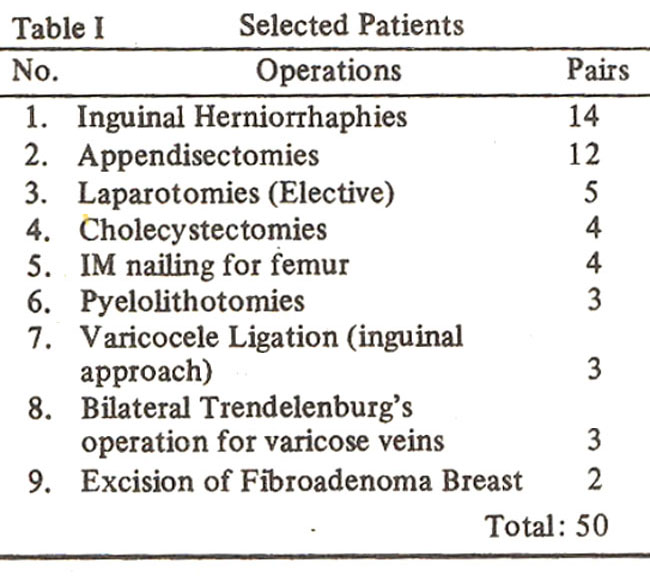
The age and sex distribution is shown in Table II.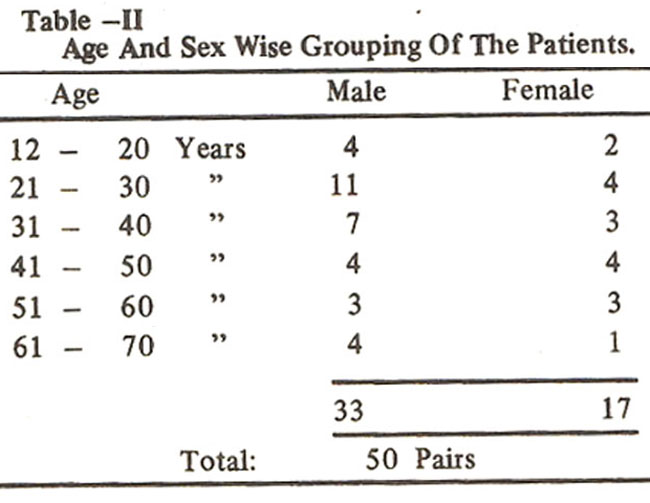
One of each pair was assigned at random to the "Polyurethane membrane" group and the "control group". Children below 12 years, unconscious and unresponsive patients were excluded from the trial to ensure satisfactory patient response to comfort of dressing or otherwise.
Most of the patients of a pair were operated upon on the same day. In some of the cases retrospect pairing was also done. Each pair was operated upon by the same senior surgeon not less than Senior Registrar to ensure surgical competence.
Pre-operative preparation was identical for all cases, using tincture iodine. The suturing technique was identical for all the pairs using 2 zero braided silk. “Polyurethane membrane” was applied umnediately after the operation and normally remained in situ until removal of the stitches. Fresh film was applied on discharge which was left until the first visit to the out-door after a week.
The conventional gauze dressing was changed after 48 hours. Wound observations were recorded simultaneously by the same observer on a simple scale 0, +, ++, and +++ ‘(Table III).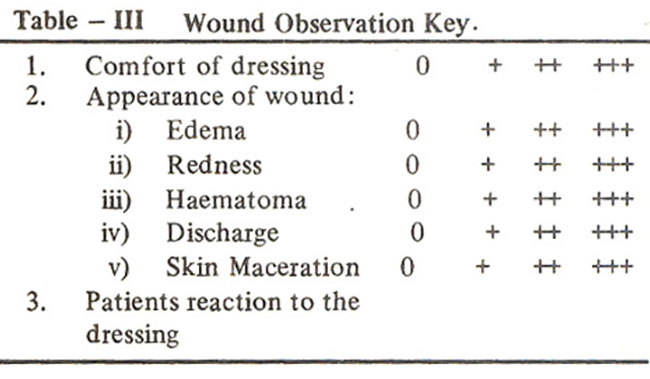
Subsequent observations were the same as those for “Polyurethane membrane”. Both members of the group received same antibiotics for equal duration of time, as given in Table-IV.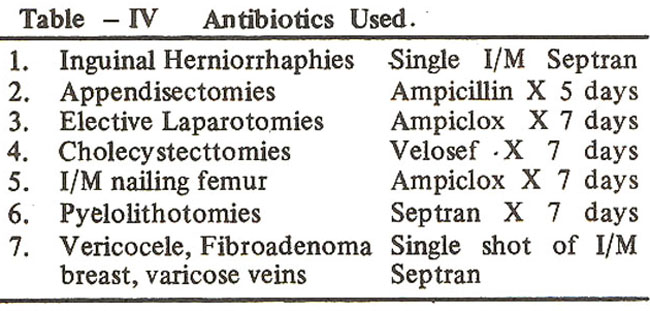
If infection occurred dressings were changed more frequently. On first indication of infection swabs were taken to isolate the causative microorganisms and appropriate antibiotics were administered.
Results
The efficiency of “Polyurethane membrane” was assessed on a simple scale 0, +, -H-, +++, ++++. Presence of wound infection, allergic reactions, bullae formation, haematoms, and local tenderness were taken as negative criteria. The patients with absence of all these signs were categorized as good (5/5) with presence of one sign (4/5) as satisfactory, 2 signs (3/5) as average and 3 signs (2/5) as poor. The results of both groups were compared for each sign.
Most of the patients in whom "Polyurethane membrane" was used had uneventful recovery. 40 patients from this group were categorized as having good recovery, 6 patients were placed in satisfactory and 4 patients in the average group. No patient was placed in the poor wound healing group. Similar results were reported by Schuren and Rohde (1981). Some of the patients remarked that they would not like to see the wound hence disliked this kind of dressing.
In the control group with conventional gauze dressing 32 patients were categorized as good, 10 patients satisfactory and 5 patients average. 3 patients had poor wound healing. The comparative results are given in the accompanying figure.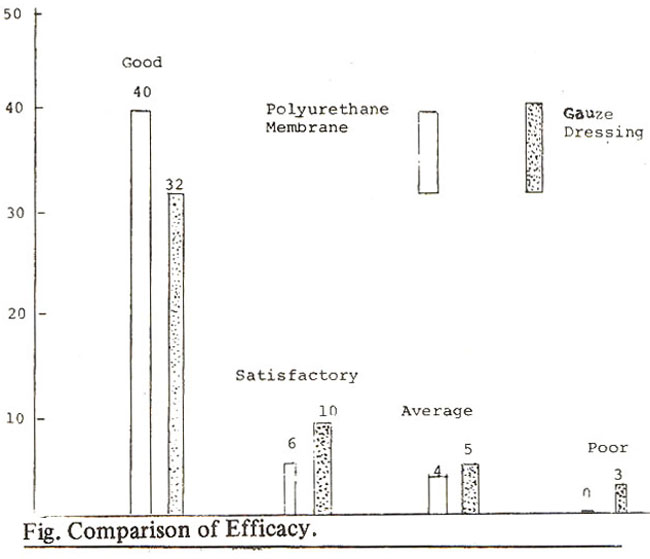
Side Effects
Various untoward reactions in both groups were compared and the data is shown in Table V.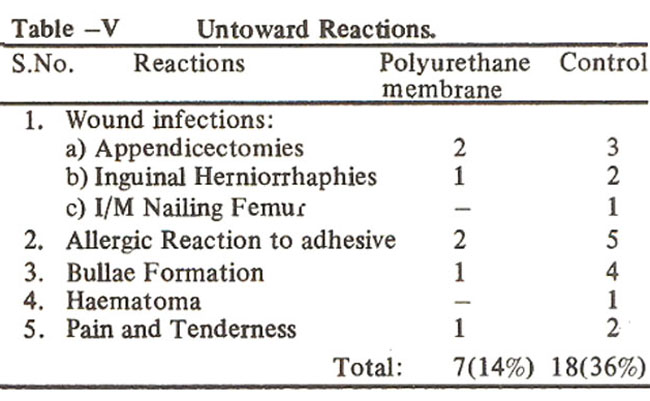
Seven patients from the "Polyurethane membrane" group had untoward reactions pertaining to wound healing while eighteen patients from the control group had similar side effects.
Discussion
There are a number of methods for postoperative care of wounds. They vary from complete exposure of wounds to keeping them covered with first dressing till the time of removal of stitches. Those who advocate the former method believe that wound inspection is not possible in the latter method and infection can only’ be detected after it is fully established. Transparent “Polyurethane adhesive membrane” combines the advantage of keeping the wound covered and at the same time allowing frequent examination.
In this trial “Polyurethane membrane” was considered by majority of patients as a comfortable dressing. Allergic reactions due to polyurethane membrane were few and far between, while it was a common occurrence in traditional Zinc Oxide dressing. It was possible to detect the signs of infection by observation at an earlier stage without disturbing the wound. The number of dressings could be reduced to one. It has got obvious advantage because repeated trauma and application of irritants delays wound’ healing (Peacock, 1973). Moreover, it was economical for the hospital and the patients. Lesser number of dressing not only saves time and minimizes patients discomfort but also reduces the risk of secondary exogenous infection. A decrease in infection rate by “Polyurethane membrane” was also reported by Buchan et al. (1980) in another similar trial. The patients could take bath much earlier which was welcome by majority of them.
The use of “Polyurethane membrane” in potentially infected wounds like perforated appendix is possible provided a drain is put in through a separate stab wound after careful peritoneal lavage.
The use of “Polyurethane membrane” in infected wounds and those containing potentially non-viable tissue is not recommended. Purulent material from sub-graft suppuration migrates beneath the dressing which will require a change of membrane.
Acknowledgement
The authors are grateful for the help and assistance of Dr. Azam Yousuf (Registrar) and Dr. S.N.H.Kazmi (M.O.), North Surgical Ward. Thanks are also due’ to Mr. Abdul Ghaffar Naeem of the Postgraduate Medical Institute, Lahore.
References
1. Buchan, l.A., Andrew; J.K. and Lang, S.M. (1980) J.G. Boonnan, J.V. Harvey Kemble and B.G.H. Lamberty. (1980), Burns 7. 5, 326 Great Britain.
2. Peacock, E.E. (1973) Biologic frontiers in the control of healing. Am. J. Surg, 126 :708.
3. Schirren, J. and Rhode, H. (1981) Surgical clinic, operative medicine centre I, teaching hospital of the philipps University Marburg, Die Schwester 20, 579.
Journal of the Pakistan Medical Association has agreed to receive and publish manuscripts in accordance with the principles of the following committees:


