

Salim Hafiz ( Department of Microbiology, Aga Khan University Hospital, Karachi. )
Neville Lyall ( Department of Microbiology, Aga Khan University Hospital, Karachi. )
Mehboob Alam ( Department of Microbiology, Aga Khan University Hospital, Karachi. )
July 1989, Volume 39, Issue 7
Original Article

Abstract
The significance Minimum Inhibitory Concentration (MIC) of determination for Meningococci is described and according to the present study a shift in the sensitivity of Meningococcus is occurring, local isolates show higher Minimum Inhibitory Concentration for Chloramphenicol and Azactam. Strains of Meningococcus can successfully be stored in a domestic freezer (JPMA 39: 177, 1989).
INTRODUCTION
Neisseria nieningitidis is an extremely intriguing organism. On one hand it inhibits the upper respiratory tract and other mucosal surfaces of humans, the only known reservoir, without causing any ill effects. On the other hand it causes invasive infection, killing the patient in few hours. Meningococcal disease tends to occur in clusters and usually in epidemic forms. Epidemics due to N. Meningococcus group A tend to occur in cyclic waves approximately every decade and have been documented since the beginning of 20th century1. In Karachi the first documented outbreak of N. ineningococcus occurred during 1966-67. Unfortunately the group causing the outbreak is not known while the recently concluded epidemic was caused by sero group A and interestingly it followed identical steps in its spread. The isolates were sensitive to the routine drugs2. N meningococcus is closely related to N. gonorrhoeae and the difference is very subtle3. Both members of the family were highly sensitive to Penicillin but with passage of time one member N. gonorrhoeae become gradually resistant to Penicillin4 and according to one report, N. gonorrhoeae had the ability to inactivate Penicillin even in 19455; the time Penicillin was commercially available yet N. meningitidis a sister member has failed to acquire this ability. It is universally accepted that N. ineningitidis is sensitive to Penicillin and Chioramphenicol and as the isolates in the recently concluded epidemic were all found to be thus sensitive tested by disc sensitivity method, we decided to compare the MIC of local isolates because of considerable abuse of antibiotics compared to foreign isolate where use of antibiotic is restricted.
MATERIALS AND METHODS
Organisms:
A total of 22 clinical isolates of N. ineizin gitidis were used for the determination of Minimum Inhibitory Concentration (MIC). They included 5 strains isolated in UK and provided by Dr Abbott, 9 strains were isolated by our laboratory and 8 strains were provided by “The Lab” and “Sind Lab”, Karachi. AU the local isolates belonged to Sero-group A. The UK strains were freeze dried. They were grown on chocolate agar identified and confirmed by gram’s staining, oxidase and carbohydrate fermentation reaction. All local strains, as and when isolated, were confirmed, sensitivity test carried out by Kirby Bauer method and 10 colonies were emulsified in 1 ml of sterile tryptone soya broth (oxoid) containing 10% glycerol, stored in the freezer compartment of refrigerator at —15 to — 20°C. When needed, the tubes containing the organisms were thawed, subcultured onto chocolate agar, incubated at 36-37°C in a carbon dioxide incubator with enhanced humidity and 24 hour growth was used for determination of MIC.
Determination of Minimum Inhibitory
Concentrations:
Agar dilution methods were used for the determination of MIC. Media: The basal media used was Difco G.C. agar base with defined supplement6.
Carbohydrate Fermentation Reaction:
Carbohydrate fermentation reactions were determined by incorporating 1% carbohydrate in the medium and 1 ml of 0.02% Phenol red indicator sterilized by autoclaving at 10 lbs/sq inch (115°C) for 15 minutes and plates were poured.
Determination of Minimum Inhibitory
Concentrations:
Agar dilution method was used for the determination of MIC. A range of concentration of Penicillin, Chioramphenicol, Azactam and Amikacin were prepared according to the recommendations7to give the required final concentration as given in the Table.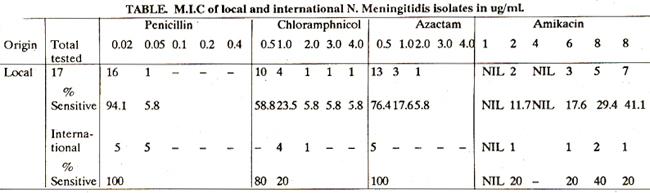
Plates were poured and used within a week of preparation.
Inoculation of Plates:
A multipoint inoculator (Denley Instrumcnts Ltd, Billinghurst, Sussex, United Kingdom) was used to deliver 0.001 ml inocula (106CFU) to the surface of antibiotic containing plates, carbohydrate containing plates and control plates without any antibiotics or carbohydrate were also inoculated as growth control. After inoculation, the carbohydrate plates were cut by using sterile scalpel blade in order to avoid smudging of fermentation results. All plates were incubated at 36°C in an atmosphere of 5% carbon dioxide with enhanced humidity. Results were recorded after 24 and 48 hours and the MIC’s were taken as the lowest concentrations of antibiotic preventing the growth. Carbohydrate fermentation were recorded by observing for growth and change in colour from red to yellow.
RESULTS
Storage Results:
All the strains of N. ineningitidis stored in freezer survived for over 6 months. This provides a simple, convenient and economic method for preserving cultures where sophisticated facilities are not available.
Carbohydrate Fermentation:
All the strains tested fermented Glucose and Maltose while Sucrose and Lactose were negative and the results fully matched with fermentation reactions compared with serum free sugars.
MIC Determination:
On disc sensitivity all strains were sensitive to Chloramphenicol, Penicillin and Azactam. The results of MIC are recorded in the Table and it is interesting to note that there is a difference between the United Kingdom isolates and local isolates as far as MIC are concerned. In all cases, local isolates show an increased resistance, with Penicillin it is only marginal 5.8% (1 strain) has MIC of 0.05ug/ml, with chloramphenicol 17% isolates shows MIC greater than I ug/ml, with Azactam it amounts to 23% and in the case of Amikacin more than 41% local isolate has MIC > 8 ug/ml as opposed to 20% of UK isolates.
DISCUSSION
Inspite of the close relationship enjoyed by M. meningitidis with N. gonorrhocae, N. meningitidis has failed to acquire the ability to produce Beta lactamase but if this ever happens it would be devastating. One way would be to carry out MIC on meningococcal isolates specially in the parts of the world where antibiotic abuse is a common practice and all laboratories in the developing world carry out antibiotic sensitivity tests by Disc diffusion method. The study involves a limited number of isolates but reveals that the sensitivity pattern of a Meningococcal isolates is exhibiting a gradual shift towards resistance to the commonly used antibiotics, Penicillin and Chloramphenicol. the increase in MIC for Chloramphenicol is higher as compared to Penicillin. Organisms can be stored conveniently in domestic refrigerators for appreciable length of time and carbohydrate fermentation reactions carried out using a multipoint inoculator. The abuse of antibiotics, specially underdosing, may have the clue for the gradual shift of MIC in Meningoeocci.
ACKNOWLEDGEMENT
We thank Drs. J.D. Abbott of Manchester, UK, Iftikhar Ahmad, Sind Lab, Karachi, Iqbal Ahmad, the Lab, Karachi for supplying strains of meningococci and Mrs Fatima Nadir for her secretarial help.
REFERENCES
1. Lapeyssonnie, L La meningite cerebrospinale en AMque. Bull. WHO 28 (supp.): 3.
2. Hafiz, A. Acute meningitis in Karachi—Past and present. Med. Spectrum, 1988; 9: 25.
3. Odugbemi, t.O. and Hafiz, S. Identification of Neisseria gonorrhoeae by carbohydrate disc reactions on a modified fermentation medium. J. Trop. Med. Hyg., 81: 106.
4. Jamil, J.J., Hafiz, S., and McEntegart, M.G. The effect of Benzylpenicillin on strains of Neisseria gonorrhoeae in liquid and solid media. Antimicrob. Chemotherapy, 1981; 210.
5. Hatiz, S., McEntegart, M.G. and Gooch, H. Did Neis seria gonorrhoeae acquire the ability to produce B-lactmase in 1976? Lancet, 1982; 1: 558.
6. Flynn, J. and Waitkins, S.A. A serum-free medium for testing fermentation reactions in Neisseria gonorrhoeae. Clin. Pathol., 1972; 25: 525.
7. Anahalt, J.P. and Washington, J.A. Preparation and storage of antimicrobial solution in ASMs, manual of clinical microbiology 4th ed. Bethesda, 1985, p. 1019.
Journal of the Pakistan Medical Association has agreed to receive and publish manuscripts in accordance with the principles of the following committees:


