

Qaisar H Siraj ( Armed Forces Institute of Pathology, and Combined Military Hospital, Rawalpindi. )
Mahmood A. Akhtar ( Nuclear Medical Centre, Combined Military Hospital, Rawalpindi. )
July 1989, Volume 39, Issue 7
Original Article

Abstract
This study details our initial experience with pharmacologically induced penile erections in the diagnosis and therapy of patients with impotence. lntracavernosal injections of papaverine were performed in 5 normal volunteers, 5 patients with psychogenic impotence and 2 patients with penile venous incompetence. The patients were first investigated extensively to determine the etiological basis for their erectile dysfunction. It was observed that the patients with psychogenic impotence and the normal volunteers showed a good response whereas the patients with venous incompetence failed to achieve erection in response to intracavernosal injection. A new drug, Prostaglandin Ei was also tried for the first time for comparison. It appears that this drug has potential advantages over the currently used agent papaverine for the production of pharmacological erections (JPMA39: 17Z 1989).
INTRODUCTION
Until recently the complaints of a man with impotence received relatively little attention, the common belief being that the condition is basically psychological, but contemporary work in this field has shown that a large proportion of men with erectile failure have an organic etiology. This has resulted in search for various methods of diagnosing and treating patients with erectile failure. The latest among them is the technique of pharmacologically induced penile erection (PIPE) which is now being used both as a diagnostic and a therapeutic tool. In 1977, the inadvertent intracavernosal injection of papaverine (PPV), a smooth muscle relaxant was reported to produce prolonged erection1 and Viragin 1982 suggested the possibility of direct intracorporeal injection of PPV to induce erection2. However, the intracavernosal injection technique was fir st employed as a diagnostic test for evaluation of impotent patients by Brindley in 1983 who used an alpha-adrenergic blocker to induce erection3 Papaverine HC1, was subsequently utilized for differentiating psychogenic from organic causes of impotence. 4 Combining PPV with an alpha-adrenergic blocker further improved the erectile response. 5 The use of intracavernosal injections provides an objective test of penile erection and is a very useful screening test for diagnosing abnormalities of venous outflow. A wide variety of drugs have been injected into the penis with varying effects. 6 However, the ideal dose, drug, or combination of drugs has not yet been determi-ned7 and the search for other drugs continues. In the present study we have evaluated the technique of PIPE using intracavernosal injections of PPV. A new drug prostaglandin Ei (PGEI) which has been reported to be an effective relaxant of penile vascular smooth muscle in vitro has also been used for the first time.
MATERIALS AND METHODS
Patients
There were 12 subjects in this study, aged 21 to 42 years (mean 33 years) including five normal controls, five patients with psychogenic impotence with one patient among them with an additional element of arterial insufficiency, and two patients with known venous incompetence. Informed written consent was obtained from all the subjects in this study and the nature of the test along with the procedure involved explained to the individuals in detail. The clinical details of the subjects in this study are listed in Table 1.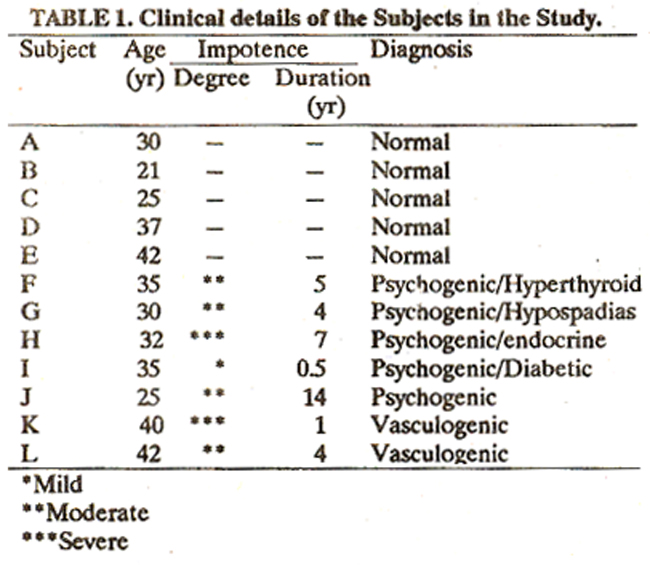
Investigations
The patients were first investigated in a systematic fashion in order to define the etiological basis for impotence in each case. The following diagnostic protocol was adopted and appropriate tests were performed.
1) Psychogenic vs. organic: History, physical examination, psychological evaluation, nocturnal penile tumescence tests.
2) Neurogenic vs. Vascular: Electrocardiography, glucose tolerance test, detailed neurological examination.
3) Penile blood supply evaluation: Dopplerultrasound assessment of penile arteries, penile scan, corpus cavernosogram.
4) Endocrine: Serum levels of sex hormones including testosterone, FSH, LH and PRL were routinely assayed.
After a detailed history, physical examination and psychiatric assessment, routine investigations were performed to exclude any systemic disease. A complete haematological and biochemical screening was done. Because of high incidence of impotence among diabetic males, a glucose tolerance test was routinely performed. Nocturnal penile tumescence studies were performed where indicated. This was done by using a one-way band which measured the maximum increase in the penile circumference during sleep. The presence or absence of pulsations in the penile arteries was noted through doppler ultrasound evaluation of the penile blood vessels. Radioisotope studies of penile blood flow were also performed. 8 Where venous outflow problem was suspected to be a cause of the erectile dysfunction, cavernosography was performed. 9 Autonomic function was assessed by electrocardiiographic monitoring of the heart rate variation. 10 The last colunm of Table 1 shows the final diagnosis in each case arrived as a result of the above investigations.
Intracavernosal injection technique
Intracavernosal injections were performed in identical fashion to standardize the technique. The dorsal length of the penis from its base to the penile tip (urethral aperture) and the maximum penile circumference was measured before and 15 minutes after the injection. The injection was given into the mid-shaft of the penis into either corpus cavernosum without local anaesthesia through a 21 gauge butterfly needle with the patient lying supine. Following injection the penile shaft was stroked to evenly distribute the drug into the penis. No tourniquet was placed at the penile base. For papaverine-induced erection we used 60 mg papaverine (Macarthy) in a total volume of 10 ml and for PGE1 a dose of 10 uGm Alprostadil (Sanol Schwarz) was injected in the same volume. A fixed dose was used for the purpose of comparison. The papaverine and PGEi intracavernosal injections were performed on separate occasions two to seven days apart. method described by Wespes et al. 11 This involves measuring the angle between the penis and the legs with the patient in standing position. The total duration of erection and any side effects were also recorded. The data were analysed using Student’s ‘t’ Test for paired samples.
RESULTS
The intracavernosal PPV injection elicited a good erectile response in the normal subjects and patients with psychogenic impotence. Erection started two to five minutes after the injection and lasted for a variable length of time. Good tumescence and rigidity was produced with an erectile angle of greater than 85 degrees in all the subjects. However, the patients in whom venous leakage was established on cavernosography showed only mild short-lived tumescence with no rigidity. It was also observed that the diabetic patient in whom a mild degree of arterial insufficiency was established through NPT testing and radioisotope penile blood flow studies showed a comparatively weaker erection with an erectile angle of 85 degree. A comparison of the various parameters of PPV versus PGE1 induced erection (Table II)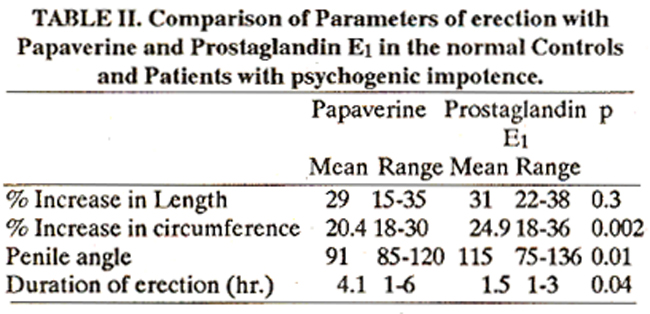
in the normal controls and the psychogenic impotent patients showed that although there was no significant difference (p = 0.3) in the penile length induced by both the agents, there was a significantly greater increase in the penile circumference with PGE1 as compared to PPV (p = 0.002). Also, the erectile angle obtained with PGE1 was significantly greater (p = 0.01). Assessment of the erectile response visually and by manual palpation also showed an overall better erectile response due to the PGE1 injection. The duration of PGE1-induced erections in the normal controls and patients with psychogenic impotence ranged from 1-3 hours (mean 1.5 hours). In contrast, the duration of PPV induced erection showed a wide range, 1 to 6 hours (mean 4.1 hours). Very few complications were noted in this series. Only one patient had a prolonged erection (6 hr) as a result of PPV injection. Detumescence was achieved by injecting 2 mg of metraminol into the cavernosum penis and withdrawing 20 ml of blood. Two patients developed mild ecchymosis and one patient developed a small haematoma at the injection site which resolved spontaneously in 5-7 days. Some of the patients complained of local pain and burning during the injection, more so with PPV . PGE1 injections were better tolerated. No systemic effects were noted due to either drug. The blood pressure and pulse was monitored for 30 minutes after the PGE1 injection but no noticeable changes were observed.
DISCUSSION
The technique of PIPE using intracavernosal injections of vasoactive drugs is proving to be an invaluable tool in the diagnosis and management of patients with impotence. Various agents in addition to PPV have been studied. Lue and Tana-gho have documented 6 groups of medications with smooth muscle relaxing properties which induce erection when injected intracorporeally12. They include: the smooth muscle relaxants, papaverine and nitroglycerin; alphablockers, phenoxybenzamine and phentolamine; Calcium channel blockers such as verapamil, polypeptides, such as vasoactive intestinal polypeptides; /3- agonists like isoproterenol; antidepressants such as trazodone, and anti-psychotic agents such as tho-razine. These pharmacological agents release neurotransmitters and relax the smooth muscles, resulting in decreased peripheral resistance and sinusoidal space enlargement. 12 Amongst the various agents studied, PPV is the most effective and the most popular agent for the production of PIPE. Papaverine HC1 is a strong nonspecific smooth muscle relaxant which acts directly on the arteries and sinusoids bypassing neurogenic influence and causes erection by relaxing the smooth muscle lining the sinusoidal channels in the corpora cavernosa allowing engorgement of the erectile bodies with blood and consequent erection, 13 It has now been established by several workers that in normal and psychogenic impotent patients the intraeavernous injection of PPV provokes a rapid and complete erection. The erectile response probably is rarely affected by psychologic inhibition except perhaps in an extremely anxious patient, whereas patients with poor blood flow to the cavernosal arteries of the penis experience a diminished response or no erection at all. Failure to achieve erection in response to PIPE does not exclude arterial causes but is indicative of venous leakage which can be confirmed by infusion studies or dynamic cavernosography. However, most men who fail to obtain full erection within approximately ten minutes after injection probably have some degree of vasculogenic impotence. 14 Our study confirms the usefulness of intracavernosal injections in the evaluation of impotence. All the patients with psychogenic impotence manifested a good erectile response to the intracavernosal injection of PPV whereas the patients with venous incompetence showed no erection. Veno-occulusion of the corpora cavernosa has been generally recognised as an essential prerequisite for adequate penile erection and veno-occlusive incompetence is suspected to be a frequent cause of impotence. This condition is easily diagnosed by the intracavernosal injection technique. The psychogenic impotent patient with additional mild arteriogenic involvement showed a comparatively weaker erection. Therapy with PPV and PGE1 intracavernosal injections was very effective in these patients and all five psychogenic impotent patients reported an enhancement in their libido with either restoration or improvement in their erectile capability. It appears that the technique of PIPE is instrumental in breaking the vicious cycle of anxiety-performance by restoring lost confidence. However, there are potential short and long-term complications with PPV which advocate caution for this form of treatment. There are many reports of prolonged erections which if lasting more than 4 hours may result in priapism. Some cases of subclinical Peyronic\'s disease (cavernosal fibrosis), approximately 4% in one series have been reported. 5 Infrequent events like vasovagal reaction, bradycardia, hypotension, dizziness and facial flushing have also been reported. 14-16 Possibly during a long treatment period corporeal fibrosis, which may result in a Peyronie’s disease state, will be the limiting factor with any combination of PPV, since the çH of about 3-4 with this agent will cause sclerosis17. Because of the possibility of these side effects and the fact that some patients may develop tolerance to these agents perhaps secondary to a depletion of the neurotransmitters involved. Nelson has emphasized the need for investigating other agents for PIPE in search of a better drug. 18 Prostaglandins are lipid acids derived from arachidonic acid and cause relaxation of arteriolar smooth muscle there by increasing the blood flow through vascular beds19 and PGE1 has been implicated in the induction of penile erection. 20 Our results indicate that with the doses used in this study PGE1 generally elicited a better erectile response as compared to PPV. It induced greater tumescence as evidenced by a significantly greater increase in the penile circumference. Further, the erectile angle, a measure of penile rigidity was also greater. The PGE1 injection was better tolerated by the patients. There was no case of prolonged erection and lesser degree of pain or discomfort during injection was reported. No systemic effects were noticed at the doses administered. PGE1 appears to have potential advantages over the currently available agents for PIPE. The pharmacological activity of E series prostaglandins is almost entirely lost in their passage through the lung circulation. 21 Therefore its effects are more likely to be local with a less chance of systemic effects. Also the shorter duration of PGE1 induced erection will decrease the need for physician intervention for treating episodes of prolonged erection or priapism and consequently this agent may be better suited for therapeutic self-injection. Further, as it is a naturally occurring agent, it likely to be free from the potential drawbacks of an exogenously administered pharmacological agent. The vasoactive intestinal polypeptide (VIP), is suspected to be the neutrotransmitter involved in penile erection as high concentration of this substance have been shown in the penile blood during erection in animals and man. 22-25 However, Kelly et al. were unable to demonstrate any rise in the mean cavernosal VIP concentration following erection induced by several pharmacological agents. 26 Prostaglandins play an active role in the regulation of blood flow in various vascular beds. Generation of different prostaglandins and thromboxanes from human corpus cavernosum tissue in vitro has been demonstrated27 and PGE1 has been shown to be a very effective relaxant of human penile smooth muscle tissues in vitro. 20 In light of these facts the possible role for the prostanoids in erection is worth investigating. The superior erectile response elicited by PGE1 as compared to PPV may either be a function of dose or due to an added counteraction of sympathetic tone by PGE1 as the stimulation of prostaglandin synthesis has been reported to reduce the vasoconstrictor response to sympathetic nerve stimuli in various vascular beds. 28 Although the number of subjects in this study is too small for adequate statistical analysis, however, it seems that at the doses used in this study PGE1 intracavernosal injection has distinct advantages over the conventional PPV injections and that this drug can be safely added to the list of agents used for PIPE and has diagnostic and therapeutic potential in patients with impotence.
REFERENCES
1. Michal, V., Kramer, R. and Pospichal, J. Arterial epigastrico cavernous anastomosis for the treatment of sexual impotence. World J. Surg., 1977; 1:5 15.
2. Virag, R. Intracavernous injection of papaverine forerectile failure. Lancet, 1982; 2:938.
3. Brindley. 0.5. Cavernosal alpha-blockade; a new technique for investigating and treating erectile impotence. Br. J. Psychiat., 1983; 143:332;
4. Virag, R., Fiydman, D., Legman, M. and Virag, H. Intracavernous injection of papaverine as a diagnostic and therapeutic method in erectile failure. Angiology, 1984;35: 79.
5. Zorgniotti, A. W. and Lefleur. P.S. Auto-injection of the corpus cavernosum with a vasco-active combination for vasculogenic impotence. J. Urol., 1985; 133:39.
6. Brindley, G.S. Pilot experiments on the actions of drugs injected into the human corpus cavernosum penis. Br. J. Pharmacol., 1986; 87:495.
7. Williams, G. Erectile dysfunctions; diagnosis and treatment. Br. J. Urol., 1987; 60:1.
8. Siraj, Q.H., Hilson, A.J.W., Townell, N.H., Morgan, Ri. and Cottrall, M.F. The role of radioisotope phallogram in the investigation of vasculogeaic impotence. NucI. Med. Commun., 1986; 7:173.
9. Herberg, Z., Kellet, Mi., Morgan, R.J. and Piyor, J.P. Method, indications and results of corpus cavernosography. Br. J. Urol., 1981;53:641.
10. Mackay, J.D., Page, M.M., Cambridge, J. and Watkins, P.J. Diabetic autonomic neuropathy. The diagnostic value of heart rate monitoring. Diabetologiea, 1980;18:471.
11. Wespes, E., Delcour, C.,Rondeux, C., Struyven, J. and Sehulman, C.C.The erectile angle: objective criterion to evaluate the papaverine test in impotence. 3. Urol., 1987; 138:1171.
12. Lue, T.F. and Tanagho, E.A. Physiology of erection and pharmacological management of impotence. 3. Urol., 1987; 137:829.
13. Jucnemann, K.P., Lue, T.F., Fourneir, G.R. and Tanagho, E.A. Hemodynamics of papaverine and phentolamine-induced penile erection. J. Urol., 1986; 136:158.
14. Mellinger, B.C., Vaughan, E.D. Jr., Thompson, S.L. and Goldstein, M. Correlation between intracavernous pa paverine injection and doppler analysis in impotent men. Urology, 1987; 30: 416.
15. Lue, T.F., Hricak, H., Schmidt, R.A. and Tanagho, E.A. Functional evaluation of penile veins by cavernosog raphy in papaverine- induced erection. J. Urol., 1986;135:479.
16. Kiely, E.A., Williams, G. and Goldie, L. Assessment of the immediate and long-term effects of pharmacologically induced penile erections in the treatment of psychogenic and organic impotence. Br. J. Urol., 1987; 59:164.
17. Nelson, R.P. Pathophysiology, diagnosis, and management of erectile dysfunction, in urology annual. Edited by Norwalk R.S. Los Altos, California, Lange, 1987, p.139.
18. Nelson, R.P. Nonoperative management of impotence. J. Urol., 1988; 139:2.
19. Moncada, S. and Vane, J.R. Pharmacology and endogenous roles of prostaglandin endoperoxides, thromboxane A2 and prostacyclin. Pharmacol. Rev., 1987; 30: 293.
20. Hedlund, H. and Andersson, K.E. Contraction and relaxation induced by some prostanoids in isolated human penile erectile tissue and cavernous artery. 3. Urol., 1985;134:1245.
21. Bowman, W.C. and Rand, M.J. Textbook of pharmacology, Oxford, Blackwell, 1980, p. 12.
22. Andersson, P.O., Bloom, S.R. and Mellander, S. Haemodynamics of pelvic nerve induced penile erection in the dog; possible mediation byvasoactive intestinal poly peptide. J. Physiol. (Lond), 1984; 350:209.
23. Dixson, A.F., Kendrick, K.M., Blank, M.A. and Bloom, S.R. Effects of tactile and electrical stimuli upon release of vasoactive intestinal polypeptide in the mammalian penis. J. Endocrinol., 1984; 100:249.
24. Virag, It, Ottesen, B., Fahrenkrug, J., Levy, C. and Wagner, G. Vasoactive intestinal polypeptide release during penile erection in man. Lancet, 1982; 2:1166.
25. Ottesen, B., Wagner, G., Virag, R. and Fahrenkrug, J. Penile erection; possible role for vasoactive intestinal polypeptide as a neurotransmitter. Br. Med. J., 1984;288:9.
26. Kiely, E.A., Blank, M.A., Bloom, S.R. and William, 0.Studies on intracavernosal VIP levels during pharmacologically induced penile erections. Br. J. Urol., 1987;59:334.
27. Roy, A.C, Tan, S.M., Kottegoda, S.R. and Ratman, 5.5. Ability of human corpora cavernosa muscle to generate prostaglandins and thromboxanes in vitro. IRCS Med.Sd., 1984; 12:608.
28. Nasjletti, A. and Malik, KU. Interrelationships among prostaglandins and vasoactive substances. Med. Clin.North Am., 1981; 65:881.
Journal of the Pakistan Medical Association has agreed to receive and publish manuscripts in accordance with the principles of the following committees:


