

Fauzia A. Khan ( Department of Anaesthesiology, The Aga Khan University Hospital & Medical College, Karachi. )
Najam U. Saqib ( Department of Anaesthesiology, The Aga Khan University Hospital & Medical College, Karachi. )
Tajammal H. Bhatti ( Department of Anaesthesiology, The Aga Khan University Hospital & Medical College, Karachi. )
Ursula C. Rizvi ( Department of Anaesthesiology, The Aga Khan University Hospital & Medical College, Karachi. )
Rehana S. Kamal ( Department of Anaesthesiology, The Aga Khan University Hospital & Medical College, Karachi. )
April 1991, Volume 41, Issue 4
Original Article

ABSTRACT
The thiopentone dose needed for abolition of eyelash reflex was studied in 505 Pakistani patients who were divided in three subgroups, i.e., age less than 16 years, between 16 and 60 years, and over 60 years. The minimum induction dose for thiopentone was then determined in the three groups and the effect of sex, ASA classification, premedication and advancing age were seen. The minimum induction dose in the adult patients (16-60) was 215.8 ± 66 mgs (3.48 mgs/kg). Both the adult groups and the elderly showed a statistical difference in the dose required by the males and females, but this difference was not seen in children. Thiopentone dose also showed a steady decline as the age progressed. A statistical correlation existed between ASA I and II patients compared to ASA Ill who required less thiopentone. The premedicated patients required less thiopentone compared to those who did not receive a premedication. Our patients required a lesser dosage for abolition of eyelash reflex than the figures recommended for British population. We recommend a dose of 3.5 mg/kg for adult Pakistani males and 3.3 mg/kg for adult females (JPMA41: 83, 1991).
INTRODUCTION
Thiopentone sodium is a very popular induction agent for general anaesthesia especially in developing countries where newer induction agents are not easily available. Though by no means perfect, anaesthetists have learnt to live by its disadvantages. It has not been possible to study the true induction dose of thiopentone because of several problems one of which is that thiopentone is a rapidly acting agent with no effective blood brain barrier. Dundee et al1 recommended a method to study the minimum induction dose of thiopentone and used the disappearance of the eyelash reflex as a fixed end point since it is easy to elicit and reflects the degree of cerebral depression fairly consistently. The dosage of thiopentone delivered is then referred to as the minimum induction dose. It was stated that the variance in the minimum induction dose reflected the true induction dose of thiopentone in the population. We decided to carry out a similar study to determine the minimum induction dose of thiopentone in Pakistani patients and to see whether it varied significantly from Caucasian population, since our patients tend to differ from the Western population in many respects which can influence the induction dose.
PATIENTS AND METHODS
Five hundred and five Pakistani patients Of both sexes who presented for general anaesthesia were included in the study. Patients belonged to different age groups and ASA classifications. The age groups were stratified in three:
a) Children under 15 years of age.
b) Adults between 16-60 years Of age inclusive.
c) Elderly over 60 years of age.
Patients with full stomach, or where intravenous induction was coniraindicated were excluded. All the
inpatients were ordered an oral premedication, i.e., diazepam 0.15 mg/kg 2 hours before surgery. All the day cases included did not have premedication. On arrival in the operating room the degree of sedation was noted, i.e., whether the patient was alert or drowsy. The dosage schedule for thiopentone injection was according to the method described by Dundee et al1. Initial dose of 2 mgs/kg to the nearest 25 mgs of 2.5% solution was given over the dorsum of hand over 10 seconds. Eyelash reflex was tested 30 seconds after the end of injection. Increments of 25 mgs intravenous were then given every 15 second interval till the eyelash reflex disappeared. The total amount given was recorded as the minimum induction dose which was calculated in milligrams and also as mg/kg for individual patients, and a mean was calculated for the three sub-groups. The induction time was defined as the period from the end of initial bolus injection till the loss of eyelash reflex. It reflects a fairly constant degree of cerebral depression2. The data was analysed statistically by students t test and a p value of < 0.05 was considered significant.
RESULTS
Our study included 505 patients rangingin age from 5-84 years. They were divided into three age groups, under 15
years (49), between 16-60 years (399), and over 60 years (57). The demographic data of these patients is presented in Table I.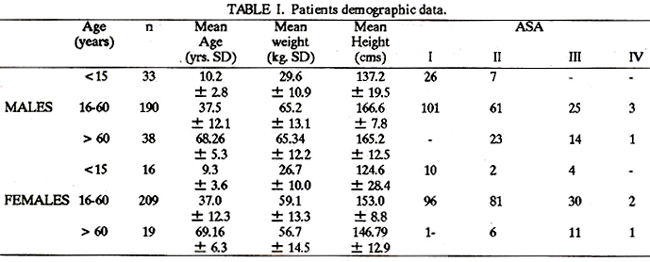
The minimum induction dose of thiopentone expressed as milligrams and mgs/kg for three subgroups is presented in Table II.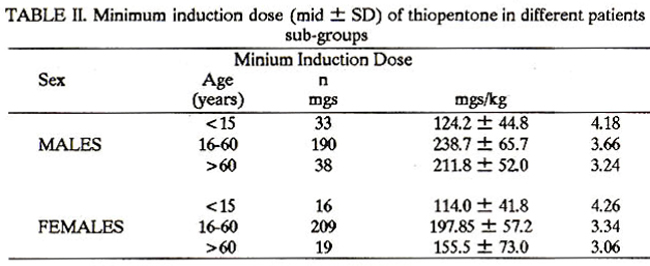
In the adult patients (age 16-60 years), the mean induction dose was 215.8 ± 66 mgs, and the weight related dose was 3.48 mgs/kg.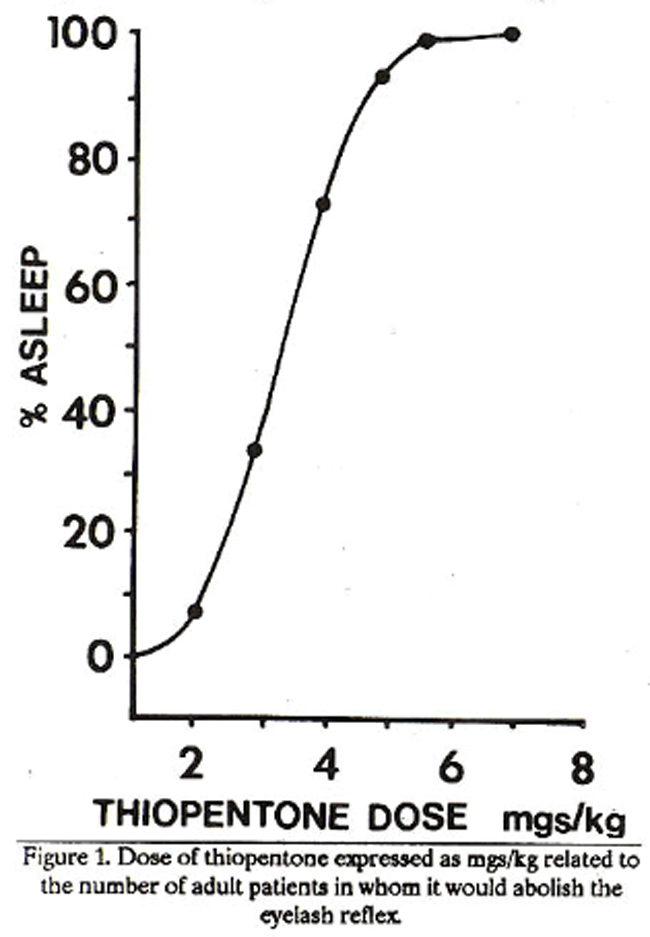
Figure 1 shows the dose of thiopentone expressed as mgs/kg related to the number of adult patients in whom it would abolish the eyelash reflex. Ninety percent of the patients were asleep at a dose of 5 mgs/kg.
Effect of sex
Table II shows the difference in the induction doses required by males and females. In children the difference among sexes was not significant, but in adults the difference was significant (p value <0.001). Females over 60 required a significantly lesser dose than the males (p value <0.01).
Effect of age
The patients were further stratified according to age.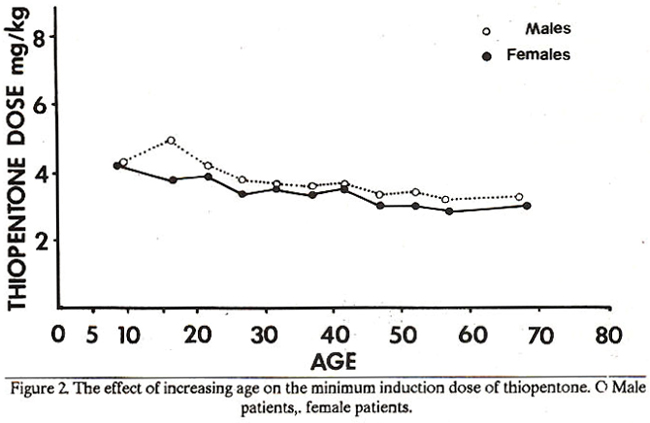
This is presented in Figure 2 for both males and 100 females. The thiopentone dose showed a steady decline as the age progressed.
ASA Status
The adult patients were further divided in different ASA groups according to the anaesthesia risk (Table III).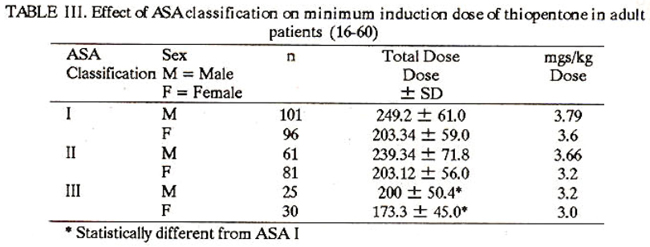
The weight and age of the patients in each group was comparable. There was no statistical difference seen between ASA 1 and II patients in both sexes, but the difference was highly significant in both males and females when the induction dose was compared between ASA I and III patients and ASA II and III patients, ASA III patients requiring lesser dose than ASA I and II patients. The number of patients in ASA W group was too small to be considered statistically.
Effect of premedication
There was no statistical difference in the age, weight and sex among the premedicated and the non-premedicated patients among the adults.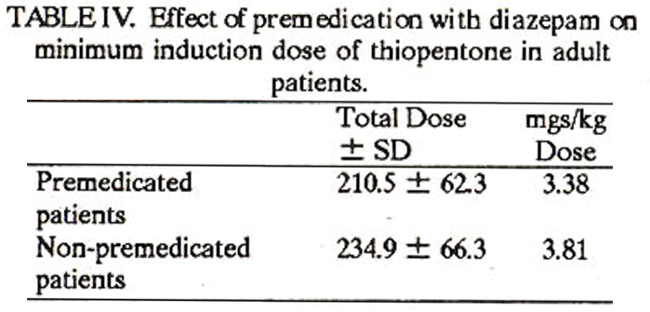
Table IV presents the difference in thiopentone dose required by the two groups. Patients who received diazepam 0.15 mgs/kg2-3 hours preoperatively required a smaller dose of thiopentone compared to those patients who did not receive diazepam. This difference was statistically significant. The premedication group was further divided on the basis whether the patients were alert or drowsy at the time of induction. Patients who were labelled as drowsy required a mean dose of 205.7 mgs (3.2 mgs/kg) compared to 212 mgs (3.5 mgs/kg) in those who were assessed as being alert.
DISCUSSION
There are many factors which can influence the induction dose of thiopentone, e.g., sex, physical status, social habits and anxiety. These factors can vary in different population group, e.g., the incidence of the intake of alcohol, and smoking especially among the females is much less in the local population compared to the Europeans. It has also been the personal experience of the authors that because of the social setup in our society the Pakistani patients are much more apprehensive of surgery than theft Western counterparts. Dundee et al1 have quoted a figure of 224.6 ± 79.9 mgs (3.72 mgs/kg) as the mean induction dose of thiopentone required in the adult British population. In our study, adult patients required 215.8 ± 66.4 mgs (3.48 mgs/kg) of thiopentone. This figure was significantly less (p <0.05 ) than that recommended for the British population1. Some investigators have shown a difference in the amount of thiopentone needed for induction in different age groups1,3, with children requiring higher doses and elderly less. Homer and Stanski4 found a significant decrease in the initial volume of distribution with increased age based on a smaller central compartment and therefore a higher initial serum concentration. In our study the thiopentone dose showed a steady decrease as the age progressed. Children less than 16 years of age required higher doses on mg/kg bases compared to adults and elderly in our study. This was in contrast to Dundee’s1 study where mg/kg dose for children was less than the adult patients but more than the elderly group. In each age group the females required a significantly lower average dose. This pattern was again similar to Dundee1. When the data was broken down according to the anaesthesia risk, ASA I and II patients required a significantly higher dose of thiopentone compared to ASA III patients among both sexes. This indicates the predictive value of ASA classification in the estimation of thiopentone induction dose requirements. The drugs used in premedication have been shown by several authors to alter the requirement of induction agents5-7. Last few years have seen transition of premedication from opiate injection to oral benzodiazepines due to a number of advantages. Oral diazepam given approximately two hours before induction provides good anxiolysis and anterograde amnesia and has therefore become increasingly popular. It is also the standard premedication use in our hospital, given to all inpatients. The day cases constituted the group receiving no premedication. There was a significant difference in the minimum induction dose of thiopentone in the two groups, with patients who received diazepam premedication requiring a statistically smaller dose of thiopentone. In the same group when patients who were drowsy before induction were compared to those who were alert, a significant difference was again illustrated. The degree of sedation therefore appeared to influence the dosage of thiopentone to a marked degree and may reflect the effectiveness of the premedicant drug. In conclusion, our patients required a statistically smaller dose compared to British patients and we recommend a dose of 3.5 mgs/kg for Pakistani adult males, and 3.3 mgs/kg for Pakistani adult females, for abolition of eyelash reflex at induction of anaesthesia with thiopentone sodium.
REFERENCES
1. Dundee, J.W., Haaaard, T.H., McGowan, WA. and Henshaw, J. The induction dose of thiopentone. A method of study and preliminary illustrative results. Anaesthesis, 1982; 37: 1176.
2. Henshaw, J.S., Dundee, J.W., McGowan, W.A.W. and Hassard, T. A method of studying the dosage of thiopentone. Br. 3. Anaesthesiol., 198% 52: 957.
3. Westrin, P., Jonmsrker, C. and Werner, 0. Thiopental requirements for induction of anaesthesia in neonates and in infants one to six months of age. Anaesthesiology, 1989; 71: 344.
4. Homer, T.D. and Stanski, DR. The effect of increasing age on thiopental disposition and anaesthetic requirement. Anaesthesiology, 1985; 62: 714.
5. Christensen, 3.H. and Andressen, F. Individual variation in response to thiopental. Acts Ansesthesiol. Scand., 1978; 22: 303.
6. Duncan, B.B., Zaimi, F., Newman, G.B., Jenkins, 3.0. and Aveling, W. Effect of premedication on the induction dose of thiopentone in children. Anaesthesia, 1984; 39:426.
7. Dundee, 3W., Hsllidsy, N.J., McMurray,T.3. and Harper, LW. Pretrestmentwithopiods. The effect of thiopentone induction requirements and on the onset of action of midazoism. Anaesthesia, 1986; 41: 159.
Journal of the Pakistan Medical Association has agreed to receive and publish manuscripts in accordance with the principles of the following committees:


