

Salimuddin Aziz ( PMRC Research Centre, Jinnah Postgraduate Medical Centre, Karachi. )
Tariq Zia Lodi ( PMRC Research Centre, Jinnah Postgraduate Medical Centre, Karachi. )
S. Ejaz Alam ( PMRC Research Centre, Jinnah Postgraduate Medical Centre, Karachi. )
October 1992, Volume 42, Issue 10
Original Article

ABSTRACT
Frequency of byssinosis in 276 workers from 5 ginning factories of rural Sindh are described. Twenty-four (9%) had byssinosis, 178 were asymptomatic and the remaining 74 had other respiratory symptoms. Chronic obstructive pulmonary disease was present both in symptomatic and asymptomatic workers and was equally distributed amongst smokers and non-smokers. A possible involvement of some factors other than cigarette smoking is discussed (JPMA 42: 239, 1992).
INTRODUCTION
Bernardo Ramazzini1, in De Morbis Artificim described incessant cough and asthma like symptoms in carders and weavers of flax and hemp. Kay described these symptoms in cotton mill workers in "spinner phthisis" in 18312. The term \\\'byssinosis\\\' was first used by Oliver3 in 1902, having been coined by Proust4 in 1877. The first survey was conducted in 19505. Byssinosis is diagnosed by symptoms of chest tightness, difficulty in breathing or both on the first day of work, after a period of rest6. Pulmonary functions usually show acute changes in post-work measurements. This study was designed to assess prevalence of byssinosis in ginning factories of Sindh in Tharparker district, home to many factories, with a combination of both new and old machines.
SUBJECTS AND METHODS
Five mills, both new and old, were selected and total work force was included in the study. Each worker was interviewed according to a specially designed proforma on the pattern of the one designed byBritish Medical Research Council. Each worker had a physical examination and pulmonary function test (PFT) using a cornputensed S-model vitalograph before and after completing 8 hours work shift in standing position without the nasal clip. The procedure was explained and trial runs conducted before recording three efforts. The computer automatically selected the best effort. Values for forced vital capacity (PVC), forced expiratory volume in one second (FEY1), forced expiratory volume percent (FEV1%) and forced expiratory flow rates .2-1.2 ml (PEP .2-1.2L) and (FEF 25-75%) were obtained. Each worker was x-rayed and sputum examined for AFB by direct smear. Diagnosis of byssinosis was made when recurrent pattern of chest tightness or difficulty in breathing and cough on Saturdays after a day of rest was observed. Symptoms were graded according to Schillings as follows9:
Grade 0 No symptoms
Grade 1/2 Occasional chest tightness or difficulty in breathing on Saturdays.
Grade 1 Chest tightness or difficulty in breathing on every Saturday.
Grade 2 Chest tightness or difficulty in breathing on Saturdays and other days.
Grade 3 Grade 2 symptoms with permanent incapacity.
Respiratory functions were graded as follows:
F-0 No acute effect or chronic ventilatory impairment.
F-i/2 Slight acute effect (FEy1 decrease 0.06.0.2L).
F-i Definite acute effect (FEV1 decrease> 0.6 lit)
F-2 Slight or moderate irreversible ventilatory impairment (FEV1% 60-80% of predicted)
F-3 Moderate to severe ventilatory impairment (FEV1% <60% of predicted) Workers were divided into three groups according to their symptoms. Byssinotics, symptomatic other than byssinosis and asymptomatics. Statistical analysis was done using chi square and student’s ‘t’ test.
RESULTS
Three hundred and ten workers were examined, 18 had acute or healed pulmonary tuberculosis, 10 chronic bronchitis or asthma and 6 missed pre or post work shift PFT and hence were excluded. Twenty-four (9%) of 276 workers had byssinosis; of the remaining 252, 74 had respiratory symptoms not typical of byssinosis (Table I)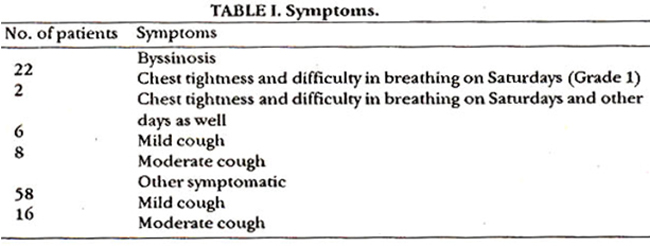
and the rest were asymptomatic. Amongst byssinotics, 15 (63%) were smokers a percentage higher than both 37 (50%) non-byssinotic symptomatic and 65 (37%) asymptomatic. Average exposure to cotton dust amongst byssinotics was not much different to other groups and ranged between 12-16 years. Post shift PFT in byssinotics had lower values but were not remarkably significant (Table II).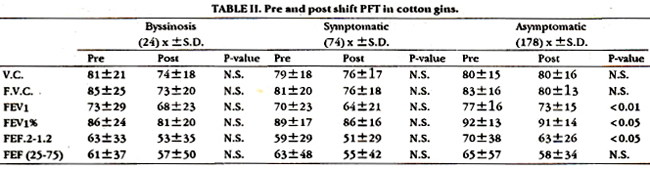
F-3 changes were higher (29%) amongst byssinotics compared to both non-byssinotic symptomatics (22%) and asymptomatics (6%) (Table III).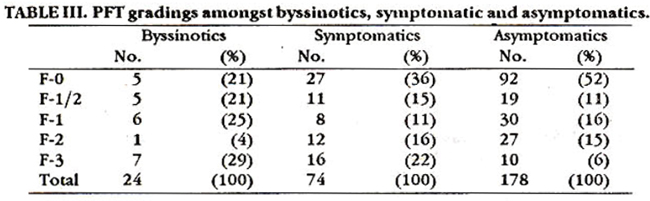
These changes were equally distributed among smokers and non-smokers (Table IV).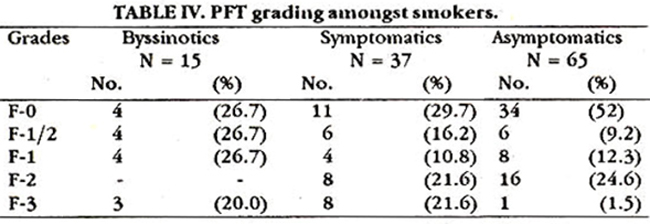
However when PET were compared amongst smokers and non-smokers there was significant difference in FEV1, FEV1% and flow rates (Table V)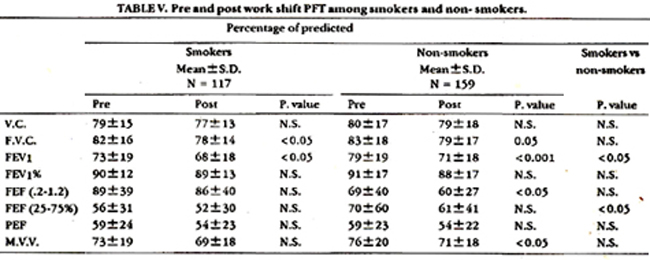
similar changes were observed when pre and post PFT was compared in total 276 workers (Table VI).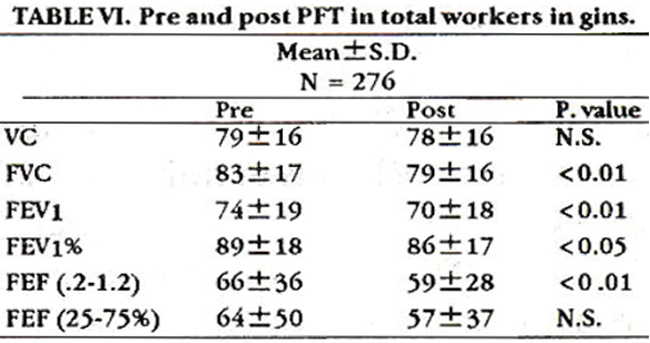
DISCUSSION
Byssinosis defined as recurrent chest tightness or difficulty in breathing, or both, on the first day of work after a period of rest. It was first recognised amongst flax7 and cotton8 mattress workers and later in the cotton mills9. Kay2 describing the symptoms, wrote ‘patient experience a diffuse and obscure sensation behind the sternum”, and later a recurrent pattern of symptoms on the first working day after rest6. The disease has worldwide distribution in countries involved in growing and using cotton fibre. The prevalence differs in different countries, but the pattern is similar. In the present study 9% workers complained of byssinotic symptoms. Twenty-one percent had normal PET and another 21% only showed F-1/2 changes. Although post work shift recordings showed slight decrease in PET values, these were statistically not significant This does raise the question should these workers be classified as potential byssinotics or are these symptoms spurious and the diagnosis must rest on more significant objective changes in PFT. In our experience it is seldom that a worker describes his symptom as chest tightness, though history of difficulty in breathing especially on Saturdays with or without cough is usually available. This lack of correlation of symptoms with PFT makes diagnosis very difficult. F-3 changes amongst non-byssinotic symptomatics were higher than in asymptomatics (Table III) but equally distributed among smokers and non-smokers (Table IV). Some had decrease in post work shift PET while others had no acute effect. In the absence of byssinotic symptoms these would be classified as chronic obstructive pulmonary disease (COPD), hence all groups includ ing byssinotics must include some cases of COPD also. Asymptomatics and those not complaining of truly byssinostic symptoms also had fair numbers with severely compromised PFT, although these changes were higher amongst symptomatics. This raises a further question “whether exposure to cotton dust increases the risk of COPD"? A widely accepted predictor of eventual development of COPD is an accelerated decline of expiratory flow rates, especially FEY1 and requires repeated PFT over a number of years. Studies conducted so far10-13 have shown greater declines of FEY1 in cotton workers compared to workers handling synthetic fibre. It has also been suggested that cotton workers have higher prevalence of disabling lung functions than people in a community at large not exposed to cotton dust14 and other agriculture workers15. It is generally accepted that an exposure of 10-20 years in cotton mills is usually required for COPD16. Since work in our gins is seasonal, an exposure of 40-80 years will be required to produce similar exposure of cotton dust, hence the level of chronic disease should be much lower than that seen in cotton mills. With an average exposure of 15 years in this study the prevalence of chronic disease is higher in symptomatics than asymptomatics and equally distributed amongst smokers and non- smokers. This suggests that there may possibly be some other factor or factors involved in this incidence for example, the quality of cotton handled or contamination17. Very few studies have been conducted in ginning factories. In Egypt preliminary reports suggested 52% prevalence18 which with better dust controls in late sixties was estimated to be 11 ,3%19, whereas in the United States, Palmer20 did not find any, the reason put forward was that since in the States gin’s working is a continuous process without rest period, workers didnotdevelop any symptoms. Ours is the first study in Pakistani gins, the previous two studies21,22 were conducted in cotton textile mills and showed a prevalence of 8-21%. As both these studies were based on symptoms and PFT done only during the work shift, these may have included some cases of COPD and missed those with acute changes only, but even then 8% seems a rather low and a figure of 21% seems more likely22. It is proposed that larger scale studies both in Sindh and Punjab should be conducted to assess the situation further and appropriate steps adopted for its control. It is quite obvious that workers do not die of byssinosis but the pool of workers with irreversible ventilatory impairment will keep on increasing.
ACKNOWLEDGEMENT
This study was funded by Pakistan Science Foundation.
REFERENCES
1. Rarnazzini, B. Diseases ofworkers. Translated from latin text’De Morbia Artificium of 1793 by W.C. Wright. New York, Hafner, 1964. p. 257.
2. Kay, J.P. Observations and experiments concerning molecular irritation of the lungs as onesource of tubercularconsumption and on spinner’s phthisis. Noah EngI. Med. Surg. J., 1831;1:348-63.
3. Oliver, T. Dangerous trades. London, Murray, 1902, p,273.
4. Proust, A. Pulmonary diseases resulting from inhalation of cotton dust. Traite d’ Hygiene publique et privee. Paris, 0. Masson, 1877,7: p. 171.
5. Schilling, R.S., Hughes, J.P., Dingwall-Fordyce, L and Gilson, J.C. An epidcmiological study in byssinosis smongLsncsshire cottonworkers. Br.J. Indus. Med., 1955; 12:217-27.
6. Lee, W.R. clinical diagnosis of byasinosis. Thorax, 1979;34:287-89.
7. Greenhow, H. Flax manufacture in Patley Bridge.Third report ofmedical officerofprKy council. Sir John Simon 1860, p. 152.
8. NseL P.A., Schneiter, R. and Caminita, RH. Report of acute illness among rural mattress makers using lowgrsde stained cotton. JAMA., 1942;199:1047-82.
9. Schilling, R.S.F. Byssinosis in cotton and other textile workers. Lances, 1956;2:261-65, 319-25.
10. Berry, G., Mekerrow, C., Molyneux, M., Rossiter, c. and Tombleson, 3. Astudy in the acute and chronic changes in ventilatory capacity ofworkera in Lancashire cotton mills.Br.3.lndus.Med., 1973;30:2.5-36.
11. Berry , G., and Motyneux M.K. An epdemiological study of respiratory symptoms in Lancashire cotton mills. Br.J.Indus.Med., 1970;17:19-23.
12. Gupta, S. and Gupta, BK. A study of byasinoaia and associated respiratory disorders in cotton mill workers. Indian. J. Chest Dia. Allied Sci., 1986;28:183-88.
13. Gerald,)., Beck, 0.)., Schshter, EN. and Maunder, L.R. The relation of lung function to subsequentemploymentatatusand mortality in cotton textileworkers. Chest, 1981;79 (Suppl.):26- 30.
14. Bouhuya, A., Beck, 0.3. and Schoenberg, J.B. Priorities in prevention of chronic lung disease. Lung, 1979;56:129-48.
15. Larson, R.K., Barman, M.L., Smith.D.W. and Nicol, L. Study of respiratory effects of short and long term cotton gins exposure. chest. 1981;79 (Suppl.):22-26
16. Palmer, A., Finnegan, W., Herwas, P. and Jones, J. Byssinosie and chronic respiratory disease in U.S. cotton gins.). Occup. Med., 1978;20:96-102.
17. Cinkotal, F.F., Lockwood, M.G. and Rylander, R. Airborne bacteria and prevalence of byssinolic symptoms in cotton mills, Am.lnd. Hyg.Aasoc.J., 1977;38:554-59.
18. El-Batawi, M.A. Byssinosisin cotton industry of Egypt, Br.J.Indus. Med., 1962;19:126-30.
19. Nowier, M.H. Some observations on epidemiologic studies in Egyptian gins, cotton pressing plants and cotton seed oil extraction plants. Chest, i981;79 (Suppl.):15-20.
20. Palmer, A. and Ayer, HE. Byssinosis CRC Crit. Rev. Environ. Control, 1971;2:207-41.
21. Rab, SM., Zafar, MA., Beg, M.Z. and Bashir, M. Byssinosis in Karachi. Ann. JPMC., 1983; 1:14-17.
22. Rehman, M. Byssinosis in Karachi Cotton Mills. 1990, p. 159 (Thesis).
Journal of the Pakistan Medical Association has agreed to receive and publish manuscripts in accordance with the principles of the following committees:


