

Haren Kumar ( The Kidney Centre, 197/9, Rafiqui Shaheed Road, Karachi. )
Feroze Alam ( Department of Medicine, Aga Khan University Hospital, Karachi. )
S.A.J. Naqvi ( Department of Nephrourology, Jinnah Postgraduate Medical Centre, Karachi. )
October 1992, Volume 42, Issue 10
Original Article

ABSTRACT
Seventy-nine patients of end stage renal disease (ESAD) on maintenance haemodialysis were studied. Most of the cases were in their prime of life. The disease was equally common in both sexes and all ethnic groups. Chronic glomerulonephritis was the commonest cause followed by diabetes mellitus. Hypertension was the commonest associated illness. All patients were screened for hepatitis B surface antigen and antibody and those found negative were vaccinated. A-V fistula in the upper extremity was used as the vascular access in 93% cases. In 68% cases dialyzer was reused without any ill effect. Amongst the complications observed, hypotension was seen in 65%, psychological disorders in 52%, followed by nausea, vomiting, itching and cramps. Technical complications were related to A-V fistula in 45% cases. Forty three percent patients were maintained without blood transfusion and 88% showed improvement in their quality of life (JPMA 42: 234, 1992).
INTRODUCTION
Haemodialysis is an established form of management for patients with ESRD. Many new developments, advanced concepts and methods have markedly changed the overall approach1. Pretreatment of water for dialysis has become an essential pre-requisite1,2. New and sophisticated dialysis machines and a wide range of haemodialyzers are now available according to the individual need of the patient. High flux and bicarbonate dialysis is commonly used in many parts of the world3. More emphasis is laid on the rehabilitation of these patients and a definite role of dietician, psychiatrist and a social worker have been identified4. Though facilities for haemodialysis are available in Pakistan for the past many years, there is a need to organise a cost effective dialysis programme on scientific lines, to determine base line data and identifr common problems associated with haemodialysis and thereafter draw guidelines for dialysis patients.
PATIENTS AND METHODS
This study at the Kidney Centre included 79 registered patients of ESRD requiring long term maintenance haemodialysis. Over 3,000 dialysis treatments were given to these patients in a 15 month period. Patients were dialysed on SPS45O Baxter/Travenol haemodialysis machines, using hollow fibre dialyzer. Only purified and treated water obtained from Reverse Osmosis water treatment plant was used for the preparation of dialysate. Quality control was maintained by regular laboratory analysis of raw and treated water. The data of patients were collected on the basis of history, clinical examination, past investigations and record of each dialysis session. The blood chemistry, reflecting the metabolic control of these patients is not presented here.
RESULTS
Of 79 dialysis patients,. 48 were males and 31 females, 71 were married. Ages of the patients ranged between 15-78 years (mean 43 years). Age distribution is shown in Figure.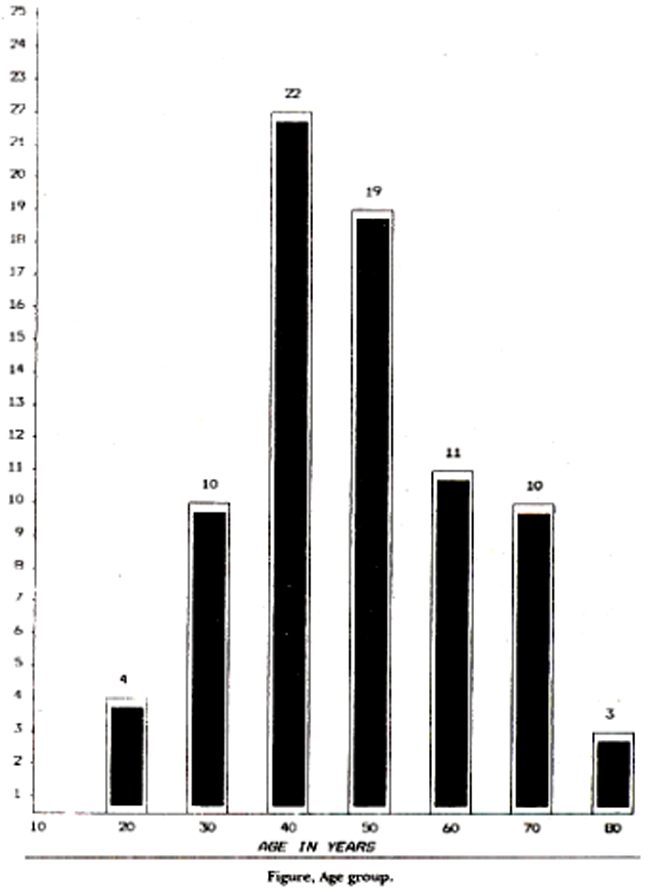
Majority were in 3rd and 4th decade of life. Mother tongue was used to determine the ethnic origin; 39 were Urdu speaking, 15 Punjabi, 14 Memon/Gujrati, 4 Sindhi, 4 Balochi and 3 Pushto. The causes of ESRD are shown in Table I.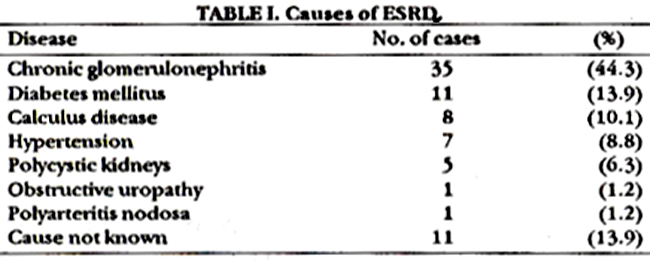
The most common associated illness was hypertension which might have been secondary to renal failure. Of 79 patients, 27 were normotensive (B.P. not above 140/90) and 52 hypertensive. Hypertension was adequately controlled by fluid/salt restriction and medications in 25 cases, poorly controlled in 23 and uncontrolled in 4 (above 200/120). The other common associated illnesses were diabetes mellitus (19), ischaemic heart disease (17), bronchial asthma (4), haemorrhoids (4), pulmonary TB (3), osteoarthritis (3) and peptic ulcer (2). Majority (46.8%) of the patients received dialysis on charity basis (Zakat Fund, etc.), 36.7% were self paid and 16.45% sponsored by various institutions or individuals. In 54 patients (68.3%) the dialyzer was reused with good response whereas in 25 patients new dialyzer was used each time.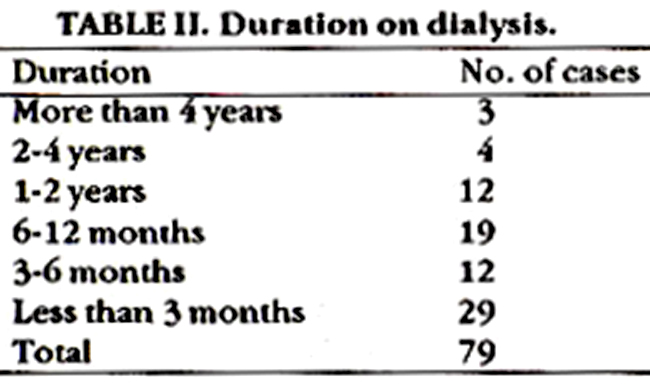
Table II shows duration ofdialysis.Almost 25% were on dialysis for more than one year. Presently the facility for dialysis is available for only HBSAg negative patients. Of the 79 patients, only 13 (16.4%) had preformed antibodies. Fifty-three cases (67%) were fully vaccinated, 10 were being vaccinated and 3 who had recently joined the study were to be vaccinated. The commonest blood group was B (36%), followed by 0 (25%), A (12%) and AB (8%). Also dialysed were 1 patient each of B-negative, AB-negative and 0-negative. The blood group was not determined in 4 patients. Majority of patients (34) did not require transfusion during the study period, 14 patients required transfusion every month, 15 every two months, 8 every three months, 6 patients every six months and 2 patients once a year. Recently 14 patients have been started on erythropoietin therapy with encouraging results. In 74 patients A-V fistula in upper extremity was the most commonly used vascular access. In 4 patients the fistula had to be reconstructed either because of initial failure or complications arising later on. Other forms of vascular accesses which were used as emergency measure to tide over the crises were femoral and subclavian catheters and A-V shunts placed in the legs. Mean weight of dialysis patients was 56 kg. In 31 cases the interdialytic weight gain was less than 2 kg, 38 gained upto 3 kg and 8 gained upto 5 kg of weight between two dialysis. In 2 patients we were unable to determine the weight because of their moribund condition.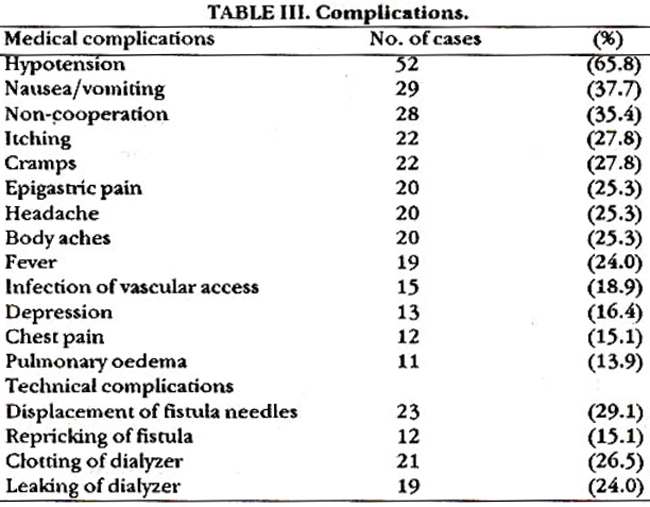
Table III shows the various complications encountered. Of the medical complications, hypotension was seen in the majority (66%) while the displacement of fistula needles was the commonest (29%) of the technical complications. Twenty eight patients regained meaningful employment after coming on dialysis, 41 although not employed were leading a productive life (retired persons and housewives) and in 10 no improvement was noticed after dialysis. At the conclusion of study period 50 patients were still on dialysis at The Kidney Centre, 7 went abroad, 6left for other centres, 5 left for kidney transplant, 4 left against medical advice and 2 were admitted in other hospitals because of their unstable condition.
DISCUSSION
ESRD and subsequent need for dialysis are the most dreaded outcome of renal diseases and many of these can be prevented by early detection and treatment. It poses a major socio-economic problem, requiring intensive psychiatric and physical rehabilitation not only of the patients but also of the entire family5,6. In the present study ESRD was equally distributed between both the sexes and all ethnic groups. Most of the patients were married and in the prime of life. Psychiatric problems like depression, anxiety and non-cooperation contributed a major proportion of medical complications; similar has been the observation in other studies7. This emphasizes the role for psychiatrist in the initial assessment and follow-up and would not only help in the rehabilitation but also improve the quality of life8. chronic glomerulonephritis was the most common cause of ESRD and in 14% the cause remained undetermined. Similar pattern is reported in other studies9. In the present study, diabetics with ESRD contributed to 14% of dialysis population as compared to 25% in U.S.A. 1. Such patients are now being given the option of maintenance dialysis more frequently because of better management of diabetes, prolongation of life and availability of better vascular access in the form of A-V fistula2,10. Calculus disease leading to ESED in our patients is high as compared to western countries9 emphasizing the need for prevention, early detection and treatment of calculus disease in our country. As in other studies, hypertension was the most common associated illness and pulmonary edema the most drastic complication related to dietary indiscretion. Strict maintenance of interdialytic weight gain by salt and fluid restriction not only control hypertension but may even obviate the need for antihypertensive medications11,12. It would also help in minimising the incidence of hypotension during dialysis which was the most common medical complication in our study along with nausea, vomiting, cramps, headaches and chest pain1. A-V flstula in the upper extremity is an ideal form of vascular access for haemodialysis and the same was used in the present study13. Incidence of infections and technical complications were higher in our study which can be reduced or avoided by allowing sufficient time to newly formed A-V fistula to mature, proper technical training of the dialysis staff and better patient education14. The blood groups in our dialysis population corresponds with the blood group distribution in Karachi15. Fifty percent patients did not require blood transfusion as they were asymptomatic, nor did their low haemoglobin pose any technical difficulty in the procedure because of the compensatory mechanisms. These findings correlate well with the literature16,17. In those who require multiple transfusion, erythropoietin therapy can be considered provided the financial resources are available; thereby preventing the complications associated with multiple transfusions18,19. Hepatitis B is prevalent in our general population as 16% of patients had preformed antibodies before coming on dialysis. Intense and proper screening at frequent intervals alongwith vaccination are mandatory not only for the patients but also for the dialysis staff20,21. In our study only 1/3rd of the patients were able to afford the expenses of haemodialysis, reflecting low per capita income and limited resources in our country. With the reuse of dialyzer, we have brought down the cost of dialysis by 30%. Reuse of dialyzer is an established practice in USA, where it is performed in more than 65% of dialysis units’. We found it to be biocompatible and have observed some morbidity but no mortality with its reuse which correlates with the other studies22,23. The cost can be further reduced by the use of dialyzer reprocessor with which dialyzer can be used upto 8 times (presently we are manually reprocessing the dialyzer upto 4 times). Much needed cadaveric transplant programme in our country can also go a long way in reducing long term financial burden and improving the quality of life in these individuals. In conclusion, the care of patients on haemodialysis requires coordination between the patients’ family and a team of health care personnel including social worker, dietician and psychiatrist Most of the patients in our study are leading a productive life and 1/3rd of them have actually regained meaningful employment.
REFERENCES
1. Daugirdas, J.T. and Ing. T.S. Handbook of dialysis. Boston,Little Brown, 1988w pp. 30-321.
2. Wright, L.F. Maintenance haemodialysis. Boston. O.K. Hall,, 1981, pp. 56-81.
3. Grade, U., Milutinovich, 3., Follette, W.C, vino, J.E., Babb, A.L. and Scribner. B.H. Lesa dialysis . induced morbidity and vascular instability with bicarbonate in dialysate. Ann. Intern. Med. 1978; 88:332-36.
4. Blagg, CR. Importance of nutrition in dialysis patients. Am.J. Kidney Dis., 1991;17:458-61.
5. Landsman, M.K. The patient with chronic renal failure: a marginal man. Ann. Intern. Med., 1975; 82:268-70.
6. Levy, NB., Wynbrandt, GD. The quality of life on maintenance haemodialysis. Lancet, 1975;1: 1328-30.
7. Hampers, C.L., Schupak. E, Lowrie, E.G. and Lazarus, 3M. Longterm haemodialysis. 2nd ed. New York,Grune and Stratton, 1973, pp. 217-21.
8. Abrams, H.S. The psychiatrist, the treatment of chronic renal failure and prolongation of life. Am.J. Psychiatry, 1968; 124:1351.
9. Marsh, F. Postgraduate nephrology. London, William Heinemann, 1985, pp.131-355.
10. Kumar, H. and Naqvi, S.AJ. Diabetic nephropathy. Specialist, 1985; 2:41-44.
11. Rains, A.E.G. Hypertension, blood viscosity and cardiovascular morbidity in renal failure; implication of etythropoietin therapy. Lancet, 1988;1:97-99.
12. Vertes, V., cangiano, J.L., Berman, LB. and Gould, A Hypertension in end-stage renal disease. N. Engl. J.Med.. 1969; 280:978-81.
13. Brescia, Mi., cimino, J.E., Appel, K and Hurwich, Bi. chronic haemodialysis using venipuncture and a surgically created arteriovenous fistula. N. Engl. 3. Med., 1966;275:1089-92.
14. Kinnaert, P., Vereerstraeten, P., Toussaint, C and Ven Geertruyden, 3. Nine years experiencewith internalarteriovenous fistulas forhaemodialysis:astudyofsomefactors influencing the results. Br. J. Surg., 1977; 64:242-46.
15. Mujeeb, S.A and Hashmi, M.R.A.ABO blood group in Karachi. Medical Gazette, 1988;19:6.
16. Koch, KM., Patyna, W.D., Shaldon, S. and Werner, E. Anaemia of the regular haemodislysis patients and its trestmenL Nephron., 1974; 12:405-19.
17. Eschbach, J.W. and Adamson, .1.W. Anaemia of end-stage renal disease (ESRD). Kidney Int., 1985;28:1-5.
18. casati, 5., Passerini, P.,. Gampise, MR., Graziani, G., Gasasna, B., Periscic, M. and Ponticelli, C Benefits and risks of protracted treatment with human recombinant erythropoietin in patients havinghaemodialysis. Br. Med.J., 1987; 295:1017-20.
19. Cotes, P.M. Erythropoietin: the developing story. Br. Med.J., 1988; 296:805-6.
20. Eddleaton, A Modern vaccines. Lancet, 1990;335:1142-44.
21. Mayer, LA., Alter, Mi.and Favero, MS. Haemodialysia- associated hepatitis B: revised recommendations for serologic screening. Semin. Dialysis, 1990; 3:201-4.
22. Wing. A.J., Brunner, F.P., Brygner, H.O.A, chantler, C, Donckerwolclce, LA, Gurland, Hi., Jacobs, C and Selwood., N.H. Mortality and morbidity of reusing dialyzers. Br.Med. 3., 1978;2:853-55,
23. Venholder, It and Ringoir, S. Influence of reuse and of reuse aterilants on the first use syndrome. Artif. Organs, 1987; 11:137-39.
Journal of the Pakistan Medical Association has agreed to receive and publish manuscripts in accordance with the principles of the following committees:


