

Saad Sultan Ghumman ( Shifa College of Medicine, Islamabad, Pakistan. )
Muhammad Nadeem ( Shifa College of Medicine, Islamabad, Pakistan. )
Anem Javed Nawaz ( Shifa College of Medicine, Islamabad, Pakistan. )
Muhammad Umer Azeem ( Shifa College of Medicine, Islamabad, Pakistan. )
Zarak Hassan Khan ( Shifa College of Medicine, Islamabad, Pakistan. )
Syed Mohsin Mazhar ( Shifa College of Medicine, Islamabad, Pakistan. )
September 2013, Volume 63, Issue 9
Student's Corner

Abstract
Objectives: To quantify the frequency of self-management for headache by adult population aged >18 years in urban and rural Islamabad.
Methods: The cross-sectional study using systematic sampling of households was conducted in I-8 sector of Islamabad and its outskirts (in Nurpur Shahan) from March to September 2011. It comprised 248 individuals above 18 years of age who were interviewed using a structured questionnaire. SPSS 16 was used for data analysis.
Results: Of the total, 136 (54.8%) were males and 112 (45.2%) were females. The overall mean age was 32±12.5 years, and 218 (87.9%) suffered from headache. Out of those suffering from headaches, 178 (81.7%) employed self-management. Pharmaceutical drugs (n=155; 87.1%) were the commonest modality employed, while vitamins (n=6; 3.4%), massage (n=8; 4.5%), herbal remedies (n=4; 2.2%) and homeopathic medicines (n=5; 2.8%) were infrequently utilised. Acetaminophen (panadol) was the commonest pharmaceutical drug used (n=91; 58.7%), followed by salicylic acid (aspirin) (n=46; 29.7%). Self-management was slightly more frequent among males (n=95; 53.37%) and in the above-matriculation group (n=103; 57.8%). A total of 151 (84.7%) people claimed to be satisfied with their self-management.
Conclusion: Self-management of headaches is highly prevalent among the general public. The majority opts for pharmaceutical drugs, mostly preferring acetaminophen. Most are satisfied with their self-management.
Keywords: Headache, Self-management, Pharmaceutical drugs. (JPMA 63: 1210; 2013).
Introduction
Headache is a global health problem which can affect individuals across a range of age groups and genders.4-7 Very few people will experience no headache in their life.1 Self-management is a common choice of treatment which can be challenging if remedies taken without professional opinion result in unfavourable consequences.5 Headache is a common ailment for which the general population relies on self-management rather than seeking a professional\\\'s advice.6 Hence, it is important to define patterns of self-management in the local population in order to devise future preventive measures.7 Due to the demanding everyday routines, poor socioeconomic status, high cost of modern medicines and non-availability of doctors in Islamabad (population of 1.33 million),8 difficulties do arise in accessing modern healthcare. Studies of pharmaceutical practice have called attention to the role played by pharmacists and pharmacy attendants in fostering self-medication and medicine experimentation among the public. Pharmacies frequently serve as the public\\\'s first point of contact with the healthcare system.9 In India, a neighbouring South Asian country with economic and cultural similarities to Pakistan, pharmacists and pharmacy attendants play an important role in fostering self-medication among the public.10-12 What remains unclear is the extent to which clients passively follow the advice of pharmacy personnel or question their motive or expertise.10
A study carried out in Santa Catarina states headache prevalence to be higher among women,4 being related to gender,13,14 use of birth control pills, Caucasian race,13 low economic status, divorced or widowed status,14 somatic symptoms,15 menstrual cycle,16 presence of co-morbidities and higher risk of mental illness and other pain conditions.17 For some, headaches become a limiting condition that interferes with their quality of life, affecting professional activities, as well as social activities and relationships.1
Because headaches interfere with daily life, a large number of patients seek treatment outside healthcare institutions, mainly through self-management and advice from friends and family. A study18 observed that 69.9% of respondents with headache used common painkillers, among which sodium dipyrone (26.8%) and acetaminophen (25.5%) were the most frequently mentioned.18 In addition to pharmacological management, individuals use non-pharmacological management, such as rest,19 physiotherapy20 and acupuncture.21
The current study planned to quantify the prevalence of self-management of headaches and to look at the different modalities employed by the general public. The study also tried to explore the rationale behind self-management.
Subjects and Methods
A pilot study with 10 individuals around a local marketplace of Islamabad was carried out to check the appropriateness and readability of the questionnaire. 4th Year medical students under the guidance of a neurosurgeon at Shifa College of Medicine, Islamabad, carried out the cross-sectional observational study on 248 respondents using the structured and pre-tested questionnaire. RAOSOFT software was used for sample size calculation. Using 5% margin of error, and 95% confidence interval, and population size of 20000, with response distribution of 20%, the recommended sample size was 243. The study was conducted from March to September 2011.
Systematic random sampling of households was done in I-8 sector Islamabad, and Nurpur Shahan (Sector G-8). A house was picked randomly as the starting point, and thereafter every 4th house was attended to with one person from each house being interviewed. The respondents were briefed about the research and consent was obtained. No identifying information like name, address, telephone number or CNIC number was taken from the participants.
The inclusion criteria comprised respondents of age 18 years and above, both males and females, living in the selected area and willing to participate in the study by providing written consent. Exclusion criteria was residents <18 years of age because of uncertainty whether they would be able to comprehend and respond properly to the queries or not.
For operational purposes self-medication was defined as medication by oneself without professional supervision to alleviate an illness or a condition, while self-management was defined as the act or manner of managing, handling or controlling an illness or a condition with pharmaceutical or non-pharmaceutical measures.
The questionnaire was composed of both open-ended and close-ended questions, which aimed at gathering information regarding the individual\\\'s profile. Subject\\\'s age, occupation, locality, marital status and education were noted. Locality was central/urban Islamabad (I-8 sector) or outskirt/rural (G-8 sector, Nurpur Shahan). The respondent\\\'s education was noted as below matriculation or above matriculation. They were questioned on occurrence of headache and its duration, frequency, severity, site and associated symptoms. They were further questioned regarding their choice of self-management, preferred pharmaceutical drug, level of satisfaction, and if they had consulted a physician before taking the medication. Modalities in question were pharmaceutical drugs, massage, vitamins, herbal remedies and homeopathic medicines. Pharmaceutical drugs that were addressed included panadol/paracetamol (acetaminophen), aspirin (salicylic acid), voltral/artifen (diclofenac sodium) and ponstan/gardan (mefenamic acid).
Data received was compiled and fed into SPSS 16.0 for analysis. Data was evaluated to determine the prevalence of headaches. Statistical analysis was done using chi-square test.
Results
The age of 248 subjects ranged from 18 to 71 years with a mean age of 31.79±12.60 years. There were 136 (54.8%) males, 144 (58%) married, and 160 (64.5%) belonged to urban locality. With respect to education status, 145 (58.5%) belonged to the above matriculation group (Table-1).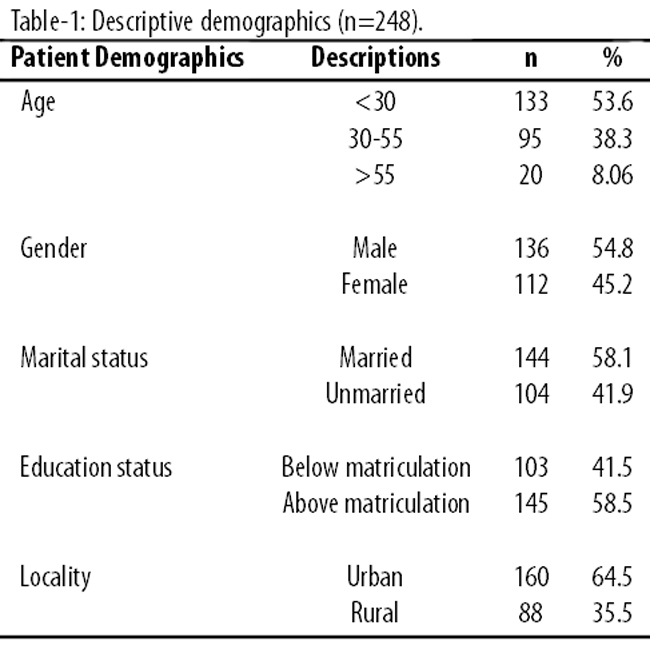
Of all the respondents, 218 (87.9 %) reported having headache at some point in their lifetime. Majority (n=79; 36.4%) said that they have had headaches for the past 5 years and had episodes once a month (n=66; 30.5%). Diffuse headache involving the entire head was the most common complaint (34.3%). Headache was accompanied with factors like photophobia (n=20; 9.1%), dizziness (n=30; 14%) and visual disturbance (n=21; 9.8%), while majority of the headaches were not accompanied with any other complaint (n=87; 39.9%).
Out of the 218 reported cases of headaches, 178 (81.7%) had employed self-management (Table-2).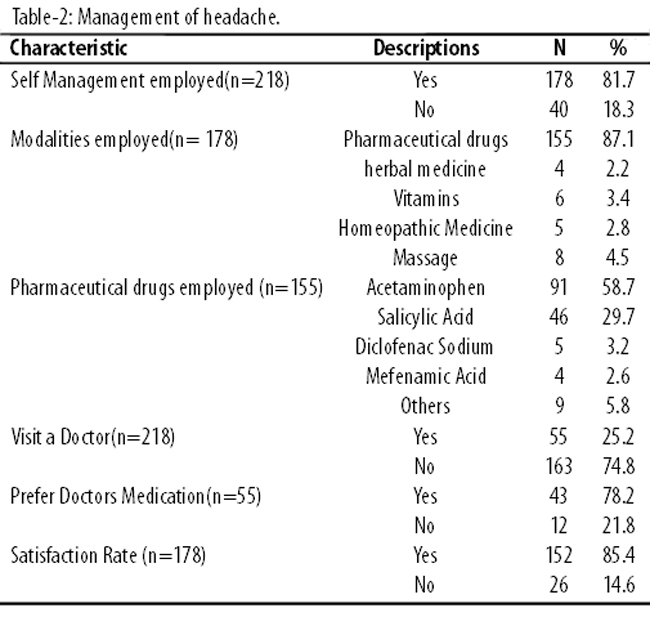
Pharmaceutical drugs were the most commonly used modality (n=155; 87.1%), and most people claimed using acetaminophen (paracetamol/panadol) containing drugs (n=91; 58.7%), followed by salicylic acid (aspirin) containing drugs (n=46; 29.7%). Non- pharmacological management was used by 23 (12.9%) respondents, which included herbal remedies, vitamins, homeopathic medicine and massage. Only 55 (25.2%) respondents had visited a doctor, and of them 43 (78.2%) said that they preferred doctor\\\'s medication over self-prescribed medication. A vast majority of respondents (n=152; 85.4%) claimed to be satisfied with their chosen modality of self-management. Satisfaction rate was higher among the urban residents, males, unmarried and those belonging to the above-matriculation group.
Self-management rate was 53.37% (95/178) for the males and 46.62% (83/178) for the females (Table-3).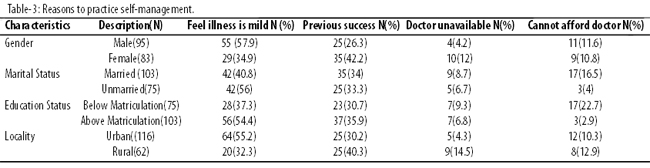
The frequency of self-management for the urban residents was 65.96% (116/178) and 34.83% (62/178) for rural localities. We found the use of acetaminophen-containing drugs to be more frequent among the urban locality (n=74; 68.1%) and the married respondents (n=58; 58.2%). Salicylic acid was more preferred by the people of rural locality (n=29; 52.2%).
The most common reason told by the respondents to practice self-management was that they felt the illness was mild (n=84; 47.2%). Other reasons stated included having had previous success with self-management (n=60; 33.7%), unavailability of the doctor (n=14; 7.9%) and inability to afford a doctor (n=20; 11.2%). Majority (n=55; 57.9%) of the males thought their illness was mild, while the most common reason among the females was that they had had previous success with self-management (n=35; 42.2%).
Discussion
The results of the study revealed that about 88% of the sample suffered from headache, out of which almost 82% claimed to employ self-management for their headache. Unfortunately, only a handful of studies similar to this were found at the national level. One study conducted in Karachi stated that the prevalence of self-medication for headache amongst university students was around 72%.22 A study conducted in Southern Santa Catarina stated the prevalence of self-management with prescription drugs among headache sufferers to be around 87%.4 Owing to the established belief that self-management is more prevalent among those living in rural areas, it was surprising to observe that there was little difference between the self-management rates among the urban and rural populations in our study. This observation can be distinguished from the study conducted in Nepal which stated urban population to be practising self-management more than the rural population.23 Likewise, it has been commonly observed that self-management is more among the females.24 Though our study supported this, foreign literature such as a study conducted in Southern Santa Catrina, showed higher rates of self-management among the males.4 The prevalence of self-management of headaches, according to our study, was significantly high. This calls for future studies to investigate the detrimental effects of various self-management modalities on health.
Pharmaceutical drugs were the mainstay of treatment chosen by the respondents (87.1%) which is supported by studies conducted in Indonesia and Southern Santa Catarina.3,25 Such self-prescribed medications could lead to unidentified damages of harmful side effects, drug interactions and drug dependence.
The preference of acetaminophen-containing drugs established in our study (58.7%) was found analogous to the study conducted at Dalhousie University, Canada,26 which revealed that 56% of respondents with tension-type headache and 60% with migraine self prescribe acetaminophen. Other foreign literature also confirmed the high rates of self-prescription with acetaminophen.12,27 Moreover, acetaminophen was preferred by the urban and married respondents. The preference for acetaminophen in our part of the world could be due to the household popularity of this drug, it\\\'s cheaper cost and availability over the counter. About 30% of our respondents preferred salicylic acid-containing drugs. Such drugs were more common among the rural and the married. Preference for salicylic acid-containing drugs was low elsewhere, like in Southern Santa Catrina4 where studies showed its prevalence to be as low as 7.5%.
Satisfaction rate to self-management was high (85.4%). Such high levels of contentment rates could compel the masses into self-managing themselves for other commonplace illnesses such as fever, diarrhoea/constipation and sore throats.28,29 At present, increased self-management with antibiotics is already alarmingly challenging due to the rising issue of resistant strains.30
Contrary to the popular belief that people employ self-management due to the difficulty in accessing healthcare system in Pakistan, the two most common reasons cited for employing self-management among our study respondents were mildness of illness (47.2%) and previous success with self-management for other illnesses (33%). This is parallel to the study conducted by university students of Karachi, where \\\'previous experience with similar symptoms\\\' (50.3%) and the \\\'problem seeming to be too trivial\\\' (48.3%) were the commonest reasons cited.22 Previous success with self-management was found to be the most prevailing rationale given by females and respondents of rural areas. This observation is reinforced by the Slone Survey, a study conducted in USA regarding the use of over-the-counter medications,24 where they reported rates of self-prescription to be exceptionally high among females. The previous success with use of self-management among the rural population could be due to the popular practice of self-administering herbal and homeopathic medications among this group.
Only around 25% of the patients reported visiting a doctor for headache; most of them said they preferred doctor\\\'s prescription over their own. Though relevant data was unable, we believe this trend could either be due to headache being beyond the threshold of mildness, easy accessibility to a doctor or extreme lack of satisfaction with their personal choice of drug.
Conclusion
The prevalence of headache self-management was exceptionally high. Pharmacological modalities were the mainstay of treatment with acetaminophen-containing drugs being the most preferred. Only a small number of people seek treatment from medical practitioners. There is a high level of satisfaction among the population to their chosen modality of self management. The situation calls for paying attention to the potential detrimental problems. There is a need to implement strategies which could involve spreading awareness regarding the potential adverse effects of such practices revising/restricting the number of over-the-counter drugs available to the general public, and improving the accessibility of healthcare. The study can serve as a platform for future studies that address the practice of self-management for different types of headaches.
References
1. Corrêa TDS, Santos KMD, Galato D. Prevalence and management of headache in a selected area of Southern Santa Catarina. Arq Neuropsiquiatr 2010; 68: 216-23.
2. Silva FS, Sampaio MCF, Costa Neto J, Serva WD, Lima J, Valenca MM. Prevalence of headache in the course of life in a sample of the population of the metropolitan area of Recife. Migrâneas Cefaléias 2005; 8: 104-6.
3. Souza JA, Moreira Filho PF, Jevoux CC, Albertino S, Sarmento EM, Brito CM. Age as a risk factor for independent secondary headaches. Arq Neuropsiquiatr 2004; 62: 1038-45.
4. Gorayeb MAM, Gorayeb R. Cefaléia associada a indicadores de transtornos de ansiedade em uma amostra de escolares de Ribeirão Preto, SP. Arq Neuropsiquiatr 2002; 60: 764-8.
5. Amoako EP, Richardson-Campbell L, Kennedy-Malone L. Self-medication with over-the-counter drugs among elderly adults. J Gerontol Nurs 2003; 29: 10-5.
6. Derry S, Moore RA, McQuay HJ. Paracetamol (acetaminophen) with or without an antiemetic for acute migraine headaches in adults. Cochrane Database Syst Rev 2010; 11: CD008040. doi: 10.1002/14651858.CD008040.
7. Balbuena FR, Aranda AB, Figueras A. Self-medication in older urban Mexicans: an observational, descriptive, cross-sectional study. Drugs Aging 2009; 26: 51-60.
8. Ministry Of Population Welfare, Govt of Pakistan. Population Dynamics 2011. (Online) (Cited 2012). Available from URL: http://www.mopw.gov.pk/PopulationDynamicsByProvince.aspx.
9. Kafle KK, Madden JM, Shrestha AD, Karkee SB, Das PL, Pradhan YM, et al: Can licensed drug sellers contribute to safe motherhood? A survey of the treatment of pregnancy related anaemia in Nepal. Soc Sci Med 1996; 42: 1577-88.
10. Kamat VR, Nichter M. Pharmacies, self-medication and pharmaceutical marketing in Bombay, India. Soc Sci Med 1998; 47: 779-94.
11. Greenhalgh T. Drug prescription and self-medication in India: an exploratory survey. Soc Sci Med 1987; 25: 307-18.
12. Drug utilization research group, Latin America. Multicenter study on self-medication and self-prescription in six Latin American countries. Clin Pharm Ther 1997; 61: 488-93.
13. Pahim LS, Menezes AMB, Lima R. Prevalence and factors associated with migraine in the adult population of Pelotas, Brazil. Rev Saúde Públ 2006; 40: 692-8.
14. Queiroz LP, Barea LM, Blank N. An epidemiological study of headache in Florianopolis, Brazil. Cephalalgia 2006; 26: 122-7.
15. Tietjen GE, Brandes JL, Digre KB, Baggaley S, Martin V, Recober A, et al. High prevalence of somatic symptoms and depression in women with disabling chronic headache. Neurology 2007; 68: 134-40.
16. MacGregor EA, Hackshaw A. Prevalence of migraine on each day of the natural menstrual cycle. Neurology 2004; 63: 351-3.
17. Saunders K, Merikangas K, Low NCP, Korff MV, Kessler RC. Impact of comorbidity on headache-related disability. Neurology 2008; 70: 538-47.
18. Domingues RB, Kuster GW, Dutra LA, Santos JG. Headache epidemiology in Vitória, Espírito Santo. Arq Neuropsiquiatr 2004; 62: 588-91.
19. Miranda F, Dantas B, Krymchantowski AV. Prevalence and characteristics of headache in a population of regular physical exercise practitioners. Arq Neuropsiquiatr 2006; 64: 802-6.
20. Morelli JGS, Rebelatto JR. The effectiveness of manual therapy in individuals TTH patients with and without cervical degeneration: analysis of six cases. Rev Bras Fisioter 2007; 11: 325-9.
21. Wink S, Cartana MHF. Promoting self-care to patients suffering headache through the oriental perspective of health. Rev Bras Enferm 2007; 60: 225-8.
22. Zafar SN, Syed R, Waqar S, Zubairi AJ, Vaqar T, Shaikh M, et al. Self-medication amongst university students of Karachi: prevalence, knowledge and attitudes. J Pak Med Assoc 2008; 58: 214-7.
23. Shankar PR, Partha P, Shenoy N. Self-medication and non-doctor prescription practices in Pokhara valley, Western Nepal: a questionnaire-based study. BMC Fam Pract 2002, 3:17.
24. Kaufman DW, Kelly JP, Rosenberg L, Anderson TE, Mitchell AA. Recent patterns of medication use in the ambulatory adult population of the United States: the Slone Survey. JAMA 2002; 287: 337-44.
25. Sclafer J, Slamet LS, de Visscher G. Appropriateness of self-medication: method development and testing in urban Indonesia. J Clin Pharm Ther 1997; 22: 261-72.
26. Forward SP, McGrath PJ, MacKinnon D, Brown TL, Swann J, Currie EL. Medication patterns of recurrent headache sufferers: a community study. Cephalalgia 1998; 18: 146-51.
27. Arrais PS, Coelho HL, Batista MC, Carvalho ML, Righi RE, Arnau JM. Profile of self-medication in Brazil. Rev Saude Publica 1997; 31: 71-7.
28. Kasilo OJ, Nhachi CF, Mutangadura EF. Epidemiology of household medications in urban Gweru and Harare. Cent Afr J Med 1991; 37: 167-71.
29. Figueiras A, Caamano F, Gestal-Otero JJ. Sociodemographic factors related to self-medication in Spain. Eur J Epidemiol 2000; 16: 19-26.
30. Bauchner H, Wise P. Antibiotics without prescription: "bacterial or medical resistance"? Lancet 2000; 355: 1480-4.
Journal of the Pakistan Medical Association has agreed to receive and publish manuscripts in accordance with the principles of the following committees:


