

Shoaib Rafique ( 4th Year MBBS Student, Nishtar Medical College, Multan. )
Hasaan Rafique ( 3rd Year MBBS Student, Nishtar Medical College, Multan. )
September 2013, Volume 63, Issue 9
Student's Corner

Abstract
Objective: To obtain feedback on teaching and assessment methods in professional undergraduate medical examinations.
Methods: The study was conducted at Nishtar Medical College, Multan, Pakistan, from May 21 to May 26, 2012. A written questionnaire covering topics on various teaching and assessment methods was used to get feedback from students of 2nd, 3rd, 4th and 5th year M.B.B.S. SPSS version 17 was used for statistical analysis.
Results: Of the 534 questionnaires distributed, 538 (99%) were returned duly filled. Overall, 382 (71%) students were satisfied with all aspects of the lectures delivered and 393 (73%) students agreed that teaching staff was punctual in delivering lectures. Although 312 (58%) students were satisfied with the teaching conducted in the wards, students felt dissatisfaction with the teaching carried out in outpatient departments and operating theatres. Multimedia was favoured by 306 (56%) students as a supporting teaching tool. Although the students agreed that questions asked in examinations were relevant and the pattern of Objective Structured Clinical Examination (OSCE) / Objective Structured Practical Examination (OSPE) was satisfactory, they felt that the time allowed was insufficient. 399 (74%) students agreed that multiple modes of assessment improved their knowledge and skill.
There was no consensus among the students on the best form of assessment. Number of students favouring short essay questions (SEQ\\\'s), multiple choice questions including true/false type, single best choice questions (BCQ\\\'S) and descriptive questions were 209(38.8%), 176(32.7%), 70 (13%) and 28 (5%) respectively.
There was disparity in students\\\' satisfaction in internal assessment and university examination. Although 226 (42%) students were satisfied with internal assessment, 199 (37%) were satisfied with university assessment.
Conclusion: Overall, the students were satisfied with the lectures and clinical teaching conducted in the wards. Preferred methods of assessment included short essay questions (SEQ\\\'s) and multiple choice questions. Most of them wanted sufficient time for OSCE/OSPE and the satisfaction with university examination was only 37%.
Keywords: Teaching methods, Assessment methods, Students\\\' feedback, Teaching tools, Internal assessment, University assessment. (JPMA 63: 1205; 2013).
Introduction
Recently, extensive changes have taken place in most countries at all levels to improve the standard of medical education. Teaching and assessment methodologies are evolving to achieve the intended goal. In Pakistan, the Pakistan Medical and Dental Council (PMDC) has taken steps to modify the medical curriculum to make it consistent with that of international standards. These modifications have included improved system of teaching and assessment.
It is generally agreed that reviewing the teaching and assessment methods at regular intervals is necessary so that methodologies can be modified for improving the undergraduate medical education. Various evaluation tools, such as feedback, help the faculty to identify the strengths and weaknesses of their teaching and assessment methods.1,2
Therefore in developing the teaching and assessment strategies, it is important to obtain feedback from students that will later allow the teachers/faculty to modify their methods to meet the needs of the students without adversely affecting the standards of education. Of the many tools available, student feedback represents the primary means used by most programmes to assess their methodology.3 In addition, student feedback is considered to be the best method to bridge the communication gap between teachers and students.4 It is an inexpensive and invaluable tool to improve the quality of teaching.
Although student feedback is conveyed to the teachers verbally or non-verbally from time to time, a large-scale survey has never been conducted at our institution. The objective of the present study was to obtain student feedback on teaching and assessment at Nishtar Medical College, Multan, Pakistan, which is a well-reputed public sector medical institution of the country.
Subjects and Methods
The descriptive cross-sectional survey of students at Nishtar Medical College (NMC), Multan, using non-probability convenience sampling, was conducted from May 21 to May 26, 2012. A specially-designed close-ended questionnaire was developed on the basis of interviews and discussions with medical students and teachers [Appendix-1]. It included questions about teaching and assessment of the students. The undergraduates were requested to indicate their agreement or disagreement about the given statements in the feedback form. To preserve anonymity of the responders, they were asked not to disclose their names when answering the questions. However, they were requested to print their age and gender on the proformas.
The survey included students from 2nd, 3rd, 4th and 5th year M.B.B.S. classes. Students were approached during morning class lectures on different days of the same week. They were briefed in the class lectures about the objectives of the study and were requested to answer the questions in 15 minutes. The questionnaires were collected at the end of the given time. For 2nd year M.B.B.S. students, question number 4, relating to teaching in outpatient departments (OPDs), operating theatres (OTs) and wards was omitted as these students, being in the basic sciences, had not been exposed to clinical teaching yet. First Year students were excluded from the study altogether as they had not gone through any university assessment. Recommendations were also sought from the students for improving teaching and assessment methods.
Data was entered and analysed using SPSS version 17. Descriptive statistics were applied to calculate the mean and standard deviation for the ages of the respondents. Frequencies and percentages were calculated for qualitative variables. Potential confounders like age, gender and year of study were controlled by stratified tables.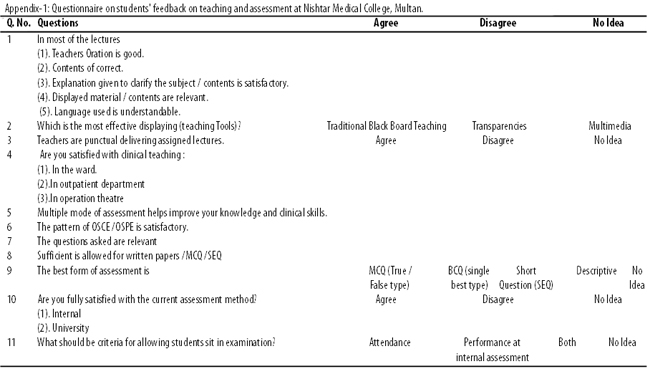
Results
The total number of medical students in all classes at Nishtar Medical College at the time of the study was 1493. After excluding First Year students, there were 1172 (78.5%) students left as potential subjects. The questionnaire was handed over to 543 (46.3%) students of these classes, and 538 (99.07 %) returned the questionnaire after completion. The number of respondents from 2nd, 3rd, 4th and 5th Year were 167 (31%), 168 (31.2%), 131 (24.3%) and 72 (13.3%) respectively. The number of male and female respondents was 203 (37.73%) and 335 (62.2%) respectively. The mean age of the respondents was 22.39±1.47 years and it ranged from 19 to 26 years.
Students\\\' response was obtained regarding various aspects of lectures, which are delivered to large groups, including oration, content, explanations given, relevance of the displayed material and the language used. Overall, 382 (71%) students were satisfied with all aspects of lectures (Figure-1).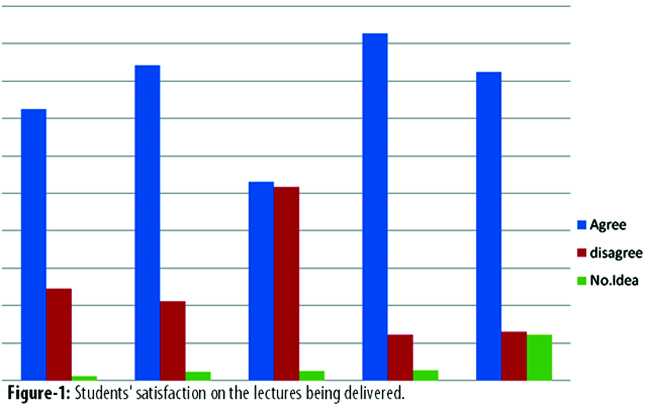
Majority of the students (n=306; 56.8%) students favoured multimedia as an audio-visual aid to teaching as compared to traditional blackboard teaching and transparencies which were favoured by 186 (34.5%) and 18 (3.4%) students respectively. 393 (73%) students agreed that the teaching staff was punctual in delivering lectures.
Clinical teaching question number 4 was answered by 371 (68.9%) students as 2nd year M.B.B.S. students were excluded. Although 312(58%) students were satisfied with the teaching in the wards, there was a bit of dissatisfaction about teaching in the OPDs and OTs, with satisfaction rates 30% and 21.8% respectively.
Number of students favouring short essay questions (SEQ\\\'s), multiple choice questions (MCQs), single best choice (BCQs) and descriptive questions was 209(38.8%), 176(32.7%), 70 (13%) and 28 (5%) respectively (Figure-2).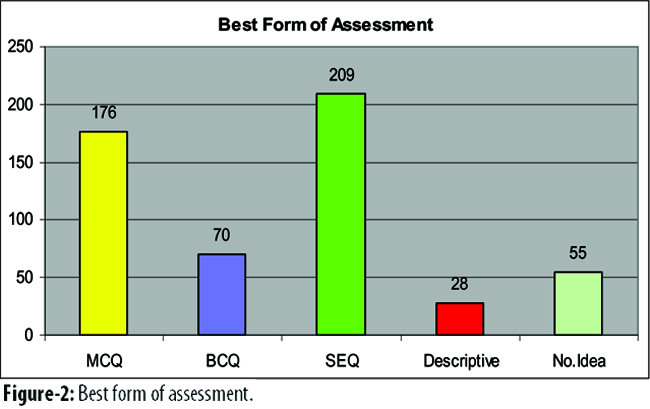
As far as the pattern of Objective Structured Clinical Examination (OSCE)/Objective Structured Practical Examination (OSPE) was concerned, 274 (51%) were satisfied and 242 (45%) were dissatisfied with this form of assessment. Majority (n=312; 58%) of the students felt that the time allowed for OSCE/OSPE was insufficient.
In terms of questions being relevant, 289 (53.7%) students answered in the affirmative. An overwhelming majority (n=399; 74%) of the students agreed that multiple modes of assessment improve their knowledge and skill.
There was disparity in students\\\' satisfaction in internal assessment and university examination. Although 226 (42%) students were satisfied with internal assessment, 199 (37%) were satisfied with university assessment (Figure-3).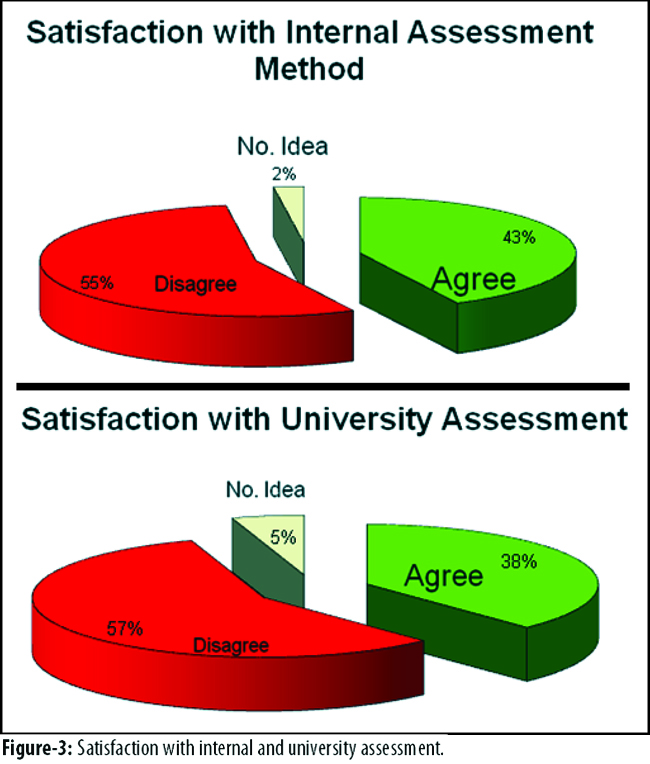
Three hundred (55.7%) students felt that class attendance and internal assessment should both be taken in to consideration for allowing students to sit in university examination.
Discussion
Extensive changes are taking place globally to improve the standards of medical education. The concept of medical teaching is changing as the boundaries of knowledge are no longer restricted to text books and lectures. Access to internet, electronic journals, educational videos and online conferences are shifting the concept of traditional lecture-based teaching. Teaching and assessment methodologies have been evolving to achieve the intended goal. Assessment is an essential part of the medical education. It provides evidence of how well the student learning objectives are being achieved and whether the teaching standards are being maintained. A medical curriculum should constantly develop in response to the need of students, institutions and communities.5 Student feedback about educational methodologies is a useful basis for modifying and improving medical education. The ultimate aim of such feedback is to identify areas of strength and/or weakness of teaching methodology used so that steps can be taken to rectify the deficiencies and to evolve the curriculum and achieve the intended goal.
The current study is important because overall majority of students were satisfied with various aspects of lectures being delivered, including oration, content, explanation given, relevance of the displayed material and the language used. Although students were satisfied with the teaching in the wards, there was a significant dissatisfaction with the teaching conducted in the OPDs and OTs. Clearly there is a need to improve clinical teaching in these areas. In the modern era, traditional blackboard teaching method is being replaced by multimedia aids. In the present study, majority of the students (56%) favoured multimedia as a supporting teaching tool compared to the traditional blackboard teaching and transparencies. An earlier study also reported a similar trend.6
Majority of the students felt satisfied with the pattern of OSCE/OSPE examination that allows clinical skill evaluation in a neutral environment compared to viva voce examination which is viewed by some as biased. However, they felt that time allocated for OSCE/OSPE was insufficient.
There was no consensus among the students on the best form of assessment. Students favoured short essay questions (SEQs), multiple choice questions (MCQs), single best choice (BCQs) and descriptive questions by 38.8%, 32.7%, 13% and 5% respectively. In other reported studies, participants have favoured different assessment forms. In one study,7 majority of the students supported MCQ-based assessment,7 while another study reported that students favoured BCQs as the best form of assessment.6
Majority (75%) of the students in our study felt that multiple modes of assessment improve their knowledge and skill. Similar findings have been reported by other studies where students suggested a need for multiple modes of assessment rather than a single assessment, which, in their view, could not fulfil assessment of all aspects of students\\\' knowledge effectively.2,8
Although the undergraduates were generally satisfied with the questions asked in the written examination and pattern of OSCE/OSPE, their satisfaction on internal assessment and university examination was 42% and 37% respectively. This issue needs consideration by the faculty members and others concerned, and steps should be taken to improve student performance and satisfaction in internal and university examinations.
In addition to answering the questionnaire, students were asked to give suggestions for improving teaching and assessment at NMC. Most respondents were of the opinion that small-group teaching and short traditional lecture time will improve their teaching. Many students felt that the shortage of qualified teachers in many disciplines was adversely affecting teaching in those areas, and demanded recruitment of qualified teachers in those departments on a priority basis.
The study had many limitations. Only the opinion of those students who were present in the lecture room on the study day could be obtained. The opinion of the students who missed the class might have been different. The students were asked to give the feedback individually, but the presence of peers at the same time may have affected their opinion. We used multiple-choice rating scale to obtain the feedback. This method limits the freedom of answers by the subjects. This was a very small sample from a single medical college and it would be difficult to generalise the results. Further multicentre studies are needed on student feedback and assessment.
Conclusion
Overall, students were satisfied with the lectures and clinical teaching in wards. Preferred methods of assessment included short essay questions (SEQs) and multiple choice questions. Most were satisfied with pattern of OSCE/OSPE but felt that insufficient time was allowed for it. Although 42% students were satisfied with internal assessment, only 37% were satisfied with university examination.
Acknowledgments
We are grateful to Professor Muhammad Rafique Anjum, Chairman , Department of Medical Education (DME); Dr. Abira Nazir, Professor of Pharmacology; Dr Amir Ali Khan, Associate Professor of Pathology, Nishtar Medical College, Multan; and Dr Imran Iqbal, Professor of Paediatrics Medicine Children Hospital, Multan for their help in the conduct of the study and the preparation of the manuscript. The authors are also grateful to Mr. Suhail, statistician, of Pakistan Medical Research council (PMRC), Multan for statistical analysis.
References
1. Ruth N. Communicating student evaluation of teaching results: rating interpretation guides (RIG\\\'s). Assessment & Evaluation in Higher Education 2000; 25: 121-34.
2. Richardson BK. Feedback .Academia Emergency Medicine 2004; 11: 1-5.
3. Victroff KZ & Hogan S. Student\\\'s perception of effective learning experiences in dental school; a quantitative study using a critical incident technique. J Dent Edu 2006; 70: 124-32.
4. Sehgal R, Dhir BV, Sawhney A. Teaching technologies in Gross Anatomy. J Anatomic Soc India 1998; 48: 36.
5. Morrison J. ABC of learning and teaching in medicine. Evaluation. BMJ 2003; 326: 385-7.
6. Manzar B, Manzar N. To determine the level of satisfaction among medical students of a public sector medical university regarding their academic activities. BMC research report Notes 2011; 4: 380.
7. Oyebola DD, Adewoye OE, Iyaniwura JO, Alada AR, Fasanmade AA, Raji Y. A comparative study of student\\\'s performance in preclinical physiology assessed by multiple choice and SEQ\\\'s. Af J Med Sci 2000; 29: 201-5.
8. Abraham RR, Upadhya S, Torke S, Ramanarayan K. Students perspectives of assessment by TEMM model in physiology. Adv Physiol Educ 2005; 29: 94-7.
Journal of the Pakistan Medical Association has agreed to receive and publish manuscripts in accordance with the principles of the following committees:


