

Jawaria Farzand Raja ( MCH Unit-I; Pakistan Institute of Medical Sciences, Islamabad. )
Kausar Tasneem Bangash ( MCH Unit-I; Pakistan Institute of Medical Sciences, Islamabad. )
Ghazala Mahmud ( MCH Unit-I; Pakistan Institute of Medical Sciences, Islamabad. )
September 2013, Volume 63, Issue 9
Original Article

Abstract
Objective: To develop a scoring system for the prediction of successful vaginal birth after caesarean section, following induction of labour with intra-vaginal E2 gel (Glandin).
Methods: The cross-sectional study was conducted from January 2010 to August 2011, at the Pakistan Institute of Medical Sciences in Islamabad. Trial of labour in previous one caesarean section, undergoing induction with intra-vaginal E2 gel, was attempted in 100 women. They were scored according to six variables; maternal age; gestation; indications of previous caesarean; history of vaginal birth either before or after the previous caesarean; Bishop score and body mass index. Multivariate and univariate logistic regression analysis was used to develop the scoring system.
Results: Of the total, 67 (67%) women delivered vaginally, while 33 (33%) ended in repeat caesarean delivery. Among the subjects, 55 (55%) women had no history of vaginal delivery either before or after previous caesarean section; 15 (15%) had history of vaginal births both before and after the previous caesarean; while 30 (30%) had vaginal delivery only after the previous caesarean section. Rates of successful vaginal birth after caesarean increased from 38% in women having a score of 0-3 to 58% in patients scoring 4-6. Among those having a score of 7-9 and 10-12, the success rates were 71% and 86% respectively.
Conclusion: Increasing scores correlated with the increasing probability of vaginal birth after caesarean undergoing induction of labour. The admission VBAC scoring system is useful in counselling women with previous caesarean for the option of induction of labour or repeat caesarean delivery.
Keywords: Vaginal birth after caesareans, Induced labour, Repeat caesarean section, VBAC scoring. (JPMA 63: 1147; 2013).
Introduction
The total number of caesarean deliveries has been increasing, largely because of an increase in primary caesarean sections (CS).1 Although the rate of vaginal birth after caesarean delivery (VBAC) is successfully increasing, but is still limited because of concern over maternal and perinatal morbidity and mortility,2,3 which is, in fact, small.4 Understanding of prenatal determinants, facility of timely intervention and proper monitoring of labour can promote vaginal birth after caesarean (VABC).5 Overall, the spontaneous VBAC success rate is between 60% and 82% in published studies.6,7 Different scoring tools have been devised to help predict whether a woman will have a successful spontaneous VBAC.8,9 There is no single scoring system for predicting the success of VBAC after cervical ripening with intravaginal E2 (Glandin Gel). Induction of labour in previous one CS is a controversial subject and not widely accepted. In order to assess suitability in patients with previous CS after induction of labour for successful VBAC, the current study looked at antenatal determinants, like maternal age, gestational age, indication of previous CS, VBAC history, Bishop score and body mass index (BMI).
Subjects and Methods
This cross-sectional study was conducted from January 2010 to August 2011 at the Pakistan Institute of Medical Sciences, Islamabad. It included 100 patients picked by consecutive sampling technique, who had a history of previous one CS from the outpatient department (OPD). The sample size was calculated by using World Health Organisation (WHO) sample size calculator taking confidence level of 95%, population proportion of 82%,6,7 and required Precision level of 8%. A detailed structured proforma was used as the study instrument, and data was collected by the corresponding researcher.
The study was approved by the institutional Ethical Review Board.
The inclusion criteria entailed previous one low transverse caesarean section; single alive foetus; gestational age 37-41 weeks; and estimated foetal birth weight 2.5-3.5kg. The exclusion criteria consisted of: Cephalopelvic disproportion; any medical disorder; malpresentation; history of antepartum haemorrhage; non-reaasuring patterns in the foetal heart rate; history of placenta previa or adherent placenta or such in the current pregnancy; and uterine surgery other than CS.
These patients underwent induction of labour with one E2 gel, which was repeated after six hours in case the Bishop score was less, and provided there were no signs of foetal or maternal compromise. Strict foetal monitoring was done by continuous cardiotocography (CTG) and maintaining partographic progress and the mode of delivery was seen. The patients were scored according to six variables: maternal age, gestational age, indication of previous CS, history of VABC, Bishop score and BMI.
All data was entered and analyzed using SPSS 10.0. Descriptive statistics were used to calculate mean and standard deviation for quantitative variables. Frequencies with percentages were presented for qualitative variables. Univariate and multivariate logistic regression models were fitted to calculate odds ratios (ORs) with 95% confidence intervals (CIs) of each variable. Logistic regression analysis was done to predict the mode of delivery i.e. caesarean or VBAC. Total score was obtained on the basis of addition of score of each variable:
Age score (years): >30=0; 25-30=1; <25=2.
Gestational age (weeks): <39=0; 1= 39-40=1; >40=2.
Indication of previous CS: Non-progress of labour (NPOL) =0; Twin pregnancy or post-dates or intrauterine growth retardation (IUGR) or placental abruption or oligohydraminios=1; breech presentation or foetal distress=2.
VBAC history: Nil=0; VBAC=1; vaginal delivery before caesarean and VBAC=2.
Bishop: 0-3=0; 4-5=1; 6-10=2.
BMI (kg/m2): >30=0; 25-29.9=1; <25=2.
A p-value of 0.05 was considered statistically significant.
Results
There were 100 women in the study with a mean age of 26±4.17 years. Univariate logistic regression showed that overall maternal age had no significant (p >0.05) relationship with the mode of delivery, after induction of labour, but it showed that age more than 30 years, had less chances of VBAC (OR=2.7, 95% CI=1.0 to 7.6, p <0.05) compared with age <25 years (Table-1).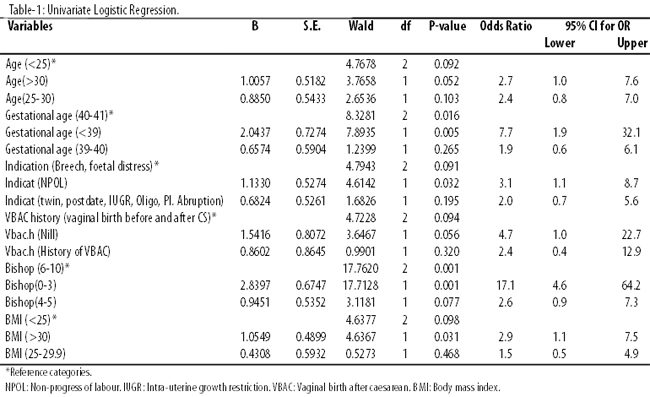
The mean gestational age was 39.6±0.9 weeks. It showed a significant (p <0.05) association with the mode of delivery; the gestational age <39 weeks was a major risk factor for repeat CS (OR=7.7, 95% CI= 1.9 to 32.1, p <0.05). Gestational age <39 weeks had 7.7 times more chances of CS compared with gestational age of 40-41 weeks. Indications for previous CS were not significantly related with the mode of delivery, but NPOL had 3.1 times less chance of VBAC (OR=3.1, 95% CI=1.1 to 8.7, p <0.05) compared with indications of breech and foetal distress. VABC history was not significantly (p >0.05) associated with the mode of delivery. The Bishop score was noted as a very significant (p <0.5) risk factor for CS. Women having Bishop score of 0-3 had 17 times more chances of a repeat CS (OR=17.1, 95% CI= 4.6 to 64.2, p <0.05) compared with reference range of Bishop score 6-10. Similarly the BMI overall was not a significant (p >0.05) risk factor for CS but women with BMI >30 had about 3 times less chance of VBAC (OR=2.9, 95% CI= 1.1 to 7.5, p <0.05) compared to those with normal BMI <25.
Multivariate logistic regression analysis showed that maternal age, gestation, indication of previous caesarean, VBAC history and BMI had no significant relationship with the mode of delivery (Table-2).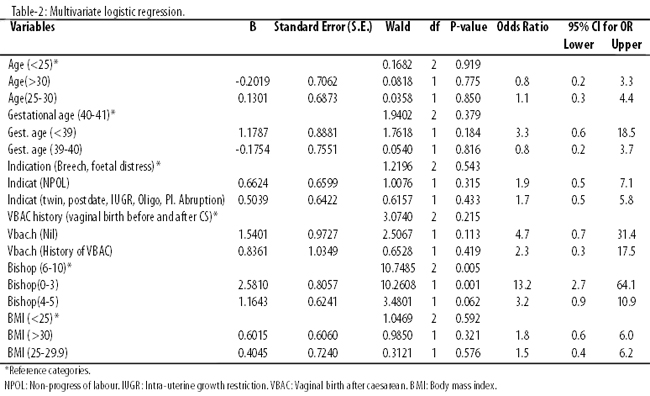
Jointly, all these variables were statistically insignificant (p >0.05) with respect to the relationship with mode of delivery. Only Bishop score in multivariate logistic regression was seen to have a significant (p <0.05) association with the mode of delivery. Women having Bishop score of 0-3 had 13 times less chance of VBAC (OR=13, 95% CI= 2.7 to 64.1, p <0.05) compared with Bishop score of 6-10.
Of the subjects, 67 (67%) women delivered vaginally, while 33 (33%) ended in repeat caesarean delivery. Besides, 55 (55%) women had no history of vaginal delivery either before or after previous CS; 15 (15%) had history of vaginal births both before and after previous caesarean; while 30 (30%) had vaginal delivery only after previous CS.
Total score, which was obtained on the basis of the six variables and analyzed by logistic regression to predict the mode of delivery after induction of labour, was very significant (p <0.05). Women with a total score of 0-3 had 10 times less chances of VBAC (OR=10.1, 95% CI= 1.9 to 52.9, p <0.05) compared to those having score of 10-12. Those having a total score of 4-6 had 4.6 times less chances of VBAC (OR=4.6, 95% CI= 1.1 to 19.7, p <0.05) compared with the reference category of score 10-12. Similarly, patients with a total score of 7-9 had 2.5 times less chance of CS (OR= 2.5, 95% CI= 0.6 to 10.1, p <0.05) compared with patients having score of 10-12 (Table-3).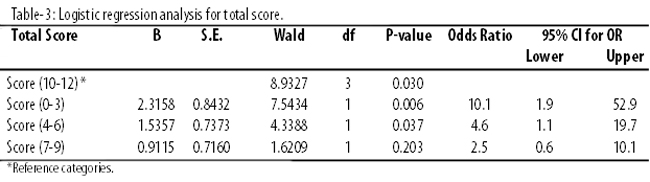
In our study, 22 (22%) women had score between 10-12 at the time of induction of labour; 19 (86.36%) delivered vaginally, while repeat caesarean was done in 3 (13.63%) of them. Besides, 39 women had score 7-9 at induction; 28 (71%) of them had VBAC. When induction was done at score of 4-6 and 0-3, successful VBAC resulted in 58% (15 patients) and 38% (5 patients) respectively.
Discussion
There is, at present, no validated method that allows antepartum assessment of the risks of emergency CS after induction of labour, and counselling of women is, at best, semi-quantitative. The present study, aimed at providing a model that classifies patients as being at low or high risk of emergency CS, on the basis of additive scoring system.
A number of researchers have attempted to develop clinical decision rules to predict the likelihood of successful trial of labour after a previous CS that went into spontaneous labour.10 Since these decision rules were not applicable in induced VBAC, we validated six variables to make the basis of our unit protocol for the prediction of a successful VBAC.
The univariate logistic regression shows the significance of each of our variables. Increasing maternal age directly correlated with the risk of emergency CS, which was also noted by an earlier study,3 but another study noted that maternal age (odds ratio 0.9) had no bearing on vaginal delivery success rates.11 The latter study, however, was on spontaneous VBAC.11
Gestational age was another important clinical variable, which independently affected the mode of delivery after induction labour. Gestational age of our patients showed a significant association with the success rate of VBAC. An earlier study also observed that chances of repeat caesarean delivery were more when gestation age was either <37 or >41 weeks.12
Another variable the indication of previous caesarean delivery. NPOL had 3.1 times less chance of VBAC compared with indication of breech and foetal distress. Similar findings were reported by a study which focused on spontaneous VBAC.13 Vaginal birth either before or after previous caesarean delivery was another favourable factor noted in our study. It also increased the chances of non-induced VBAC.14 In univariate logistic regression analysis, it was seen that the history of VBAC was not significantly associated with the mode of delivery, previously considered a favourable factor.15 It was observed that women with history of vaginal birth before or after caesarean delivery were comparatively older than those without a VBAC history, and so the increasing age also resulted in the failure of induced VBAC. If there was vaginal delivery both before and after caesarean, then the likelihood of successful induction increased, provided the maternal age was controlled.
Both univariate and multivariate analysis of data showed that the Bishop score was the most important factor of successful VBAC. Similar observation was made by a study which noted that Bishop score of 5 or less was a predominant risk factor for a repeat caesarean delivery.16 Although the overall chance of successful VBAC is greater in women with a prior vaginal birth, these women as well as those without a prior vaginal birth have a decreased chance of a successful VBAC after induction of labour if initiated with an unfavourable cervix.
Univariate logistic regression analysis of our study showed significant association of BMI with induced VBAC. The relationship of BMI and chances of successful induced VBAC in our population correlated with that observed by an earlier study.17 BMI correlates with outcomes in trial of labour after previous caesarean delivery; increased BMI is associated with greater composite morbidity and neonatal injury.18
Total score was obtained on the basis of addition of scores of our six variables and was analysed by logistic regression to predict the mode of delivery i.e. repeat caesarian section or VBAC. Patients having lower score had more chances of CS. Previous one caesarean patients with a score of 7 or more should be given the option to undergo induction of labour with intravaginal E2 gel.
Conclusion
The scoring system devised by the study for induction of labour in previous one caesarean looks simple and practical. There is emerging evidence of serious foeto-maternal adverse effects of multiple caesareans. The admission scoring system is useful in counselling patients regarding the option of induction of labour or repeat caesarean delivery. However, further studies on a larger scale are needed to establish its statistical significance.
References
1. Declercq E, Young R, Cabral H, Ecker J. Is a rising caesarean delivery rate inevitable? trends in industrialized countries, 1987 to 2007. Birth 2011; 38: 99-104.
2. McMahon MJ, Luther ER, Bowes WA Jr, Olshan AF. Comparison of trial of labor with elective second caesarean section. N Engl J Med 1996; 335: 689-95.
3. Smith GC, Pell JP, Cameron AD, Dobbie R. Risk of perinatal death associated with labor after previous caesarean delivery in uncomplicated term pregnancies. JAMA 2002; 287: 2684-90.
4. Macones GA, Peipert J, Nelson DB, Odibo A, Stevens EJ, Stamilio DM, et al. Maternal complications with vaginal birth after caesarean delivery: a multicenter study. Am J Obstet Gynecol 2005; 193; 1656-62.
5. Catling-Paull C, Johnston R, Ryan C, Foureur MJ, Homer CS. Clinical interventions that increase the uptake and success of vaginal birth after caesarean section: a systematic review. J Adv Nurs 2011; 67: 1646-61.
6. Hendler I, Bujold E. Effect of prior vaginal delivery or prior vaginal birth after caesarean delivery on obstetric outcomes in women undergoing trial of labor. Obstet Gynecol 2004; 104: 273-7.
7. Mansoor M, Kashif S, Tariq R. To evaluate factors for successful outcome in VBAC. Pak J Med Health Sci 2010; 4: 322-5.
8. Ebell MH. Predicting the likelihood of successful vaginal birth after caesarean delivery. Am Fam Physician 2007; 76: 1192-4.
9. Dodd JM, Crowther CA, Hiller JE, Haslam RR, Robinson JS. Birth after caesarean study - planned vaginal birth or planned elective repeat caesarean for women at term with a single previous caesarean birth: protocol for a patient preference study and randomised trial. BMC Pregnancy Childbirth 2007; 7: 17. doi:10.1186/1471-2393-7-17.
10. Flamm BL, Geiger AM. Vaginal birth after caesarean delivery: an admission scoring system. Obstet Gynecol 1997; 90: 907-10.
11. Weinstein D, Benshushan A, Tanos V, Zilberstein R, Rojansky N. Predictive score for vaginal birth after caesarean section. Am J Obstet Gynecol 1996; 174: 192-8.
12. Landon MB, Hauth JC, Leveno KJ, Spong CY, Leindecker S, Varner MW, et al. Maternal and perinatal outcomes associated with a trial of labor after prior caesarean delivery. N Engl J Med 2004; 351: 2581-9.
13. Dinsmoor MJ, Brock EL. Predicting failed trial of labor after primary caesarean delivery. Obstet Gynecol 2004; 103: 282-6.
14. Gonen R, Tamir A, Degani S, Ohel G. Variables associated with successful vaginal birth after one caesarean section: a proposed vaginal birth after caesarean section score. Am J Perinatol 2004; 21: 447-53.
15. Landon MB, Leindecker S, Spongy CY, Hauth JC, Bloom S, Vamer MW et al. The MFMU Caesarean Registry: factors affecting the success of trial of labor after previous caesarean delivery. Am J Obstet Gynecol 2005; 193: 1016-23.
16. Vrouenraets FP, Roumen FJ, Dehing CJ, van den Akker ES, Aarts MJ, Scheve EJ. Bishop score and risk of caesarean delivery after induction of labor in nulliparous women. Obstet Gynecol 2005; 105: 690-7.
17. Costantine MM, Fox K, Byers BD, Mateus J, Ghulmiyyah LM, Blackwell S, et al. Validation of the prediction model for success of vaginal birth after caesarean delivery. Obstet Gynecol 2009; 114: 1029-33.
18. Hibbard JU, Gilbert S, Landon MB, Hauth JC, Leveno KJ, Spong CY, et al. Trial of labor or repeat caesarean delivery in women with morbid obesity and previous caesarean delivery. Obstet Gynecol 2006; 108: 125-33.
Journal of the Pakistan Medical Association has agreed to receive and publish manuscripts in accordance with the principles of the following committees:


