

Asher Fawwad ( Research Department, Baqai Institute of Diabetology and Endocrinology, Baqai Medical University, Karachi. )
Syed Faraz Danish Alvi ( Research Department, Baqai Institute of Diabetology and Endocrinology, Baqai Medical University, Karachi. )
Abdul Basit ( Department of Medicine, Baqai Institute of Diabetology and Endocrinology, Baqai Medical University, Karachi. )
Khursheed Ahmed ( Primary Health Unit, Hub, Baluchistan. )
Muhammad Yakoob Ahmedani ( Department of Medicine, Baqai Institute of Diabetology and Endocrinology, Baqai Medical University, Karachi. )
Rubina Hakeem ( Research Department, Baqai Institute of Diabetology and Endocrinology, Baqai Medical University, Karachi. )
September 2013, Volume 63, Issue 9
Original Article
Changing pattern in the risk factors for diabetes in young adults from the rural area of Baluchistan

Abstract
Objective: To observe changing pattern in the risk factors for diabetes as overweight, obesity, smoking, hypertension and family history of diabetes in young adults in the rural area of Baluchistan.
Methods: A community based observational study was carried out in the rural area of Baluchistan by conducting two surveys, in the years 2002 and 2009 respectively. The survey was further subdivided into two groups i.e. young adults (15-25 years) and adults (>25 years). In this study, data of young adults was analyzed. Data obtained in 2002 was also analyzed according to the current guidelines and compared with 2009 survey.
Results: A total of 230 and 197 young adults participated in 2002 and 2009 surveys respectively. Obesity increased significantly (p <0.001) from 20 (10.15%) young adults in the year 2002 to 64 (27.82%) in 2009. Similarly 15 (7.61%) young adults were overweight in 2002 which increased to 24 (10.43%) in 2009 (p <0.317). Smoking increased from 8 (4.06%) to 49 (21.3%) in 2009 (p <0.001). Family history of diabetes mellitus also showed a significant increase (p <0.005). Hypertension increased from 13 (6.6%) young adults in 2002 survey to 17 (7.39%) in 2009, the increase was not statistically significant (p <0.749).
Conclusion: The present study showed that risk factors for diabetes such as overweight, obesity, smoking, hypertension and family history of diabetes increased over time in the young adults of rural Baluchistan.
Keywords: Obesity, Young adults, Diabetes. (JPMA 63: 1089; 2013).
Introduction
The prevalence of chronic diseases is increasing worldwide, with 60% of the global burden to be contributed by the developing countries.1 In the year 2011, 366 million people with diabetes were estimated globally which is anticipated to rise to 552 million by 2030.2 An upsurge in the cases of diabetes globally is mainly due to the rising prevalence of risk factors like age, ethnicity, overweight, obesity, physical inactivity and family history of diabetes.3
More than 1.1 billion adults worldwide are overweight and 312 million of them are obese.4 Furthermore, 115 million people suffer from obesity related problems in developing countries.5 A study analyzing the data from the National Health Survey of Pakistan (NHS 1990-1994) showed that the prevalence of overweight adults was 25.0% (BMI >23kg/m2), whereas 15.7% were found to be obese (BMI >25kg/m2).6 Similarly, a study conducted in adults (>25 years) in the rural area of Baluchistan (year 2002), also demonstrated that 16% of the population was obese.7
In a study in US in 18-24 years age group, it was observed that 26.1% of the subjects were overweight, and 13.6% were obese.8 Similarly, another study suggested that there was a significant increase in the incidence of obesity from 10.9% at 18 years of age to 22.1% at young adulthood over a transition period of 5 years.9 The NHS (1990-1994) showed that 1% of the population was obese, while 5% overweight in 15-24 years age group in Pakistan.10
Both genetic and environmental factors seem to contribute to obesity; however, the major precipitating factor is environmental, mostly related to sedentary lifestyle resulting in energy conservation as body fat.11 Several studies have suggested that being overweight or obese at a young age increases the risk of adulthood obesity and it has been proven that persistence of obesity in adulthood is a significant risk factor for chronic conditions like dysglycaemia, dyslipidaemia, hypertension, and metabolic syndrome.12
Hence, young adulthood is probably the most opportune period for intervention in order to prevent chronic diseases, including diabetes.13 In order to develop and target preventive efforts for young adults at risk of obesity and consequently diabetes, we must identify the risk factors. Many studies examined risk for diabetes in adults, but few focused specifically on young adults.
To our knowledge none of the studies in Pakistan observed risk factors for diabetes in young adults at the same geographical location over a period of time. Therefore, aim of the study was to observe changing pattern in the risk factors for diabetes such as overweight, obesity, smoking, hypertension and family history of diabetes in young adults aged 15-25 years, in the rural area of Baluchistan.
Subjects and Methods
A community based observational study was carried out over a period of one year from February 2009 to February 2010 in the rural area of Baluchistan province of Pakistan. The data obtained in 2009 survey was compared to a similar survey conducted in 2002 at the same location. The survey was further subdivided into two groups i.e. young adults (15-25 years) and adults (>25 years). The findings of the adult survey (>25 years) and the details of methodology have been reported previously.14 In this study, data of young adults was analyzed. Data obtained in 2002 was also analyzed according to the current guidelines.
Ethical approval for the study was taken from Institutional Review Board (IRB) of Baqai Institute of Diabetology and Endocrinology. All male and female young adults, aged 15-25 years, who gave informed consent were considered eligible to participate and informed about the purpose of the study. Team for the surveys composed of doctors, lady health workers, lab technicians and paramedical staff. All the selected participants were advised to come to a specified location after an overnight fast of 8-14 hours. After registration, a fasting blood sample was drawn. Details of demography, anthropometry smoking and family history of diabetes of the study participants were recorded on a proforma by doctors.
Anthropometric measurement for height and weight was taken by paramedical staff. Weight was taken by a digital bathroom scale placed on a flat surface, to the nearest of 0.1kg with subjects in light clothes and without shoes. Height was recorded to the nearest of 0.1cm, while subjects standing in erect posture vertically touching the occiput, back, hip and heels on the wall.
Body mass index (BMI) was calculated as weight in kg/ height in m2. BMI 23-24.9kg/m2 and >25kg/m2 were classified as overweight and obesity respectively.15
Blood pressure was measured with mercury sphygmomanometer. Individuals were requested to take 10 minutes rest at a sitting position before measuring blood pressure to reduce variation of blood pressure value with resting values. Hypertension was defined as blood pressure >130/85 mmHg.16 Hypertensives also included subjects with known hypertension who were already on antihypertensive medications prescribed by a doctor.
Within 1 hour of blood collection, the samples were centrifuged, separated and taken to the laboratory. Fasting blood glucose was performed by the glucose oxidase GOD PAP method.
Statistical Analysis
Data analysis was conducted on Statistical Package for Social Sciences (SPSS), version 13.0. Continuous variables i.e. age, BMI, height, weight, systolic and diastolic blood pressures presented as Mean±SD. Categorical variables like gender, hypertension and family history of diabetes presented in the form of frequency and percentage. Groups were analyzed for statistical difference by univariate general linear model after adjusting for age and sex; risk factors were taken as dependent variables, p<0.05 was considered statistically significant.
Results
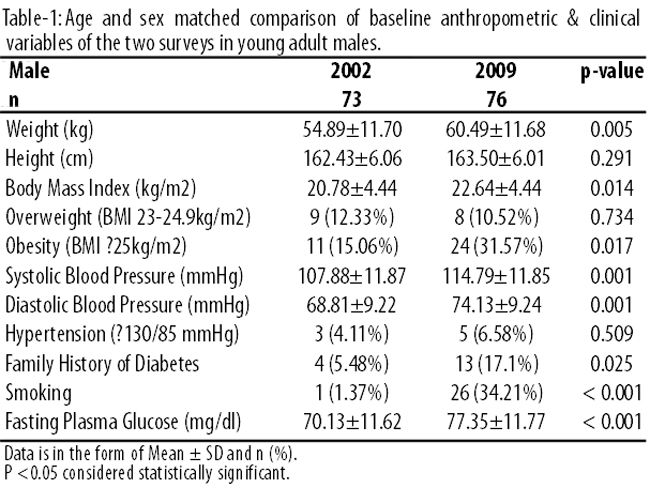
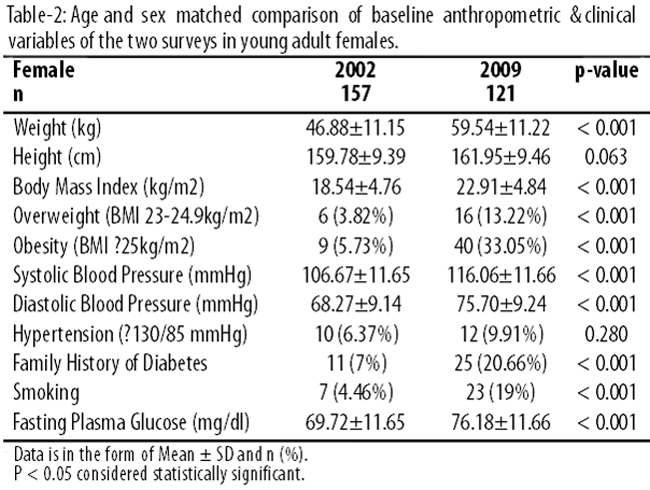
Table-1 and 2 show age and sex matched comparison of baseline anthropometric and clinical variables of the two surveys in young adult male and female subjects respectively. A total of 230 and 197 young adults participated in 2002 and 2009 surveys respectively.
Statistically significant difference (p<0.05) was seen in mean weight, BMI, systolic and diastolic blood pressure and fasting plasma glucose of the young male subjects in the two surveys. In the year 2009, obesity increased significantly (p<0.017) from the previous survey in young adult males. A significant increase in the positive family history of diabetes (p<0.025) and smoking (p <0.001) was also observed in male subjects in 2009 survey (Table-1).
When the 2002 and 2009 surveys were compared in young adult females, statistically significant difference (p<0.05) was seen in mean weight, BMI, systolic and diastolic blood pressure and fasting plasma glucose. Similarly, significant increase was also observed in overweight (p<0.001), obesity (p<0.001), family history of diabetes (p<0.001) and smoking (p<0.001) as shown in Table-2.
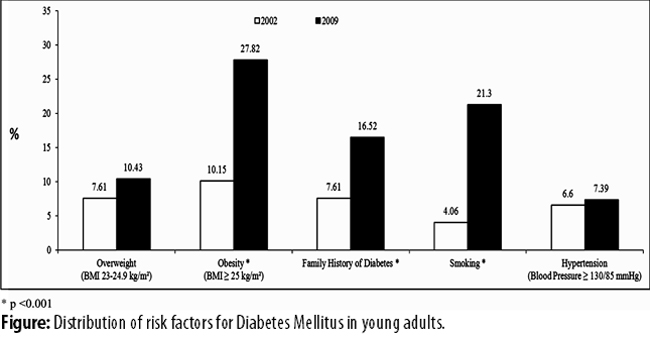
Figure shows distribution of risk factors for diabetes mellitus in young adults. In the year 2002, 15 (7.61%) young adults were overweight which increased to 24 (10.43%) in the year 2009 (p<0.317). Obesity increased significantly (p<0.001) in the year 2009. Similarly, smoking increased significantly (p<0.001) in the 2009 survey. Family history of diabetes mellitus also showed a significant increase (p<0.005). Although hypertension increased from 13 (6.6%) young adults in 2002 survey to 17 (7.39%) in 2009, the increase was not statistically significant (p<0.749).
Discussion
A comparison of the two surveys showed that obesity, family history of diabetes and smoking increased significantly in young adults in the rural area of Baluchistan over a study period of seven years.
Obesity increased nearly threefold in the young population (aged 15-25 years) in our study. Similar findings were observed in adults (>25 years) at the same geographical location, where mean BMI increased significantly (p<0.001) from 20.78±5.07kg/m2 in the year 2002 to 25.42±5.89kg/m2 in the year 2009. The rise in the prevalence of obesity was the main contributing factor to significant increase (p<0.001) in the prevalence of diabetes from 7.2% (2002) to 14.2% (2009) in the rural area of Baluchistan.14 Our study findings project an increasing burden of obesity in young adults in the rural areas and hence the risk it poses for the prevalence of chronic conditions including diabetes.
A study from Pakistan showed that overweight or obesity was less in the rural compared to the urban areas. This may be due to increased physical activity and less sedentary life style in rural community compared to their urban counterparts.17 Studies are needed in young adults in the urban areas of Pakistan, where increasing burden of obesity and other risk factors of diabetes are anticipated as a result of sedentary life style.
Studies have also demonstrated that young adulthood is associated with an average weight gain of 1-2lb per year, the largest gains are observed in the early to mid-twenties, particularly overweight individuals are at an increased risk.18 In a study in China, it was observed that the prevalence of overweight and obesity (BMI >25kg/m2) increased by 49.3% among adults aged 18 years or older over a period of ten years.19 Hence, young adulthood is the most opportune period for public health awareness campaigns and to target interventions as weight gain and obesity during young adulthood is associated with increased cardiovascular risk and diabetes later in life.18
In our study family history of diabetes increased significantly over a period of seven years. Studies have demonstrated that overweight individuals with one or both biological parents with diabetes are at an increased risk of developing diabetes in adulthood.20 Although family history is a non-modifiable risk factor for diabetes, it can be used for risk stratification, targeting interventions, and positively influencing health behaviours in young adults.21
Hypertension is commonly associated with diabetes.22 Findings of a study indicated that the risk of developing diabetes was 2.4 fold greater in hypertensive individuals as compared to the normotensives.23 Systolic and diastolic blood pressures increased significantly in both male and female young adults in our study, but interestingly hypertension did not show a significant increase. However, an increase in mean systolic and diastolic blood pressures increases the risk of developing hypertension in the young adult population of rural Baluchistan in later life.
We also found a higher proportion of young adults (21.3%) were cigarette smokers in 2009 survey which increased significantly from the year 2002. The association of smoking with type 2 diabetes is not fully understood. However, it is suggested that smoking may cause insulin resistance in peripheral tissues.24 Number of cigarettes smoked per day increases the risk of type 2 diabetes in a dose dependent manner.24 Smoking is a modifiable health risk behaviour and is generally established during adolescence and young adulthood.25 Therefore, behavioural modification strategies should be planned specifically targeting young adults to counteract this mounting problem.
Our study has some limitations; we did not observe changes in the lifestyle of the young adult population of rural Baluchistan over a period of seven years, including changes in the dietary habits as well as physical activity levels.
Conclusion
The present study showed that risk factors for diabetes such as overweight, obesity, smoking, hypertension and family history of diabetes increased in the young adults of rural Baluchistan.
Acknowledgement
We acknowledge the support of Merck Marker (Pvt) Ltd. for this survey. We would also like to appreciate the hard work and dedicated commitment of lady health workers and paramedical staff from Hub Baluchistan and also acknowledge the support of Mr. Bilal Tahir (Research Coordinator) and Ms. Fariha Shaheen (Statistician), Research Department of Baqai Institute of Diabetology and Endocrinology in data entry and analysis.
Conflict of Interest
The authors have no conflict of interest.
References
1. Murray CJL, Lopez AD (eds.). The Global Burden of Disease. Boston: Harvard School of Public Health; 1996.
2. International Diabetes Federation. IDF Diabetes Atlas. 5th ed. Brussels, Belgium: International Diabetes Federation; 2011.
3. Rewers M, Hamman RF. Risk factors for non-insulin-dependent diabetes. In: National Diabetes Data Group (eds.). Diabetes in America. 2nd ed. Bethesda, MD: National Institutes of Health; 1995; pp 179-220.
4. Haslam DW, James WP. Obesity. Lancet 2005; 366: 1197-209.
5. World Health Organization. Controlling the Global Obesity Epidemic. (Online) (Cited 2012 February) Available from URL: http://www.who.int/nutrition/topics/obesity/en/index.html.
6. Jafar TH, Chaturvedi N, Pappas G. Prevalence of overweight and obesity and their association with hypertension and diabetes mellitus in an Indo-Asian population. CMAJ 2006; 175: 1071-7.
7. Basit A, Hydrie MZI, Ahmed K, Hakeem R. Prevalence of diabetes, impaired fasting glucose and associated risk factors in a rural area of Baluchistan province according to new ADA criteria. J Pak Med Assoc 2002; 52: 357-60.
8. McCracken M, Jiles R, Blanck HM. Health Behaviors of the Young Adult U.S. Population: Behavioral Risk Factor Surveillance System 2003. Prev Chronic Dis 2007; 4: A25.
9. Gordon-Larsen P, Adair LS, Nelson MC, Popkin BM. Five year obesity incidence in the transition period between adolescence and adulthood: the National Longitudinal Study of Adolescent Health. Am J Clin Nutr 2004, 80: 569-75.
10. National Health Survey of Pakistan 1990-94: Health Profile of the People of Pakistan. Islamabad: PMRC; 1997; pp 181.
11. Misra A, Khurana L. Obesity and the metabolic syndrome in developing countries. J Clin Endocrinol Metab 2008; 93(Suppl 1): S9-30.
12. Janssen I, Katzmarzyk PT, Srinivasan SR, Chen W, Malina RM, Bouchard C, et al. Utility of childhood BMI in the prediction of adulthood disease: comparison of national and international references. Obes Res 2005; 13: 1106-15.
13. Ferreira I, Twisk JW, van Mechelen W, Kemper HC, Stehouwer CD. Development of fatness, fitness, and lifestyle from adolescence to the age of 36 years: determinants of the metabolic syndrome in young adults: the Amsterdam growth and health longitudinal study. Arch Intern Med 2005; 165: 42-8.
14. Basit A, Danish Alvi SF, Fawwad A, Ahmed K, Ahmedani MY, Hakeem R. Temporal changes in the prevalence of diabetes, impaired fasting glucose and its associated risk factors in the rural area of Baluchistan. Diabetes Res Clin Pract 2011; 94: 456-62.
15. World Health Organization, Western Pacific Region. The International Association for the Study of Obesity and the International Obesity Task Force. The Asia-Pacific perspective: redefining obesity and its treatment. Sydney, Australia: Health Communications Australia Pty Limited; 2000. (Online) (Cited 2012 February). Available from URL: http://www.wpro.who.int/internet/resources.ashx/NUT/Redefining+obesity.pdf.
16. Anoop M, Jasjeet SW, Ravinder MP. An evaluation of candidate definitions of the metabolic syndrome in adult Asian Indians. Diabetes Care 2005; 28: 398-403.
17. Nisar N, Khan IA, Qudri MH, Sher SA. Knowledge and risk assessment of diabetes mellitus at primary care level: A preventive approach required combating the disease is developing country. Pak J Med Sci 2008; 24: 667-72.
18. Truesdale KP, Stevens J, Lewis CE, Schreiner PJ, Loria CM, Cai J. Changes in risk factors for cardiovascular disease by baseline weight status in young adults who maintain or gain weight over 15 years: the CARDIA study. Int J Obes (Lond) 2006; 30: 1397-407.
19. Wang Y, Mi J, Shan XY, Wang QJ, Ge KY. Is China facing an obesity epidemic and the consequences? The trends in obesity and chronic disease in China. Int J Obes (London) 2007; 31: 177-88.
20. Morris RD, Rimm DL, Hartz AJ, Kalkhoff RK, Rimm AA. Obesity and heredity in the etiology of non-insulin-dependent diabetes mellitus in 32,662 adult white women. Am J Epidemiol 1989; 130: 112-21.
21. Harrison TA, Hindorff LA, Kim H, Wines RC, Bowen DJ, McGrath BB, et al. Family history of diabetes as a potential public health tool. Am J Prev Med 2003; 24: 152-9.
22. Mancia G. The association of hypertension and diabetes: prevalence, cardiovascular risk and protection by blood pressure reduction. Acta Diabetol 2005; 42 (Suppl 1): S17-S25.
23. Gress TW, Nieto FJ, Shahar E, Wofford MR, Brancati FL. Hypertension and antihypertensive therapy as risk factors for type 2 diabetes mellitus. Atherosclerosis Risk in Communities Study. N Engl J Med 342: 905-12.
24. Nakanishi N, Nakamura K, Matsuo Y, Suzuki K, Tatara K. Cigarette smoking and risk for impaired fasting glucose and type 2 diabetes in middle-aged Japanese men. Ann Intern Med 2000; 133: 183-91.
25. Allan JD. Identification of health risks in a young adult population. J Community Health Nurs 1987; 4: 223-33.
Journal of the Pakistan Medical Association has agreed to receive and publish manuscripts in accordance with the principles of the following committees:


