

Huma Qureshi ( Pakistan Medical Research Council, Islamabad. )
Syed Ejaz Alam ( PMRC Research Centre, Jinnah Postgraduate Medical Centre, Karachi. )
Muhammad Ayaz Mustufa ( NICH, Karachi. )
Nasreen Khalid Nomani ( Biological Production Division, National Institute of Health, Islamabad. )
Jawahar Lal Asnani ( Civil Hospital Mithi,Sindh. )
Muhammad Sharif ( Civil Hospital Umar Kot, Sindh. )
September 2013, Volume 63, Issue 9
Original Article

Abstract
Objectives: To compare the efficacy, safety and cost of Pakistani anti-snake venom with that imported from India
Methods: The comparative cross-sectional study was conducted from June to September 2010 and comprised patients hospitalised following Krait snake bite in Mithi and Umerkot hospitals of Tharparker district who had incoagulable blood test on admission (20-minute whole blood clotting time). Basic demographies of patients, the site of bite and swelling around the bite and joints were entered in a proforma. For blinding, the liquid anti-snake venoms were packed in opaque polythene bags and marked as \'A\' and \'B\', and refrigerated. Four ampoules of the venom were mixed in a drip and given over one hour while looking for adverse reactions. In case of milder reactions, the venom was temporarily stopped and anti-histamines and analgesics were given. For more severe reactions intra-muscular adrenaline was recommended. Coagulation was again checked after 6 hours and, if blood was still incoagulable, the dose of the venom was repeated after 6 hours. Once coagulation was confirmed on two occasions, the patient was discharged. Total doses of the venom given to achieve coagulation, the reactions and the cost of the venom were analysed at the end to see the response and cost-effectiveness.
Results: Of the 80 cases - 40 (50%) from each hospital - 6 (7.5%) had to be excluded for lack of data. Out of the remaining 74 (92.5%) patients, 38 (52.35%) received Pakistani anti-snake venom (A), and 36 (48.64%) received Indian anti-snake venom (B). Immediate reaction to the venom was seen in 23 (60.5%) cases with \'A\' and 25 (69.4%) with \'B\'. In terms of evenomation, 23 (60.5%) cases with \'A\' attained restoration of coagulation with the first dose, compared to 13 (36.11%) with \'B\', showing a significantly better response with \'A\' (p <0.035). Mean of 1.66 doses of \'A\' and 1.94 of \'B\' were used to neutralise venom, again showing lesser doses of Pakistani anti-snake venom. Cost-wise \'A\' was 2.5 times cheaper than the imported \'B\'.
Conclusion: Pakistani anti-snake venom was significantly quicker and better as well as cheaper than the Indian anti-snake venom.
Keywords: Anti-snake venom, Pakistan, India. (JPMA 63: 1129; 2013).
Introduction
Snake bites are common in interior of Sindh all the year round, but are increased manifold during the rainy season and floods.1 Rural population and agricultural workers are most at risk.1,2 Following snake bite, the venom predominantly produces either neurotoxic symptoms or cytolysis. Neurotoxins lead to respiratory paralysis and death if not managed promptly, while cytolytic venom causes tissue necrosis and bleeding due to damage to the vascular endothelial lining.3
After a snake bite when patients come to hospital, the standard operating procedure is admission and evaluation for blood coagulation using 20-minute whole blood clotting (20MWBC) technique along with checking for neurotoxic symptoms. If the blood coagulates, no anti-venom is required and test is repeated every 30 minutes for 3 hours and then hourly for another 3 hours before the patient is discharged. If blood fails to clot, it means that the venom has disrupted the coagulation mechanism and in such cases anti-snake venom (ASV) is injected intravenously and coagulation checked after 6 hours. The dose of ASV is repeated if the blood still fails to coagulate and the procedure is repeated every 6 hours.4
ASV produced in one country from its own indigenous snakes often do not work as effectively when used in other countries due to differences in snake varieties within the same species. In India, the ASV is produced from the snakes of Tamil Nadu, while in Pakistan it is produced from snakes of Sindh desert.5 ASVs are imported in Pakistan from India as our indigenous production is low. In Pakistan, the National Institute of Health (NIH) is the only authorised site to produce ASV. The present study was planned to compare the efficacy and safety of Indian and Pakistani ASVs regarding the dose required to restore coagulation, side effects and the cost.
Patients and Methods
The comparative, double-blind cross-sectional study was conducted in two public-sector hospitals of Mirpur Khas i.e. Civil Hospital Mithi and Civil Hospital Umerkot, from June to September 2010. Both ASVs were in liquid form to ease the blinding. Doctors and nurses in both the hospitals were trained for a day on the selection of cases, 20MWBC test, the dose, the use of ASV and the use of adrenaline and anti-histamines following a standard protocol. Special forms were prepared for each patient where required information was fed by the staff once the patient was inducted. Monitoring of the trial was done by the Pakistan Medical Research Council (PMRC). All efforts were made to standardise the treatment protocol once the patient came to the hospital, while history of management at home was taken from the attendants or the patients. Any use of antibiotics or other drugs before arrival to hospital was also noted down.
To blind the treating physicians about the origin of ASVs, the liquid form of ASVs were packed as 4 ampoules in identical simple opaque polythene bags and marked as \'A\' and \'B\' and stored in the fridge of the respective hospitals under care of the store supervisor. The doctors and the store supervisor were blind about the code of ASVs and were told to follow simple random selection where one patient received drug \'A\' and other drug \'B\'. Both hospitals followed the same random selection procedure.
All adult patients who came with a snake bite to the two hospitals for admission and who consented for the study were included. Only those cases that showed incoagulable blood on admission were inducted in the trial, while strictly following the exclusion criteria that comprised pregnant cases, children, cobra bite and those with coagulable blood. Demographic parameters, signs and symptoms following the snake bite were entered in a performa. All patients underwent the 20MWBCT test on admission. For that purpose 2ml of whole blood was placed in new, clean, dry glass tube and left to stand for 20 minutes. After 20 minutes, after which the tube was tilted at 30 degrees to see if the blood flowed out. If the blood was fluid and flowed out, it was incoagulable, but if the blood did not flow out and had formed a clot, then it was coagulated.
Cases that showed incoagulable blood received 4 ampoules of ASV in a drip which was given over an hour. The dose of 4 ampoules was calculated keeping the maximum volume of venom that a snake can inject at a time. Following ASV administration, strict observation was maintained for any adverse reaction like anaphylaxis, allergic reaction, soreness or fever. For milder reactions, the ASV was temporarily stopped and anti-histamines and analgesics were given. For more severe reactions, intramuscular adrenaline was recommended. After the first dose of ASV, the 20MWBC test was run again and if still found incoagulable, the ASV was again given in the same dose and 20MWBC test was run again at 6 hours till coagulation was achieved. After achieving coagulation, the test was repeated after 1 and 6 hours and when coagulation was confirmed on two occasions, the patient was recommended for discharge.
Total ASV doses given to achieve coagulation, reactions and the cost were analysed to assess the response and cost-effectiveness.
Data feeding and analysis was done on SPSS version 11.0. Qualitative variables (gender, first aid, bite site, local sign, reaction and type of ASV injection, treatment given, etc.) were represented by frequencies and percentages. Mean ± standard deviation was calculated for quantitative variables (age, duration from time of bite to time of arrival in hospital, dose of ASV and cost in rupees). Student t-test was applied for comparison of quantitative variables between groups and Chi-square/Fisher exact test was used for comparison of qualitative variables between groups. P<0.05 was taken as significant and 95% confidential interval was maintained.
Results
A total of 80 cases of snake bite were treated at two trial sites with 40 at each site. Management at home had comprised tying a bandage above the wound, sucking the venom out and at times application of some local remedy on the bite site. None had taken antibiotics or any allopathic treatment prior to presenting at hospital. Six (7.5%) patients were excluded from the study due to incomplete record and tests, thus making 74 (92.59%) cases eligible for analysis. Of them, 38 (51.35%) received drug \'A\' (Pakistani ASV) and 36 (48.64%) drug \'B\' (Indian ASV). Overall, there were more 57 (77%) males and the mean age was 30±13.2 years. The bite site in 46 (62.2%) cases was lower leg, and in 19 (25.7%) cases it was the lower arm. Overall, swelling crossed one joint in 65 (87.83%) cases, while it crossed 2 joints in 5 (6.75%) cases. Swelling was confined to the bitten segment of limbs in 4 (5.4%) cases.
Following ASV injection, mild drug reactions like urticaria and rash were seen in 4 (10.5%) cases in Pakistani ASV, and 6 (16.7%) in Indian ASV. Severe reactions like fever, chills and bronchospasm were also seen (Table-1)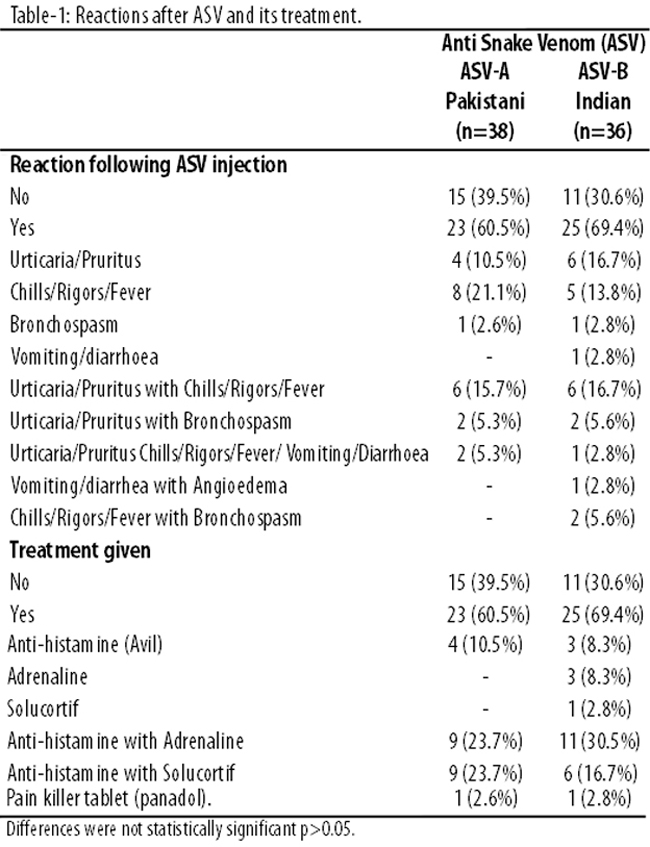
which were managed with adrenaline and steroid injections.
Blood coagulation was achieved with the 1st dose of ASV in 23 (60.5%) cases who received Pakistani ASV, and 13 (36.11%) with Indian ASV; the difference was significant (p<0.05). Mean 1.66/ doses of Pakistani ASV were required to achieve coagulation compared to 1.94 doses of Indian ASV.
The severity of the bite was assessed with the surrounding oedema associated with the bite. In most cases, (n=65; 87.83%) the swelling crossed one joint only, and in this group, the venom was neutralised with the first dose of Pakistani ASV in 22 out of 34 cases (64.7%) in comparison to only 10 out of 31 (32.2%) who got the desired effect with the Indian ASV, showing significantly better response with the former (Table-2).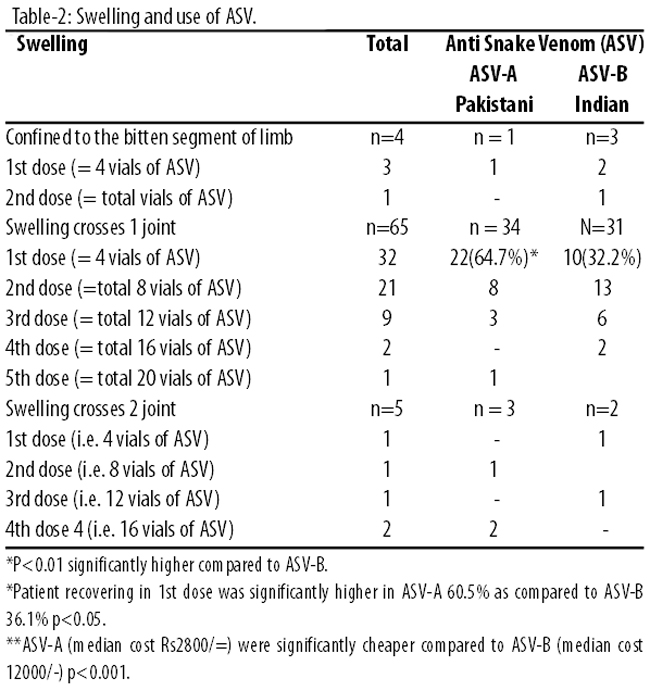
The median cost of Pakistani ASV per vial was Rs700 and with 4 vials per dose it was Rs 2800 per dose. Overall average cost, therefore, was Rs4,642±2866. For Indian ASV, the median cost per vial was Rs1500 and for 4 vials it was Rs6000; the overall average cost being Rs11,667±5352.
The efficacy and cost of total treatment, when compared showed Pakistani ASV to be 2.5 times cheaper and more effective than Indian ASV.
Discussion
Pakistani ASV was compared with Indian ASV in the management of Krait snake bite causing incoagulable blood. The results showed significantly quicker and better results with Pakistani ASV which was also found to be 2.5 times cheaper than the imported Indian ASV.
Physicians always try to look for the snake bite marks to verify the bite and identify the snake, but snake bite marks in some countries have limited use.6,7 Krait often does not leave any bite mark7 and this was also seen in the present study where only a small number of patients had visible snake bite marks on admission. The 20MWBC time is an ideal test in the field setting or at sites where sophisticated labs and trained personnel are not available.4 This was used as the sole test for induction in the protocol and served as a good follow-up test to check the restoration of coagulation.
Pakistani ASV produced at the National Institute of Health (NIH) is polyvalent and is effective against 4 common species i.e. Russles Viper, Common Cobra, Common Krait and Saw Scaled Viper. It is available in liquid form and, therefore, needs proper refrigeration and has a shelf life of 2 years. The Indian ASV is produced from snakes of Tamil Nadu region in the south of India, and it is available both in liquid and powder (lyophilised) form. The powder form is easy to store as it needs to be just kept cool.
Most snake bites in Pakistan produce bleeding or haemolysis, while very few produce neurotoxicity. Proper and prompt management is likely to save many lives with minimal mortality mostly due to late arrival. Many studies from Pakistan have also reported more cases of snake bites producing bleeding problems with very infrequent neurotoxic or myotoxic complications.8-11 Mortality was nil in the present study though some deaths were reported in the previous studies.8-11
A study reported that medical training in snake bite endemic areas is mostly dependent on literature/text books that are written from the West. For physicians practising or dealing with snake bite in the east, this literature is inadequate and produces a gap in the correct management of patients as seen in the studies from Pakistan where 4-5% cases died.12 The inadequacies of the treatment and the non-availability of hospital snake bite kit in Pakistani hospitals has been addressed by local workers.5
The dose of ASV is calculated on the basis of venom injected and a study reported that Russells Viper injects on an average 63mg of venom (range 5-147mg).13 One vial neutralises 6mg of venom, therefore 10-25 vials are required to neutralise the venom, with initial 8-10 vials as the starting dose to neutralise the average amount of venom, and the next dose to tackle the remaining free-flowing venom.6
Anaphylactic reactions to ASV are under-reported.14 Though these reactions occur infrequently, they are well-known, and need to be tackled urgently by stopping ASV and giving anti-histamine and/or steroids. Some prefer 0.5mg of adrenaline intramuscular.15 In the present study, mild and severe reactions were seen with equal frequency in both ASVs and many physicians preferred to use steroids and anti-histamine to settle the reactions. Intramuscular adrenaline was used in 9 cases where Pakistani ASV was used and in 11 where Indian ASV was used. Intramuscular adrenaline is preferred over subcutaneous due to its rapid onset of action.16
The inclusion of adult cases alone and the use of only liquid form of ASV were the limitations of the study. Use of powdered form, which is also imported from India and is used widely in Pakistan, also need to be checked while a low-dose trial may also be done to see if we can still save lives and conserve the ASV.
Conclusion
The present study showed significantly quicker and better results with Pakistani ASV which was 2.5 times cheaper. In Pakistan due to high disease burden and low production, the ASV needs to be used where clearly indicated.
References
1. Mal R. A study of snake bite cases. J Pak Med Assoc 1994; 44: 289.
2. Malik GQ, Memon MS. Snake bite. In: Ilyas M (ed.). Community Medicine. 3rd edition. Karachi: Times Traders; 1993; pp 814-31.
3. Olson KR. Poisioning. In: McPhee SJ, Papadakis M. Current Medical Diagnosis and Treatment 2009. 48th edition. USA: McGraw-Hill Professional; 2009; pp 1413.
4. Simpson ID, Quraishi NA, Qureshi HI. Snakebite Management in Pakistan: A Guide to the Latest Methods of Treatment. Islamabad: Pakistan Medical Research Council; 2008.
5. Quraishi NA, Qureshi H, Simpson ID. A contextual approach to managing snake bites in Pakistan: snake bite treatment with particular reference to neurotoxicity and ideal hospital snake bite kit. J Pak Med Assoc 2008; 58: 325-31.
6. Nishioka Sde A, Silveira PV, Bauab FA. Bite marks are useful for the differential diagnosis of snakebite in Brazil. Wilderness Environ Med 1995; 6: 183-8.
7. Norris RL. Bite marks and the diagnosis of venomous snakebite. Wilderness Environ Med 1995; 6: 159-61.
8. Mahmood K, Naqvi IH, Talib A, Salkeen S, Abbasi B, Akhter T, et al. Clinical course and outcome of snake envenomation at a hospital in Karachi. Singapore Med J 2010; 51: 300-5.
9. Nasir A, Rizvi F, Afzal M, Shafi MS. Presentation and complications of snake bite in a tertiary care hospital. J Coll Phy Surg Pak 2009; 19: 304-7.
10. Zafar J, Aziz S, Hamid B, Qayyum M, Alam T, Qazi RA. Snake bite experience at Pakistan Institute of Medical Sciences. J Pak Med Assoc 1998; 48: 308-10.
11. Suleman MM, Shahab S, Rab MA. Snake bite in Thar District. J Pak Med Assoc 1998; 48: 306-8.
12. Simpson ID. A study of current knowledge base in treating snake bite amongst doctors in the high-risk countries of India and Pakistan: does snake bite treatment training reflect local requirements? Trans R Soc Trop Med Hyg 2008; 102: 1108-14.
13. Pe T, Cho KA. Amount of venom injected by Russell\'s Viper (Vipera russelli). Toxicon 1986; 24: 730-3.
14. McLean-Tooke AP, Bethune CA, Fay AC, Spickett GP. Adrenaline in the treatment of anaphylaxis: what is the evidence? BMJ 2003; 327: 1332-5.
15. Khan B, Naseem A. Guidelines for management of snake bite cases. Pak Armed Forces Med J 2000; 50: 51-5.
16. Simons FE, Gu X, Simons KJ. Epinephrine absorption in adults: intramuscular versus subcutaneous injection. J Allergy Clin Immunol 2001; 108: 871-3.
Journal of the Pakistan Medical Association has agreed to receive and publish manuscripts in accordance with the principles of the following committees:


