

Nida Najmi ( Department of Obstetrics & Gynecology, The Aga Khan University Hospital, Karachi. )
Imtiaz Jehan ( Department of Community Health Sciences, The Aga Khan University Hospital, Karachi. )
Rozina Sikandar ( Department of Obstetrics & Gynecology, The Aga Khan University Hospital, Karachi. )
Nadeem Faiyaz. Zuberi ( Department of Obstetrics & Gynecology, The Aga Khan University Hospital, Karachi. )
September 2013, Volume 63, Issue 9
Original Article

Abstract
Objectives: To determine the prevalence of Group B Streptococcus genital tract infection in pregnant women and to determine the risk factors for its colonisation.
Methods: The cross-sectional study was conducted at the Aga Khan University Hospital, Karachi and Sobhraj Hospital, Karachi, from May to August 2007. Pregnant women at 35-37 weeks gestation attending antenatal clinic at these hospitals constituted the study population. Based on stratified sampling, 405 patients were recruited. High vaginal swabs of these patients were taken in order to calculate the prevalence of infection at each hospital. Logistic regression was used to evaluate the risk factor association. SPSS 11.5 was used for statistical analysis.
Results: The overall prevalence of colonisation was 17% (n=69) (95% CI: 13.4-20.7). Of the 155(38.27%) women at the Aga Khan Hospital, 35(22.6%) were positive, while among the 250 (61.72%) women at Sobhraj Hospital, the prevalence was 13.6% (n=34). The colonisation was found to be significantly associated inversely with the body mass index of the patient (OR 0.91; 95% CI: 0.08-1.0).
Conclusion: Group B Streptococcus screening should be an integral part of antenatal care and should be offered to all pregnant women.
Keywords: Colonisation, Female genital, Group B Streptococcus, Pregnancy, Prenatal care. (JPMA 63: 1103; 2013).
Introduction
Group B Streptococcus (GBS) is one of the leading preventable causes of neonatal morbidity and mortality worldwide. The spectrum of the disease can range from being asymptomatic to pneumonia, meningitis, septicaemia and multi-organ failure in a neonate.12 For surviving neonates, the major long term sequelae are those associated with meningitis which currently occurs in less than 10% of all neonatal GBS cases.3 It is also associated with maternal complications like urinary tract infections, (UTIs), endometritis, chorioamnionitis, meconium stained liquor or even pregnancy loss.4,5 GBS is a natural flora of the ano-rectal region in an adult and may as well colonise the vagina. Intrauterine infection of the foetus occurs due to ascending spread of GBS from the vagina of an asymptomatic woman. Although many infants can become infected during the passage through the birth canal, most of the infants remain asymptomatic after delivery.6
In Pakistan, neonatal sepsis is still the leading cause of neonatal mortality, which may further increase due to prematurity and low birth-weight. Gram-negative organisms are found to be the main cause of neonatal sepsis. However, in two of the studies conducted, there was no incidence of GBS found despite gram-negative sepsis of the neonate.7,8
Prevalence of GBS infection during pregnancy is not known among Pakistani women. The current study was planned to provide a road map for the identification of the exact burden of disease in Pakistani population. This would in turn help in proper implementation of screening methods and subsequent treatment for GBS during labour which will eventually lead to overall decreased neonatal morbidity and mortality secondary to neonatal sepsis. The study was designed to determine the prevalence of genital tract colonisation of GBS in a subset of pregnant women living in Karachi, and to determine the risk factors for maternal GBS colonisation.
Subjects and Methods
The hospital-based cross-sectional study was conducted from May to August 2007 at two tertiary care hospitals in Karachi, Pakistan; Aga Khan University Hospital (AKUH) and Sobhraj Maternity Hospital. The inclusion criteria for the study was pregnant women at 35-37 weeks of gestation who were attending antenatal clinics at these hospitals and consented to participate. Only those women were excluded who did not volunteer for screening.
After obtaining written consent, information was collected from the participating women regarding base-line demographics as well as about their past and current pregnancies. Lower vaginal and rectal swab of the patients were then taken through "Transwab for aerobes and anaerobes" (Medical Wire & Equipment Co. Ltd; Corsham, Wilts, England). The culture was immediately transferred to the inoculation medium and transported to the AKUH laboratory at the end of the day.
The AKUH Ethical Review Committee approved the study protocol. There was no ethical committee at Sobhraj, and therefore, an administrative approval was taken and the administration agreed with the AKUH approval. Patients were given detailed information, including information leaflets, regarding the implications of having a GBS positive culture and the need for the baby to be seen by the paediatrician. The patients were also provided with a copy of their culture results. The results of the GBS cultures were communicated to the relevant doctors so that the patients could be given intrapartum prophylaxis once they came in labour.
Data checking was done for all the forms on a daily basis, and, where required, data editing was done on field. After the data was edited, it was double entered by two operators using a Epi Info version 6. A consistency check of the two data sets was performed using Fox Pro version 6 and discrepancy between them was corrected. To re-validate the data entry, 25 questionnaires were randomly selected using Epi Info version 2002 and re-checked for entry.
It was estimated that a minimum of 300 deliveries occur at the AKUH and 400 deliveries at Sobhraj in a month. We assumed that the prevalence of GBS and the distribution of risk factors were similar in both the hospitals. Based on stratified sampling technique, taking the highest prevalence of GBS as 25% (p), with significance level of 0.05 and bound of error of estimation (B) of 0.03, a sample size of 385 patients was required. Out of these, 154 (40%) patients were to be selected from AKUH and 231(60%) from Sobhraj. The sample size was calculated using Epi Info version 2002. Thirty seven patients from AKUH and 18 patients from Sobhraj Hospital refused participations.
Data analysis was performed using SPSS version 11.5. Proportions of those who were found to be GBS-positive were calculated among the overall study population as well as for each hospital separately. Their 95% Confidence Intervals (CI) were also calculated accordingly. A significant difference was found among the study population of Sobhraj Hospital and AKUH (p <0.019) and, therefore, hospital was taken as a variable in the logistic regression analysis. The frequencies, proportions, mean and standard deviations of base-line demographics were calculated. Proportions of the patients having risk factors were also calculated.
As the colonisation of GBS is known to be associated with certain high-risk factors, a univariate logistic regression analysis was performed on each independent variable. Odds ratio and their 95% CI were computed to evaluate the association with the outcome.
All the variables with p<0.25 in the Univariate analysis and the variables of clinical significance were selected for inclusion in the multivariable logistic regression model. Multivariable analysis was performed using a step-wise model building method to elicit adjusted odds ratio (OR) of the selected independent variables with the outcome variable. If the p value of any independent variable became larger after including it in the model, it was removed from the model after checking for possible confounding and interaction. The confounding effect was assessed by change in the regression co-efficient (at least 15%) of the factors already in the model.
The hospital-based cross-sectional study was conducted from May to August 2007 at two tertiary care hospitals in Karachi, Pakistan; Aga Khan University Hospital (AKUH) and Sobhraj Maternity Hospital. The inclusion criteria for the study was pregnant women at 35-37 weeks of gestation who were attending antenatal clinics at these hospitals and consented to participate. Only those women were excluded who did not volunteer for screening.
After obtaining written consent, information was collected from the participating women regarding base-line demographics as well as about their past and current pregnancies. Lower vaginal and rectal swab of the patients were then taken through "Transwab for aerobes and anaerobes" (Medical Wire & Equipment Co. Ltd; Corsham, Wilts, England). The culture was immediately transferred to the inoculation medium and transported to the AKUH laboratory at the end of the day.
The AKUH Ethical Review Committee approved the study protocol. There was no ethical committee at Sobhraj, and therefore, an administrative approval was taken and the administration agreed with the AKUH approval. Patients were given detailed information, including information leaflets, regarding the implications of having a GBS positive culture and the need for the baby to be seen by the paediatrician. The patients were also provided with a copy of their culture results. The results of the GBS cultures were communicated to the relevant doctors so that the patients could be given intrapartum prophylaxis once they came in labour.
Data checking was done for all the forms on a daily basis, and, where required, data editing was done on field. After the data was edited, it was double entered by two operators using a Epi Info version 6. A consistency check of the two data sets was performed using Fox Pro version 6 and discrepancy between them was corrected. To re-validate the data entry, 25 questionnaires were randomly selected using Epi Info version 2002 and re-checked for entry.
It was estimated that a minimum of 300 deliveries occur at the AKUH and 400 deliveries at Sobhraj in a month. We assumed that the prevalence of GBS and the distribution of risk factors were similar in both the hospitals. Based on stratified sampling technique, taking the highest prevalence of GBS as 25% (p), with significance level of 0.05 and bound of error of estimation (B) of 0.03, a sample size of 385 patients was required. Out of these, 154 (40%) patients were to be selected from AKUH and 231(60%) from Sobhraj. The sample size was calculated using Epi Info version 2002. Thirty seven patients from AKUH and 18 patients from Sobhraj Hospital refused participations.
Data analysis was performed using SPSS version 11.5. Proportions of those who were found to be GBS-positive were calculated among the overall study population as well as for each hospital separately. Their 95% Confidence Intervals (CI) were also calculated accordingly. A significant difference was found among the study population of Sobhraj Hospital and AKUH (p <0.019) and, therefore, hospital was taken as a variable in the logistic regression analysis. The frequencies, proportions, mean and standard deviations of base-line demographics were calculated. Proportions of the patients having risk factors were also calculated.
As the colonisation of GBS is known to be associated with certain high-risk factors, a univariate logistic regression analysis was performed on each independent variable. Odds ratio and their 95% CI were computed to evaluate the association with the outcome.
All the variables with p<0.25 in the Univariate analysis and the variables of clinical significance were selected for inclusion in the multivariable logistic regression model. Multivariable analysis was performed using a step-wise model building method to elicit adjusted odds ratio (OR) of the selected independent variables with the outcome variable. If the p value of any independent variable became larger after including it in the model, it was removed from the model after checking for possible confounding and interaction. The confounding effect was assessed by change in the regression co-efficient (at least 15%) of the factors already in the model.
Results
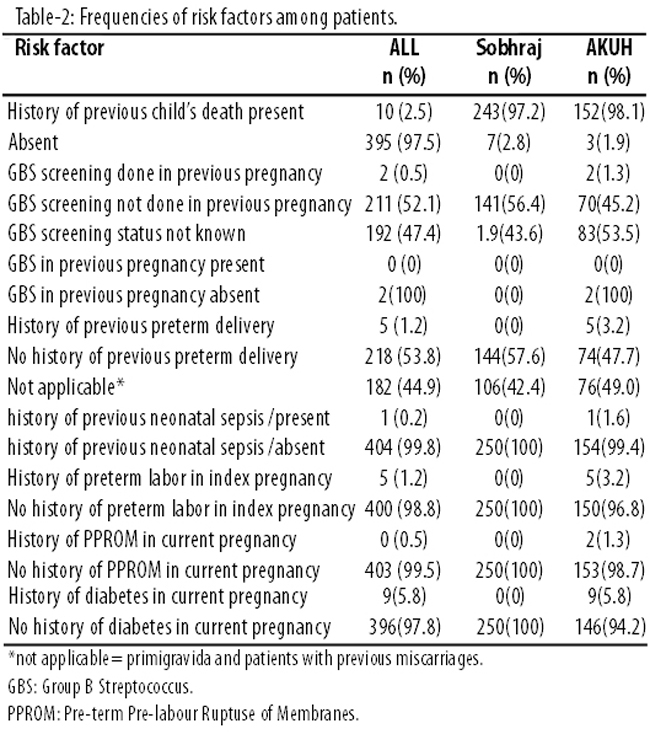
A total of 405 patients were included in the study; 250 (61.72%) from Sobhraj Hospital, and 155 (38.27%) from AKUH. The demographics and the frequency of risk factors among the study population were noted separately (Tables-1 and 2).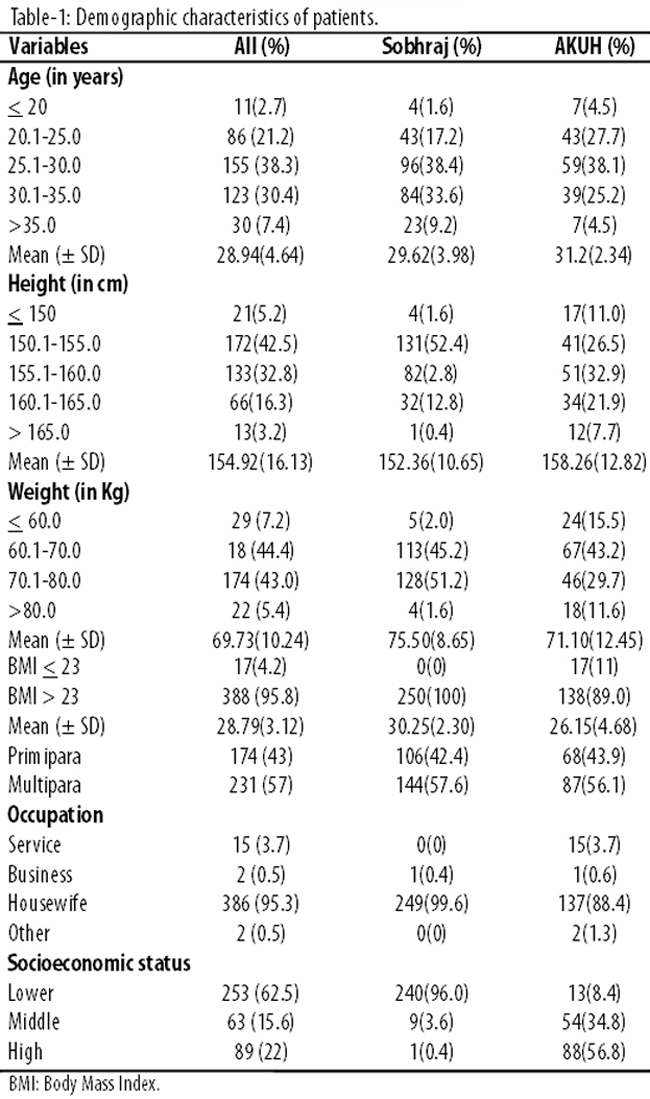
The overall prevalence of GBS colonisation along with their 95% CI was found to be 69 (17%) (13.4-20.7). The prevalence and 95% CI in Sobhraj was 34 (13.6%) (9.4-17.8), while in AKUH it was 35 (22.6%) (16-29.2). A significant difference was found between the prevalence of GBS colonisation between Sobhraj and AKUH (p <0.019) therefore hospital was kept as a variable in logistic regression analysis.
Univariate analysis was performed on all the potential factors associated with GBS colonisation (Table-3).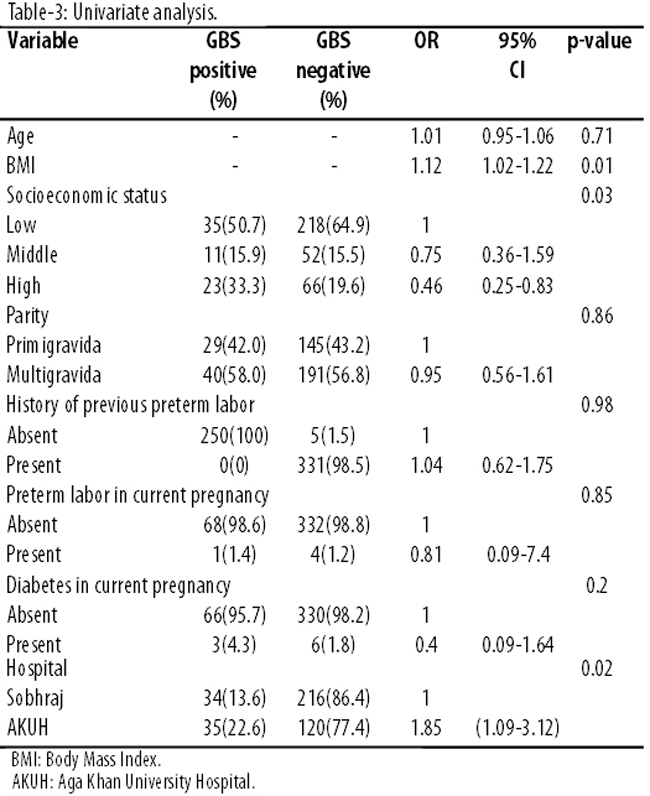
Among the demographic factors, body mass index (BMI) and socioeconomic status were found to be significant; the risk increasing with the higher socioeconomic status (OR 2.17; 95% CI: 1.20-3.93), and decreasing with higher BMI (OR 0.89; 95% CI: 0.82-0.97). All other risk factors were found to be insignificant. Although parity of the patient was not significant at Univariate analysis (OR 0.95; 95%CI: 0.56-1.61), but was kept in the multivariate model due to clinical significance. Since a difference was found among the two hospital prevalence rates, therefore this variable was also kept in the univariate model and was found to be significant (OR 1.85; 95% CI 1.09-3.12). History of GBS screening in previous pregnancy, history of pre-term pre-labour rupture of membrane (PPROM) in current pregnancy and history of previous neonatal sepsis were the factors on which Univariate analysis could not be performed due to few or no positive responses.
Five of the variables selected for multivariate analysis were BMI, hospital, parity, socioeconomic status and current history of diabetes. Interaction and confounding were checked between all the possible biologically significant combinations. There was no interaction found. However, there was a confounding effect of the history of current diabetes and socioeconomic status (Table-4).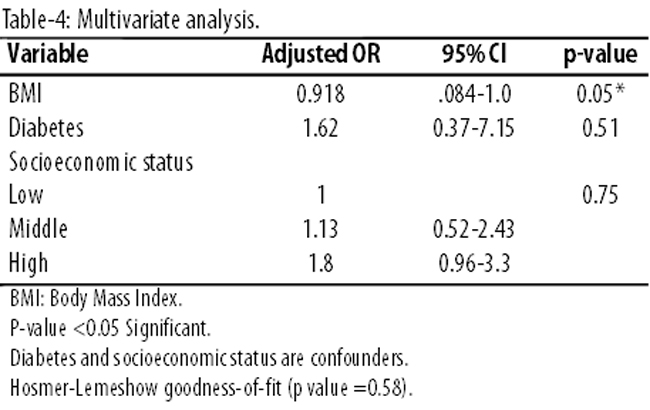
Women with low BMI were more likely to develop GBS colonisation (adjusted OR: 0.91; 95% CI: 0.08-1.0). As the history of diabetes in current pregnancy and socioeconomic status of the patient were found to be confounders, they were kept in the final model. This final model was checked for adequacy by Hosmer-Lemeshow goodness-of-fit (p value=0.58).
Discussion
Although BMI, socioeconomic status of the patient and diabetes in the current pregnancy were significant at Univariate analysis, but socioeconomic status and diabetes in current pregnancy were the confounders and only BMI remained significant at the Multivariate level.
Various risk factors are quoted in the literature. These include history of previous baby with GBS sepsis, GBS bactiuria in current pregnancy, history of previous pre-term labour, history of rupture of membranes etc. Certain other factors are also suggested in literature like diabetes, obesity maternal age etc.9 However, there are studies showing no association of these risk factors with GBS colonization.10 Our study did not show any significant association with other known risk factors like history of previous pre-term delivery and history of previous neonatal sepsis despite having an adequate sample size. Also, analysis could not be performed on other risk factors like history of PPROM in current pregnancy, history of GBS in previous pregnancy and history of previous neonatal sepsis due to absence of these factors in most women. The prevalence of PPROM in the literature is quoted to be 2.3%.11 The prevalence of pre-term labour in the literature is found to be about 6.7%.12
However, in our study the prevalence of PPROM and pre-term labour were much lower then the Western figures (0.5% and 1.2% respectively)11 and so the analysis could not be performed. The reason for lower prevalence of pre-term labour and PPROM in our study could include the fact that we had recruited the patients at 35-37 weeks of gestation. Many of the pre-term babies could be born before achieving this gestation and, hence, such patients were unable to participate in the study.
We had taken the two hospitals in order to have increased recruitment of the study population. We had assumed that the population of the two hospitals would be similar in their prevalence and risk factor distribution. However, we found a difference in the prevalence and risk factor distribution of the two study population. This could be because of the fact that AKUH, being a tertiary care hospital, may get more high-risk population compared to the Sobhraj Hospital.
The strength of our study included an adequate sample size which actually exceeded the required sample size of 385. Also the stratification into two hospitals not only helped recruit more patients, but also increased the diversity of the population and, hence, its generalisability. Within each hospital, we applied systemic sampling so as to substitute for simple random sampling which would otherwise have been better.
A study has quoted the increased chances of having GBS with those who have pre-term birth or premature rupture of membranes.13 Similar results are also shown by another study which has reputed that early onset neonatal sepsis is strongly associated with the presence of GBS-positive culture, pre-term labour and rupture of membranes.14 The finding of our study includes the inability to relate the known risk factors with the presence of GBS colonisation. This could be because of the fact that as we had taken only 35-37-week gestation women, many patients could have been delivered before this gestational age and, hence, could not be screened for GBS. This rationale also explains the decreased prevalence of these risk factors found in our study population compared to the western population. Another explanation could be that these risk factors do not hold true for our population.
One of the weaknesses of our study includes the refusal rate in our patients, especially from the AKUH. This could bring an element of potential selection bias as there is a possibility that many women with known risk factors could have been excluded from the study.
Timely administration of intrapartum antibiotic prophylaxis is important in order to reduce the incidence of neonatal GBS sepsis. One study has shown that the chances of having neonatal GBS disease is decreased if intrapartum antibiotics are administered in early labour compared to near-delivery.15 Similar results are shown in a study conducted in the United States where there was 89% reduction in the incidence of early onset neonatal sepsis with the use of intrapartum antibiotic prophylaxis.16
Conclusion
GBS screening programme should be an integral part of antenatal care in order to decrease neonatal morbidity and mortality.
Acknowledgement
We are grateful to the University Research Council (URC) of AKUH for funding the study.
References
1. Gray KJ, Bennett SL, French N, Phiri AJ, Graham SM. Invasive group B streptococcal infection in infants, Malawi. Emerg Infect Dis 2007; 13: 223-9.
2. Heath PT, Schuchat A. Perinatal group B streptococcal disease. Best Pract Res Clin Obstet Gynaecol 2007; 21: 411-24.
3. Weisman LE, Stoll BJ, Cruess DF, Hall RT, Merenstein GB, Hemming VG, et al. Early-onset group B streptococcal sepsis: a current assessment. J Pediatr 1992; 121: 428-33.
4. Piper JM, Newton ER, Berkus MD, Peairs WA. Meconium: a marker for peripartum infection. Obstet Gynecol 1998; 91: 741-5.
5. Krohn MA, Hillier SL, Baker CJ. Maternal peripartum complications associated with vaginal group B streptococci colonization. J Infect Dis 1999; 179: 1410-5.
6. Zaleznik DF, Rench MA, Hillier S, Krohn MA, Platt R, Lee ML, et al. Invasive disease due to group B Streptococcus in pregnant women and neonates from diverse population groups. Clin Infect Dis 2000; 30: 276-81.
7. Anwer SK, Mustafa S, Pariyani S, Ashraf S, Taufiq KM. Neonatal sepsis: an etiological study. J Pak Med Assoc 2000; 50: 91-4.
8. Waheed M, Laeeq A, Maqbool S. The etiology of neonatal sepsis and patterns of antibiotic resistance. J Coll Physicians Surg Pak 2003; 13: 449-52.
9. Hakansson S, Kallen K. Impact and risk factors for early-onset group B streptococcal morbidity: analysis of a national, population-based cohort in Sweden 1997-2001. BJOG 2006; 113: 1452-8.
10. Jerbi M, Hidar S, Hannachi N, El Moueddeb S, Djebbari H, Boukadida J, et al. Risk factors for group B streptococcal colonization in pregnant women at term: prospective study of 294 cases. Gynecol Obstet Fertil 2007; 35: 312-6.
11. Smith G, Rafuse C, Anand N, Brennan B, Connors G, Crane J, et al. Prevalence, management, and outcomes of preterm prelabour rupture of the membranes of women in Canada. J Obstet Gynaecol Can 2005; 27: 547-53.
12. Tracy SK, Tracy MB, Dean J, Laws P, Sullivan E. Spontaneous preterm birth of liveborn infants in women at low risk in Australia over 10 years: a population-based study. BJOG 2007; 114: 731-5.
13. Adair CE, Kowalsky L, Quon H, Ma D, Stoffman J, McGeer A, et al. Risk factors for early-onset group B streptococcal disease in neonates: a population-based case-control study. CMAJ 2003; 169: 198-203.
14. Benitz WE, Gould JB, Druzin ML. Risk factors for early-onset group B streptococcal sepsis: estimation of odds ratios by critical literature review. Pediatrics 1999; 103: e77.
15. de Cueto M, Sanchez MJ, Sampedro A, Miranda JA, Herruzo AJ, Rosa-Fraile M. Timing of intrapartum ampicillin and prevention of vertical transmission of group B streptococcus. Obstet Gynecol 1998; 91: 112-4.
16. Lin FY, Brenner RA, Johnson YR, Azimi PH, Philips JB 3rd, Regan JA, et al. The effectiveness of risk-based intrapartum chemoprophylaxis for the prevention of early-onset neonatal group B streptococcal disease. Am J Obstet Gynecol 2001; 184: 1204-10.
Journal of the Pakistan Medical Association has agreed to receive and publish manuscripts in accordance with the principles of the following committees:


