

Aliya B. Aziz ( Department of Obstetrics and Gynaecology, Aga Khan University Hospital, Karachi. )
Mehreen Sabib ( Department of Obstetrics and Gynaecology, Aga Khan University Hospital, Karachi. )
Imtiaz A. Malik ( National Cancer Institute, Clifton, Karachi. )
September 1996, Volume 46, Issue 9
Case Reports

Introduction
The incidence of Hereditary Ovarian Cancer Syndromes (HOCS) in the United States and Western Europe is less than 1% of all epithelial ovarian cancers1,2. There are three types of clinical syndromes that come under this heading; breast-ovarian cancer syndrome, site-specific ovarian cancer syndrome and familial cancer syndrome (Lynch syndrome II). Mode of inheritance of these syndromes is autosomal dominant and the risk of developing ovarian cancer in individuals belonging to these families is as high as 50%3. Genetic linkage studies have demonstrated that the gene which predisposes to breast and ovarian cancer (BRCA I) is located on chromosome 17q. BRCAI carriers’ life time risk of getting breast or ovarian cancer approaches 100%4,5. Clinically, these familial cancers are characterized by early age at onset and higher frequency of bilateral involvement. Pathologically, these tumors often tend to be poorly differentiated. This article presents three Pakistani families identified to be affected by HOCS. Importance of detailed family history and pedigree analysis in the identification of these syndromes is discussed alongwith guidelines for surveillance and management of members belonging to these families.
Case Histories
Family 1
The proband (III/40) belonging to family number 1 (Figure 1) is a 46 year female with poorly differentiated ovarian cancer stage fib diagnosed in 1993. She undenvent staging laparotorny and cytoreductive surgery for a pelvic mass. Post-operatively she received six courses ofcisplatinum and cyclophosphamide. She has been regularly followed up and has been in remission till the last follow-up.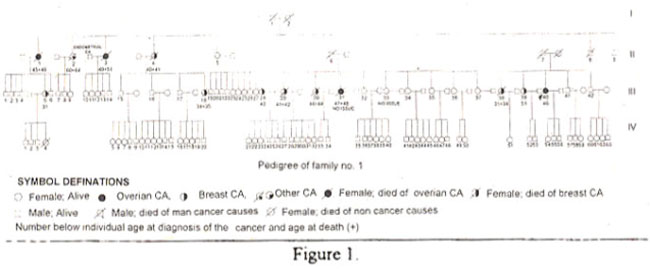
Her family history (Figure 1) revealed two of her elder sisters diagnosed as having breast cancer(III/38, III/39) at 31 and 47 years of age respectively. One of them had already expired. Her detailed family history was taken and pedigree was made including paternal lineage and 2nd and 3rd degree relatives. It reveals that fotlr of her paternal aunts had suffered from some kind of reproductive cancers. Of these, two had ovarian cancer diagnosed at ages of 45 and 49 years respectively (II/I II/3), one had breast cancer diagnosed at the age of 40 years (11/4) and one had endometrial cancer (II/2), Among the siblings of (LI/i and 1114), two have already been diagnosed with breast cancerat the age of3 I and 34 years respectively (III/5,III/18). One of them expired a year after the diagnosis. A paternal uncle (II/6) has four affected siblings, three diagnosed as breast cancer (III/28, III/29, III/30) at 42, 41 and 44 years of age respectively and one as ovarian cancer (III/31) at 47 years. Three of them had already expired. There are several family members at continuing risk of cancer.
Family 2
The proband is a60 yearold female who presented with abdominal pain in May 1992.Ultrasound revealed gallstones and she was scheduled for laparoscopic cholecystectomy. At laparoscopy, nodular masses were observed involving the omentum, small bowel and pelvis. The procedure was abandoned after taking biopsies from these masses. Histopathological examination of biopsy specimen revealed metastatic adenocarcinoma. She underwent hysterectomy, bilateral salpingoophrectorny, ileal resection, partial omentectorn)’ and cholecystectomy in June, 1992. Histopathology confirmed papillary adenocarcinoma of left ovary involving omentum and small bowel stage (IIIC). Post-operatively she received six cycles of carboplatinum and Ifosfamide combination chemotherapy. In February, 1993, she underwent second look laparotorny which was negative and four cycles of intraperitoneal etoposide and carboplatinum were given. She is having regular follow-ups including CA-125 levels which are within normal limits.
Her family history revealed, 10 family members who arc affected by some gynecological malignancy (Figure 2).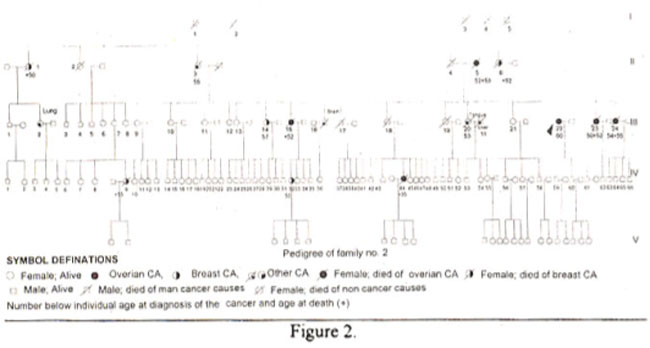
Among her sisters, one has already expired after being diagnosed as a case ofepithelial ovarian cancerat the age of 50 years (111/23). The other sister was receiving chemotherapy for the same problem and later on expired in 1994 (III/24). Her mother also died of the same disease at the age of 52 years (1115). One of her nieces (IV/44) also died of ovarian cancer at the age of 35 years. One of her paternal aunts had breast cancer (II/I)and two paternal cousins have breast (111/14) and ovarian (III/15) cancer respectively. Now in the third generation of the families of her paternal cousins there has already been two cases of breast cancer (IV/9, IV/32) and one has already expired.
Family 3
The proband belonging to this family was 44 years old female who was discovered to have a pelvic mass during a routine gynaecologic examination. She was counseled to undergo this examination because of the strong family history of ovarian cancer (Figure 3).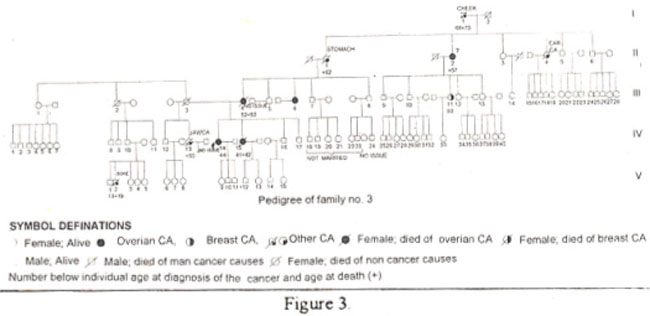
Her elder sister and one of the maternal aunts had been under treatment for this problem.
Herclinical examination and later MRI revealed a 10cm size pelvic mass. Her Ca 125 levels were raised. She underwent staging laparotomy and cytoreductive surgery in April 1993. Histopathology revealed bilateral poorly differentiated endometroid carcinoma of ovary with metastatic seedlings on sigmoid colon and bladder peritoneum (stage IIIC). Post-operatively, she received six cycles of chemotherapy. She was in remission when she died suddenly after a myocardial infarction in 1995.
Her sisteralso died at the age of42 afterbeing diagnosed a year earlier (IV/14) to have ovariancancer. Hermaternal aunt (111/6) expired in 1994. Her detailed family history revealed that her mother (11114) had also died of the same disease and one of the maternal aunts of her mother (II/2) had some sort of intra abdominal malignancy.
Discussion
Hereditary ovarian cancer syndrome(HOCS) requires to be differentiated from ordinary familial ovarian cancers; a terminology used to describe any ovarian cancer patient who has a close relative with the same disease. The former is a small subset of this category in which there is familial clustering of ovarian as well as other cancers such as breast, endometrial or colorectal cancers in a pattern of inheritance consistent with autosomal dominant mode of transnussion. Autosomal dominant mode can be suspected if mother, paternal aunt or approximately half of the sisters are affected by the disease.
The exact genetic risk of acquiring clinical disease is difficult to assess because of variable penetrance and expression of the inherited trait, however, it could be as high as 40-50%. In the absence of reliable biomarkers of acceptable sensitivity and specificity and still evolving knowledge about genetic aberrations, family history is presently the only tool by which these syndromes can be recognized. Hence, a detailed family history, including second and third degree relatives of both maternal as well as paternal lineage could provide a strong basis for recognition of HOCS and evolving plans for surveillance, early detection and management of siblings belonging to these high risk families.
The pedigree analysis in case of family 1 favours a diagnosis of breast ovarian cancer syndrome with a predilection for early age at onset. Detailed pedigree analysis suggests that gene carrier probably is of paternal lineage. The family had many members in the field of medicine and on counselling readily understood the implications of this probable diagnosis for the rest of the family members. This has helped in counselling this extended family residing in many different cities of Pakistan regarding future surveillance. DNA analysis for BRCA-1 and other genes is in progress.
The analysis of family 2 was initially suggestive of site specific ovarian cancer of maternal lineage. Later on, detailed paternal history revealed a clustering of breast as well as ovarian cancer cases in the paternal lineage. This family is still under investigation as more information is gathered about the rest of the family members again scattered in different towns and cities.
The proband in family 3 was diagnosed at quite a later stage of the disease. She would have had a chance of early diagnosis if she was having regular surveillance. Her pedigree is suggestive of site specific ovarian cancer syndrome. She herself motivated other members of the family including her daughters to undergo regular check-up. Currently. all three families are participating in genetic linkage analysis being performed on selected members.. It is hoped that these hereditary cancers can be prevented from progressing to advanced stages by regular surveillance and hence by early diagnosis.
Lvnch et al6 suggested that screening should start by age 30 and should include pelvic examination, ultrasonography, Ca-125 levels and color flow Doppler imaging of the ovarian vascular tree at 6 monthly intervals. We feel the screening strategies may require to be started earlier if any of the family members develops cancer before the age of thirty as in family I. Women whd have completed their families are candidate for prophylactic oophrectorny. This strategy has certainly been helpful. However, subjects should be informed that there is
still a small risk of peritoneal carcinomatosis7. Woman at risk of breast cancer should undergo monthly self-examinations, three monthly breast examination by a physician after the age of 18 ahd should have yearly mammograms after the age of 30. In Lynch II cancer family syndrome in addition to above, colonoscopy and endometrial biopsy is also recommended. In future, results of genetic linkage analysis might help in identifying those at high risk so that targeted screening could be provided to them and the rest of the family members can be reassured. However, further work is required before all genes involved in hereditary transfer can be detected.
Obtaining a reliable family history is not an easy task because of the recall bias and inadequate information about the earlier generations. The fact that morn information is available about the maternal side as females are better informed about their families is also an important factor. Furthermore, obtaining detailed family history is time consuming. Itis also important that historical information obtained should be supplemented by review of medical records whenever possible.
In summary genetic counselling of such families in terms of identification, workup and follow-up is a difficult but important task. Although members of such families are usually highly motivated but it requires administrative setup and professional expertise to provide adequate service to every one involved. The information regarding familial occurrence of cancer and its implications should be disseminated in the lay press as well as the medical community. It is often difficult, if not impossible, for one physician to follow extended families. Therefore, collaborative efforts at regional or national level with the formation of familial cancers registries should be promoted to improve the follow-up of these individuals.
References
1. Schildkraut, J.M. and Thompsons. WD. Familial ovarian cancer: A population based case control study. Am. J. Epidemiol., 1988;128:456-66.
2. Greggi, S., Genuardi, M., Beneditti, Panici, P. et al. Analysis of 138 consecutive ovarian cancer patients. Incidence and characteristics offamilial cases. Gynecol. Oncol., 1990;30:300-4.
3. Ponder, B.A.J., Easton, D.F and Peto, 3. Risk ofovarian cancer associated with a family history: Preliminary report of the OPCS. In: Sharp, F, Mason, W.P., Leake, R.E. editors. Ovarian cancer: Biological and therapeutic challenges. London, Chapman and Hall, 1993, pp. 3-6.
4. Narod, SA., Feunteun, J., Lynch. H. T et al. Familial breast ovarian cancer locus on chromosome 17q 12.q 23. Lancet, 1991 ;338 :82-3
5. Hall, J.M., Lee, M.K., Newman, B. et al. Linkage of early onset familial breast cancer to chromosome 1 7q2 1. Science. 1990;250: 1684-9.
6. Lynch, H.T., Watson, P., Bewtra, C. et al. Hereditarv ovarian cancer: Heterogeneity in age at diagnosis. Cancer, 1991.67:1460-6.
7. Piver, MS. and Jishi. M.F. Primary peritoneal carcinoma after prophylactic oophorectomy in women with a family history of ovarian cancer. Cancer. 1993;71:2751-5.
Related Articles
Journal of the Pakistan Medical Association has agreed to receive and publish manuscripts in accordance with the principles of the following committees:


