

Saqib Shahab ( Directorate of Health Services, Islamabad. )
M. AbdurRab ( Directorate of Health Services, Islamabad. )
Memon M. Suleman ( Capital Territory and Health Services Academy, Islamabad. )
October 1998, Volume 48, Issue 10
Original Article

Abstract
Snake bite remains a common injury in endemic areas of Pakistan. A facility based observational study was undertaken to ascertain the incidence of snake bite, its mortality and the management in public health facilities located in the Thar Desert of Province of Sindh, Pakistan. A total of 771 cases of snake bite were reported to seven randomly selected health facilities during a one-year period. Most (75%) occurred during nighttime in summer, affecting primarily males (70%) who were bitten mostly on the lower extremities (83%). Five hundred and thirteen bites (66%) were identified as poisonous and 4 deaths were reported. Seventy two percent of patients reached the health facility within 24 hours and twenty percent within 6 hours and of being bitten. Snake bite remains an important problem in endemic areas of Pakistan. People do seek assistance at public health facilities, where appropriate treatment including anti snake venom is given (JPMA 48:306, 1998).
Introudction
Over 3000 species of snakes are recorded on the earth inhabiting both land and sea. Of these, about 65 species of snakes pose serious health hazards to man in different countries of the world1. About 500,000 venomous snake bites are reported in the world annually, resulting in about 25,000 deaths eachyearwith an overall mortality rate of about 5%2. In tropical countries snake bite is usually an occupational injury inflicted in the feet and ankles of agnculture workers, herders and hunters who inadvertently step on snake3. The snake venom contains at least 25 enzymes although no single snake venom contains all of these4. The compositionof snake venom may vaiy seasonally and locally and depends on the feeding pattern of the snake5. The clinical manifestations of envenomation following snake bite depends on the type arid size of the snake, the age and health status of the patient, the location of the bite and its initial management6.
The distinction of a poisonous snake from a nonpoisonous one is often difficult. The most common symptom following snake bite is fright. The patient may appear semi-conscious with cold clammy skin, feeble pulse and rapid shallow breathing7. Local effects of snake bite include erythema, oedema and necrosis. The systemic effects in case of Elapidae and Hydrophidae bites are mainly due to neurotoxins and cardiotoxins. Early signs are ptosis and glossopharyngeal paralysis followed by dryness of throat, paralysis of tongue, respiratory distress and myasthenia, leading to shock. Deathcan ensue due to respiratory paralysis. In case of viperine bites the main clinical features arc hemorrhages from diferent sites of the body, hematuria, epistaxis, melaena and haemoptysis, which may lead to hypovolaemic shock and death8.
The estimated annual mortality rate due to snake bite in Pakistan is 1.9 per 100.000 population9. The common poisonous snakes found in Pakistan am Asian. Cobras, Common Indian Krait, Russel’s Viper, Saw Scaled Viper, Lavantine Viper, Persian Horned Viper. Malayan Pit Viperand Sea Snakes3. The purpose of this study was to estimate the snake bite cases in the Thar Desert area of Sindh, to assess mortality rate due to snake bite and to collect data on the supply, utilization and cold chain maintenance of anti-snake venom in various health facilities of Thar10,11.
Materials and Methods
This observational facility based study was carried out in three Tehsil Headquarter Hospitals (THQ), two Rural Health Ceters (RHC) and seven Basic Health Units (BHU) in Thar Desert of Sindh. Case records of all patients admitted between November, 1995 and October 1996 were examined to identify suspected cases of snake bite. Information regarding age, sex, date, time,site of snake bite, type of snake, time taken to report to health facility after bite, clinical symptoms, hospital management, duration of stay in hospital and the outcome of the snake bite victims were recorded. The data regarding anti-snake venom, (ASV). its availability, use, source of supply, quantities at the time of survey, shelf life of ASV was collected from the stock register of the facilities under study for the last one year. The arrangements regarding cold chain were also physically verified.
Results
During the period from November, 1995 to October, 1996, a total of 771 cases of snake bite were registered in the 7 health facilities of Thar area of Sindh. Most (70%) of the victims were male. The mean age of patients was 27.8 years (range 4-80). Only 5.4% of victims were children under 10 years of age.
Local tissue swelling and fang marks were predominant signs, other signs and symptoms included haemorhage at the site of bite in 527(68%) cases, hypotension and shock in 258 (33%) cases and bleeding diathesis in 207(27%) cases. Three patients developed coma (Table I).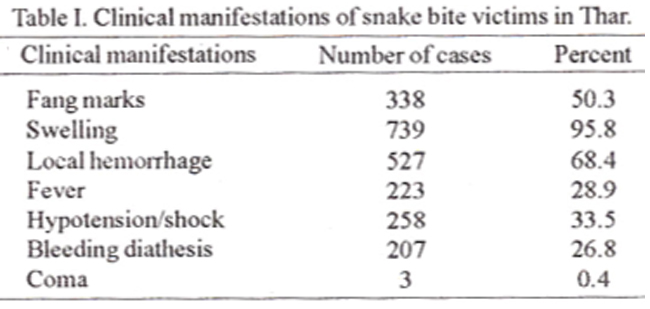
A total of 4 deaths were recorded among the 771 victims of the snake bite (over all mortality 0.5 percent). The highest frequency (75%) of snake bite cases were reported during summer season June-September and after sunset. Eighty-three percent bites were on the lower extremities. Seventy-two percent snake bite victims were taken to a health facility within 24 hours of the incidents, out of which 20% reached the facility within 6 hours.
Sixty seven percent (513) cases were bitten by poisonous snakes which included Eohis Carinatus arid Cobra, the remaining 33% (258) were either non-poisonous or were unidentified bites. Among the poisonous snake bite cases, 507 (99%) patients received anti snake venom while the remaining 6 patients were referred to other higher facilities. Among the 54 unidentified bites 31 received ASVon the basis of signs and symptoms and altered blood clotting time (Table II).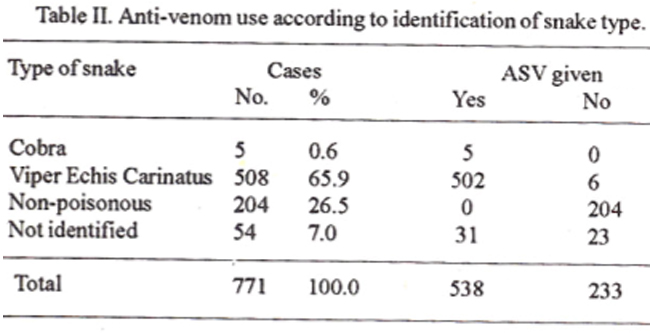
On average 19.0 ml (range 10-70 ml) polyvalent ASV was administered, with 79% of cases receiving 10-20 ml of ASV. Twelve percent of patients developed some adverse reaction which were managed clinically. Blood transfusion was given to 15% of patients. All the admitted cases were given supportive treatment which included antibiotics, analgesics and steroids. The average hospital stay was 3.5 days (range 1-16).
ASV was available in the 5 out of seven health facilities at the time of visit and was stored in the refrigerators at 2-4°C temperature. The type of ASV was polvvalent and the manufacturer was given as “Serum Institute of India12. All vials had a shelf life until July 2000. The Directorate Health Services and District Health Officer supplied the ASV. The total amount of ASV used in these facilities during the study period was 1019 vials, ranging from 17-349 vials per facility.
Discussion
This retrospective facility based study showed that 771 cases of snake bite were reported in 7 selected health facilities of the Thar area during the year November, 1995 to October, 1996. Of these 188 cases were admitted in Civil Hospital Mithi. In an earlier study conduced in the same hospital 332 cases were recorded duringtheyear 199013. The fewer number of snake bite cases admitted to the civil hospital in our study may be due to both more cases being treated appropriately with ASV in primary health care facilities such as BHU’s and RHC’s, as well as improved communication and transport facilities in the area, with a greater proportion of snake bite cases being referred onwards for treatment in tertiary care centers outside the Thar Desert.
The proportion of snake bite victims was higher among males aged 11-40 years. This age group is physically more active and usually working in the field with greater risk of snake bite13,17. The incidence of snake bite in the study area showed a distinct seasonal pattern with a peak in the warm and rainy months and is similar to what has been observed in other reports4,13,15,17,18. Snakes are generally more active during warm weather. Furthermore, insummerrural inhabitants sleep inthe open andbare ground, which exposes them to snake bite. The majority of the bites were on lower extremities, as also seen in previous studies16,18,21.
The common presenting symptoms were fang marks, swelling and bleeding from the site of bite and bleeding diathesis. Similar signs and symptoms have been reported by other researchers2,13,22,23. suggesting that the predominant biting species in the region are viperine snakes.
It is not always possible to identify the type of snake because usually the snake is not brought for identification in the health facilities. Some times the snakes are not trapped and killed and at times not even seen. This is compounded by the fact that most snake bites occur after sunset, when it is generally very dark in rural areas’. In the absei1ce of reliable snake identification clinicains are obliged to use polyvalent anti-venom. In the present study seventy percent of the total cases were administered ASV. The decision to administer anti-venom was made on the basis of history and examination. The overall mortality due to snake bite in the study was 0.5%. This is lower than the earlier reported from the same area13,
from that recorded from other areas14. This may be due to earlier referral to a larger number of accessible public sector health care facilities, timely and adequate administration of ASV or possibly due to a higher proportion bites being from non poisonous snakes.
This study shows that communities in the remote area of Thar. where snake bite is endemic, appreciate the importance of seeking medical care after snake bite. Secondary and even primary health care facilities are able to make an accurate diagnosis of envenomation by history and physical examination and are able to administer polyvalent anti-snake venom safely.
References
1. Jeva I, Sarangi A. Snakes of medical importance and snake bite treatment, New Delhi, Ashish Publishing House, 1993.
2. Anderson PC. Snake bites Lditorial South MedJ., 1994;87:673-74.
3. Malik OQ, Memon MS. Snake bite. In: Mohammad flyas Ed, Community Medicine, 3rd ed. Karachi, Time Traders, 1993, pp.814-31
4. Warrell DA. Venomous bites and stings in the tropical world, Med.J. Aust., 1993;159:773-79.
5. Russell FE. Toxic effects of animal toxins. In: Klaassen CD, Amdur MO and Doull J ads. Casareti and Doull\\\'s toxicology, 3rd ad. New York, Macmillan Publishing Company, 1986, pp. 706-56.
6. Koppel C, Martens F Clinical experience in the therapy of bites from Exotic Snakes in Berlin, Hum. Exp. Tox. 1992;11 :549-52.
7. Carrizosa J. Stings and bites. In: Kaye D and Rose LF ads. Fundamentals of Internal Medicine. St. Louis, The CV Mosby Company, 1983, pp. 1070-73.
8. Madhusudana SN, Paggarwall. Snakebitein India and itsmanagement. J. Indian Med. Assoc., 1990;88:235-6.
9. ReidHA. Snake bita.In:Maegraith BG and Gilles HM eds.Management and treatment. of tropical dis es Oxford, d well Scientifie Publications, 1971, pp. 458-65,
10. 1981 District Census Report of Tharparker. (District Census Report No.40). Population Census Organisation. Statistics Division, Islamaabad, Government of Pakistan, 1983.
11. Health facility data, Office of the District Health Officer, Tharparkar, Sindh, Pakistan, 1996 (unpublished data).
12. Manufacturers Data Sheet, Sii Polyvalent Anti Snake Venom Serum I.P. (Lyophilised), Serum Institute of India Ltd. 212/2, Hadapsar, Pune 411, 028 India, 1996.
13. Mal R. A study of snake bite cases. J. Pak. Med. Assoc., 1994;44:289.
14. Nhachi CFB and Kasilo OJM. Snake poisoning in rural Zimbabwe: A prospective study. J. App. Toxicol., 1994; 14:191-3.
15. Hati AK, Mandal M, De MK et al. Epidemiology of snake bite in the district of Burdwan, West Bengal, J.lndian Med. Assoc., 1992;90: 145-7.
16. Laloo DG, Trevett AJ, Sawen A et al, The epi4emiology of snake bite in central province and national capital district, Papua New Guinea. Trans. R. Soc. Trop. Med. Hyg., 1995;89:178-82.
17. Malik GM, Snake Bites in adults from the Asir region of Southern Saudi Arabia. Am. J. Trop. Med. Hyg., 1995;52:314-17.
18. Muguti GI, Maramba A, Washaya CT. Snake bites in Zimbabwe: A clinical study with emphasis on the need for antivenom. Cent. Aft. J. Med., 1994;40:83-8.
19. Stahel E. Epidemiological aspects ofsnakebites on a Liberianrubberplantation. Acts Trop., 1980;37:367-74.
20. Chan TYK, Critchley JAJH. An epidemiological study of the snake bites in the New Territories East, Hong Kong. Ann. Trop. Med. Parasitol., 1994;88:219-21.
21. Currie BJ, Sutherland 3K, Hudson BJ et al. An epidemiological study of snake bite envenomation in Papua New Guinea. Med. J. Aust. 1991; 154:266-8.
22. Hussain S, Ali G, Khanani Ret al. Pre-hospital measures of snake bites in Sindh. Pak. J. Med. Sci. 1995;12:23-6.
23. Shah MZ, Shah M, Rogham Metal Snake bite poisoning: A clinical problem. Pak, J. Med. Res., 1975; 14:43-4.
Journal of the Pakistan Medical Association has agreed to receive and publish manuscripts in accordance with the principles of the following committees:


