

Zaigham Abbas ( Department of Medicine, Jimiah Postgraduate Medical Centre, Karachi. )
Wasim Jafri ( Department of Medicine, The Aga Khan University Hospital, Karachi. )
Abdul Haleern Khan ( Department of Medicine, The Aga Khan University Hospital, Karachi. )
Mashoor Alam Shah ( Department of Medicine, Jimiah Postgraduate Medical Centre, Karachi. )
July 1998, Volume 48, Issue 7
Short Reports

Abstract
Prevalence of Helicobacter pylori (Hp) is high in developing countries. As endoscopy personnel are at greater risk of exposure to gastric secretions, they are apparently at higher risk of acquiring this infection, The aim of this study was to determine prevalence of Hp antibodies m endoscopy staff and compare it with non-medical volunteers and assess any additional risk of occupational exposure to Hp in the former group. Thirty-three subjects working in endoscopy suites of different hospitals of Karachi and 33 non-medical volunteers were investigated for the prevalence of Hp antibodies by using a commercially available rapid qualitative test (FlexPack HP; Abbott), The two groups were coin parable in mean age, sex and social class, Twenty-six of 33 (79%) of the endoscopy personnel and 19/33 (58%) of the non- medical volunteers were positive for Hp serology (p=O.O6 R.R 1.37). Among the endoscopy personnel 13/14 (93%) of endoscopy assistants were positive and this subgroup had a significantly higher prevalence of lip antibodies as compared to the control group (p=O.OI9). No correlaion could be found between the positive serology and symptoms of dyspepsia (JPMA 48: 201,1998).
Introduction
Helicobacter pylon (H. pylon) is the main etiological agent for antral gastritis and plays a leading pathogenic role in duodenal ulcers and majority of non-NSAID gastric ulcers1,2. There is a significant association between H. pylon infection and mucosa associated lymphoid tissue lymphomas (MALTOMAs)3 and gastric cancer4.
There is high prevalence of H. pylori in the developing world where people have tow socio-economic status and live in an unhygienic environment5. H. pylori thought to be transmitted by faccal oral or oral-oral route1. Staff working in the endoscopy suite may be at greater risk of direct exposure to gastric secretions so the prevalence of H. pylon among this gmup might be higher. Some recent studies have Shown a high prevalence of H. pylori among endoscopy workers, while others do not support it6-9. This study was done to find out the prevalence of H. pylori antibodies in the endoscopy staff. Other objective were to determine antibody posilivity in non-medical volunteers and asymptomatic individuals of both groups.
Methods
Thirty-three doctors, nurses and nursing aids working in the endoscopy suites of different hosptials of Karachi were tested for antibodies to H. pylon in their blood. Nineteen were doctors and 14 were nurses and nursing assistants. Same number of non— medical subjects who were friends and neighbours of the cndosocpy personnel were taken as control group. Controls were comparable in age, sex and social class.
A commercially available rapid qualitative in-office test FlexPack HP (Abbott) was used for serology. It detects IgG antibodies to H. pylori in whole blood by using the principle of reverse flow chromatography. It has about 90% sensitivity and specificity relative to urea breathe test10. Statistical analysis was done using Chi square test. Fisher exact test and Students’ t test.
Results
Demographic data of the two groups is given in Table I.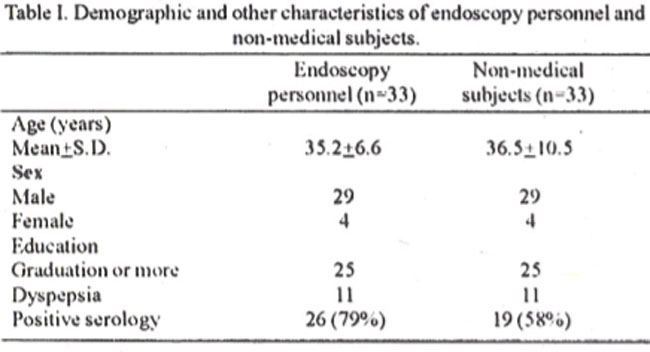
The H. pylori antibody prevalence among the endoscopy personnel was 79% (26/3 3) and in the control group 58.1% (19/33). The difference did not reach the statistically significant value but showed a trend (p=0.06, R.R. 1.37). The prevalence in nurses and nursing assistants was significantly higher: 93% (13/14) (Table II)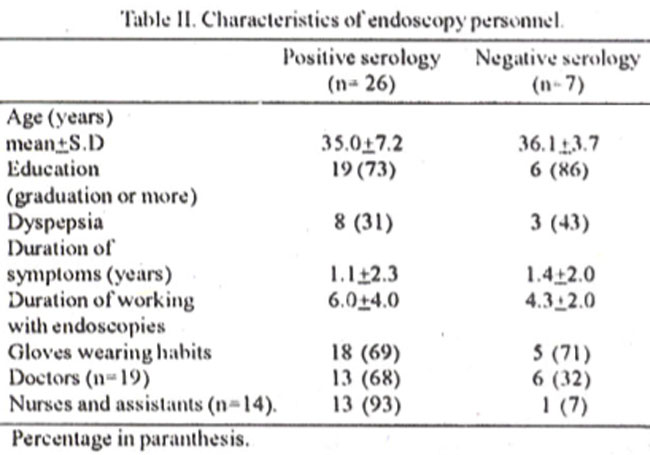
than in non-medical control group (p=0.019, R.R=1.61). Sixty-eight percent (13/19) doctors were positive for H. pylori. Comparing this sub-group with the control did not show any difference (p=0.43).
Data of both groups was pooled to compare the characteristics of seropositive and seronegative subjects (Table III).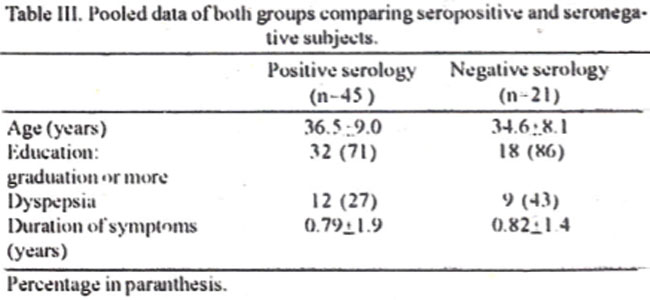
There was no significant difference in the mean age, educational status, presence of dyspepsia and duration of symptoms. H. pylori antibodies were present in 57% (12/21) of symptomatic subjects and 73% (33/45) of asymptomatic individuals.
Discussion
H. pylori is transmitted by faeco-oral and oro-oral route1. Standard of hygiene and socio-economic status are important factors predicting the prevalence of infection. In some developing counines, over 80% of asymptomatic 20-year old subjects ate infected5,11. It is known that infected gastric secretions may cause epidemics of gastritis12. Nosocomial transmission between patients undergoing endoscopy has also been reported13. As endoscopy personnel are at greater risk of exposure to gastric secretions, they ate apparently at higher risk of acquiring this infection. Studies in favour and against are avaiIablet6-9.
This study shows a higher prevalence of positive serology for H. pylon both in the endoscopy personnel and non-medical subjects (79% vs. 58%, =OA)6. Though the study did show a trend of higher prevalence in the eudoscopy personnel, analysis of subgroups showed that only the nurses and nursing assistants were aLa higher risk, but nol the doctors. No difference was found in the duration of working with the endoscopes and the glove wearing habit of two sub-groups. The only difference could be that nurses and nursing assistants in Pakistan came from lower socio-economical status. As tile acquisition of H. pylori occurs during the childhood14. they could have acquired this infection during that period while liv ing with their lamilies in small—overcrowded houses.
This study indicates that symptoms of dyspepsia and positive serology do not correlate with each other. Only 27% of subjects with positive serology were symptomatic and in Symptomatic subjects the prevalence of seropositivity was 57% (12/21) as compared LO 73% (33/45) in asymptomatic individuals. So any screening program which is focussed on screening only symptomatic subjects will miss a significant number of H. pylon positive subjects who are asymptomatic.
References
1. Marshall BJ Helicobacter pylon, Am i Gastroenterol. 1994 89;81:16-28.
2. Walsh ill and Peterson WI. The treatment of H elicob acter p for infection in the management of peptic ulcer disease N. Eng J Med , 1995;333:954-91.
3. Wotherspoon AC, Dogliani C, Diss, TC, et at Regression of primary low grade B cell gastric tymphoms of mucosa associated tymphoid tissue type alter erad cation of Helicohacter pylori, Lancet, 1993;342:575:577.
4. Parsonnet J. Helicobacter pylon and gastric cancer Gastroenterol Clin North Am. 1993;22:89-104.
5. Gill Hill, Majmudar P, Shankaran K, et a! Age related prevalence of Ilelicohacter pylori antibodies in Indian subjects Indian J Gastroenterol, 1994;13:92-4.
6. I.in SK, Lambert JR. Schembri MA, et at Helicobacter pylon rrevalencc in endoscopy and medical stall J Gastroenterol Hepatol., 1994;9:319-24.
7. Goh KL, Parasakthi N and Ong KK Prevalence of H elicobacter pylon infection in endoscopy and non-endoscopy personnel Results of field survey with serology and 14C urea breath test Am J Gastroenterol , 1990;91:268-70.
8. Sato T, Kojima Y. Kitachara F, et at Prevalence of Hehcobacter pylon antibodies in gastroenterologists in Japan Proceedings of 10th Asian Pacific Congress of gastroentrology Yokohama, Japan. 1996. Abstract AP63.
9. Graham 1)1. Evans DJ, Peacock J, et at Comparison of rapid serological tests (Fkxsure lip and Quick Vue) with conventional ELISA for detection of Helicobacter pylori infection Am J Gastroenterol 1996;91:942-8.
10. Change Claude J, Raedseh R, Waldherr R, et at Prevalence of Helicobacter pylon infection and gastriiis among young adults in (hina Eur J Cancer Prey, 1995,473-9.
11. Ramsay EJ, Carey K\\\\. Peterson WL, et at Epidemic gistritis with hypochiorihydna Gastroenterology, 1979,76:449-57.
12. langcnhcrg W, Rauws E.A. Oudluer ill, et at Patient to patient transmission f Compylobacter pylori infection by fiberoptic gastroduodenoscops and bropsy J Infect Dis., 1996;161:107-11.
13. Cullun DiE. Collins BJ. C hristiansen KJ. ci al When is helicobacter pylon infection acquired Gut, 1993;34:1081-2.
Journal of the Pakistan Medical Association has agreed to receive and publish manuscripts in accordance with the principles of the following committees:


