

Gulsah Gurol Arslan ( Dokuz Eylul University, School of Nursing, Department of Fundamentals of Nursing, Izmir, Turkey. )
Ismet Eser ( Ege University, School of Nursing, Department of Fundamentals of Nursing, Izmir, Turkey. )
Leyla Khorshid ( Ege University, School of Nursing, Department of Fundamentals of Nursing, Izmir, Turkey. )
November 2011, Volume 61, Issue 11
Original Article

Abstract
Objectives: To evaluate the impact of lying on the ear on the measurement of body temperature by a tympanic thermometer.
Methods: Participants in the study were healthy young people of the Nursing Department of the College of Health, Izmir, Turkey. Sixty-eight participants who agreed to participate, and who had no discharge or infection of the ear and no upper respiratory tract infection, were included in the study. Immediately after the first temperature reading, measurement had been performed five times. Non-probability sampling method was used and the study was conducted in January 2007.
Results: Tympanic thermometer body temperature results were significantly higher (p<0.05) when measurements were taken following lying on the ear compared to those when the subject did not lie on the ear prior to temperature measurement.
Conclusions: There are significant differences in tympanic temperature caused by the subject lying on his or her ear. This is important to keep in mind during health workers\\\' assessments.
Keywords: Tympanic membrane, Temperature, Turkey (JPMA 61: 1065; 2011).
Introduction
As thermoregulation reflects an individual\\\'s physiological balance, it is important to measure the body temperature correctly as part of routine nursing assessment.1 To date, there exist insufficient and contradictory results from nursing studies on temperature measurement despite the importance of accurate temperature measurement.1 Nurses need to keep current on research providing answers to accuracy issues in temperature measurement.2 Although temperature measurement is quite simple, the health worker must be aware of the variables affecting vital signs, how these variables are reflected in an individual\\\'s body temperature, and how these variables may be controlled.3-5 Accurate monitoring of core temperature is an important component of the routine care of critically ill patients.6 While temperature is considered the most basic of observations, conflicting opinions exist about the most accurate site for measuring core body temperature.2,6-12
The literature consists mostly of studies from the 1960s and 1970s and mainly involves the use of mercury glass thermometers. An increasing tendency to use electronic and tympanic thermometers in clinical applications was observed in the 1980\\\'s.1 The most popular noninvasive method for measuring body core temperature is in the ear canal. With this method, which uses infra-red waves, it is possible to measure body temperature quickly and noninvasively by placing the probe inside the ear canal. This method is more convenient compared to other methods and is less influenced by thermal and environmental artifacts. There are two main locations for measuring temperature in the ear: the tympanic membrane and the ear canal. The tympanic membrane gets its blood supply from a section of the aorta that supplies blood to the thermoregulatory centre in the brain. Therefore, it is an important site for measuring body core temperature. In addition, access to the ear canal is very convenient.12 Since the tympanic membrane shares the same blood supply as the hypothalamus, which is the heat regulation centre, it is believed that body temperatures obtained by use of a tympanic membrane thermometer are very accurate.1,9,12-14
Advantages of tympanic thermometers include ease of use, decreased risk for cross-infection and speed of use.1,13,15 However, results of studies on the reliability of measurements from tympanic thermometer are contradictory.1,16-18
Each type of thermometer has its advantages and disadvantages, and, as new technologies are introduced, there is discussion about whether the new devices measure body temperature correctly.19 The tympanic thermometer, like other types of thermometers, can give inaccurate readings when used incorrectly. It is thought that lying on the ear could obstruct heat loss by radiation and convection,4,20 and thus result in inaccurate body temperature readings when tympanic temperature is taken in the ear immediately following the subject lying on that ear. This definition was the basis of the present study.
The aim of this study was to examine the effect of lying on the ear (in a lateral position) on the measurement of body temperature by tympanic thermometer in the ipsilateral ear. Three questions related to the study\\\'s purpose were:
1. Does lying on the ear effect on the measurement of body temperature by tympanic thermometer in the ipsilateral ear?
2. Does measurement of body temperature by tympanic thermometer in the ipsilateral ear increase duration increased of lying on the ear?
Subjects and Methods
Participants in the study were selected with nonprobability sampling method, 74 first-and second-class School of Health in Turkey, healthy young people in January 2007. Sixty-eight participants who agreed to take part, and who had no discharge or infection of the ear and no upper respiratory tract infection, were included in the study. In order to control for differences between right and left ears, body temperature was measured in the right ear of 34 participants and the left ear of the other 34 participants. This selection was performed by drawing lots. Of the possible 74 participants in the sample, 2 participants did not consent to participate and 4 participants who left before the end of the study were excluded.
Each participant was exposed to a constant environmental temperature before the simultaneous temperature measurements. Using of the ear thermometers as the ears are cold may give unreliable results, because the environmental temperature may also affect the tympanic membrane temperature.9,11
Briefly, the measurement of temperature over the tympanic measurement was performed as follows; the probe of the non-contact infrared thermometer (Microlife IR 1DA1 tympanic thermometer) was inserted into the external auditory canal by pulling the pinna backward, and the probe was directed toward the eye. The probe was held in this position until the device bleeped, which usually took a few seconds. The cover of the probe was changed after each measurement. The ear temperatures of the participants were measured by the same researcher.
Immediately after the first temperature reading, participants were asked to lie on the ear on the side. The participants were laid down on their ear for 30 min. Measurement had been taken for periods of 5, 10, 15, 20 and 25 minutes. Tympanic temperature was measured at the end of each period and results were recorded on a data form. Tympanic measurements were delayed for 2 minutes following the end of each lying period to allow passage of the cooling effect of the tympanic probe on the ear canal, a phenomenon known as temperature draw-down. This temperature draw-down causes falsely low tympanic values if not enough time elapses between measurements.21
Permission to carry out the study was obtained from the Ethics Committee of Ege University College of Nursing, the College of Health where the study was conducted. Verbal informed consent was obtained from the participants.
Statistical Methods:
Data were analyzed using the SPSS for Windows, Version 13.0 (SPSS, Inc.,Chicago, IL) Descriptive statistics were used to describe participants\\\' demographic characteristics. Data analysis included Repeated Measures ANOVA, Paired Samples T and One Samples T tests.
Results
Body temperatures measured by tympanic thermometer were found to be as follows: 36.02±0.50ºC at 0 minutes; at 36.23±0.50ºC at 5 minutes; 36.47±0.47ºC at 10 minutes; 36.60±0.39ºC at 15 minutes; 36.69±0.36ºC at 20 minutes; and 36.80±0.38ºC at 25 minutes. The difference according to length of time lying on the ear was statistically significant (F=250.252 p<0.001). Measured temperature rose as the time lying on the measured side increased (Table).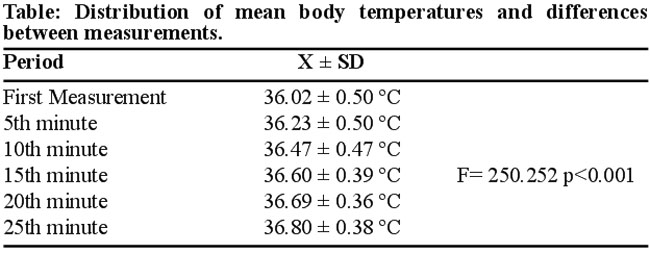
When comparing measurements from one interval to the next, each succeeding measurement was higher than the one preceding it.
Discussion
The difference between measurement results according to length of time lying was found to be statistically significant (F=250.252 p<0.001). The measured temperature rose as the time spent lying on the measured side increased. It can be seen that there were statistically significant differences among the body temperature measurements.
The human body generates heat, and also loses heat to keep the internal temperature balance. Body temperature of the heat produced is in balance with the heat lost. Loss of body heat takes place through radiation, conduction, convection and evaporation.22 In this study, participants were exposed to a constant environmental temperature as in both studies,9,11 to eliminate the short lived effects of minor temperature disturbance. On the other hand, heat loss through radiation, convection and evaporation could have the potential to be blocked as a result of lying on the ear. This may have caused an increase in the tympanic measurement results.
Fulbrook8 examined the relationship between pulmonary artery blood temperature, axillary temperature, and tympanic membrane temperature, in sixty adult intensive care patients (mean age was 63.4 years) had their temperatures monitored. Body temperature measurements were recorded from five different areas: right ear; left ear; right axilla; left axilla; and pulmonary artery blood. The subjects\\\' positions and whether or not they were subjected to fan therapy to the head were recorded during data collection. A statistically significant difference was detected between right and left tympanic membrane temperatures with subjects lying on the right side. Although the difference when lying on the left side was clinically significant it was not statistically significant. The results from this study indicate that fan therapy to the head has a negligible effect. When a patient is lying with his or her ear on the pillow, the difference between left and right tympanic membrane temperatures, although clinically significant, was found to be statistically significant only when the patient was lying on his or her right side. According to the results of data analysis, large differences between the left and right tympanic membrane can be explained by the position of the specified ear on the pillow.8 The finding of this study supports our results.
It was established that measurements by tympanic thermometer, on the ear towards the pillow, shows increased temperature. This rises by increasing time lying on the ear. In accordance with these results, it is recommended that temperature should be measured from the ear which is not on the dependant side, to obtain a correct reading by tympanic thermometer. Nurses are responsible for obtaining correct measurement for evaluating vital signs. To be achieved, they must know what could cause a false reading, and take the appropriate action to prevent this.
Although the main purpose of this study was not to determine the difference between right and left ear measurements, there was no difference between right and left ear. The results of this study were consistent with literature results.8-11
Limitations:
Nonprobability sampling limits the generalizability of findings due to impossibilities, and may have introduced a selfselection bias. Generalizability is further limited because our sample was younger than the general population. Limited sample size may have weakened the effective size. Age, gender, diseases, the changes in the environment (different temperatures) may have introduced extraneous variance. Thus, because of the small sample size and the aforementioned limitations, these results should be considered preliminary at this stage. If it is done as randomized controlled trials, more evidence-based findings could be obtained.
Conclusion
Measurements using tympanic thermometer following intervals in which the subject was lying on the ear showed increases, such that as the length of time spent lying on the ear increased, the temperature also increased. It is therefore recommended that in reading when using a tympanic thermometer, measurement should take place in the ear that the patient was not lying on immediately prior to measurement. As a result of this study, we advised that \\\'care should be taken not to measure the temperature in an ear on which the patient has been lying recently\\\'.
Relevance to Clinical Practice:
Nurses should be aware that lying on the ear prior to tympanic temperature measurement in this ipsilateral ear can lead to erroneous measurements. Tympanic temperature should be taken in the ear that the patient was not lying on in the interval immediately preceding temperature measurement.
Acknowledgments
We wish to thank the sales representative of Bioaktif Medikal, Mr. Behçet Lale, for supplying the tympanic thermometer (Microlife IR 1DA1 tympanic thermometer).
References
1.Fulbrook P. Core temperature measurement in adults: a literature review. J Adv Nurs 1993; 18: 1451-60.
2.Barton SJ, Gaffney R, Chase T, Rayens MK, Piyabanditkul L. Pediatric temperature measurement and child/parent/nurse preference using three temperature measurement instruments. J Pediatr Nurs 2003; 18: 314-20.
3.Taylor C, Lillis C, LeMone P. Vital signs, Fundamentals of Nursing The Art and Science of Nursing Care, 3rd ed. Philadelphia: JP Lippincott Company 1997; pp 431-72.
4.Ulusoy MF, Görgülü RS. Vital signs, Fundamentals of Nursing Theory-Basic Principles and Methods. 5th ed. Ankara: TDFO Ltd. 2001; pp 151-3.
5.Potter PA, Perry AG. Vital signs: Body temperature, Fundamentals of Nursing. 7th ed. Canada: Mosby Elsevier Company 2009; pp 504-20.
6.Maxton FJ, Justin L, Gillies D. Estimating core temperature in infants and children after cardiac surgery: a comparison of six methods. J Adv Nurs 2004; 45: 214-22.
7.Erickson RS, Meyer LT. Accuracy of infrared ear thermometry and other temperature methods in adults. Am J Crit Care 1994; 3: 40-54.
8.Fulbrook P. Core body temperature measurement: a comparison of axilla, tympanic membrane and pulmonary artery blood temperature. Intensive Crit Care Nurs 1997; 13: 266-72.
9.Childs C, Harrison R, Hodkinson C. Tympanic membrane temperatures as a measure of core temperature. Arch Dis Child 1999; 80: 262-6.
10.Robb PJ, Shahab R. Infrared transtympanic temperature measurement and otitis media with effusion. Int J Pediatr Otorhinolaryngol 2001; 59: 195-200.
11.Kocoglu H, Goksu S, Isik M, Akturk Z, Bayazit YA. Infrared tympanic thermometer can accurately measure the body temperature in children in an emergency room setting. Int J Pediatr Otorhinolaryngol 2002; 65: 39-43.
12.Moran DS, Mendal L. Core temperature measurement methods and current insights. Sports Med 2002; 32: 879-85.
13.Robinson JL, Jou H, Spady DW. Accuracy of parents in measuring body temperature with a tympanic thermometer. BMC Fam Pract 2005; 6: 3.
14.Sund-Levander M, Forsberg C, Wahren LK. Normal oral, rectal, tympanic and axillary body temperature in adult men and women: a systematic literature review. Scand J Caring Sci 2002; 16: 122-8.
15.Best practice: Evidence based practice information sheets for health professionals. (Online) (Cited 2010 Dec 15). Available from URL: http://www.joannabriggs.edu.au/pdf/BPISEng_9_2.pdf.
16.Uzun Ö, Özer N. Adult patients oral, axillary and tympanic comparison of the measured heat. 6th International Participation in Nursing Congress Book. Ankara: Damla Typography 1999; pp 243-7.
17.Sari D, Ekti GR, Erdo?du M. Body temperature measurement in pediatric patients comparison of tympanic and axillary road. 6th Nursing Congress of Pediatric Surgery, Scientific Program and Abstract Book - Mersin 2002; pp 360.
18.Khorshid L, Eser I, Zaybak A, Yapucu Ü. Comparing mercury-in-glass, tympanic and disposable thermometers in measuring body temperature in healthy young people. J Clin Nurs 2005; 14: 496-500.
19.Basbakkal Z, Kiliç M, Yardimci FK. Axillary body temperature measurement in children using glass-mercury tempadot thermometers. ?nönü University J Vocational School of Health Services 1998; 4: 3-9.
20.Çoksevim B. Thermoregulation, physiological effects of hot and cold. Erciyes University Faculty of Medicine, Physiology Notes, Kayseri 2003; pp 45-53.
21.Giuliano KK, Giuliano AJ, Scott SS, MacLachlan E, Pysznik E, Eliot S, Woytowicz D. Temperature measurement in critically ill adults: a comparison of tympanic and oral methods. Am J Crit Care 2000; 9: 254-61.
22.Isik RD, (Ed. Ay FA). Vital signs. The Basic Concepts and Skills at Health Applications. 3rd ed. Istanbul: Nobel medical bookstore 2011; pp 357-68.
Journal of the Pakistan Medical Association has agreed to receive and publish manuscripts in accordance with the principles of the following committees:


