

Fauzia Anis Khan ( Department of Anaesthesia, Aga Khan University, Karachi, Pakistan. )
Fauzia Nasim Minai ( Department of Anaesthesia, Aga Khan University, Karachi, Pakistan. )
Shahla Siddiqui ( Department of Anaesthesia, Aga khan university, Karachi, Pakistan. )
November 2011, Volume 61, Issue 11
Original Article

Abstract
Objective: To explore the fourth year medical student\\\'s knowledge regarding anaesthesia as a specialty, their attitude towards anaesthesia as a career choice and the effect of clinical clerkship on these.
Methods: This survey was conducted in the Department of Anaesthesia of a university medical centre in a developing country. One hundred and fifty year four medical students rotating in anaesthesia were enrolled. They were asked to fill a structured questionnaire before (pre) and after (post) their anaesthesia rotation. The questionnaire sought information on their perception of anaesthesia as a specialty, role of anaesthetists, clerkship duration, and reasons for considering or not considering anaesthesia.
Results: Prior to anaesthesia clerkship 12 students (8%) included anaesthesia in their first three career choices (2 as first preference). Post clerkship 36 (24%) included it in their first 3 career choices (3 as first preference). There was a change in perception of specialty for 57 participants.
Conclusion: The findings support the positive influence of anaesthesia clerkship on changing the attitude of medical students towards anaesthesia specialty in a developing country with shortage of anaesthesia personnel.
Keywords: Anaesthesia, Career choice, Pakistan, Karachi (JPMA 61: 1052; 2011).
Introduction
Trends in career choice vary from country to country1-3 and even in the same country over a period of time.4 The subject has important implications in national workforce planning. Although other factors may influence career choices, exposure to a subspecialty in the undergraduate curriculum may significantly affect the career preference of a medical graduate.5
The aim of this survey was to explore fourth year medical student\\\'s knowledge of anaesthesia as a specialty, their attitude towards anaesthesia as a career option and to assess the immediate effect of the clinical clerkship on both.
Methods
This cross-sectional survey enrolled a sample of 150 students from fourth year, School of Medicine, Aga Khan University in Pakistan (academic year 2008/2009). Institutional ethical committee approval was taken and signed informed consent was obtained from all students. The survey was conducted between 1st October 2006 to 30th September 2008. Data was collected through self-reporting questionnaire. There were a total of 167 students in the two academic years. Seventeen students did not take part in the study.
A set of forms (Pre-rotation) was filled by the students on day one of a two week anaesthesia clerkship. The form listed eleven common career choices including anaesthesia and students were asked their preference for their top three choices. The option of including a choice other than the eleven listed and"not decided yet" were also available. The second question was related to reasons for not choosing anaesthesia. This was followed by a set of eight questions related to awareness and knowledge about the specialty of anaesthesia. Some questions were open ended and the student\\\'s had an opportunity to write comments.
A second set of forms (Post rotation) was filled by the students immediately after completing the rotation. These forms were identical to the first set but had four additional questions related to the feedback on the clerkship. The option of comments was again available (Appendix-1).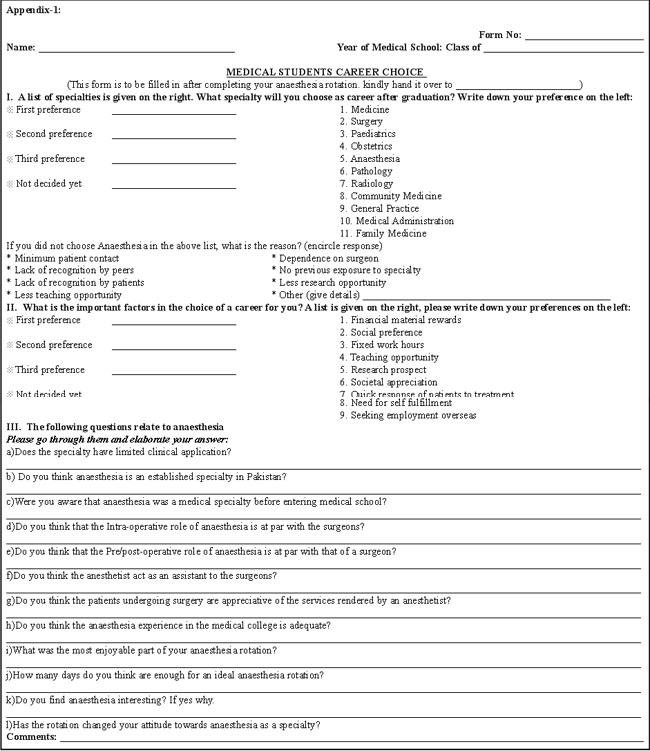
A survey coordinator explained the form to the students and was responsible for handing over and collecting the forms.
Statistics:
Data was double entered by two data entry operators using EPIDATA 3.1 (Denmark). Frequencies of all responses to questions asked were obtained. McNemar\\\'s test was used to compare the responses pre and post rotation with 95 percent confidence interval calculated for the difference.
Results
The survey included 150 students consisting of 78 males (52%) and 70 females (47%). Gender was not specified on two of the forms. Prior to the anaesthesia clerkship twelve students (8%) included anaesthesia in their first three career choices. Two students (1.3%) stated anaesthesia as their first career preference, two (1.3%) chose anaesthesia as their second career preference and (5.3%) as their third career preference.
In the post rotation survey, 36 students (24%) included anaesthesia in their first three career choices. Three (2%) selected anaesthesia as their first preference, 12(8%) as their second preference and 21 (14%) as their third preference. This was statistically significant from the pre clerkship survey result (p = 0.001).
Response to questions that related to awareness and knowledge of anaesthesia are given in Table-1.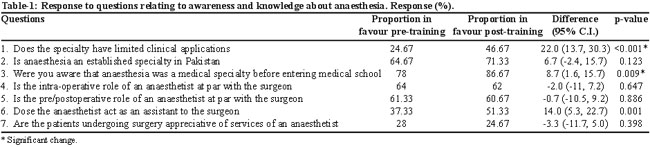
The responses to questions related to evaluation of clerkship are given in Table-2.
In response to what should be the ideal duration of an anaesthesia clerkship 63 (42%) respondents suggested 14 days, 22 (15%) listed 21 days, 30 (20%) 28 days, and 12(8%) mentioned 10 days as adequate. In 57% of the responders there was a change in attitude towards anaesthesia as a specialty.
Regarding the most enjoyable part of rotation 69 (46%) listed specific skills of intravenous cannulation and tracheal intubation, 15(10%) listed practical experience without specifying it and 10(7%) found the teaching interesting. The rest cited miscellaneous reasons.
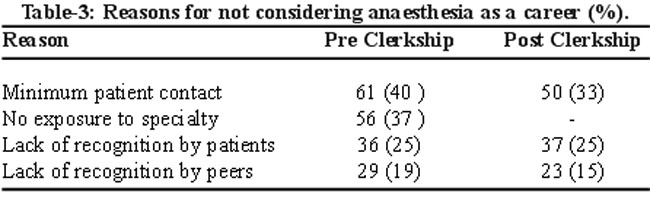
Table-3 lists the reasons given by those who did not consider anaesthesia as a career option.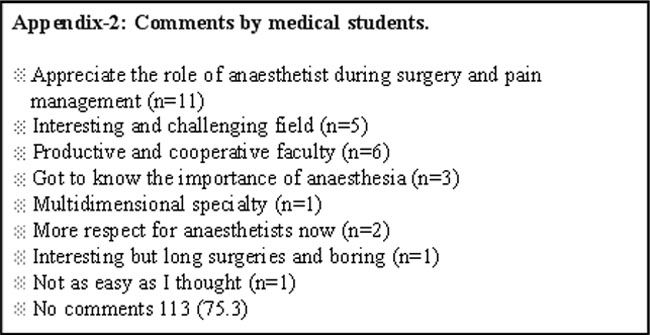
Appendix-2 shows the comments given by the students related to the rotation.
Discussion
Undergraduate teaching of anaesthesia occurs in all medical schools in Pakistan; however some schools offer didactic teaching only, whereas a few offer proper rotations in addition to formal teaching. In our institution a formal anaesthesia clerkship has been in place since 1985. The rotation includes a two week observation of anesthetic management. Five working days are spent in the main operating room and post anaesthesia recovery and the other five days in day care operating rooms, labour operating suite, preoperative clinic, acute pain rounds and chronic pain clinic. The students also perform intravenous access and airway management under direct supervision. Ten formal problem based tutorial/student presentations are scheduled during this period.
In our survey only two students\\\' selected anaesthesia as first choice and this did not change significantly after the clerkship (n=3). A higher percentage of students selected anaesthesia as their second or third career choice post rotation and this change was significant. Students who included anaesthesia in their career choice post clerkship found the field to be interesting and challenging. On the other hand those who did not consider it as a career choice thought that anaesthesia lacked patient contact and there was lack of recognition by the patients and peers. Our results are similar to those reported from other developing countries like Sri Lanka,1 and Jordon 3.1%.6 Data from developed countries is dissimilar. A survey from UK reported that between 1974 and 2002 the percentage of doctors choosing anaesthesia one year after qualification rose from 5 to 12%.7
Career choices are made either in the medical school, or during internships.8,9 It is also not necessary that preference for a specialty may lead to training in that specialty,10 but it can change the attitude of an individual. It has been shown that a four weeks clerkship in anaesthesia has significantly improved the graduating student\\\'s attitude towards anaesthesia as a specialty.11 Rotation may have a negative effect as well.12 In our survey a two week rotation in different subsections of anaesthesia was associated with a positive effect. Seventy six percent of our students were not influenced by the rotation and did not change their minds about career choice, but 57% of the respondents claimed that it changed their attitude towards the specialty and they were more appreciative of the role of the anesthetist.The anaesthetist influenced the students in considering anaesthesia as their second or third career option. Another argument that is put forward is that by the time students rotate in anaesthesia they have already made up their minds in favour of more popular and front line specialties like general medicine and surgery.13
The duration of undergraduate exposure in anaesthesia varies from one week to several weeks, generally four. In some countries anaesthesia is offered as an elective rather than a mandatory rotation. The effect of duration of clerkship on anaesthesia recruitment is also controversial and Yang et al concluded that anaesthesia recruitment is more influenced by technical, applied basic sciences and life style factors than undergraduate exposure.14 Forty two percent of our students thought 14 days as adequate exposure, and 35% wanted the exposure to be 3-4 weeks. Only 8% students said that exposure should be less.
The rotation changed the perception of students in some areas. The numbers who thought that the specialty had limited clinical applications and that the anaesthetist acts as an assistant to the surgeon significantly decreased. However it is alarming that nearly 34% still perceived the image of the anaesthetist as negative and subordinate to the surgeon. There was significant increase in the numbers who thought that anaesthesia was an interesting and challenging specialty. Eighty six percent were aware that anaesthesia was a medical specialty before entering medical school.
One of the limitations of this survey is that it is a single institution survey. None of the other teaching institutions that we approached in our city were rotating students through the anaesthesia department. Another limitation is that we have only tested the short term effects of the rotation only but the long term effects may be different.
In conclusion we found that a two week rotation in anaesthesia influenced the medical student\\\'s perception of the specialty. A significant number were willing to consider it as their second and third career choices. It would be interesting to follow up the cohort and see how many actually take up the specialty as a career. Anaesthetists need to emphasize on the positive aspects and scope of the specialty outside the operating room. They need to create awareness of their collaborative role in patient management rather than as an assistant or subordinate to the surgeon by highlighting their role as team members in trauma, critical care and pain management. This is also needs to be done at seminars and meetings as undergraduate anaesthesia rotations are lacking in majority of our universities.
We recommend a dedicated rotation of at least two weeks in anaesthesia as it brought about a distinct change in the perception of the students regarding the specialty.
References
1.Karalliedde LD, Senanayake N, Aluwihare AP. Career preferences of the 1984 medical graduates of Sri Lanka. Med Educ 1986; 20: 64-8.
2.Lebovits A, Cottrell JE, Capuano C. The selection of a residency program: prospective anesthesiologists compared to others. Anesth Analg 1993; 77: 313-7.
3.Wass CT, Long TR, Randle DW, Rose SH, Faust RJ, Decker PR.Recruitment of house staff into anesthesiology: a re-evaluation of factors responsible for house staff selecting anesthesiology as a career and individual training program. J ClinAnesth 2003; 15: 289-94.
4.Newton DA, Grayson MS. Trends in career choice by US medical school graduates. JAMA 2003; 290: 1179-82.
5.Field D, Lennox A. Gender in medicine: the view of first and fifth year medical students. Med Educ 1996; 30: 246-52.
6.Khader Y, Al-Zoubi D, Amarin Z, Alkafagei A, Khasawneh M, Burgan S, et al. Factors affecting medical students in formulating their specialty preferences in Jordon. BMC Med Educ 2008; 8: 32
7.Turner G, Goldacre MJ, Lambert T,Sear JW. Career choices for anaesthesia national surveys of graduates of 1974-2002 from UK medical schools. Br J Anaesth 2005; 95: 332-8.
8.Howat DDC. Anaesthesia as a career. Anaesthesia 1977; 32: 979-95.
9.Walts RW, Marley J, Worley P. Undergraduate education in anaesthesia: the influence of role models on skills learnt and career choice. Anaesthesia Intensive Care 1998; 26: 201-3.
10.Matteson MT, Smith SV. Selection of medical specialties: preferences versus choices. J Med Edu 1977; 52: 548-54.
11.Samra SK, Davis W, Pandit SK, Cohen PJ. The effect of clinical clerkship on attitude of medical students towards anesthesiology. J Med Educ 1983; 58: 641-7.
12.Burrack JH, Irby DM, Carline JD, Ambrozy DM, Ellsbury KE, Strilter FT. A study of medical student\\\'s specialty choice pathways: trying on possible selves. Acad Med 1997; 72: 534-41.
13.Levin KJ, Friedman CP, Scott PV. Anesthesiology and the graduating medical student: a national survey. AnesthAnalg 1979; 58: 201-7.
14.Yang H, Wilson-Yang K, Raymer K. Recruitment in anaesthesia: results of two national surveys. Can J Anaesth 1994, 41: 621-7.
Journal of the Pakistan Medical Association has agreed to receive and publish manuscripts in accordance with the principles of the following committees:


