

Attaullah Mazhar ( Department of Paediatrics, Quaid-e-Azam Medical College, Bahawalpur. )
Abdul Rehman ( Department of Paediatrics, Quaid-e-Azam Medical College, Bahawalpur. )
Muhammad Amin Sheikh ( Department of Paediatrics, Quaid-e-Azam Medical College, Bahawalpur. )
Malik Muhammad Naeem ( Children Ward-I, BV Hospital, Bahawalpur. )
Imran Qaisar ( Children Ward-I, BV Hospital, Bahawalpur. )
Memoona Mazhar ( Children Ward-I, BV Hospital, Bahawalpur. )
July 2011, Volume 61, Issue 7
Original Article

Abstract
Objective: To determine a change in the mortality of admitted children (neonates and children above 28 days of age to less than 17 years) and to document a change in the causes of neonatal admissions along with their mortality during a four year period.
Methods: Conducted in Pediatric unit-I, Bahawal Victoria Hospital, Bahawalpur. The data of all the children admitted from 1st January 2005 to 31st December 2008 was analyzed.
Results: The mortality among admitted neonates was significantly higher than that of children of postneonatal age group. There was decrease in mortality among not only total admitted children but also among admitted children with postneonatal age group i.e. 1 month to less than 17 years of age over a four year period (2005-2008) while no such decrease was seen in children of neonatal age group. The three common causes of neonatal admission and deaths were sepsis, birth asphyxia and prematurity.
Conclusion: There was no improvement in neonatal mortality over a 4 year period. However, a decrease in postneonatal mortality was seen.
Keywords: Neonatal mortality, Postneonatal mortality, Sepsis, Prematurity, Birth asphyxia, Case fatality (JPMA 61:625; 2011).
Introduction
Pakistan is ranked as 43rd in countries with highest under-five mortality (90/1000 live births), and 7th in neonatal mortality (53/1000 live births).1 Neonatal deaths are roughly 10 times higher in Pakistan as compared to developed countries.2 The UN Millennium Development Goal 4 is to reduce childhood mortality by two-thirds by 20152 which are not possible without reducing neonatal deaths.1 Infection (36%), preterm birth (28%) and birth asphyxia (23%) account for 87% of neonatal deaths, not only, worldwide but also in Pakistan.3-5
There are rapid changes in the field of paediatrics and its sub-specialties as well as changes in health seeking behaviour of the people which lead to improvement in mortality and morbidity. There is no population based survey to measure such improvement in child health care especially neonatal care in this area of Pakistan. The indirect means to measure such changes is by hospital records.
The purpose of this study was to know any change in the mortality of admitted children (both neonates as well as above 28 days of age) along with any change in the common causes of neonatal admissions with their mortality during that time period.
Patients and Methods
This is a cross sectional survey of hospital records. The data of total admissions of children below the age of seventeen years over the four years in Paediatric unit-I, Bahawal Victoria Hospital, Bahawalpur from 1st January 2005 to 31st December 2008 was included. Children who left against medical advice or children with incomplete record were excluded from the study. Bahawal Victoria Hospital is the main tertiary care center for Southern Punjab and a part of Sindh and Baluchistan. This hospital has two paediatric units; each has the facility of a separate neonatal section but no sophisticated paediatric or neonatal intensive care sections. The data of total admissions and mortality (on yearly basis) was taken from the ward record and entered on a set performa. These data were divided on yearly basis into two groups i.e. children with age less than 28 days (neonatal) and older than 28 days but less than 17 years (postneonatal). The data of clinical diagnoses of the admitted neonates during this period along with disease wise outcome was also taken. For diagnostic purposes birth asphyxia was defined as first cry delayed for more than 60 seconds, prematurity was defined as newborn delivered with a gestational age (calculated by history of maternal menstruation period/ ultrasound of the foetus and or clinical examination of newborn) less than 37 weeks. The clinical sepsis was defined as the presence of nonspecific features like fever, hypothermia, poor feeding or pneumonia and meningitis. Newborn born prematurely or with birth asphyxia were included in their respective group. The sample size was calculated by taking anticipated probability of mortality among admitted children (P1) as 0.07 and anticipated probability of mortality of children in general population as 0.06, level of precision 50% and confidence interval 95% the minimum sample required was 272.6
The collected data was entered and analyzed using SPSS version 12.0. Chi-square test was used to calculate p value and p value less than 0.05 was taken as significant.
Results
Total and year wise admissions, deaths and mortality among admitted children are shown in Table-1. The mortality among admitted neonates was significantly higher than that of children of postneonatal age group. There was decrease in mortality not only among total admitted children but also among admitted children with postneonatal age group over the four years (2005-2008) while no such decrease was seen in children of neonatal age group (Table-1).
The three common causes of neonatal admission and deaths were sepsis, birth asphyxia and prematurity (Table-2).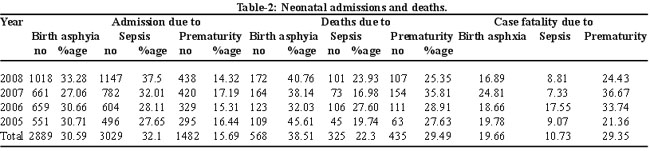
Discussion
This is the only study conducted, not only locally in this area but also in Pakistan, about the changes in mortality pattern of children admitted in paediatric unit over the time. This study clearly showed that the outcome of children above the neonatal age improved with time. There was no decrease in the mortality of admitted neonates, but, rather it increased in the years 2006 and 2007 in spite of continuous decrease in mortality among admitted postneonatal children.
This study showed that 19.71% of the total children admitted were neonates. Nizamani MA et al 2005.7 showed that 34.2% of the total children admitted were neonates.
The mortality among admitted neonates in this study was 15.62%. The studies conducted in hospitals of other areas of Pakistan8-16 regarding neonatal admissions and mortality is shown in Table-3. All studies except two11,16 showed higher mortality among neonates as compared to our study. The three common causes of neonatal admission were birth asphyxia, sepsis and prematurity in this study. The studies conducted in other parts of Pakistan showed mixed results (Table-3).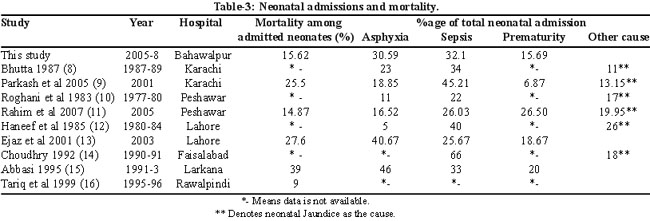
Some studies9-12,14 showed jaundice to be among the three common causes. Jaundice is a symptom but not a disease. There are many risk factors for the development of jaundice including sepsis, prematurity and asphyxia. So the jaundice may be the sole representative of its risk factor.
There were 38.51% deaths among admitted neonates due to birth asphyxia, 29.49% due to prematurity and 22.3% due to sepsis in this study while 31% deaths among admitted neonates were due to birth asphyxia, and 37% due to sepsis in the study by Tariq et al 199916 during the study period of 1995-96 conducted at Rawalpindi. Ejaz et al 200113 showed that there were 55.42% deaths due to birth asphyxia, 22.89% due to prematurity and 19.28% due to sepsis in the study done during the period of 2000 at Lahore. Nizamani MA et al 2005,7 during the study period of 2001 conducted at Nawabshah, showed that there were 22.5% deaths due to birth asphyxia, 20.6% due to prematurity and 33.5% due to sepsis while Khurshid et al 2005,17 during the period of 2004-5 at Mozaffargarh, showed that there were 22% deaths due to birth asphyxia, 19% due to prematurity and 44% due to sepsis.
This study showed that case fatality rate due to prematurity was 29.35%, due to birth asphyxia 19.66% and due to sepsis 10.73% while the study done by Ejaz et al 200113 showed that case fatality rate due to prematurity was 33.93 %, due to birth asphyxia 37.7% and due to sepsis 20.78%. The study done by Sultan et al 200618 during 2000 at Lahore showed that 24% neonates with birth asphyxia if admitted within 12 hours of birth while 76% if admitted after 12 hours of birth died. Chishty et al 200119 and Chishty et al 200220 from Lahore gave a case fatality rate due to asphyxia as 40% and 34% respectively. Abbasi 199515 from Larkana observed a case fatality due to birth asphyxia as 27.43% if the neonate was admitted in general ward and 40.63% if the neonate was admitted in the neonatal ward. This data showed that although the case fatality due to birth asphyxia is high in this area but less as compared to other parts of Pakistan. The reason may be due to the fact that there is always delayed referral or the attitude of the parents to bring the neonate very late to the hospital as well as the parents have to travel a long distance to reach the hospital leading to the death of seriously asphyxiated neonate before arrival to the hospital.
As far as the risk factors leading to high mortality in neonates is concerned, these are very difficult to determine as most of the deliveries occurred at home without any proper antenatal check up.
This study shows that neonatal mortality is high in this hospital, in comparision with data from other hospitals of Pakistan. There has been little improvement in neonatal mortality over the years in Pakistan despite of building new health facilities, upgrading the skill level of the health care providers from paramedics to doctors and also launching the National Programme for Family Planning and Primary Health Care.21 Hence, attention should be given to maternal health, safe pregnancy and safe deliveries along with timely newborn resuscitation.22-24 As far as the quality management of seriously ill neonates in neonatal intensive care of developing countries is concerned, it is very expensive and cannot be supported.25 With limited resources, it is necessary to prioritize neonatal care in the developing countries. Paediatricians should be well trained in the resuscitation and stabilization of newborn infants, infections should be prevented in the nursery, warming devices must be made available to maintain the body temperature of newborns, blood glucose should be monitored, and antenatal management provided to women in premature labour.22-24
Conclusion
There is no improvement in neonatal mortality in spite of decrease in postneonatal mortality and the common causes of neonatal admission and mortality are asphyxia, sepsis and prematurity.
References
1.The State of the World\\\'s Children 2009: Maternal and Newborn Health. UNICE December 2008. (Online) (Cited 2009 June 15). Available from URL: http://www.unicef.org/publications/files/SOWC_2009_Main__Report__03112009.pdf.
2.Saving Newborn Lives Initiative. State of worlds\\\' newborns Pakistan. Save the Children, USA; 2001. (Online) (Cited 2009 June 30). Available from URL: http://www.savethechildren.org/publications/technical-resources/saving-newborn-lives/country-documents/State-of-the-World-s-Newborns-Pakistan-2001.pdf.
3.Lawn JE, Cousens S, Zupan J; Lancet Neonatal Survival Steering Team. 4 million neonatal deaths: when? Where? Why? Lancet 2005; 365:891-900.
4.Bhutta ZA. Maternal and child health in Pakistan: challenges and opportunities. Oxford University Press; 2004.
5.Demographic and Health Survey 2006-07. Islamabad, Pakistan: National Institute of Population Studies and Macro International Inc.
6.Lwanga SK, Lemeshow S. Sample Size Determination in Health Studies. A Practical Manual. World Health Organization; 1991.
7.MA, Nizamani SM. An audit of mortality in hospitalized neonates and young infants at Pediatrics Department Peoples Medical College Nawabshah. Med Channel 2005; 11: 7-15.
8.Bhutta ZA. Neonatal tertiary care in Pakistan--a preliminary experience at the Aga Khan University Hospital. Mother & Child 1987; 25: 62-6.
9.Parkash J, Das N. Pattern of admissions to neonatal unit. J Coll Physicians Surg Pak 2005; 15: 341-4.
10.Roghani MT, Muhammed T. Neonatal disease profile in the NWFP: an analysis of 4-year experience. Pak Paediatr J 1983; 7: 17-22.
11.Rahim F, Jan A, Mohummad J, Iqbal H. Pattern and outcome of admission to neonatal unit of Khyber Teaching Hospital, Peshawar. Pak J Med Sci 2007; 23: 249-53.
12.Haneef SM, Tabassum S, Qureshi ZH, Ilahi S. Pattern of neonatal disease. Pak Paediatr J 1985; 9: 42-50.
13.Ejaz I, Khan HI, Baloch. GR. Neonatal mortality: Report from a Tertiary Hospital in Lahore/causes and outcome. Pak Pediatr J 2001; 25: 35-8.
14.Choudhry MZ, Mustansar M, Chaudhry MY. Neonatal mortality in Pakistan -- a hospital based study. Specialist 1992; 8: 13-20.
15.Abbasi KA. Neonatal disease profile in Larkana before and after establishment of neonatal ward. J Pak Med Assoc 1995; 45: 235-6.
16.Tariq P, Kundi Z. Determinants of neonatal mortality. J Pak Med Assoc 1999; 49: 56-60.
17.Khurshid A, Rashid J. Neonatal mortality in a district hospital setup. Ann King Edward Med Coll 2005; 11: 373-6.
18.Sultan T, Maqbool S. Does early referral to tertiary care decrease the mortality related to birth asphyxia? J Coll Physicians Surg Pak 2006; 16: 220-2.
19.Chishty AL, Iqbal MA, Anjum A, Maqbool S. Spectrum of multiorgan systemic involvement in birth asphyxia. Pak J Pathol 2001; 12: 81-7.
20.Chishty AL, Iqbal MA, Anjum A, Maqbool S. Risk factor analysis of Birth Asphyxia at the Children`s Hospital, Lahore. Pak Paediatr J 2002; 26: 47-53.
21.Brief of the National Maternal, Neonatal and Child Health Program. (Online) (Cited 2009 Aug 15). Available from URL: http://www.who.int/pmnch/countries/pakistanmnchplan.pdf.
22.Bhutta ZA, Memon ZA, Soofi S, Salat MS, Cousens S, Martines J. Implementing community-based perinatal care: results from a pilot study in rural Pakistan. Bull World Health Org 2008; 86: 452-9.
23.Wall SN, Lee AC, Niermeyer S, English M, Keenan WJ, Carlo W, et al. Neonatal resuscitation in low-resource settings: what, who, and how to overcome challenges to scale up? Int J Gynaecol Obstet 2009; 107: S47-64.
24.Bhutta ZA, Yusuf K. Neonatal sepsis in Karachi: factors determining outcome and mortality. J Trop Pediatr 1997; 43: 65-70.
25.Ho NK. Priorities in neonatal care in developing countries. Singapore Med J 1996; 37: 424-7.
Related Articles
Journal of the Pakistan Medical Association has agreed to receive and publish manuscripts in accordance with the principles of the following committees:


