

Samina Rafique ( Bahauddin Zakariya University, Multan. )
Waseem Sarwar ( Nishtar Medical College and Hospital, Multan. )
Asima Rashid ( General Practitioner, Multan. )
Fatima Sheerin ( Nishtar Medical College and Hospital, Multan. )
March 2017, Volume 67, Issue 3
Short Communication

Abstract
Free drug samples are distributed among doctors as a promotional tool.
We investigated the effects of dispensing samples on prescriptions by the doctors and their opinion about samples through a cross-sectional survey.
A questionnaire was distributed among the doctors in the Department of Medicine, Nishtar Hospital Multan. It contained drug choices for two hypothetical scenarios, options and reasons for using free samples and doctors\\\' views about them.
Response rate remained 83% (166/198). In scenario 1 (rheumatoid arthritis), 100 % and in scenario 2 (acid peptic disease), 13% of sample users dispensed against their preference while in both cases 78 % prescribed the same brand afterwards. Trainees used samples more frequently in both vignettes (p value 0.24 and 0.001 respectively). Mainly, samples were used as a cost-effective measure and were considered a source of medication for poor, significantly. (p value 0.007). But in this process, physicians ignored their first choice and inadvertently increased the total expenditure.
Keywords: Prescription, Drug samples, Pharmaceutical industry.
Introduction
The provision of free drug samples to clinicians is an important method of promotion of medicines and gaining commercial benefits. The expenditure of pharmaceutical companies on marketing upon physicians and public is twice the amount spent on research and development.1 The retail value of medication samples distributed in the United States was more than $18 billion in 2005, an amount which has tripled since 1995.2
The opinions about the use of free medication samples are contradicting. The proponents of free drug samples perceive several benefits of their clinical use including prompt initiation of therapy, evaluation of efficacy and adverse effects of medicine and adjusting the dose before purchase of full prescription. It may also help low income patients by decreasing some burden of the cost of medication.3 But it may also affect physician\\\'s prescribing decision including deviation from the standardized guidelines of treatment,3,4 and may culminate in illogical and even harmful prescribing.5 In addition, initiation of the treatment with samples may compel physicians to prescribe the same brand afterwards resulting in unwarranted use of more expensive pharmaceuticals despite the availability of cheaper alternatives.6
In Pakistan, total public sector share in health care provision is 36.8%7 therefore out-of-pocket payment is very high. Most of the doctors work both in public and private sectors and are focused by the pharmaceutical industries. The present study aimed to understand doctors\\\' attitudes and behaviour in response to pharmaceutical promotions. This is essential to guide the emerging under graduate and post-graduate programmes in medical institutions that aim to educate medical students/trainees about marketing and prescribing.
Method and Participant
This cross sectional study was conducted in May and June 2013 in Nishtar Hospital Multan, Pakistan (the largest tertiary care hospital of the area). The eligible doctors were consultants, attending, or post graduate trainees, working in the field of medicine. A questionnaire was developed after thorough review of the literature, taking guide lines from Chew et al.3 It was then circulated among senior doctors and modified according to local circumstances. The reliability of research tool was calculated using Cronbach alpha method and statistics (0.730) showed it to be highly reliable.
The survey form had three domains. The 1st part comprised of respondent\\\'s demographic characteristics. The 2nd part like Chew et. al, offered 2 hypothetical clinical scenarios comprising a middle aged woman with arthritis and a young man with peptic ulcer disease. For each scenario the respondents were asked whether they would use a drug sample, which is different from their preference, and the reasons behind that (5 reasons were listed in the survey form). The sample users then were presented with the follow up cases of the same conditions that came back with well controlled symptoms on sampled drug. Doctors were asked to choose one of the following strategies: prescribe the sampled medication, prescribe a cheaper brand or write the same drug with generic name. The last part of the survey reported opinion of the doctors about free drug samples on a five point Likert scale and included seven statements similar to those used in the questionnaire by Chew et al.4
Physicians were classified as "sample users" or "non sample users" for each scenario depending upon the self report. We then evaluated their own statement about the use of samples different form their choice. To probe further the sample users\\\' characteristics, we divided respondents into two groups: a) infrequent sample users (did not utilize samples or used in one vignette)
b) frequent sample users (both scenarios). Beliefs about free samples were collected on 5-point Likert scales, and then dichotomized for analysis into "Agree" (strongly agree and agree) versus "Don\\\'t agree" (neutral, disagree, strongly disagree). Chi-square analysis was used to compare the two groups.
Results
A total of 198 survey forms were distributed, 166 forms were completed and returned. Response rate remained 83%. Out of 166 respondents 54.3% (n=90) were males and 45.7% (n=76) were females. There were 111 post graduate trainees and 55 were attending physicians. Among trainees 69.3% and amidst attending physicians 41.8% were found to be frequent users of the samples. Females were more prone to do so. (68.4 vs 53.3%)
For a patient of rheumatoid arthritis, 110(69%) doctors reported to use the samples and 100% of them ignored their 1st choice. For PUD, 136 (79%) doctors used drug samples of an expensive brand of PPI and 13% dispensed against their preference Younger doctors and residents were more likely to use the samples in both vignettes. (P value= .024 and < 0.01 respectively) (Table-1).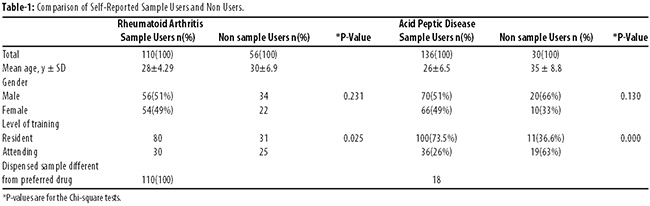
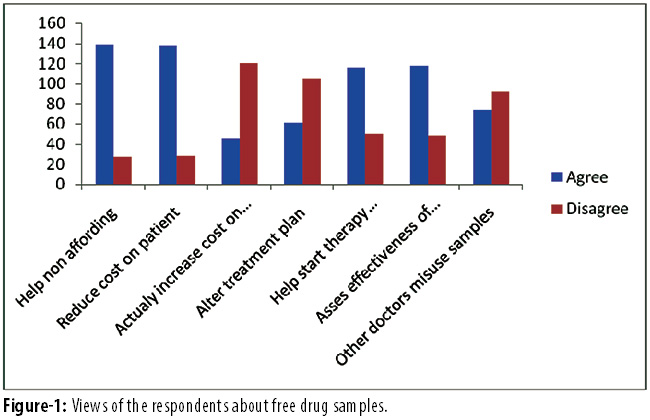
When presented with a follow-up situation in which the same patient came back with well-controlled symptoms on the dispensed drug, 78% of sample users prescribed the same trade name in both scenarios. The remaining 22% in RA and 15% in PUD prescribed the cheaper brand." To avoid burden of cost to the patient" was cited by 65% and 58% of sample users respectively as key factor for dispensing the samples. Opinions about free drug samples were compared between frequent sample users and infrequent sample users. A considerable number of frequent sample users believed that samples can be a source of help to non affording ( p value= 0.007) and a significant proportion (p < 0.05) thought that sample can reduce the cost of the treatment. Only 16% of sample users agreed that drug samples may actually result in high cost of care. (p < 0.01) Similarly, 24% actually realized that dispensing of samples leads to alteration of the initial treatment plan. (p= <0.01) A considerable proportion of infrequent sample users (p= 0.0016) were of the belief that other doctors misuse the samples.
Discussion
"Helping non affording patients", remained the main motive for clinicians to use free samples. This, however frequently resulted in dispensing or prescribing against their initial preference. Furthermore, in an attempt to help the patient, physicians actually raised the total cost of treatment as a significant number of doctors (78%) continued to prescribe the same trade name afterwards. Therefore, interactions between physicians and drug companies raise scientific and ethical questions and there is rising debate about the moral principles of this relationship. Concerns are about conflicts of interest with regard to prescribing by doctors who receive samples and gifts from the industry.8 In our view, Gift-giving (free sampling) invokes the reciprocity rule, which creates a feeling of gratefulness in the receiver together with the desire to pay back the favour in some way. The ethical outcome is that this liaison can and does result in harm to patients: at an individual level through illogical prescribing, and at a social level through the rising opportunity costs associated with the unnecessary and unrestricted use of more expensive pharmaceuticals.9
Though Pakistan Medical and Dental Council have laid principles regarding interaction between pharmaceutical industry and doctors but most of the doctors are unaware of even the presence of such a document So we think that our doctors need to be trained regarding encounters with industry before they enter the clinical practice.10
In our study trainees were more likely to use drug samples. This is extremely important as prescribing habits develop during training period, so educational efforts should be aimed at minimizing the effects of drug sample availability on residents\\\' prescribing patterns.
Conclusion
The main motive of the doctors behind dispensing free samples is to avoid cost to the patient but it resulted in overuse of expensive brands and sometimes deviation from the guidelines of the treatment. The doctors should be trained and restricted in their interaction with pharmaceutical industry. Teaching hospitals should consider alternative means of providing medications to patients who cannot afford to buy them.
Acknowledgment
We acknowledge the services of Dr. Aslam (PHD) Assistant Professor, department of statistics, Bahaudin Zakariya University, Multan for statiscal analysis of the data.
Disclaimer: None.
Conflict of Interest: There is no potential conflict of interest of any author.
Funding Support: None.
References
1. Mahan D. Profiting from pain: where prescription drug dollars go. Families USA Publication No. 02-105. Available from: URL: http://www.familiesusa.org/site/DocServer/PPreport.pdf?docID=249. NOT FOUND.
2. Donohue JM, Cevasco M, Rosenthal MB. A decade of direct-to-consumer advertising of prescription drugs. N Engl J Med. 2007; 357: 673-81.
3. Chew LD, O\\\' Young TS, Hazlet TK, Bradley KA, Maynard C, Lessler DS. A Physician Survey of the Effect of Drug Sample Availability on Physicians\\\' Behavior. J Gen Intern Med.. 2000; 15: 478-83.
4. Boltri JM, Elizabeth R, Gordon MD, Robert LV. Effect of Antihypertensive Samples on Physician Prescribing Patterns. Fam med. 2002; 34: 729-31.
5. Wazana A. Physicians and the pharmaceutical industry: is a gift ever just a gift? JAMA. 2000; 283: 373-80.
6. Spurling GK, Mansfield PR, Montgomery BD, Lexchin J, Doust J, Othman N, et al. Information from Pharmaceutical Companies and the Quality, Quantity, and Cost of Physicians\\\' Prescribing: A Systematic Review. PLoS Med. 2010; 7:e1000352.
7. World Bank report. [Online] [Cited on 2014 January 14]. Available from URL: http://data.worldbank.org/indicator/SH.XPD.PUBL.
8. Rohra DK, Jawaid A, Rehman T, Sukkurwala AQ, Palanpurwala AS, Rajesh Gangwani R. Prescription of New Drugs by General Practitioners in Pakistan: An Exploration into Information Sources, Prescription Influences and General Attitudes. Pak J Med Res. 2007; 46:5-10.
9. Shiwani MH. Quest of prescribing practice in Pakistan. J Pak Med Assoc. 2006; 56:249-50.
10. Jawaid A, Rehman TU. Physician-Pharmaceutical Interaction: Training the doctors of tomorrow. J Pak Med Assoc. 2007; 57: 380-1.
Journal of the Pakistan Medical Association has agreed to receive and publish manuscripts in accordance with the principles of the following committees:


