

Sanam Shah ( Department of Family Medicine, The Indus Hospital, Karachi. )
Niloufer Sultan Ali ( Department of Family Medicine, Aga Khan University Hospital , Karachi. )
Kashmira Nanji ( Department of Family Medicine, Aga Khan University Hospital , Karachi. )
November 2016, Volume 66, Issue 11
Original Article

Abstract
Objective: To determine the knowledge regarding calcium contained in food among secondary school-going children.
Methods: The cross-sectional study was conducted from February to May 2013 in two public and two private schools of Jamshed Town, Karachi. Stratified random sampling was used to raise the study sample. A pre-coded, piloted questionnaire was used for data collection. Data was analysed using SPSS 19.
Results: Of the 153 participants, 27(18.3%) had adequate knowledge while 126(81.7%) had inadequate knowledge about calcium contained in food. The mean age of the participants was 13.52±1.725 years. Statistically significant association was present between knowledge regarding calcium and mother\'s and father\'s educational level (p=0.039 and p=0.012, respectively), mother\'s and father\'s working status (p=0.002 and p=0.015, respectively) and acquisition of knowledge from parents (p=0.020), teachers (p=0.039) and via television (p=0.034).
Conclusion: Most adolescents did not have knowledge about calcium contained in food.
Keywords: Calcium, Knowledge, Adolescents, Secondary schools. (JPMA 66: 1452; 2016)
Introduction
Calcium is an important mineral and the most abundant nutrient in the human body. It is particularly important for adolescents as it helps with bone mineralisation during the growing age period and consequently protects from osteoporosis and fracture occurrences later in life. Low calcium intake has been implicated in the occurrence of osteoporosis.1
Osteoporosis, a condition signified by low bone mass, is a highly prevalent condition. It has been proposed that by 2020, 1 in 2 Americans over the age of 50 years would have osteoporosis or would be at risk of developing this condition.2 According to a Pakistani study conducted by Fatima et al.,3 the prevalence of osteopenia was reported at 43.4% and the prevalence of osteoporosis was reported at 12.9%. These figures are alarmingly high.
Calcium needs are greatest during adolescence and puberty.4 Therefore, adolescence is the ideal time to promote preventive strategies as the skeletal bone mass is most rapidly increased during this age period. The peak average age for skeletal growth from bone mineralisation with calcium is 12.5 years for girls and 14 years for boys.5 This process helps delay bone loss later in life.6 Therefore, this is the ideal time to provide targeted preventive intervention.
Apart from preventing osteoporosis, other health benefits of consuming calcium include decreased risk of obesity,7 decreased risk of developing insulin resistance syndrome,8 protection from developing hypertension9 and colon cancer as well.10
For adolescents, the recommended dietary allowance (RDA) of calcium is 1,300 mg per day.11 However, studies have shown that the consumption of calcium is well below the recommended intake. The National Health and Nutrition Examination Survey (NHANES) 2001-02 (United States)12 revealed that the mean calcium intakes for boys aged between 9 and 13 years was 1,139 mg/day and for ages 14 to 18 years was 1,142 mg/day. For girls, it was even lower: 865 mg/day for ages 9 to 13 years and 804 mg/day for ages 14 to 18 years.
Considering the importance of adequate calcium intake, F.R. Greer13 observed in a survey that only 10% of girls aged 12-19 years consume the recommended intake of calcium. In a similar context, an Indian study conducted by Sanwalka et al.14 stated that there was maximum calcium intake in the upper social class adolescent boys (893 mg per day) and lowest calcium intake in lower social class adolescent girls (506 mg per day), highlighting the poor intake of calcium amongst adolescents in the South Asian region as well.
Inadequate knowledge about calcium and its dietary sources negatively influence adolescent\\\\\\\'s intake of calcium-containing foods and has been recognised as an important cause of suboptimal intake.15,16 According to a survey done by Neumark et al.,17 adolescents who had adequate knowledge about calcium consumed more calcium-containing foods compared to adolescents who had poor knowledge. Moreover, the American Academy of Paediatrics (AAP) endorses that knowledge about calcium is the first step towards ensuring adequate consumption.18 Highlighting the lapse in knowledge about calcium, a survey by Harel Z et al.19 demonstrated that only 19% of the adolescents were aware about the correct number of servings of dairy foods to be consumed per day, whereas only 10% knew the correct content of calcium in food.
To the best of our knowledge, there is limited data from Pakistan about dietary calcium knowledge among adolescents. The current study was planned to determine the knowledge about calcium contained in food amongst secondary school-going children.
Subjects and Methods
This cross-sectional survey was conducted from February to May 2013 and the data was collected from two government and two private schools of Jamshed Town, Karachi. The area represented diverse socio-economic strata. Stratified random sampling was used. A list of students from classes VI to matriculate was used to randomly select boys and girls from each grade. Students of classes VI to matriculate of either gender, students whose parents gave informed consent and children who gave informed assent were included. Physically challenged children and students who were absent on the day of data collection were excluded.
The sample size was calculated using World Health Organisation\'s (WHO) calculator20 with confidence interval (CI) of 95%, bound on error of 5% and approximated proportion of adolescent\'s knowledge about calcium contained in food of 90%.21 The final sample size was calculated after addition of 10% for non-response.
Written permission was sought from individual school principals for conducting the study in their respective schools. Ethical review committee (ERC) of the Aga Khan University Hospital (AKUH), Karachi, approved the study. Confidentiality of the participants was maintained and informed assent and informed consent were obtained from the students and their parents, respectively.
A pre-tested and coded Urdu or English questionnaire was distributed among the students that took about 15 minutes to fill in. It was a self-administered questionnaire. In the first part, the student\'s age, gender and the class he/she attended was enquired about. Next, questions pertaining to the knowledge about the recommended daily allowance of calcium, the food sources and the functions of calcium in the body, the most important age for bone development and the recommended daily servings of calcium were asked. Participants were also asked about their sources of information about calcium. Each correct answer was scored as 1.
SPSS 19 was used for data analysis. Descriptive analysis was done by calculating frequencies and percentages of categorical variables such as child\\\\\\\'s gender, class he/she attended, parents educational level and employment status, sources of knowledge about calcium as well as for the presence of adequate knowledge. Mean values and standard deviation (SD) were calculated for children\\\\\\\'s age and the outcome variable of interest, knowledge about calcium. Frequencies of all questions related to knowledge were calculated. Chi-square test with 95% confidence interval was used to compare the data. In case of cell count less than 5, Fisher\\\\\\\'s exact test was used. A 5% level of significance was used throughout the study and all analysis was carried out using one-sided tests. Effect modifiers were controlled through stratification of parents educational level and parental employment status via chi-square test. All the analyses were two tailed. P<0.05 was considered significant.
Results
Of the 153 participants, 27(18.3%) had adequate knowledge while 126(81.7%) had inadequate knowledge.
The mean age of the participants was 13.52±1.725 years. Overall, there were 57(37.3%) boys and 96 (62.7%) girls. Of those who had adequate knowledge, 7(25%) were boys and 20(75%) were girls (p=0.138).
Regarding the recommended daily amount of calcium, only 34(22.2%) participants answered correctly. Moreover, 76(48.4%) participants were studying in public schools and 77(51.6%) in private schools (Table 1)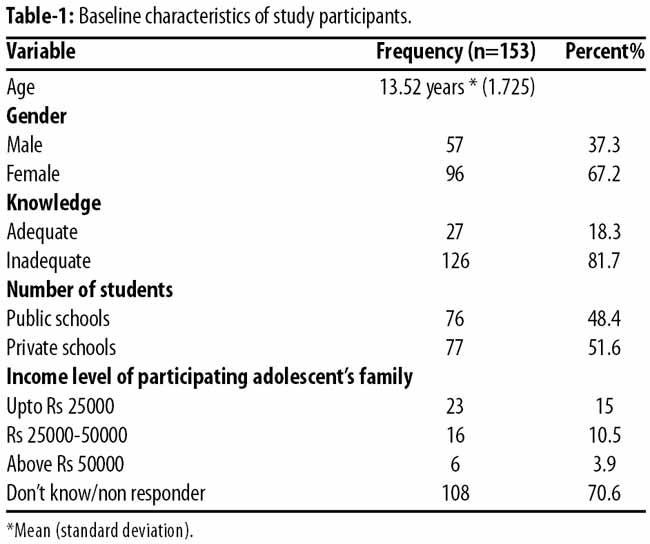
Furthermore, 144(94.1%) participants agreed that calcium was present in milk. Similarly, the number of respondents who identified cheese as a source of calcium was 76(49.7%), eggs 106(69.3%), ice cream 77(50.3%), yogurt 122(79.7%), pudding 66(43.1%), fruits 133(86.9%), vegetables 108(70.6%), fish 63(41.2%), almonds 112(73.2%) and meat 73(47.7%) (Table-2)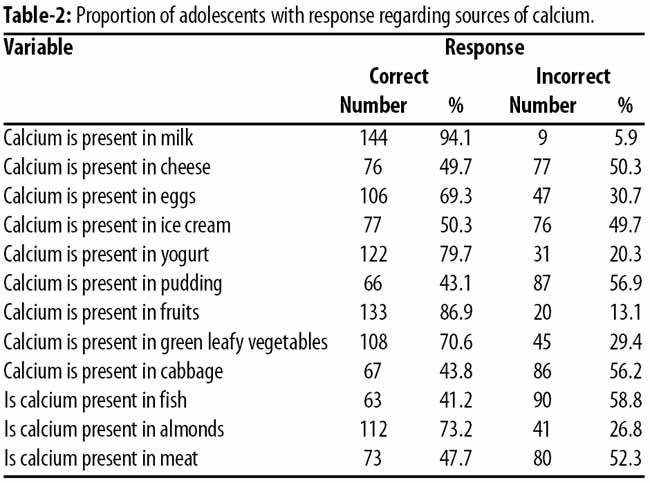
As far as the function of calcium was concerned, 104(68%) participants agreed that it was good for health, 139(90.8%) said it strengthened bones, 129(84.3%) said it produced good teeth, 131(85.6%) believed it made one taller whereas 99(64.7%) believed it protected from fractures. Besides, 87(56.9%), 59(38.6%), 58(37.9%) and 71(46.4%) respondents said calcium reduced the risk of heart disease, diabetes, cancer and blood pressure, respectively (Table-3)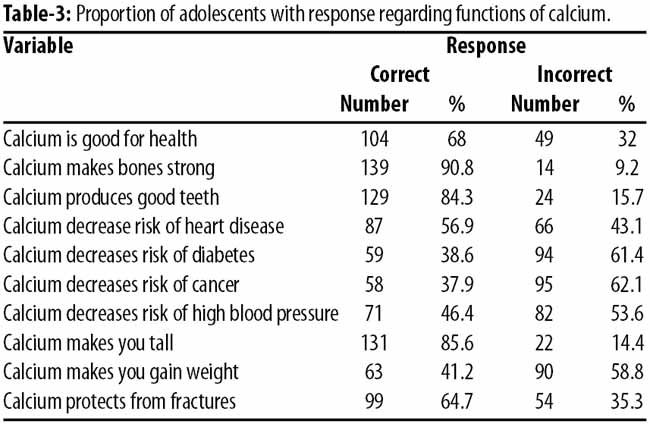
Adolescence was mentioned by 56 (36.6%) participants as the most important age for calcium intake and absorption. Furthermore, 31(20.3%) students were aware of the recommended daily servings of calcium, 46(30.1%) of the calcium content in a cup of milk and 43(28.1%) of the calcium content in a cup of yogurt.
Of those who had adequate knowledge, mothers of 22(82.1 %) had received formal education, whereas fathers of 17(64.3%) had formal education (p=0.039 and p=0.012, respectively).
On the other hand, 15(57.1%) participants with adequate knowledge had working mothers whereas 21(79.2 %) had unemployed fathers (p=0.002 and p=0.015, respectively).
In response to sources of information, parents were mentioned by 16(60.7%) of adolescents with adequate knowledge, whereas teachers and doctors were mentioned by 14(53.5%) and 7(25%), respectively. Books, television, friends and school nurse were mentioned by 10(35.7%), 10(35.7%), 3(10.7%) and 2(7.1%) respondents, respectively.
Moreover, 10(13%) of the participants from public schools had adequate knowledge compared to 12(15%) from private schools (p=0.704).
Discussion
Our study found knowledge about calcium contained in food to be quite inadequate among secondary school-going children.
In this study, fewer than one-third of participants knew the correct RDA of calcium. The majority of the participants were aware about the dairy sources of calcium and more than half of the participants were aware regarding the non-dairy sources as well. Our findings were consistent with the findings of a study conducted by Zeev Harel19 who reported that the majority of participants knew that dairy products are a source of calcium and half of the study participants were aware about non-dairy sources. Similarly, Martha Raidl22 concluded that 88% of participants correctly identified yogurt, 83% identified cheese and the majority correctly identified milk as food sources of calcium, whereas only a quarter of participants were aware of fish being a source. Our observation was that the participants were sufficiently knowledgeable about the food sources but lacked information about daily requirements. There is also a need to raise awareness about the non-dairy sources as they comprise a significant proportion of daily balanced diet.
Regarding the role of calcium in the body, there was insufficient knowledge about lack of calcium intake as risk factor for chronic diseases. Our study findings differed from a Bangladeshi study23 which found that the majority of the participants were aware about the health benefits of calcium.
Our findings also differed from another study19 which reported that the majority of adolescents knew that dietary calcium is healthy, and that it strengthens the bones and produces good teeth whereas half of the participants were aware about the role of calcium in promoting bone health. In the same study, fewer than half of the participants were aware of the role of calcium in blood pressure regulation. Furthermore, a South African study21 found that the majority of the adolescents were aware of the importance of calcium in bone formation and maintaining bone health. Only about half of the participants knew of its role in the prevention of cancer and regulation of blood pressure. This was consistent with our study. Better knowledge scores in international studies could be attributed to strong emphasis on health education in schools in developed countries that involve students as well as their parents and families. Therefore, we need to divulge information or formulate health education classes at the primary and secondary school levels to overcome the knowledge gaps.
Recent studies have demonstrated that there is a preoccupation with being thin, especially among females, in the adolescent age group, hence a predisposition to avoid consuming dairy products.24 The same misconception was reflected in our study where more than half of the participants stated that milk causes weight gain. Therefore, it is quite imperative to address nutrition and food myths to promote healthy behaviours.
Our study findings regarding the most important age group for intake of calcium were consistent with a study by Kamila et al.,25 who found that only one quarter of the participants were knowledgeable. This could be explained by the fact that the prevalence of diseases is generally low in adolescence and this age group does not deem necessary to lay enough stress on preventive health measures. Therefore, disseminating information to adolescents about the risk factors of occurrence of chronic diseases at an early age is very important.
Our study findings about the approximate calcium content in milk and yogurt concurred with another study by Sztainer D. et al.,17 who reported that only 10% of respondents knew the calcium content of various dairy foods.
In our study, a majority of the participants had prior discussions about the importance of calcium. Similar findings were reported by another study.23 In contrast to our observations of sources of information, a study19 reported the sources of information regarding calcium for the adolescents to be mainly health classes (55%) whereas about one-third of the participants reported they had discussions with their health care provider. Some of the participants in this study also reported acquiring knowledge from books (26%), television (18%), friends (9%) and school nurses (7%). This too is reflective of the presence of health curriculum at schools abroad and a strong school-based health promotion system. Therefore, we need to inculcate health classes in our own schools and encourage schools to hire health personnel to help disseminate relevant information. Employing help from radio or television and involvement of community leaders to arrange regular health promotion sessions in the communities could be one of a few ways to disseminate maximum information.
Participants whose parents had received formal education and were working had higher knowledge scores as compared to the rest of the participants. Our study results are comparable to a study conducted by Salamoun et al.26 This suggests that working parents may be more aware of the responsibility for promoting healthy diet and lifestyle.
Participants from the private schools were not found to have better knowledge scores than those from the government schools. This could be because of lack of exposure to information from lectures, seminars and reading materials in both settings.
The strengths of the current study are that, firstly, it explored an area of nutritional research that had not been studied previously. Secondly, by conducting the survey in both public and private schools, we included adolescents from different socio-economic strata so that we could compare and assess their knowledge. Thirdly, our study assessed the knowledge regarding calcium contained in different foods, which is directly proportional to the amount of calcium consumed per day as revealed by previous literature.
Our study has a few limitations as well. The sample size was small and the participants were included from only one town of Karachi. Therefore, these results cannot be generalised to the entire population. Further studies should be conducted with appropriate sample size in order to compare our findings and to improve the external validity. A future research recommendation could be to undertake the study in rural areas to compare results from varied backgrounds and to implement health promotion and disease-preventive interventions there, as a large chunk of our population resides in rural areas.
A second research recommendation is to conduct studies to assess the exact calcium intake in adolescents and to compare findings with RDA by employing food frequency questionnaires. Evaluating the anthropometric measurements can be reflective of dietary intake and can be predictive of calcium intake in particular. This would help us to streamline our efforts towards health promotion and school curriculum recommendations by identifying specific factors influencing decreased intake.
Based on our study findings, parents and school teachers should be primed about the importance of calcium in food as they are the first contact persons to divulge important information to children. There should be a coordinated effort involving teachers, parents, school nurses/doctors, public health personnel, the government and the media to work towards this common goal.
Conclusion
Knowledge deficit was evident about calcium contained in food amongst adolescents. As primary care physicians, we should support the goal of healthy eating behaviours amongst our paediatric and adolescent age groups and specific information about the sources of calcium, its functions and the recommended intake should be provided during routine visits. We can write a proposal to our health ministry to support us to introduce mandatory school health classes at both private and government institutions and to provide support framework to train individuals who can work towards this cause.
Disclaimer: The abstract was presented at the 18th postgraduate medical education conference at the Aga Khan University Hospital, Karachi.
Conflict of Interest: None.
Source of Funding: None.
References
1.Khadilkar AV, Mandlik RM. Epidemiology and treatment of osteoporosis in women: an Indian perspective. Int J Womens Health 2015; 7:841-50.
2.Surgeon General Report. Bone Health and Osteoporosis: A Report of the Surgeon General. [online] [cited 2006 Feb 5]. Available from: URL: http://www.surgeongeneral.gov/ library/bone health/content.html.
3.Fatima M, Nawaz H, Kassi M, Rehman R, Kasi PM, Afghan AK, et al. Determining the risk factors and prevalence of osteoporosis using quantitative ultrasonography in Pakistani adult women. Singapore Med J 2009; 50: 20-8.
4.Lappe JM, Watson P, Gilsanz V, Hangartner T, Kalkwarf HJ, Oberfield S, et al. The longitudinal effects of physical activity and dietary calcium on bone mass accrual across stages of pubertal development. J Bone Miner Res 2015; 30: 156-64.
5.Bailey DA, Martin AD, McKay HA, Whiting S, Mirwald R. Calcium accretion in girls and boys during puberty: a longitudinal analysis. J Bone Miner Res 2000; 15: 2245-50.
6.Sharma SV, Hoelscher DM, Kelder SH, Day RS, Hergenroeder A. Psychosocial, environmental and behavioral factors associated with bone health in middle-school girls. Health Educ Res 2009; 24: 173-84.
7.Villarroel P, Villalobos E, Reyes M, Cifuentes M. Calcium, obesity, and the role of the calcium-sensing receptor. Nutr Rev 2014; 72: 627-37.
8.Calton EK, James AP, Pannu PK, Soares MJ. Certain dietary patterns are beneficial for the metabolic syndrome: reviewing the evidence. Nutr Res 2014; 34: 559-68.
9.Guessous I, Bochud M, Bonny O, Burnier M. Calcium, vitamin D and cardiovascular disease. Kidney Blood Press Res 2011; 34: 404-17.
10.Weingarten MA, Zalmanovici A, Yaphe J. Dietary calcium supplementation for preventing colorectal cancer and adenomatous polyps. Cochrane Database Syst Rev 2008; 1: CD003548.
11.Prentice A. Calcium Requirements of Children. Nutr Rev 1995; 53: 37-40.
12.Gao X, Wilde PE, Lichtenstein AH, Tucker KL. Meeting adequate intake for dietary calcium without dairy foods in adolescents aged 9 to 18 years (National Health and Nutrition Examination Survey 2001-2002). J Am Diet Assoc 2006; 106: 1759-65.
13.Greer FR, Krebs NF. Optimizing bone health and calcium intakes of infants, children, and adolescents. Pediatrics 2006; 117: 578-85.
14.Sanwalka NJ, Khadilkar AV, Mughal MZ, Sayyad MG, Khadilkar VV, Shirole SC, et al. A study of calcium intake and sources of calcium in adolescent boys and girls from two socioeconomic strata, in Pune, India. Asia Pac J Clin Nutr 2010; 19: 324-9
15.Krebs-Smith SM, Heimendinger J, Patterson BH, Subar AF, Kessler R, Pivonka E. Psychosocial factors associated with fruit and vegetable consumption. Am J Health Promot 1995; 10: 98-104.
16.Harnack L, Block G, Subar A, Lane S, Brand R. Association of cancer prevention-related nutrition knowledge, beliefs, and attitudes to cancer prevention dietary behavior. J Am Diet Assoc 1997; 97: 957-65.
17.Neumark-Sztainer D, Story M, Dixon LB, Resnick MD, Blum RW. Correlates of Inadequate Consumption of Dairy Products among Adolescents. J Nutr Educ 1997; 29: 12-20.
18.Baker SS, Cochran WJ, Flores CA, Georgieff MK, Jacobson MS, Jaksic T, et al. American Academy of Pediatrics. Committee on Nutrition. Calcium requirements of infants, children, and adolescents. Pediatrics 1999; 104: 1152-7.
19.Harel Z, Riggs S, Vaz R, White L, Menzies G. Adolescents and calcium: what they do and do not know and how much they consume. J Adolesc Health 1998; 22: 225-8.
20.Lwanga SK, Lemeshow S. Sample size determination in health studies, A practical manual. World Health Organization. 1991:1-3.
21.Chemaly C, Abrahamse H. Calcium intake and knowledge among white adolescent girls in Gauteng, South Africa. South Afr J Clin Nutr 2004; 17: 102-8.
22.Martha R, Rhea L, Katie M, Peutz. J. Got Calcium? - A youth curriculum that promotes dairy and non-dairy sources of calcium. The Forum for Family and Consumer Issues 2007; 12: 2.
23.Uddin R, Huda NH, Jhanker YM, Jesmeen T, Imam MZ, Akter S. Awareness regarding the importance of calcium and vitamin D among the undergraduate pharmacy students in Bangladesh. BMC Res Notes 2013; 6: 134
24.Agras WS, Bryson S, Hammer LD, Kraemer HC. Childhood risk factors for thin body preoccupation and social pressure to be thin. J Am Acad Child Adolesc Psychiatry 2007; 46: 171-8.
25.Poslušná K, Matejová H, Brezková V. Risk factors of osteoporosis-knowledge and practices among adolescent females. School Health 2008; 21: 211-20.
26.Salamoun MM, Kizirian AS, Tannous RI, Nabulsi MM, Choucair MK, Deeb ME, et al. Low calcium and vitamin D intake in healthy children and adolescents and their correlates. Eur J Clin Nutr 2005; 59: 177-84.
Journal of the Pakistan Medical Association has agreed to receive and publish manuscripts in accordance with the principles of the following committees:


