

Asma Bilal ( FCPS Trainee at Military Hospital, Rawalpindi, Pakistan. )
Mohammad Arif Sadiq ( Department of Pathology at Combined Military Hospital, Quetta, Pakistan. )
Nighat Haider ( Pediatrician, Frontier Corps Hospital, Quetta, Pakistan. )
September 2016, Volume 66, Issue 9
Original Article

Abstract
Objective: To determine the frequency of hyponatraemia and hypokalaemia in malnourished children with acute diarrhoea.
Methods: This cross-sectional study was carried out at the Military Hospital, Rawalpindi, Pakistan, from September 2013 to March 2014, and comprised acute diarrhoea patients whose ages ranged from six months to five years. Blood samples for serum sodium and potassium were examined at the Armed Forces Institute of Pathology. Patients were labelled as having hyponatraemia, hypokalaemia, both or having normal serum sodium and potassium levels.
Results: Of the 80 patients, 49(61.3%) were boys and 31(38.7%) were girls with an overall mean age of 1.9±1.4 years. Besides, 41(51.3%) were aged below one year.
The mean duration of diarrhoea was 3.2±1.7 days, with 53(66%) patients having the illness for 1-3 days. Hyponatraemia was observed in 26(32.5%) patients and hypokalaemia in 44(55%), whereas 10(12.5%) had no electrolyte imbalance. None of the participants had hypernatraemia or hyperkalaemia.
Conclusion: Electrolyte disturbances among malnourished children may not be clinically evident, but diarrhoeal illness aggravated these imbalances.
Keywords: Malnutrition, Serum electrolytes, Diarrhoea. (JPMA 66: 1077; 2016)
Introduction
Malnutrition is the leading contributor to global burden of disease in children, responsible for more than one-third of all childhood deaths.1 The National Nutrition Survey (NNS), conducted jointly by the government of Pakistan and the United Nations Children\\\'s Emergency Fund (UNICEF), showed that 31% of children under the age of five years had stunted growth, 41.5% were underweight, 11.6% had wasting, and 50% were anaemic. Among school-going children, 44% were found to be malnourished.2
Malnutrition interacts with diarrhoea in a vicious circle leading to high morbidity and mortality in children, especially in developing countries. The association between diarrhoea and malnutrition is a well-documented fact.3 Severe malnutrition accounts for 2 million deaths annually, with diarrhoea being the most common complication. Not only the prevalence of diarrhoea is 5-7 times more in malnourished as compared to well-nourished children, the overall mortality of children having diarrhoea with malnutrition is also higher than children having diarrhoea without malnutrition.4 Malnutrition increases both the frequency and duration of diarrhoea, doubling the days of diarrhoeal illness.5 So diarrhoea continues to be a serious problem in our children and may be fatal when superimposed upon malnutrition.
In malnutrition, along with other elements, electrolyte abnormalities also occur in the body, which may worsen by associated diarrhoea. Diarrhoea results in large loss of water and electrolyte, especially sodium, potassium and bicarbonate. Hyponatraemia and hypokalaemia are common findings in children with diarrhoea having malnutrition with increased chances of fatal outcome.5,6
There is significant difference in the prevalence of hyponatraemia between malnourished children with and without diarrhoea.7 This loss of electrolyte has importance in immediate therapy in cases of life-threatening situation. Both malnutrition and electrolyte disturbances are considered to be risk factors for death among children with diarrhoea.4 Malnourished children have poor sodium balance during acute diarrhoea and they lose more sodium from their body in stool and urine, decreasing their total body sodium. Water is also lost which might lead to water retention to compensate for the volume depletion.8
The hypokalaemia could be due to increased potassium loss through diarrhoea. The bicarbonate loss is also responsible for it. Hypokalaemia affects function of several organs, especially the cardiovascular system, muscles, and neurological and renal system. In situation of profound potassium deficiency, muscle paralysis can occur. 9
Malnourished children being reported with diarrhoea in outpatient department (OPD) are commonly managed with antibiotics and oral rehydration salt but without estimation of serum electrolytes. This practice exposes them to significantly high risk of morbidity and mortality. However, an early detection and correction of hyponatraemia and hypokalaemia in diarrhoeal patients having malnutrition with World Health Organisation (WHO) approved oral rehydration salt or intravenous fluids can significantly reduce risk of morbidity and mortality. All patients reporting to hospital with malnutrition and diarrhoea are at increased risk of death. A simple estimation of serum electrolytes is a quick, cheap and cost-effective method in identifying children at increased risk of mortality and morbidity and helps clinicians to devise and provide prompt treatment.
The current study was planned to determine the frequency of hyponatraemia and hypokalaemia in malnourished children with acute diarrhoea.
Patients and Methods
This cross-sectional study was conducted at the Department of Paediatric Medicine, Military Hospital Rawalpindi, Pakistan, from September 2013 to March 2014, and comprised children suffering from acute diarrhoea. Children having weight between 60-80% of expected weight for that age were considered malnourished. Acute diarrhoea was defined as passage of more than 3 watery stools per day for more than 3 days. Serum electrolytes assessed were sodium (Na+) and potassium (K+). Hyponatraemia was defined as serum concentration of sodium less than 135mmol/L; normal reference range: 135-145 mmol/L. Hypokalaemia was considered as serum concentration of potassium less than 3.5 mmol/L (normal reference range: 3.6-5.5 mmol/L).
Malnourished children of both genders aged between six months and five years who had acute diarrhoea were included. Children under six months or above five years, malnourished children who were receiving diuretics treatment (as diuretics affect serum electrolytes and disturb their normal concentration), those with congenital anomalies and with known congenital diseases like cystic fibrosis (as such conditions can affect serum electrolytes), those with cardiac diseases, with chronic diarrhoea (diarrhoea for more than two weeks)and children with severe dehydration (urine output less than 100 ml/h) were excluded.
The study was approved by the institutional ethics committee and administrative permission from the authorities concerned was taken. Parents were briefed about the risk and benefits of the study and informed verbal consent was obtained for their children examination and intervention according to the guidelines of Helsinki Declaration. After enrolment, demographic data was collected regarding participants\\\' name, age, gender and address. Each child was assessed by taking detailed history from mother/caregiver regarding the frequency and duration of diarrhoea and measuring the weight of the patient. Blood sample for serum electrolytes (Na, K) was taken under aseptic measures and was sent to Armed Forces Institute of Pathology (AFIP). Patients were labelled as having hyponatraemia, hypokalaemia, both or normal serum sodium and potassium and results were confirmed by consultant pathologist. The nutritional status of these children was assessed by Modified Gomez classification10 using weight for age as reference and weight of child less than 60% of expected weight for that age was labelled severe malnutrition. Appropriate entries were made in the structured study proforma.
SPSS 17 was used for data analysis. Descriptive measures like mean and standard deviation were computed for quantitative variables, while frequency and percentages were computed for the hyponatraemia and hypokalaemia among the patients.
Results
Of the 80 participants, 49(61.3%) were boys and 31(38.7%) were girls. Besides, 41(51.3%) were aged below one year, 27(33.7%) between 2-3 years and 12(15%) between 4-5 years.The overall mean age was 1.9±1.4 years (Table-1)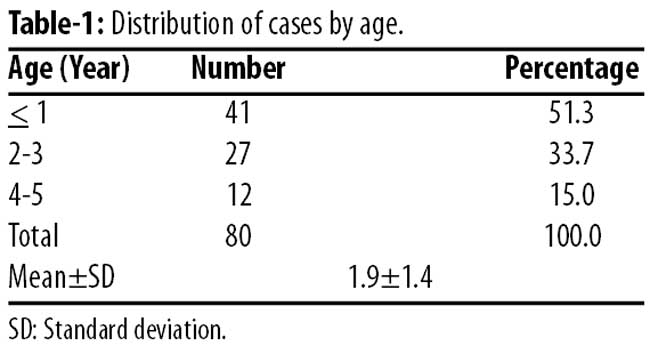
The mean duration of diarrhoea was 3.2±1.7 days, with 53(66%) patients having the illnessfor1-3 days and 27(34%) for 4-7 days (Table-2)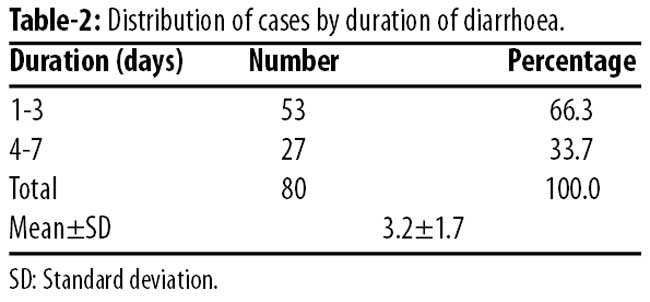
Hyponatraemia was observed in 26(32.5%) patients and hypokalaemia in 44(55%), whereas 10(12.5%) had no electrolyte imbalance. None of the participants had hypernatraemia or hyperkalaemia (Table-3)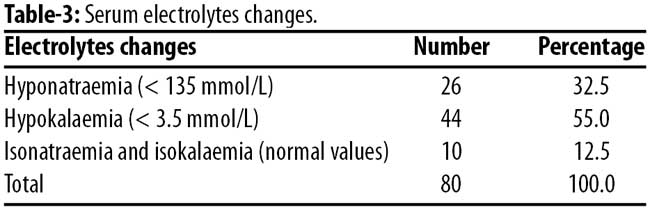
Discussion
In children of developing countries both diarrhoea and malnutrition are common, with a complementary relationship between the two. Malnutrition may not affect the incidence of diarrhoea, but it does prolong its duration. One of the most common causes of death in children is diarrhoea as out of more than 10 million deaths of children per year, diarrhoea contributes to about 1.5 million of these deaths.6 Malnutrition directly affects the infant mortality rate and has a large contribution in increasing the disease burden, especially in developing countries.
In our study, 51.3% patients were aged between 6-12 months similar to study conducted at India indicating that probably the method and timing of the feeding may be the one of contributing factor for both malnutrition and diarrhoea.11 The mean duration of diarrhoea was 3.2±1.7 days in our study.
An electrolyte abnormality was observed in about 87.5% patients who presented with diarrhoea and malnutrition. In contrast, another study showed 33.62 children having hypokalaemia with malnutrition.12 Shah et al. had similar results as ours, with 80% patients having electrolyte abnormality presenting with diarrhoea and malnutrition.13
The most common electrolyte disturbance in our study was hypokalaemia (55%) followed by hyponatraemia (32.5%). However, about 12.5% patients had no electrolyte disturbance. A study conducted in India showed hyponatraemia (13.33%) and Hypokalaemia (8.33%) to be the most common electrolyte imbalances in children with severe malnutrition even without diarrhoea, which further aggravates the situation. 14 Hyponatraemia was less frequent in our study. A study found hyponatraemia (56%) followed by hypokalaemia (46%).13 Another study from Bangladesh reported frequency of hyponatraemia and hypokaelemia at 27.8% and 47.5%, respectively.15
A study showed that diarrhoea (50.8%) was the most common infection and hyponatraemia (22.6%) the most common electrolyte abnormality in severely malnourished patients.16
In our study, none of the patients had hypernatraemia. Memon et al.17 found hypernatraemia in 1.5% cases with acute gastroenteritis and malnutrition. Hypernatraemia could be due to inadequate free water intake by the patients or increased intake of sodium through improperly prepared oral rehydration solution. A Bangladesh study found hypernatraemia to be an independent predictor of death among the under-five children admitted with diarrhoea.18
The incidence of hypokalaemia was much higher in our study (55%) as compared to a report from India reporting hypokalaemia in 24% and hyperkalaemia in 7%.19 In another study conducted by Rehana et al., 37% children having acute diarrhoea were found to be having hypokalaemia.20
The studies have shown significant mortality in patients presenting with hypokalaemia and hyponatraemia as compared to children who present with normal electrolytes. Other researchers also reported a 3-3.5 times increase in risk of mortality in patients with hyponatraemia as compared to those with normal sodium levels. 21,22
Ortuno et al. reported hypokalaemic-induced paralysis in their case series which were secondary to acute diarrhoea.23 Hypokalaemia can be sub-clinical in malnourished children, but during diarrhoeal illness it becomes obvious clinically and presents as hypotonia, paralytic ileus, cardiac arrhythmia and respiratory distress.
Most severely malnourished children present with deficiencies in potassium, sodium and magnesium, which may take a couple of weeks or more to correct. When concentrations of intracellular potassium are low, it promotes sodium and water retention, reduces myocardial contractility and affects the transport of ions across cell membrane. 24
In severe malnutrition with diarrhoea, there is a significant risk of lethal abnormalities, including hyponatraemia, hypokalaemia and metabolic acidosis.25 In malnourished children concentration of serum electrolytes does not exactly reflect the body content but shows only the circulating concentration. Therefore, high levels of serum potassium may mask intracellular potassium deficiency, whereas low serum sodium may mask sodium overload. However, it is important to treat it immediately to avoid the disastrous outcome.26
Limitations of this study include small sample size, unintentional dominant representation of males and participants mainly representing northern Pakistan.
Conclusion
Electrolyte disturbances in malnourished children may be sub-clinical, but they become obvious with diarrhoeal illness. Estimation of serum electrolyte is helpful for immediate therapy to avoid serious life-threatening situation. Serum electrolytes of every malnourished child with diarrhoea should be assessed and corrected to avoid any fatal outcome.
Disclosure: No.
Conflict of Interest: No.
Funding Sources: No.
References
1. Picot J, Hartwell D, Harris P, Mendes D, Clegg AJ, Takeda A. The effectiveness of interventions to treat severe acute malnutrition in young children: a systematic review. Health Technol Assess 2012; 16: 1-316.
2. Miyoshi M, Tsuboyama-Kasaoka N, Nishi N. School-based "Shokuiku" program in Japan: application to nutrition education in Asian countries. Asia Pac J Clin Nutr 2012; 21: 159-62
3. Irena AH, Mwambazi M, Mulenga V. Diarrhea is a Major killer of Children with Severe Acute Malnutrition Admitted to Inpatient Set-up in Lusaka, Zambia. Nutr J 2011; 10: 110.
4. Talbert A, Thuo N, Karisa J, Chesaro C, Ohuma E, Ignas J, et al. Diarrhoea Complicating Severe Acute Malnutrition in Kenyan Children: A Prospective Descriptive Study of Risk Factors and Outcome. PLoS One 2012; 7: e38321.
5. Roderiguez L, Cerventes E, Ortiz R. Malnutrition and Gastrointestinal and Respiratory Infections in Children: A Public Health Problem. Int J Environ Res Public Health 2011; 8: 1174-205.
6. Roy SK, Buis M, Weersma R, Khatun W, Chowdhury S, Begum A et al. Risk Factors of Mortality in Severely-malnourished Children Hospitalized with Diarrhoea. J Health Popul Nutr 2011; 29: 229-35.
7. Odey FA, Etuk IS, Etukudoh MH, Meremikwu MM. Hypokalaemia in children hospitalised for diarrhoea and malnutrition in Calabar, Nigeria. Niger Postgrad Med J 2010; 17: 19-22.
8. Greenbaum LA. Pathophysiology of body fluids and fluid therapy In: Behrman RE, Kliegman RM, Jenson HB (eds). Nelson Text Book of Pediatrics. 17th ed. Philadelphia: Saunders; 2004, pp199-202.
9. Weiner D, Wingo CS. Hypokalemia-Consequences , Causes , and Correction. J Am Society Nephrol 1997; 8: 1179-88.
10. Santos W, Lopes N, Barbosa JJ, Chaves D, Valente JC. Nutrition and Food Sciences: Present Knowledge and utilization: Vol 1; Food and nutrition policies and programs. 1980; 529.
11. Gangaraj MA, Das G, Madhulata S. Electrolytes and Blood Sugar Changes in Severely Acute malnourished Children and Its Association With Diarrhoea and Vomiting. Int J Pharm Sci Invent 2013; 2: 33-36.
12. KamberiTh, Azemi M, Avdiu M, Jaha VI, Uka VG. 675 Malnourished Children with Acute Diarrhea. Arch Dis Child 2012; 97: A195
13. Shah GS, Das BK, Kumar S, Singh MK, Bhandari GP. Acid base and electrolyte disturbance in diarrhoea. Kathmandu Univ Med J 2007; 5: 60-2.
14. Shah RH, Javdekar BB. Management of children with severe acute malnutrition: experience of nutrition rehabilitation centre at Baroda, Gujarat. Intl J Contemp Pediatr 2014; 1: 3-6.
15. Chisti MJ, Ahmed T, Bardhan PK, Salam MA. Evaluation of simple laboratory investigations to predict fatal outcome in infants with severe malnutrition presenting in an urban diarrhoea treatment centre in Bangladesh. Trop Med Int Health 2010; 15: 1322-5.
16. Sameen I, Moorani KN. Morbidity patterns of severely malnourished children at tertiary care hospital. Pak Paed J 2014; 38: 3-8.
17. Memon Y, Majeed R, Ghani MH, Shaikh S. Serum electrolyte changes in malnourished children with diarrhea. Pak J Med Sci 2007; 23: 760-4.
18. Chisti MJ, Pietroni MA, Smith JH, Bardhan PK, Salam MA. Predictors of death in under-five children with diarrhoea admitted to critical care ward in an urban hospital in Bangladesh. Acta Paediatr 2011; 100: 275-9.
19. Singhi S, Gulati S, Prasad SV. Frequency and significance of potassium disturbances in children. Indian Pediatr 1994; 31: 460-3
20. Majeed R, Shamsi AH, Rajar U. Clinical manifestation of hypokalemia. J Liaquat Uni Med Health Sci 2006; 3: 50-3.
21. Singhi S, Prasad SVSS, Chug KS. Hyponatremia in sick children, a marker of serious illness. Indian Pediatr 1994; 31: 19-24
22. Singhi S, Dhawan A. Frequency and significance of electrolyte abnormalities in pneumonia. Indian Pediatr 1994; 31: 735-40
23. Ortuno AF, Cabello CN, De Diego GR, Salaverria GI, Vazquez RS. Hypokalemia induced paraplegia secondary to acute diarrhea. Ann Med Intern 2002; 19: 76-8.
24. Manary MJ, Brewster DR. Potassium supplementation in kwashiorkor. J Pediatr Gastroenterol Nutr 1997; 24: 194201.
25. Uysal G, Sokmen A, Vidinlisan S. Clinical risk factors for fatal diarrhea in hospitalized children. Ind J Paedtr 2000; 67: 329-33.
26. Doherty CP, Reilly JJ, Peterson WF. Growth failure and malnutrition. In: Walkev VA, editor. Pediatric Gastro Intestinal Disease. 3rd ed. Hamilton Ontario: Decker, 2000. P. 12-27.
Journal of the Pakistan Medical Association has agreed to receive and publish manuscripts in accordance with the principles of the following committees:


