

Sidra Sattar ( Final Year MBBS Student, Karachi, Pakistan. )
Nabeel Khan ( Fourth Year MBBS Student, Karachi, Pakistan. )
Farah Ahmad ( Department of Community Health Sciences, Ziauddin University, Karachi, Pakistan. )
Farzana Adnan ( Department of Nephrology, Liaquat National Hospital, Karachi, Pakistan. )
Syed Hasan Danish ( Department of Community Health Sciences, Ziauddin University, Karachi, Pakistan. )
June 2016, Volume 66, Issue 6
Student's Corner

Abstract
Objective: To assess the post-dialysis effects in normal and diabetic patients on haemodialysis.
Methods: This cross-sectional study was conducted from January to December 2013 at two hospitals in Karachi, and comprised patients receiving dialysis. Participants were selected through purposive sampling technique. SPSS 20 was used for data analysis.
Results: Of the 150 subjects, 148(98.8%) were diabetics. Overall, 93(62%) were men and 57(38%) women. Besides, 22(14.7%) participants were having dialysis as a complication of hypertension and 128(85.3%) as a complication of diabetes. Diabetes was a comorbid condition for 148(98.7%) patients, hypertension for 139(92.7%) and cardiac diseases for 40(26.7%). Of the total, 114(76%) subjects were having dialysis thrice a week, 31(20.7%) twice and 5(3.3%) once.
Post-dialysis, dizziness was present every time in 25(16.6%) patients, nausea and vomiting in 14(10%), cramps in 22(14.7%), headache in 21(14%), anxiety and depression in 16(10.7%), hunger in 43(28.7%) and itching in 30(20%).
Conclusion: Post-dialysis complications were common in normal and diabetic patients. Nutritional status was found to be poor among long-term dialysis-dependent diabetics.
Keywords: Diabetes, Haemodialysis, Post-dialytic hypertension. (JPMA 66: 781; 2016)
Introduction
End-stage renal disease (ESRD) is the terminal irreversible deterioration in renal function. Beyond this stage, life can only be sustained with renal replacement therapy, either in terms of dialysis or transplant.1 The United States Renal Data System (USRDS) reported an ESRD incidence of 268 per million people a year.2 Around 5%per annum increment has been rated in Pakistan and cost of dialysis per patient per year is $3,000, which is about eight times the average annual per capita income of the country.3 The incidence of disease in Pakistan is 100 per million population a year.4
The technique of haemodialysis has served to save millions of patients of ESRD since 1960.5 Patients on maintenance haemodialysis respond differently to the procedure due to several confounding factors. These include co-morbid conditions like diabetes mellitus (DM), vascular disorders, hypertension (HT), compromised cardiac function, age, nutritional status, patient compliance and duration of the therapy, sessions with a frequency of two to three per week.6 Although it is a life-saving modality, as with any other procedure, maintenance dialysis stays prone to complications.
The risk of occurrence of complications in this life-saving modality have put a major impact in the field of medical sciences which have led to an increment in the interest of the researchers in this domain. Positive correlation exists between the frequency of dialysis sessions per week and duration of hours to inter and intradialytic complications. As a result, a suboptimal level of clearance is achieved as a replacement to the normal functions of the kidney. This non-physiological pattern and inability to remove all types and sizes of uraemic toxins result in both interdialytic and intradialytic complications with an association of high risk of cardiovascular morbidity and mortality.7 Along with the duration of dialysis, patients\\\' disease load in terms of comorbidities plays an adjunctive role to the intradialytic and postdialytic complications.8
Around 4,000 new cases per annum of ESRD are reported as a complication of diabetes.9 HT accounts for turnover of 25% new cases of ESRD, either as a consequence of accelerated HT or resulting atherosclerotic changes as a presentation of associated cardiovascular disease (CVD) that goes hand in hand with HT.10 One of the other important entities associated with postdialysis complications is the occurrence of intradialytic hypertension (IDH), defined as an increase in blood pressure (BP) during or immediately after haemodialysis that results in postdialysis HT. It has been recognised to complicate the haemodialysis procedure and a risk factor for emergence of postdialysis complications.11 Although the pathophysiologic mechanisms of IDH are uncertain, it is likely to be multifactorial and includes subclinical volume overload, sympathetic over activity, activation of the renin-angiotensin system (RAS), endothelial cell dysfunction, and specific dialytic techniques.12 IDH has been correlated to the fluctuation in dry weight which is a marker of intradialytic fluid accumulation and serves as an important assessment tool for IDH monitoring, hence it can serve to minimise complications. It is also essential to keep a record of predialysis and postdialysis systolic/diastolic BP monitoring, the importance of which is evident by research in correlation to left ventricular function or as an early marker of left ventricular dysfunction. Therefore, it can help screen patients at risk of development of associated complications, whereas the postdialysis BP control depends on the hypertensive status of the patient before the beginning of dialysis.13 Previous studies have also shown a positive correlation between serum albumin levels and the nutritional status of patients on maintenance haemodialysis keeping other physical and inflammatory parameters in account.14 Sleep apnoea and daytime sleepiness are common sleep disorders among patients with ESRD.15 Keeping all the aforementioned factors in account, the patient can present with a wide range of symptoms and signs or grouped together as postdialysis complications. The sequelae can range from fatigue, nausea, vomiting, pruritus, body aches, chest pain, cramps, headache to serious complications like electrolyte disturbance related seizures, convulsions or bleeding due to thrombosis in indwelling catheters and passage of clots or air embolism-associated infarcts and Cerebrovascular accidents.
The current study was planned to find an association between diabetes as a forerunner of post-dialytic complication which, in a broad sense, covers nutritional status and IDH as the major areas of discussion.
Patients and Methods
This cross-sectional study was conducted from January to December 2013 at a private and a government tertiary care hospital in Karachi, and comprised ESRD patients who were receiving dialysis on a weekly basis and were above 55 years old. The sample size was calculated using the World Health Organisation (WHO) sample size calculator for the standard formula of prevalence:16 n= z2 p (1-p)/d2
The sample size was inflated to accommodate non-response and incomplete questionnaires. The sample was selected through non-probability consecutive sampling technique. Diagnosis and duration were confirmed through their medical records.
Patients who were on dialysis for at least one year, who were both diabetics and hypertensive or diabetics alone and had an ejection fraction (EF) of greater than 55% based on a previous echocardiogram were included. Those who were not compliant with their dialysis at least once a week and were hypertensive only were excluded. Also excluded were those who were not willing to participate in the study and who were absent at the time of data collection.
Informed consent was taken from the hospitals and participants. A proforma-based interview was conducted and questionnaire was developed in both English and Urdu and filled in by the researchers themselves. For clarity the questionnaire was evaluated and revised by a physician. Diabetes has been implicated in dialysis patients as a predictor of complications and negative health, hence the analysis comprised complications and side effects in diabetic dialysis patients. Control of diabetes was computed by adding the presence of diabetic complications like retinopathy, neuropathy, gangrene and peripheral arterial disease (PAD) and current status of fasting and random blood glucose levels. The categories were developed in consultation with a diabetologist. Nutritional status of the patients on dialysis was assessed on the basis of albumin levels and vitamin supplementation.
For the purpose of analysis, categorisation of some variables was performed as follows: weekly frequency of dialysis as once weekly, twice weekly or thrice weekly; time duration of single session of dialysis as greater than or equal to and less than four hours of dialysis; duration of dialysis as less than five years of dialysis and greater than or equal to five years of dialysis; for IDH, BP was measured once during and once after the sessions.
SPSS 20 was used for statistical analysis. In lieu of errors data was cleaned prior to analysis. It was initially entered into Microsoft Excel and all inconsistencies were resolved. P=0.05 was taken as significant. For descriptive statistics, frequency and percentages were calculated as entire data was categorical. Association between diabetes and side effects was determined using chi-square test. Ethical approval was taken from institutional review committees of both the hospitals.
Results
Of the 150 patients, 93(62%) were men and 57(38%) women. The overall mean age was 58±6 years. Of all, 22(14.7%) participants were having dialysis as a complication of HT and 128(85.3%) as a complication of diabetes. Diabetes was a comorbid condition for 148(98.7%) patients, 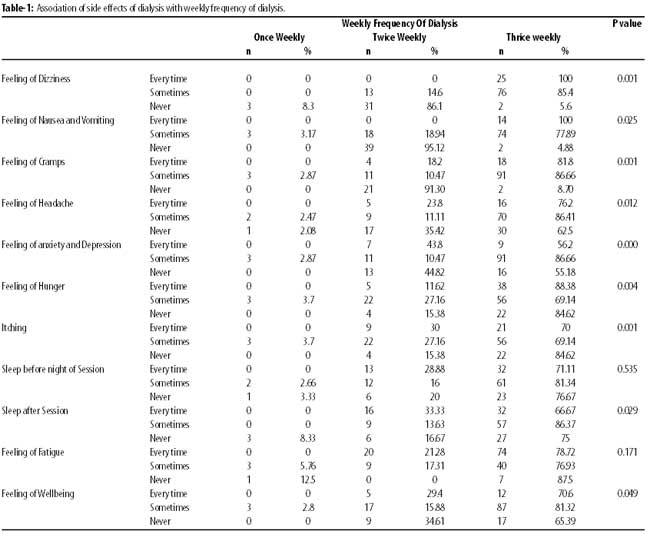
HT for 139(92.7%) and cardiac diseases for 40(26.7%). Besides, 114(76%) participants were having dialysis thrice a week, 31(20.7%) twice and 5(3.3%) once.
Postdialysis complications revealed the following findings. Feeling of dizziness was present every time in 25(16.6%) patients, sometimes in 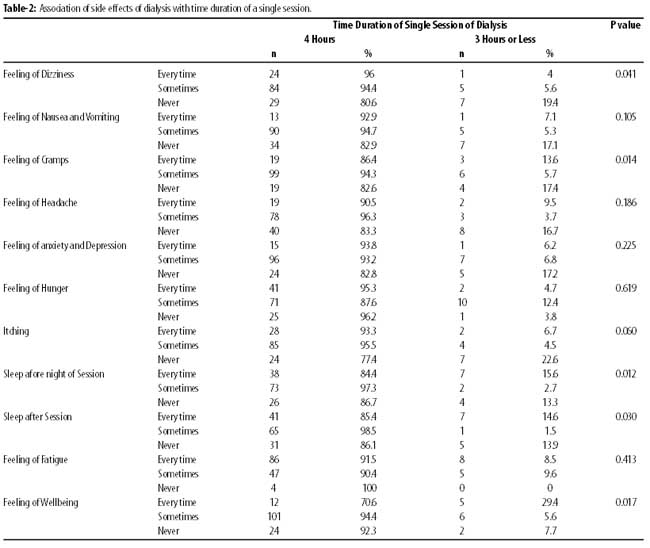
89(59.4%), whereas there was no feeling of dizziness in 36(24%) patients. Nausea and vomiting were present every time in 14(10%) patients, sometimes in 95(63%) and never in 41(27%). Cramps were present every time in 22(14.7%) patients, sometimes in 105(70%) and never in 23(15.3%). Headache was a prominent feature every time in only 21(14%) patients, sometimes in 81(54%) and was never felt by 48(32%). Psychological symptoms of anxiety and depression were present every time in 16(10.7%) patients, sometimes in 105(70%) and never in 29(19.3%). Feeling of hunger was observed every time in 43(28.7%), sometimes in 81(54%) and never in 26(17.3%). Itching was seen every time in 30(20%) patients, sometimes in 89(59.3%) and never in 31(20.7%) patients. A full night sleep before dialysis session every time was seen in 45(30%) patients, sometimes in 75(50%) and never in 30(20%) patients. Night sleep postdialysis was seen every time in 48(32%), sometimes in 66(44%) and never in 36(24%) patients. Feeling of fatigue was observed every time in 94(62.7%) patients, sometimes in 54(34.7%) and never in 4(2.6%). Only 17(11.4%) patients identified a feeling of wellbeing every time, 107(71.3%) sometimes and 26(17.3%) never felt it.
Of the diabetics, 23(15.5%) were found to have good control over the condition, 121(81.8%) had moderate control and 4(2.7%) had poor control. Feeling of dizziness every time after dialysis was only prevalent among diabetics with moderate control, 25(16.66%) (p<0.001), and those with nausea and vomiting 14(9.3%) (p=0.008). Cramps were mostly seen in moderate control group, i.e. 21 (95.5%) (p=0.032), while headache in 20(95.2%) (p=0.026). Anxiety and depression were present in 12(75%) from moderate control group (p<0.001). Moreover, 32(74.4%) patients felt hunger after dialysis session in moderate control group. Itching was found more in moderate control group, i.e. 21(70%) (p=0.004). Trends in sleep patterns showed that 11(24.4%) and 12(25%) from good control group were able to sleep before and after night of the dialysis session compared to 30(66.7%) and 32(66.7%) from moderate control group. All 4(100%) patients from the poor control group were able to take a night sleep before and after the session (p=0.009 and p=0.034, respectively). Feeling of wellbeing after session was observed in 5(29.4%) from good control group, 10(58.8%) from moderate control group and 2(4.5%) from poor control group. From the poor control group 4(100%) had feeling of fatigue affecting their daily life routine compared to 77(81.9%) from moderate control group and 13(13.8%) from good control group.
In addition, 82(54.7%) had well while 68(45.3%) had poor nutritional status. Those with good nutrition displayed more dizziness 14(56%),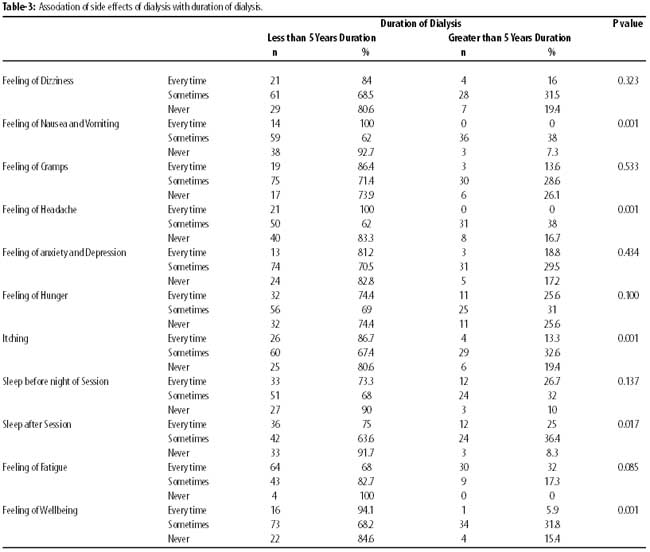
nausea and vomiting 11(78.6%), cramps 14(63.6%), pschychological symptoms 11(68.8%), itching 19(63.3%) and feeling of wellbeing 11(64.7%). Headache was prominent feature in patients with poor nutrition 14(66.7%) along with feeling of hunger 23 (53.5%). Fatigue was seen equally in both groups (p=0.026). Sleep before and after dialysis session every time was seen more in patients with good nutrition 27(56.3%) and 27(60%), respectively, as compared to patients with poor nutrition 21(43.7%) and 18(40%).
Good control of IDH was seen in 61(40.7%) patients as compared to poor control in 89(59.3%) patients. When associated with post dialysis complications, dizziness, itching and cramps were seen equally among both groups. Those with poor control showed more nausea and vomiting 8(57%) (p=0.03), headache 14(66.7%), feeling of hunger 25(58%), fatigue 60(63.8%) and feeling of wellbeing 11(65%). Good control of IDH showed more psychological symptoms 11(68.8%) (p=0.036). Sleep patterns observed before and after a dialysis session in patients with poor control of IDH were similar, in 32(66.7%) and 30(66.7%) patients, and more affected compared to good control group.
Discussion
This study sought to explain the range of side effects that patients undergoing haemodialysis persevere. Studies have elucidated that dialysis itself is a predictor of attenuated physical health.17 Patients who have chronic kidney disease (CKD) who choose conservative treatment endure multiple side effects18 but even those on haemodialysis suffer the same reporting drowsiness, muscle cramps, loss of appetite and sleep disturbance as mentioned in Table-1.19 However, despite the introduction of regular dialysis treatments, many patients remain symptomatic.20 In this study patients with diabetes who were on haemodialysis suffered similar side effects.
Our results reported nausea and vomiting in 73% of participants as has been shown by literature (Table-1).21 However, none of the earlier studies categorised this symptom as performed in this research. Majority of participants were enduring fatigue. This is similar to an earlier study which found fatigue/lethargy as the most frequent symptom in dialysis patients.22,23 Claxton et al. demonstrated more than 50% of patients sustaining fatigue when on dialysis.20 Headache was a frequently occurring symptom in this study, similar to previous works (Table-1).22 Other studies have found itching in more than half of participants, which was the case in our study as well.20
Dialysis and depression link has been highlighted through a pschycodynamic literature.
Earlier works have demonstrated depression and anxiety around 20-27% in haemodialysis patients.24 In this study, a major proportion of participants subsisted with anxiety and depression which was relatively higher than earlier research (80%), although an incidence of 20-30% of depression in dialysis patients has been proved.24 Dialysis patients suffer from sleep abnormalities much more than the general population.25 Sleep disturbance was yet another symptomatic hallmark in majority of our participants. Works by Sabbatini et al. on multi-centres showed 45% patients affected by the same.26 Unfortunately, our questionnaire did not include questions that investigated psychiatric complaints.
Diabetes follows dialysis individually as a predictor of decreased physical health. In patients on haemodialysis, diabetes serves as a negative predictor of health. Recent works have suggested that diabetic patients on dialysis have limited physical activities due to health-related problems.17 Self-rated physical health has been low in diabetic patients on dialysis compared to non-diabetic dialysis patients and diabetic patients with normal kidney function.27 Our patients demonstrated the same with headaches, anxiety, depression, cramps, hunger and itching specifically prominent in group with moderate control of diabetes. Surprisingly, sleep disturbances in our study were inversely related to control of diabetes with better sleep performance as control of diabetes declines. Other studies have found no difference in sleep disorders between diabetics and non-diabetics on dialysis.27 However, we found no such study where individual side effects were compared with control of diabetes in dialysis patients.
We utilised serum albumin and vitamins as a standard for nutritional status based on previous works.28 Nearly 45.3% participants in our study had poor nutritional status. Several reports have augmented the fact that patients on dialysis display malnutrition.28 Although other studies have indicated that dialysis patients with no complications have normal nutritional status.29 Hypoalbuminemia was recently reported to be associated with lower sleep and even life quality which was the case in our participants.30 Studies have further shown that nutritional status, if in bad shape, leads to withdrawing from dialysis.29 We found no literature where nutritional status was correlated to side effects on patients with dialysis.
Our results showed more symptoms with longer duration of dialysis in accordance with previous works.23 All symptoms were higher in those undergoing dialysis for longer time in our research. Recent studies have reported that the time to recover postdialysis is shortened by shorter but more frequent dialysis sessions.31 On the contrary, our study showed that increasing frequency of dialysis to three times a week augmented side effects.
Differences in symptom reporting occur even after adjusting for age, gender, ethnicity and comorbidity.32
Limitations of this study include a lack of a community comparison group and the reliance on self-report measures of physical health without corroboration from health biomarkers. As with any study based on patient questionnaires, there is always the question of validity of patient responses. Despite these limitations, there were also methodological strengths like random selection within each dialysis shift and both self-report and clinician report measures. Another strength is the high level of patient participation (>90%) and the wide spectrum of patients in terms of age, comorbidities and ethnic variation. Although there are many studies addressing quality of life of patients with ESRD, there are very few studies that have displayed a special accent at patient symptoms directly attributable to the dialysis procedure.23 Depression has been seldom identified or treated adequately in haemodialysis patients.33 Till date we did not find any study with such comparisons of side effects and relate it to nutritional status and diabetic status as has been performed in our study (Table-2). We performed identification of factors that contribute to poor quality of life, especially when quality of life of dialysis patients with diabetes and/or malnutrition has to be improved. As doctors spend less time reviewing patients in outlying dialysis centres, the frequency of symptoms is often underestimated by clinicians34 and, as such, mainly left untreated.20 A particular attention should be paid to malnutrition, the onset of which can be quite insidious with anorexia that is commonly underestimated.35
Our study also underlines the importance of multi-factorial diabetic treatment and care, not only when patients are in the early stages of diabetic nephropathy or in the pre-dialysis state, but also when they have ESRD (Table-3). Like previous recommendations, our results should be considered by nephrologists in order to identify factors predisposing patients to sleep complaint in dialysis centres, that nephrologists should investigate sleep complaints of all patients on dialysis.36 Our data needs to be replicated in larger, multicenter studies that will yield populations that are more similar.
Conclusion
Complications were seen quite common in normal and diabetic dialysis patients. Having a long history of attaining dialysis, more frequency of dialysis per week and longer time spent in a single session of dialysis were other factors associated more with side effects. Poor nutritional status was also a factor aligned with side effects in dialysis of diabetic patients.
Disclosure: The article or part of the article has not been published in any other journal.
Conflict of Interest: No conflict of interest present in this research.
Financial Support: No financial support taken for this research.
References
1. Hafeez F. Acute complications of Hemodialysis in Pediatric age group. J Coll Physicians Surg Pak. 2005;15:280-3.
2. Incidence and prevalence of ESRD. US renal data sytem. AM J Kidney Dis. 1998;(2suppl.1) 32: 38-49.
3. Worldwide Science [ Homepage of Worldwide science.org][online]2014 [cited 2014 October 8] URL : http://worldwidescience.org/index.html
4. Nasir H, Kumar H, Hussain R, Jamil B, Naqvi SAJ. Pericardial effusion as a cause of morbidity in patients on maintenancehemodialysis is it preventable?J Pak Med Assoc. 2001; 51:146-8.
5. Scribner BH, Caner JE, Buri R, Quinton W. The technique of continuous hemodialysis. Trans Am SocArtif Intern Organs. 1960;6:88-103.
6. Khan MA. Frequency of symptomatology in patients on hemodialysis: a single center experience. Rawal Med. 2012;37:24-6.
7. Amira CO, Braimoh RW, Bello BT. Pattern of intradialytic complications at the Lagos University Teaching Hospital. Afr J Med Med Sci. 2012;41:411-6.
8. Stein G, Fünfstück R, Schiel R. Diabetes mellitus and dialysis. Minerva Urol Nefrol. 2004;56:289-303.
9. Friedman EA. Renal failure in diabetes: a substantive problem in provision of health care. Verh K AcadGeneeskd Belg. 1989;51:81-149.
10. Inrig JK. Intradialytic hypertension: a less-recognized cardiovascular complication of hemodialysis. Am J Kidney Dis. 2010;55:580-9.
11. Agarwal R, Peixoto AJ, Santos SF, Zoccali C. Pre- and postdialysis blood pressures are imprecise estimates of interdialytic ambulatory blood pressure. Clin J Am Soc Nephrol. 2006;1:389-98.
12. Locatelli F, Cavalli A, Tucci B. The growing problem of intradialytic hypertension. Nat Rev Nephrol. 2010;6:41-8.
13. Conion PJ, Walshe JJ, Heinle SK, Minda S, Krucoff M, Schwab SJ. Predialysis systolic blood pressure correlates strongly with mean 24-hour systolic blood pressure and left ventricular mass in stable hemodialysis patients. J Am Soc Nephrol. 1996;7:2658-63.
14. SiddiquiUA, HalimA, HussainT.Nutritional profile and inflammatory status of stable chronic hemodialysis patients at Nephrology Department,Military Hospital Rawalpindi. J Ayub Med Coll Abbottabad. 2007;19:29-31.
15. Hanly P. Sleep apnea and daytime sleepiness in end-stage renal disease. Semin Dial. 2004;17:109-14.
16. Agarwal SK, Dash SC, Irshad M, Raju S, Singh R, Pandey RM. Prevalence of chronic renal failure in adults in Delhi, India. Nephrol Dialysis Transplant. 2005; 20:1638-42.
17. Sørensen VR, Mathiesen ER, Watt T, Bjorner JB, Andersen MV, Feldt-Rasmussen B. Diabetic patients treated with dialysis: complications and quality of life. Diabetologia. 2007;50:2254-62.
18. Carson RC, Juszczak M, Davenport A, Burns A. Is maximum conservative management an equivalent treatment option to dialysis for elderly patients with significant comorbid disease?. Clin J Am Soc Nephrol. 2009; 4:1611-9.
19. Murtagh FE, Addington-Hall JM, Edmonds PM, Donohoe P, Carey I, Jenkins K, et al. Symptoms in advanced renal disease: a cross-sectional survey of symptom prevalence in stage 5 chronic kidney disease managed without dialysis. J Palliative Med. 2007; 10:1266-76.
20. Claxton RN, Blackhall L, Weisbord SD, Holley JL. Undertreatment of symptoms in patients on maintenance hemodialysis. J Pain Symptom Management. 2010; 39:211-8.
21. Murtagh FE, Addington-Hall J, Higginson IJ. The prevalence of symptoms in end-stage renal disease: a systematic review. Adv Chronic Kidney Dis. 2007; 14: 82-99.
22. Antoniazzi AL, Bigal ME, Bordini CA, Tepper SJ, Speciali JG. Headache and hemodialysis: a prospective study. Headache: J Head Face Pain. 2003; 43:99-102.
23. Caplin B1, Kumar S, Davenport A. Patients\\\' perspective of haemodialysis-associated symptoms. Nephrol Dial Transplant. 2011;26:2656-63.
24. Cukor D, Peterson RA, Cohen SD, Kimmel PL. Depression in end-stage renal disease, hemodialysis patients. Nat Clin Pract Nephrol. 2006; 2: 678-87.
25. Gul A, Aoun N, Trayner EM Jr. Why do patients sleep on dialysis? Semin Dial. 2006;19:152-7.
26. Sabbatini M, Minale B, Crispo A, Pisani A, Ragosta A, Esposito R, et al. Insomnia in maintenance haemodialysis patients. Nephrol Dialysis Transplant. 2002; 17:852-6.
27. Sabry AA1, Abo-Zenah H, Wafa E, Mahmoud K, El-Dahshan K, Hassan A, et al. Sleep disorders in hemodialysis patients. Saudi J Kidney Dis Transpl. 2010;21:300-5.
28. Bergström J. Nutrition and mortality in hemodialysis. J Am SocNephrol. 1995;6:1329-41.
29. Barany P, Pyettersson E, Ahlberg M, Hultman E, Bergstrom J. Nutritional assessment in anemichemodialysis patients treated with recombinant human erythropoietin. Clin Nephrol. 1991; 35:270-9.
30. Akgul A, Sezer S, Arat Z, Ozdemir FN, Haberal M. Nutritional status and depression, sleep disorder, and quality of life in hemodialysis patients. J Ren Nutr. 2007;17: 381-8.
31. Lindsay RM. Daily/Nocturnal Dialysis Study Group. The London, Ontario, Daily/Nocturnal Hemodialysis Study. Semin Dial. 2004; 17: 85-91.
32. Clark LA, Watson D. Constructing validity: basic issues in objective scale development. Psychol Assess. 1995; 7: 309-19.
33. Kimmel PL, Peterson RA. Depression in patients with endstage renal disease treated with dialysis: Has the time to treat arrived? Clin J Am Soc Nephrol. 2006; 1: 349-52.
34. Weisshaar E, Matterne U, Mettang T. How do nephrologists in haemodialysis units consider the symptom of itch? Results of a survey in Germany. Nephrol Dial Transplant. 2009; 24: 1328-30.
35. Rottembourg J, el Shahat Y, Agrafiotis A, Thuillier Y, de Groc F, Jacobs C, et al. Continuous ambulatory peritoneal dialysis in insulin-dependent diabetic patients: a 40-month experience. Kidney Int. 1983;23:40-5.
36. Merlino G1, Piani A, Dolso P, Adorati M, Cancelli I, Valente M, et al. Sleep disorders in patients with end-stage renal disease undergoing dialysis therapy. Nephrol Dial Transplant. 2006;21:184-90.
Journal of the Pakistan Medical Association has agreed to receive and publish manuscripts in accordance with the principles of the following committees:


